Representative End User Clients







Representative Automation Clients







Representative Software Clients








Keywords: Simulation, Digital Twin, Process Automation, Optimization, Siemens, SIMIT, gPROMS, Virtual Commissioning, Operator Training
In the process industries, simulation software has become a strategic weapon to cut costs and reduce engineering time in all phases of process automation systems. Modern, sophisticated platforms support simulation across the spectrum of process systems, from the concept and design phase, through construction and commissioning, and continue to add value throughout the operational lifecycle of process assets.
This ARC View is the second of two reports that examine the value and benefits of taking a holistic view of simulation in design, constructing and operating process plants. This report focuses on specific case studies.
Simulation tools and digital twins can deliver significant value through the entire asset lifecycle of process plants, from design to construction and commissioning to operations and maintenance. Today’s simulation solutions address a wide range of stakeholders, from designers (frontend engineering design and detailed design) to construction contractors and owner-operators (operations and maintenance). Simulation software also addresses information management issues resulting from siloed business processes and related inefficiencies.
Simulation of production processes is used to lay out, test, and optimize workflows. Sophisticated algorithms help to eliminate bottlenecks early in the game. In the future, when it’s time to reconfigure or expand the plant, digital twins of current plant equipment can be employed to run new scenarios based on existing and planned equipment and capabilities.

Simulating the operation of the process automation system can deliver huge benefits during all phases of a process asset’s lifecycle. Coupled with data from engineering design software and process control systems, realistic and useful simulations are possible using historical or even live process data.
The following section summarizes a series of case studies in which users have shared the value they achieved through using SIMIT for virtual commissioning and operator training.
Desalination is a critical technology that turns salt water into potable water suitable for human consumption, for irrigation, or for industrial uses. The process removes minerals (mostly salt) from seawater via chemical and physical processes.
Acciona is a Spanish EPC that specializes in sustainable infrastructure solutions. The company is a leader in desalination through reverse osmosis technology, which emits fewer greenhouse gases than conventional thermal desalination processes. In 2020, Acciona completed construction of Al-Khobar 1, one of the largest desalination plants in Saudi Arabia. The plant produces 210,000 cubic meters of drinking water per day to supply a population of 350,000.
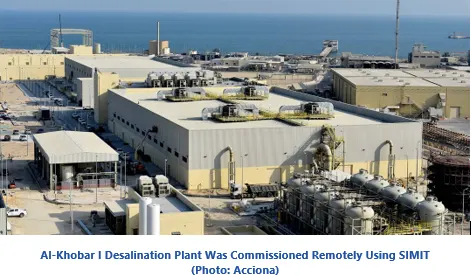
Construction of the plant was completed just as the COVID-19 pandemic forced companies around the world to shut down operations. The next phases – testing and commissioning – involved testing and verifying a wide variety of processes, as well as operator training. The pandemic would have delayed these phases, but thanks to digital twin technology, Acciona was able to perform them remotely. A team of specialists at Acciona in Madrid used a digital twin to test and commission the plant remotely with minimal on-site personnel to a minimum, allowing on-time completion of these tasks despite pandemic-induced delays.
The system was developed at CECOA (the Acciona water control center), adopting the same cybersecurity standards and communication channel allocation used at all other plants connected. This gave access to all functions in a quick and flexible way. The creation of the digital twin meets an ever-increasing need in the water sector: the automation systems are implemented with highest efficiency and availability, so that the plants are commissioned as quickly as possible.
According to Acciona, using SIMIT allowed the company to create a digital twin not only to perform virtual commissioning, testing, optimization, and operator training in a safe, simulation environment, but also to commission the new plant remotely in the face of massive delays due to the COVID-19 pandemic.
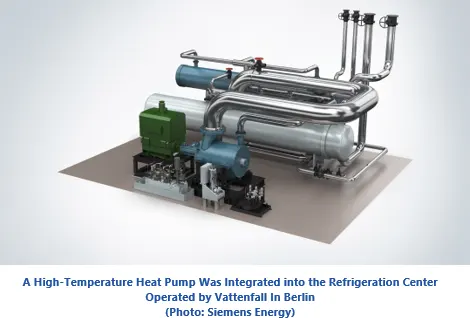
Automation simulation is not restricted to industrial uses. In this case, SIMIT was used to build and commission one of the most efficient combined heat and power plants in Europe. Located in the center of Berlin, Germany’s capital, the new large-scale, high-temperature heat pump generates green district heating from waste heat and renewable electricity. The heat is fed into the Berlin city heating network.
The existing cooling center has been supplying 12,000 offices, 1,000 apartments and numerous cultural institutions in the neighborhood with locally and efficiently generated cooling since 1997. Previously, unused waste heat was discharged into the environment via cooling towers. By integrating a new high-temperature heat pump into ongoing operations, the new technology makes the waste heat usable, increasing the energy efficiency of cooling generation while providing green heat from renewable electricity for the district.
The result is a significant reduction in heat emissions to the environment and an additional heat supply for the district of 55 GWh per year with an estimated annual saving of around 6,500 tons of CO2 emissions and 120,000 m³ of cooling water. The goal of this pilot project was to help Vattenfall understand the technical and economic potential of heat generation using large and high-temperature heat pumps.
The project used SIMIT with the Solution Power Plant Library in four phases, from integration test to high fidelity operator training. Dynamic modeling was used for the gas & steam turbine, the water/steam cycle, the heat recovery steam generator, the main generator, and the steam extraction for district heating. According to Vattenfall, using SIMIT resulted in a shortening of commissioning time and effective training of plant behavior, including startup, shutdown and failure scenarios.
Solvay is a French chemical company with 160 years of supplying a wide variety of industries including agriculture, feed and food, automotive, construction, consumer goods and healthcare, electronics, resources, environment, and energy. The Solvay/Butachimie industry platform in Chalampé (Haut-Rhin Department, France) is amongst the world’s largest facilities to specialize in the manufacture of polyamide 6.6 and its intermediary products. What distinguishes the platform is its high-efficiency process, its production volume and the high quality of its products, which are sold all over the world.
When deciding to invest in future-proofing their facilities, Solvay and Butachimie opted to rely on the technological expertise of Siemens to guarantee optimum changeover of the platform’s entire production facilities, according to their "Factory of the Future" vision.
To achieve its vision of the Factory of the Future, Solvay’s challenges were:
Siemens supported Solvay in this important project by offering a lifecycle approach. SIMIT was used for virtual commissioning of project engineering, factory acceptance testing (FAT), and operator training, SIMATIC PCS 7 was the selected process control system, and COMOS Walkinside was used for 3D visualization.
SIMIT lets the user create a digital twin of a plant that enables newly developed or altered programs to be tested virtually before commissioning. Following testing, the SIMATIC PCS 7 process control system is integrated into the actual plant for ongoing process monitoring. With COMOS Walkinside, users can train maintenance tasks in advance, virtually interact with the equipment as an avatar, and look up documents onsite from a database, as well as access production data. This allows for a faster diagnosis.

Recently certified in compliance with the ISO 1400 standard (international standard forming the framework for the introduction of an Environment Management System), Solvay's facility Chalampé operates around the clock, seven days a week in strict compliance with hygiene, safety, environmental and quality stipulations, to ensure the prompt delivery of high-quality products to its customers. This calls for the meticulous coordination and monitoring of manufacture, the analytical lab, support services and logistics. According to the company, using Siemens’ solutions with a lifecycle approach resulted in faster and smoother recommissioning, safe testing and training in advance, and increased operational safety and productivity.
SIMIT has been used in a variety of applications for virtual commissioning and operator training. The table below lists a selection of these applications together with their goals and results.
Owner-operators face enormous cost pressure in industries with already thin margins and falling backlogs, driving the urgency to reduce costs, capture market share, and improve competitiveness. Quick fixes like implementing analytics on top of running processes or introducing artificial intelligence into the planning process may help, but the most valuable tool may not be new technology, but rather the holistic application of a familiar technology: simulation.
Today’s simulation tools take a holistic approach to simulation that extends from design, construction and commissioning to operations and maintenance. Together with the digital twins they create, simulation tools can deliver significant value by lowering costs and shortening engineering time in the early stages of designing new plant automation systems.