Representative End User Clients







Representative Automation Clients







Representative Software Clients









This report explores the opportunities and challenges for technology vendors and users in plastics recycling including mechanical, physical, and chemical processes. Investing in plastic circularity is not only a moral duty, but also a smart strategy for achieving sustainable development and economic growth. Plastic circularity has the potential to create a win-win situation for both the environment and society, as well as for the businesses that embrace it. Global plastic production is expected to double by 2050 and today less than 10 percent is recycled and most of it ends up in landfills or is mismanaged.
Plastic waste has negative effects on people’s health, wildlife and the environment. Humans ingest the equivalent of a credit card in plastic every week. The microplastic mainly comes from degradation of plastic waste that has been mismanaged and ended up in the ocean. The plastic we consume contains chemicals that are known to have negative effects on health (affecting our hormones, increasing the risk of cancer).
Although plastic recycling consumes less energy and water than virgin resins, recycled plastic usually is more expensive and tends to have less performance. These, together with the high capital cost involved and other challenges, have limited the investment to further develop the industry.
On the other hand, governments around the world are moving forward by banning the usage of single-use plastic and pushing companies to use more recycled components in their products. Fortunately, these efforts are pushing investments toward this industry. In Europe, Plastic Europe members plan to invest more than €8 billion in chemical recycling and produce 2.8MT of recycled plastics by 2030. Digital solutions are enabling companies to overcome the challenges related to plastic circularity. Blockchain, artificial intelligence, advanced control and process simulation are some of the technologies that help to make the process more efficient and feasible.
Key findings include:
Plastic is one of the most widely used materials in the world, with applications ranging from packaging to clothing to electronics. However, plastic also poses a serious environmental challenge, as most of it ends up in landfills or is mismanaged, harming wildlife, degrading ecosystems, and contributing to climate change.
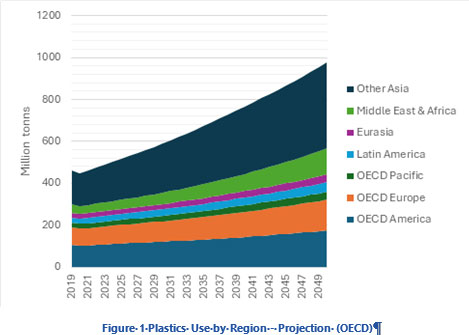
According to OECD, plastic use is expected to double by the year 2050. According to a report by the World Economic Forum less than 10 percent of plastic is currently being recycled; 14 percent of plastic packaging is collected for recycling globally; and only 2 percent is recycled into the same quality material. This means that most of the plastic is wasted, creating a huge economic and environmental loss.
Plastic circularity is an alternative approach to the current linear model of plastic production, consumption, and disposal. It aims to reduce the amount of virgin plastic produced, increase the reuse and recycling of plastic, and minimize the leakage of plastic into the environment.
ARC Advisory Group clients can view the complete report at the ARC Client Portal.
Contact Us if you would like to speak with the author.
Obtain more ARC In-depth Research Market Analysis.