Representative End User Clients







Representative Automation Clients







Representative Software Clients








The modern distributed control system (DCS) is the operational focus point of the process plant. As such, the DCS is critical for many functional areas. Besides its defined role of 24/7 process automation and control, the DCS provides  local and remote human-machine interface, integration with skid-mounted systems, and with other auxiliary equipment. It also serves as the focal point for collection of historical process data, monitoring and visualization of safety functionality, interface for advanced process control and optimization, and as an interface for enterprise level applications such as enterprise asset management and asset performance management, among others.
This broad range of functions gives the DCS a central and critical role in the process plant, but it also makes the DCS more difficult to maintain and (especially) update. This presents DCS suppliers with something of a dilemma. Because of the long lifecycle of a DCS, suppliers can never render large portions of a DCS obsolete without causing difficulty for their installed base.
Today, most of the development effort for DCS centers around software rather than hardware, but the comprehensive capabilities of the DCS make a major “big bang” software update impractical as well as risky. Therefore, what one sees in the market is only incremental improvement in DCS software. It is impractical for suppliers to develop a complete re-write of their system software. End users thus rely on multiple DCS software tools that are old, archaic, and fragmented. It is difficult or impossible to completely re-architect DCS software without forcing end users to adopt entirely new software tooling. Because the end users have significant experience and investment with the existing (though archaic) software tools, this can become a formidable barrier to a major software upgrade.
Recognizing these difficulties, Siemens has taken a unique approach with its newest SIMATIC PCS neo, an eventual replacement for Siemens’ long standing SIMATIC PCS 7. Siemens realized that the vast majority of improvement would come through adopting a modern DCS software design rather than from updating hardware. So, Siemens adopted the strategy of retaining the existing controller and IO hardware from PCS 7, while entirely re-architecting the DCS system software to take maximum advantage of state-of-the-art software technologies.
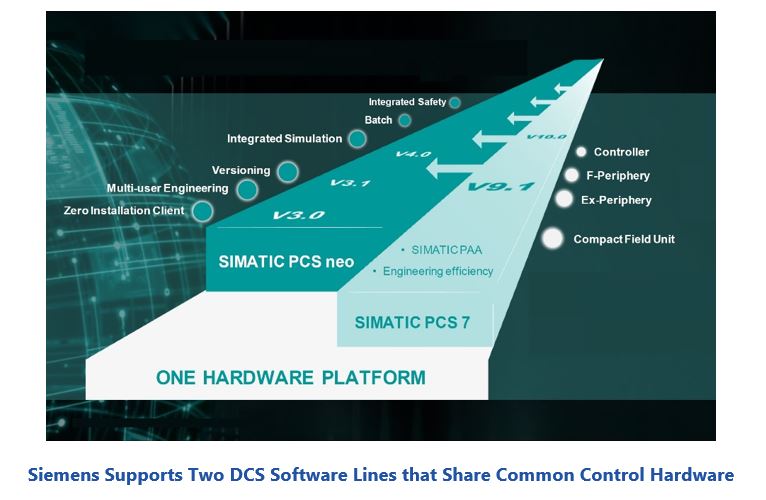
As this strategy was being developed, Siemens’ market approach was to inform its installed customer base well in advance and seek their feedback during the product development. Siemens could do this without disturbing the installed base because they made a firm support commitment to the existing DCS before releasing any new product. They told customers they would continue to develop and support the existing PCS 7 for an indefinite period going forward. They also committed not to force PCS 7 customers onto the new PCS neo platform. This strategy enabled Siemens to gradually expand the capabilities of PCS neo while receiving feedback from customers. Thus, Siemens could develop and release entirely new DCS software gradually without causing the installed base to worry or panic about support for their existing DCS.
Creating PCS neo presented Siemens software engineers with a “clean sheet of paper” to work with for the new DCS – a most unusual situation. They focused on the system as a complete entity and provided support for the entire DCS lifecycle (engineering, commissioning, operation, maintenance, and expansion).
To support the complete DCS as a system, the software architecture revolved around object-oriented data management, which supported all aspects of the DCS configuration, and provided modern database-like “ACID” properties (atomicity, consistency, isolation, durability). All DCS configuration operations are performed via a secure web connection, which enables access to both operations and engineering functions from anywhere to those who are authenticated and authorized. Multiple parties can collaborate because tools are accessed within a session management framework that ensures data consistency, enables testing, and supports versioning. In effect, Siemens has placed the DCS software tools within a complete software change management and CI/CD pipeline, but one that is largely invisible to the engineers. These same session management features are in place for the entire lifecycle of the PCS neo system, supporting all types of DCS software changes during operation, maintenance, and system expansion.

Developing an entirely new software architecture also enabled a high degree of system hardware independence and facilitated “late binding” of the DCS configuration to a specific set of target hardware. Along with the ability to support global engineering collaboration, this is a most important feature because it shortens the DCS engineering and overall project schedules.
Siemens DCS customers executing greenfield projects now have a choice between the PCS 7 or the PCS neo platform. How should they decide which system to use? Siemens recommends they choose on the basis of their project requirements. Given that the development and release of PCS neo is gradual, some capabilities (notably batch and integrated safety) still remain on the future roadmap. Clearly, if the current release of PCS neo is not a match for the requirements of a particular project, then PCS 7 is a logical choice, even though that means the system will likely migrate to the newer platform during its operating life.
An important aspect of Siemens’ DCS strategy was to establish a means by which the PCS 7 installed base could easily migrate to the new platform at a time of their own choosing. To do this, Siemens defined a PCS 7 architecture set that could be ported directly into PCS neo. By designing a PCS 7 project using the common architecture, the risks of migration are greatly reduced.
In ARC’s view, another deciding factor is the need to become familiar with any new system. Most global process firms  have a formal qualification program for determining the operational readiness of new technologies, and PCS neo software is one technology where Siemens’ customers should make the effort (perhaps first in a qualification context) to understand how the PCS neo capabilities can improve their project outcomes, even though that means performing the qualification work on a less critical project or unit. Like any technological product, new DCS software must be combined with updated project and engineering procedures in order to deliver the highest value.
ARC Advisory Group clients can view the complete report at ARC Client Portal
If you would like to buy this report or obtain information about how to become a client, please Contact Us
Keywords: DCS, Distributed Control System, DCS Software, PCS neo, PCS 7, ARC Advisory Group.