Representative End User Clients







Representative Automation Clients







Representative Software Clients








Central control rooms have become the norm in most large-scale industrial plants and facilities across the heavy process industries. These control rooms enable a relatively small number of process operators, engineers, and other operational personnel to monitor multiple production processes from a central location. The goal is to help ensure safe, efficient, and environmentally compliant operation and production control.
In a typical central control room, operators monitor thousands of process loops plus multiple process units, production areas, and/or plants and make necessary adjustments as needed in response to control loops that are trending in the wrong direction, actual  process upsets, or other abnormal situations. Production data from controllers is communicated and processed in real time. Alarms are displayed instantaneously and stay active until acknowledged by an operator.
For its deepwater operations in the Gulf of Mexico and off the coast of Brazil, Shell Oil has created a control room that goes well beyond the scope of a typical control room. As we learned in a panel presentation by Tom Moroney, Shell Oil’s VP of Wells and Facilities Technologies, at ARC Advisory Group’s 2016 Industry Forum in Orlando, Shell’s next-generation integrated operations center in New Orleans, Louisiana, provide remote operations management capabilities across a large number of complex, costly, and environmentally sensitive offshore assets spread over a very large geographical area. From this central, land-based operations center, the company effectively and efficiently manages, monitors, analyzes, troubleshoots, and optimizes these production, gathering, and processing assets on a round-the-clock basis without having to send specialized personnel out to the assets themselves to trouleshoot issues.
While not simple or inexpensive to implement, in addition to the obvious “hard” and “soft” safety and logistics benefits, Shell is confident that it has already received ample payback based on production optimization.
From its integrated operations center in New Orleans, Shell Oil manages, monitors, and leverages remote operations and engineering support for the company’s deepwater offshore production activities in the Americas. The assets being monitored and managed from the operations center include seven floating and two fixed offshore oil and gas platforms in the Gulf of Mexico and two floating platforms off the coast of Rio de Janeiro in Brazil. These superstructures are connected to seven drilling rigs and 300 to 350 production wells. These facilities produce roughly 600,000 barrels of oil equivalent per day.
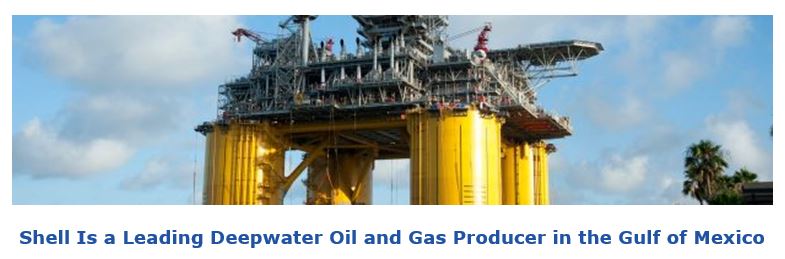
On any given day, 2,000 people are working offshore and these people and the drilling activities are supported by 35 support vessels and 10 helicopters. This is clearly a big operation.
16,000 to 17,000 pieces of equipment are being monitored in terms of their speed, thrust, pressure, temperature, or other critical variables on a daily basis. The integrated production environment being monitored includes reservoir detection sensors, subsurface equipment, connections to the well, and above-ground processing equipment. This generates 870 million points of data per day. There are 430,000 analyses conducted daily with each analysis consisting of 30 to 150 calculations. This is truly Big Data, requiring sophisticated analytics capabilities.
Production management, process control, and safety management are well understood across the process industries. Centralized control rooms came into operation in the 1920s and many large process industry companies, including Shell, have built multiple  generations of control rooms. But Shell wanted to shift the design to include advanced engineering analyses and improve the ROI of this set of incredibly capital-intensive offshore investments. The ROI was to come from making sure that every piece of equipment was being utilized at maximum efficiency to optimize production. Events like equipment wearing down, wells sanding up, or insufficient water injection into the reservoir should be detected and dealt with before production or asset performance are adversely affected.
Understanding when parameters are trending outside a targeted operating envelope is important for determining how well equipment is operating. But to optimize production, models based on the stage of life of a reservoir need to be applied to parameter data to generate actionable information. “If this well is at this stage of its life and the reservoir pressure is X, we know it should be operating at this level” is the example that Mr. Moroney gave.
Shell first needed to develop clarity around roles and responsibilities. A consistent terminology around alerting was developed:
From a data perspective, the end-to-end data gathering and processing needed to be thought out, including how the data were collected, interrogated, stored and managed. “Data interrogation” refers to how often a piece of equipment needs to be providing data. Leak detection data needs to be continuously collected on a sub-second basis, for example; but a machine that is off line may only need to be interrogated on a daily basis. Interrogation was tightly defined to provide actionable information in the desired time periods. The data collected, and the frequency with which equipment is interrogated, was based on a safety and ROI analyses.
Automating analytic calculations was also an important goal. According to Mr. Moroney, the team thought about what engineers do on a daily basis, their activities, and the calculations and models they run and worked to automate these activities. The goal was to have highly specialized engineering talent, like reservoir production experts, focus on where they add the most value and not have analysis delayed as engineers turned on their computers, downloaded data, put it into the latest models, and waited while calculations were run.
When Mr. Moroney was asked about the benefits of this project, he said “We believe visibility is a differentiator.” He shared that while it certainly costs to develop this solution, the company believes that the benefits realized are five to ten times as great as the investment. Shell tracks metrics such as deferred production volumes, equipment uptime, and other metrics that impact production volumes and a field’s recovery efficiencies. And as previously noted, a service is closed out with a step that determines the dollars saved or costs prevented, so Shell has a very good handle on exactly the kind of ROI this operations center is producing.
When asked about lessons learned from this project. Mr. Moroney mentioned that it’s important to look at data from an end-to-end perspective and not become so enamored with the technology that you don’t have a clear business case.
Additionally, Mr. Moroney discussed the importance of forming solid partnerships. Internally, they needed to closely collaborate with the IT function. Externally, Honeywell Process Solutions was Shell’s key partner.
Finally, Mr. Moroney stressed that this was a “change journey” that will never end. Engineers will continue to create new types of events based on their modeling, and new services will continue to be defined. In particular, Shell has more work to do relative to incorporating oilfield service companies into its service’s standard operating procedures.
If you would like to buy this report or obtain information about how to become a client, please Contact Us
Keywords: Control Room, Integrated Operations Center, Deepwater, Big Data, Safety, Production Optimization, Remote Operations, ARC Advisory Group.