Representative End User Clients







Representative Automation Clients







Representative Software Clients









ARC Advisory Group often attends the Offshore Technology Conference (OTC) held annually in early May down in Houston. This year, we found the mood and activity levels both surprisingly upbeat in light of the precipitous decline in 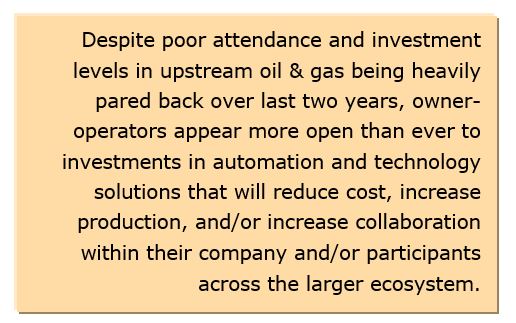 oil prices over last ten months. The 28 percent decline in attendance from last year reflected the steep decline in capex across the sector. No doubt the recent recovery in oil prices over last few months, due in large part to material cutbacks in capex budgets and rig count reductions, has helped provide some stability and perhaps even rekindle the resilient spirit that oil & gas industry participants have generally exhibited over the decades.
The common theme heard from many was the times were tough indeed but that the worst was likely over in terms of falling prices. In addition, more than a few people we spoke with expressed the belief that these adverse conditions provide the industry with an opportunity to rethink legacy approaches and processes across the upstream oil & gas value chain, particularly as they apply to leveraging new automation and other technologies.
From ARC’s perspective, OTC also provided an excellent opportunity to see demonstrations of the latest specialized solutions for this sector and speak with both technology end users and suppliers to support several current market research projects.
Arguably the biggest announcement made at OTC was the partnership between ABB and Aker Solutions intended to propel and power subsea production. Although the two companies have been working together for years, the decision to formalize the partnership signals the growing need among operators for best-of-breed solutions to help reduce their largely out-of-control production costs. ABB brings its expertise in automation, including communications, safety, process control, and condition monitoring as well as subsea power solutions. Aker brings its expertise in subsea production, including production trees, manifolds, pumping, boosting and compression (the company deployed the world’s first subsea gas compression project for Statoil).
Subsea compression and pumping solutions can increase production by over 300 million barrels, lower the number of personnel required (reducing safety-related risks), and lower costs through increased standardization and best-of-breed collaboration. In addition, these new collaborative solutions will be designed to allow for longer subsea step outs (400 km or more) and extend maintenance intervals beyond five years via effective condition monitoring.
One of our objectives at OTC was to seek out companies exhibiting and/or offering multiphase flow, wet-gas and/or 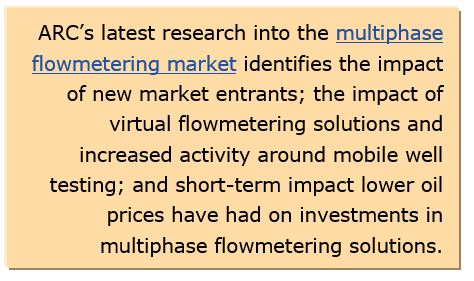 water-cut metering solutions to ascertain how market dynamics impacted the market now that oil is trading at around $50 per barrel.
Although not all the suppliers exhibited their solutions, ARC was able to see multiphase flow solutions from ABB, Emerson Process Management (Roxar), Lanzhou Haimo Technologies, OneSubsea (a Schlumberger Company), and Expro. While not apparently on display at OTC, GE Oil & Gas also offers its own multiphase flowmeter, Safire, which we believe has been developed in partnership with Chevron. ARC’s latest research indicates that other suppliers participating in this market include Schlumberger, MPM, Neftemer, Agar, Abbon, Schneider Electric, and Pietro Fiorentini.
The findings from ARC’s current market research into intelligent pumps for the digital oilfield were largely confirmed while visiting with a number of companies exhibiting various pump types at OTC. These included pumps used for artificial lift, positive displacement pumps, and/or multiphase pumps from SPX ClydeUnion (and other SPX brands), LobePro Rotary Pumps, Gorman-Rupp, CAT Pumps, Gardner-Denver (with a number of pump brands), CheckPoint Pumps & Systems, NETZSCH Pumps, Leistritz Pumps, Tenaris, Bake Hughes, Schlumberger, Flowserve, and Accudyne (with a number of pump brands including a meeting with Pulsafeeder).
There seemed to be a dichotomy among companies we visited. Some were responding to increasing customer demand for intelligent pumps, while others continued to offer traditional pumps. The first category typically offered on-board diagnostics to indicate when repair or replacement was required. Pumps in the latter category were generally designed to operate for a predetermined number of hours before rebuild or replacement.
ARC’s research indicated a growing demand for intelligent pumps operating in an increasing number of upstream oil & gas applications. Intelligent pumps can be integrated with variable frequency drives (VFD) and digital controls to enable companies to automatically adjust operation to match the head requirements of the system, enabling the pump to operate more effectively and efficiently. ARC believes the value-adding benefits such as enhanced performance, increased pump availability, and increased production due to lower downtime derived from intelligent pumps far outweigh the incremental costs.
Emerson displayed its Dynamic Gas Lift solution, which is designed to work with any form of artificial lift and is well suited for free-flowing wells. This online, real-time solution can help operators maximize field-level production by advising which wells it should operate if unable to operate all wells at maximum production. According to the company, some operators have seen a 10 percent increase in production and realized a payback in some instances in weeks rather than months or years. ARC intends to cover many more of these types of solutions later in the year when we update our artificial lift optimization market research.
At this year’s OTC event, we had an opportunity to speak with several suppliers not covered in our initial market 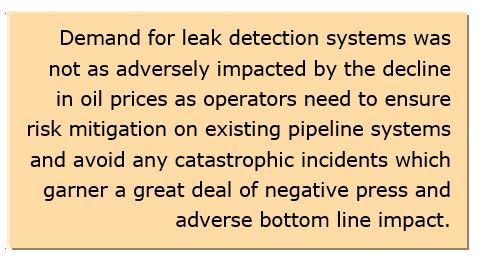 research into leak detection systems. This enabled us to fill out the research for our latest market research into this critical technology area.
During a booth visit to Flexim, a supplier of ultrasonic flowmeters, ARC uncovered MAGNUM LEO-Pipe. In addition, booth visits to OZ Optics and ClampOn AS helped ARC to round out its growing coverage of the fiber optic and ultrasonic LDS segments. Additional LDS companies included in the study update for the first time were Silixa, Pure Technologies, Sensuron, HIMA, SensorNet, AP Sensing GmbH, Yokogawa, and FEBUS OPTICS SAS.
ARC also used OTC as an opportunity to continue to gauge the level of awareness of and potential interest in Industrial Internet of Things (IIoT)-connected devices and equipment in offshore or onshore upstream oil & gas operations.
Based on discussions with leading technology suppliers such as Halliburton, Baker Hughes, GE Oil & Gas, Yokogawa, Siemens, ABB, Rockwell Automation, Schneider Electric, Emerson, and Bentley Systems, it appears that IIoT-enabled solutions will play a greater role in helping operating companies optimize well production, improve drilling optimization, increase visibility into the reservoir, increase collaboration among internal operational groups and among ecosystem participants, and/or improve profitability.
Given the fifteenth largest attendance ever recorded at OTC and a healthy number of exhibitors, it is clear that the oil & gas industry has not been totally deterred by the precipitous fall in oil prices. The recent price stabilization over the last several months seems to be bolstering the mood and future outlook for many industry stakeholders. However, more than ever before, owner-operators must develop ecosystems that provide standardized, cutting-edge automation and technologies that can help them overcome environmental challenges and technical complexities, and do so quickly, cost-effectively, and with long-term availability and reliability.
ARC believes that owner-operators should seek out suppliers that are prepared to develop the appropriate automation and technologies such as leak detection systems, multiphase flowmeters, and intelligent pumps to solve their operational challenges, which have only been exacerbated with lower oil prices. Investing in other IIoT-enabled solutions including enhanced communications, advanced analytics and machine learning is also recommended. Users should continue to collaborate with and, if necessary, encourage suppliers to help them reduce their capex and operational costs, improve operational performance, increase recovery rates and production, and improve profitability. Ultimately, this would benefit the suppliers as well.
If you would like to buy this report or obtain information about how to become a client, please Contact Us.
Keywords: Offshore Technology Conference, ABB, Aker Solutions, Emerson Process Management, Yokogawa, OneSubsea, Siemens, Rockwell Automation, GE Oil & Gas, Bentley Systems, ARC Advisory Group.