Representative End User Clients







Representative Automation Clients







Representative Software Clients








There is a surprising amount of confusion in the automation industry at present concerning open process automation. Though the 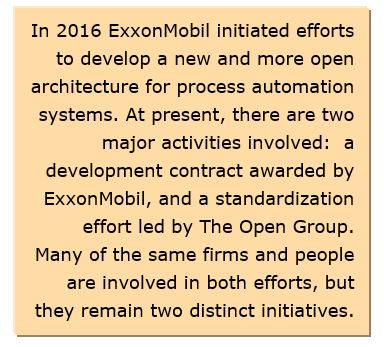 subject has been a hot topic of conversation, and almost everyone can name some of the firms engaged in the efforts, ARC Advisory Group has observed confusion about which firms are doing what, and who is working with whom. Likewise, technically oriented folks within the industry are familiar with some of the technology that is likely to be employed, but not with the organizations and people who are working with it. This report will look at the whole landscape to make it easier for readers to see “the forest” of open process automation, rather than just the trees.
The key concept to understand is that two major pieces of open process automation work are going on at present related to ExxonMobil. From an administration perspective, these are separate efforts, but they do involve some of the same companies and people -- hence the potential for confusion. However, from a business standpoint these efforts are quite separate.
The first major open process automation effort is being conducted under the contract awarded by ExxonMobil to aerospace and defense system integrator, Lockheed Martin (LMCo). The contracted organization within LMCo is Lockheed Martin’s “Mission Systems and Training,” a roughly $7 billion business unit with 14,000 employees that develops complex systems, primarily defense-related.
ExxonMobil’s multi-year contract, announced on January 14, 2016, charged LMCo “…to serve as the systems integrator in the early stage development of a next-generation open and secure automation system for process industries. Lockheed Martin will be responsible for the advanced processing architecture working with ExxonMobil Research and Engineering (EMRE) in this pre-development phase.” As explained to potential subcontractors early in 2016, the work will include development of a laboratory prototype system that will be delivered to ExxonMobil, followed by development of an objective system that will be used in a field trial (see figure). Each system will have its own set of requirements (it is likely that the second set of requirements will be a superset of the first). Each system will be developed using LMCo’s systems engineering process.

The very aggressive schedule for this program slipped during 2016, and ExxonMobil reports that it is working to develop a more credible schedule. According to some reports received by ARC, the Request for Quotation (RFQ) for the prototype system will now be delivered sometime during the 4th quarter of 2016.
The second major area of work is the Open Process Automation Forum. This is a standards initiative of The Open Group. The effort is just now being organized so the Forum has not yet agreed upon structure, purpose and scope other than “…developing a standards-based, open, secure, interoperable process control architecture.” The Open Group will manage the Forum using its established processes and procedures. These require that Forum member firms also be members of The Open Group. The initial face-to-face meetings of this Forum will take place November 16-17, 2016 in San Francisco.
The Forum now has over 30 members representing end users, suppliers, consultancies, and system integrators (see table below). ExxonMobil and Lockheed Martin are both Forum members, as is ARC Advisory Group.
Though the structure of the Forum is still undefined, ExxonMobil has stated publicly the expectation that its work will be modeled on the FACE Consortium, which codified an open architecture for modular military avionics systems. The Open Group managed the FACE Consortium standardization work, while Lockheed Martin (and others) participated in the military procurement programs that use FACE-conformant products.
FACE has a rigorous conformance process managed by The Open Group, but conducted by authorized outside organizations. Conformance consists of a verification process and a separate certification process. The verification process is a technical software testing process, while certification is a business process that encompasses legal aspects. A contracted administrator maintains a library of FACE conformant software products.
In ARC’s view, the key takeaway from using FACE as a model is that the Open Process Automation Forum should plan its scope and deliverables based on Lockheed Martin’s existing systems engineering program. If the Forum deliverables are to support a multi-vendor business, they will have to fully document the design decisions made during the development of ExxonMobil’s prototype and field test systems. In addition, best engineering practices developed during the prototype or field test work may also become areas which can be documented and added to the Forum’s deliverables.


If you would like to buy this report or obtain information about how to become a client, please Contact Us.
Keywords: ExxonMobil, FACE Consortium, Lockheed Martin, The Open Group, Open Process Automation, Open Process Automation Forum, ARC Advisory Group.