Representative End User Clients







Representative Automation Clients







Representative Software Clients








A consequence of digital transformation is the growing influence of information technology (IT) in operational technology (OT, or classic automation systems) as industrial solutions increasingly use technologies based on open IT standards. 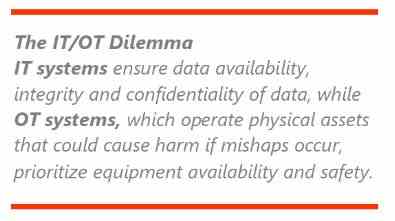 Even the most conservative industrial companies are convinced of the need to adopt these technologies as part of their digital transformation journeys. IT-based solutions offer a multitude of advantages, ranging from universal connectivity to rapid application development to highly efficient asset management of hardware and software. Industry users are well aware of the often-diverging priorities of IT versus OT systems, so how can these differences be resolved?
To help customers achieve the best of both worlds while addressing these differences, Siemens developed the Industrial Automation Data Center (IADC), an engineered solution for process industry users that solves the practical challenges of delivering classic process automation solutions in an IT environment.
The benefits of employing a modern IT architecture in any environment are countless, ranging from lower hardware costs and greatly improved data accessibility to solution scalability, better maintainability and ubiquitous cybersecurity. Industry users would flock to modern architectures immediately if it weren’t for the IT/OT dilemma: the fact that IT and OT systems have fundamentally different priorities. With IT systems, the top priority is to ensure availability, integrity and confidentiality of data for applications. OT systems, on the other hand, operate expensive physical assets with the potential to cause harm if mishaps occur. For this reason, these systems prioritize equipment availability and safety.
Process automation systems have evolved gradually over decades, but architectures are still mostly proprietary. Commercial “office” technologies such as Ethernet and desktop operating systems were often spurned in favor of home-grown solutions that addressed industry-specific requirements for redundancy, determinism or intrinsic safety.
Plant automation is designed and built to be robust and reliable with high availability. Hardware may be hot-swappable and is often set up in redundant configurations so that continuous processes and mission-critical applications cannot be interrupted. While regular maintenance is critical to reliable operation, software updates are treated with suspicion and subject to rigorous testing. These requirements are critical for the safe and secure operation of process plants.
The use of open technologies based on commercial IT standards has grown in areas such as connectivity and virtualization as industrial communications standards continue to evolve, and some equipment suppliers now deliver non-critical systems using virtual machines. However, adopting these technologies doesn’t mean that modern plant automation systems must completely redesign their architectures. Instead, the key is to deploy these systems in a modern IT-like environment while preserving the integrity of mission-critical control systems. This is what Siemens set out to achieve when the company developed IADC.
Siemens’ IADC is not a product, but rather an individually engineered solution that packages process automation systems in an IT infrastructure. According to Siemens, the system is designed to facilitate entry into the forward-looking,  digitalized infrastructure of the industrial environment of the future. According to the company, the development work on IADC took into account the fact that digital developments common in office IT environment for years are becoming increasingly important in the OT environment. It also recognized that OT requirements differ greatly in terms of long asset lifecycles, high system heterogeneity, and the need for high plant availability. Finally, Siemens recognized the need for a solution that combines expertise in automation, digitalization, and cybersecurity.
The solution is an individually engineered “data center” offering high performance computing with high availability, IT/OT networks, back-up and disaster recovery, process data archiving, an uninterruptible power supply and an IEC 62443 compliant security architecture. As an engineering solution, Siemens takes a holistic approach by offering services for consulting, configuration, and lifecycle support.
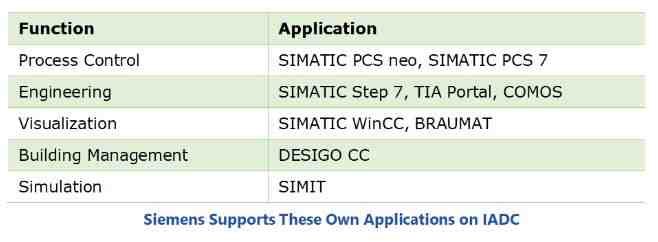
The IADC hosts a wide variety of Siemens process automation systems and software, ranging from process control to visualization, engineering and simulation. These applications are deployed as virtual machines (VM) on servers mounted in the IADC rack, allowing the user to benefit from typical VM advantages. These include lower total cost of ownership (TOC), lower hardware costs, higher system availability (lower downtime), faster application deployment, and faster disaster recovery response. Siemens brands this solution “SIMATIC Virtualization as a Service,” or VaaS.
The IADC engineering services provided by Siemens start with the specification, purchase, assembly, and installation of proven technology from market leading vendors. These solutions include front & back firewalls, industrial DMZ, IT & OT networking, computing, backup & disaster recovery, process historian, and uninterruptible power supply. The operating system, VMs, and applications are then installed and configured to the customer’s requirements.
To ensure high system availability, hardware components such as fans, power supplies, network cards, and system components such as firewalls and switches are always set up in a redundant configuration. Redundancy options are available that offer a two-host configuration using PCS 7 OS Server redundancy only for hot standby availability, or a 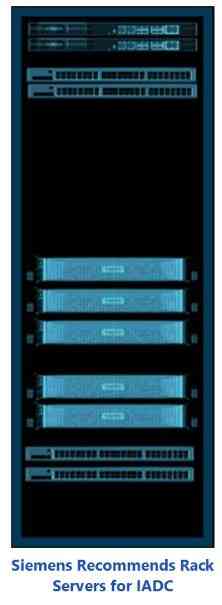 three-host configuration using PCS 7 redundancy as hot standby and VMware vSAN as additional cold standby high availability. The vSAN concept is also capable of providing redundancy for a complete cluster, for example, if hosted in separated fire zones.
The requirements of OT application software such as PCS 7 regarding the underlying hypervisor layer are significantly higher compared with typical IT applications, a fact that can lead to conflicts during the lifecycle of the asset. To address this, Siemens recommends separating OT applications from other IT applications by using different IT infrastructure environments. Blade server architectures are also feasible, but at significantly higher costs. According to Siemens, all known cases where blade servers were used, eventually reverted to rack servers.
Siemens recommends physically separating OT networks from IT networks and using industry-proven infrastructure devices like the company’s own SCALANCE switches. The reason is that cross-communication between automation devices may use protocols not supported by commercial switch providers, possibly causing malfunctions. In particular, the parallel usage of redundancy protocols such as MRP and RST within the same network has been known to cause malfunctions in existing plants.
Cybersecurity is top priority for any IT solution, but once again the security requirements for OT systems may differ from those common in the IT world. Siemens addresses security with a holistic approach around the Defense in Depth (DiD) concept based on IEC 62443, which puts up multiple layers of security around the plant, network and system. Hardware, software and services for network security and system integrity are already integrated, so that two of the three layers of the DiD concept are served.
For network security, the solution includes next generation firewalls, IT/OT network segmentation, and industrial DMZ (jump host, remote access). For system integrity, the solution supports these features: computing (hardening, authentication), backup & disaster recovery, log management, endpoint protection, vulnerability management, and patch management.
The table below lists the functions and Siemens applications currently supported. As a platform, users can easily integrate a wide variety of third-party applications with these functions.
Forward-looking concepts like Industry 4.0 and digital transformation have been around long enough for even the most conservative process industry users to see them as a key part of their future. But these concepts represent a journey guided by principles and ideals, attainable only with the application of new technologies. Engineered solutions like Siemens’ IADC are designed to help users cross the digital chasm and modernize their automation architectures to reap the benefits of digitalization.
Since its introduction in 2015, Siemens has delivered more than 2,100 IADC hosts with 37,000 cores and 59,000 VMs at over 200 customer sites. That is quite a lot of experience in IT/OT integration – a domain that many still consider new in industrial applications. Process industry users should consider such engineered solutions that rely on both domain knowhow and IT expertise. However, few users have personnel with the right IT skills in place, so such solutions must be accompanied by a package of lifecycle services to help users get started along their digital transformation journeys.
ARC Advisory Group clients can view the complete report at ARC Client Portal
If you would like to buy this report or obtain information about how to become a client, please Contact Us
Keywords: Siemens, Industrial Automation Data Center, IT/OT Convergence, Digital Transformation, Industry 4.0, ARC Advisory Group.