Representative End User Clients







Representative Automation Clients







Representative Software Clients








I was thrilled to kick off our new three-part webinar series, "Energizing Industrial AI," with my colleague Mike Guilfoyle, ARC's Vice President for Energy Transition and a leading voice in supply chain. This series is all about previewing the critical themes we'll be exploring at the 30th Annual ARC Industry Leadership Forum in Orlando this February.
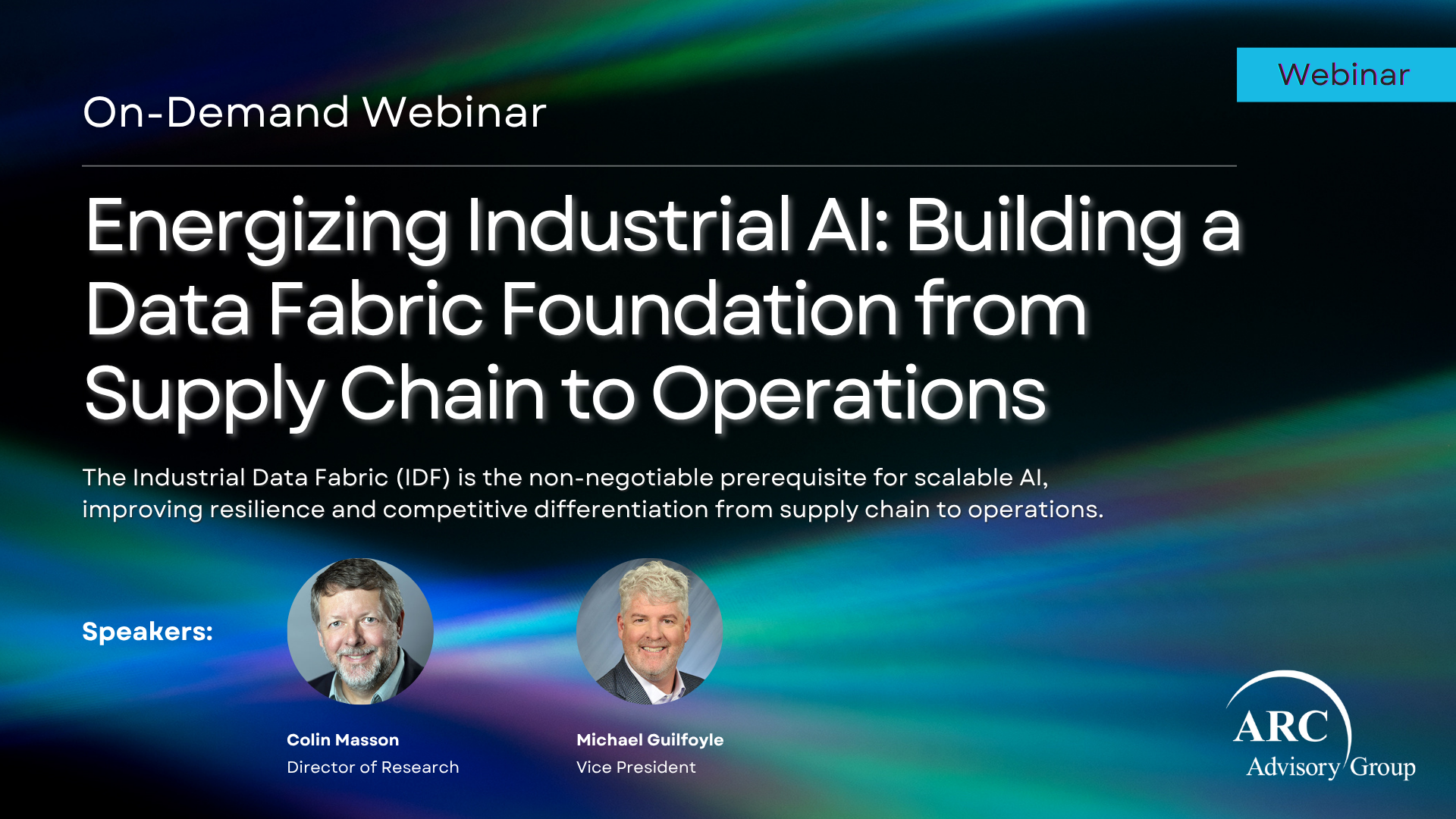
For this first session, Mike and I set the stage for the entire Industrial AI conversation. The title, "Energizing Industrial AI," isn't just a catchphrase—it represents the central paradox of AI today.
If you missed the live session, you can register and watch the full on-demand webinar here.
For everyone else, here are the key themes and memorable moments from our conversation, along with answers to some of the great questions we didn't have time to address live.
Mike kicked us off with a brilliant "Shakespearean plot" analogy for AI. We're currently in the "Rising Action": a mad dash to build out the massive, energy-hungry data center infrastructure needed to power AI. This has created a real and perceived conflict with our sustainability goals.
But, as Mike noted, this is also the "bane and the boon, the promise and the peril." We need AI to reach the "Falling Action" and the "Denouement"—the point where this powerful technology helps us make "much better decisions about energy and resources" and ethically solve our most intractable challenges.
This sets up the fundamental question: How do we ensure we get to that positive outcome?
The biggest barrier to reaching that positive "Denouement" isn't a lack of algorithms; it's a lack of good data. Our research is crystal clear: the top implementation challenges for Industrial AI are "Ensuring Data Quality" and "Accessing data from proprietary software applications."
This is where the Pacesetter story begins. When we look at what drives "Leaders" versus "Laggards," the data is startling. For Industrial AI Leaders, a top driver is "Improve Sustainability/ESG"—far outpacing the others. They aren't just exploring this; over 70 percent of them have a "corporate-wide methodology for assessing the sustainability impact of AI investments."
Mike's Decarbonization Pacesetter research shows this leadership is built on three pillars:
Culture: Nearly 100 percent of Leaders have "configured technology architecture and data workflows."
Collaboration: The difference in how Leaders prioritize collaboration across IT, OT, and ET is "startling."
Proof: Leaders can show "demonstrable proof" and "large-scale success" of their decarbonization efforts, while Laggards can't even get the data to report accurately.
Mike and I had a lot of fun comparing notes and insights from our Industrial AI and Decarbonization Pacesetters Surveys, but a few lines really stuck with me:
Mike Guilfoyle: "You can't win the AI war unless you win the energy battle."
Mike Guilfoyle: "If you don't have your data in order and you don't have good strategy around the quality of your data, you're sunk before you start."
Mike Guilfoyle: "[The Industrial Data Fabric] is not theory anymore, and it's an inevitable competency in industrial organizations, in my opinion."
Colin Masson: "I like to talk about symbiotic factories rather than dark factories."
Colin Masson: "The gap, or the digital divide, as some like to call it, is... growing."
That "configured technology architecture" that Leaders are building is the Industrial Data Fabric (IDF).
As we both stressed, the IDF is not a single product you can buy off the shelf. It's a "weave," or as I suggested, a "tapestry," that you must assemble. Our "Assembling Industrial-grade Data Fabrics" slide (Page 9 in the deck) shows companies are using everything to build it: Enterprise Data Fabrics, hyperscalers, data historians, and IoT Edge platforms.
The blueprint for this is our "Weaving Industrial Data Fabrics" slide (Page 13). This is the key concept:
The IDF's job is to "CONNECT & INGEST" data from the OT/ET world on the left (Asset Twins, Data Historians, Sensors, P&IDs).
It then weaves this with the IT/Enterprise Data Fabric on the right (ESG Data, Customers, Suppliers, Logistics Data).
This is the only way you can connect a real-time operational event from an asset to a C-suite-level business or sustainability outcome. This is what unlocks the high-value use cases on our 25-use-case list, from Supply Chain Design & Risk Management to Sustainability Analysis.
We had a flood of great questions from IT, OT, data science, and sustainability professionals. We couldn't get to them all, so here are the answers to a few of the most critical ones.
Question from IT: "We're already invested heavily in an enterprise data lake. How is the Industrial Data Fabric any different? Is it just a new marketing term?"
Answer (Colin): This is the most common question we get, and it's a good one. As Mike said, this is not a "rip and replace" scenario. Your data lake is a critical component of your fabric, but it's often IT-centric.
The Industrial Data Fabric is the "weave" that connects your IT data lake with the high-speed, unstructured, and context-rich data from the OT and ET world—your historians, sensors, and engineering models. It’s the layer that adds context before the data lands in the lake, preventing the "data swamp" and making the data "AI-ready" for your use cases.
Question from OT: "My job is to keep the plant running. This sounds like you want to pull all my real-time data, which could create risk for my historians and SCADA systems."
Answer (Colin): We hear you, and this is a "do no harm" situation. The IDF, as shown on our blueprint slide (Page 13), is an abstraction layer, not a control system. It relies on your “DATA HISTORIAN” as a key data source. It's about a “CONNECT & INGEST” function—safely reading data, often through a one-way gateway, and then contextualizing it after it has been collected. There should be zero risk to the real-time control loop.
Vendors are also responding. We're seeing key alliances, like the one between AVEVA and Databricks, specifically designed to make operational data safely and securely available to IT and data science teams, with all the necessary context.
Question from Data Science: "I spend 80 percent of my time on data janitor work. How does an IDF practically make my life easier?"
Answer (Colin): You've just described the entire purpose of the IDF. That "data janitor" work is what happens when you get raw, uncontextualized data from a data lake or historian.
The "DATA PREPROCESSING" and "Contextualization" steps shown on the Page 13 lifecycle are automated functions of the fabric itself. It's designed to create "AI-Ready Knowledge Graphs" so that when you query the fabric, you get a clean, contextualized, time-series dataset. The goal is to get you out of the janitor business and into the data science business.
Question from Sustainability: "How does an IDF practically help me move beyond just reporting my Scope 1 & 2 emissions to actually managing my Scope 3 (supply chain) emissions?"
Answer (Colin): Scope 3 is a data-weaving problem. Scope 1 and 2 are (mostly) your internal operational data. Scope 3 is your entire supply chain.
As our blueprint on Page 13 shows, the IDF is the only way to connect your internal OT data (like energy consumption per unit from “ASSET TWINS”) with your IT data (like “ESG Data,” “Suppliers,” and “Logistics Data”). By weaving these together, you can finally trace the end-to-end carbon footprint of a product or process, collaborate with suppliers (as our Decarbonization Pacesetters are doing), and use AI to optimize it.
The hard truth from our research is that this gap between Pacesetters and Laggards is growing. Our Pacesetter survey on collaboration (Page 10) shows that over 70 percent of "Leaders" are "Excellent: Fully aligned" across IT, OT, and ET. "Laggards" are "Poor: Primarily Siloed."
This organizational alignment is the data fabric. You can't buy it; you have to build this collaborative culture.
This is just the first step in our journey. I invite you to join us for the next two webinars in the series, where we'll build on this foundation:
WEBINAR 2 (Nov 20, 2025): Edge Intelligence: How Generative AI is Democratizing Robot Programming and Simulation
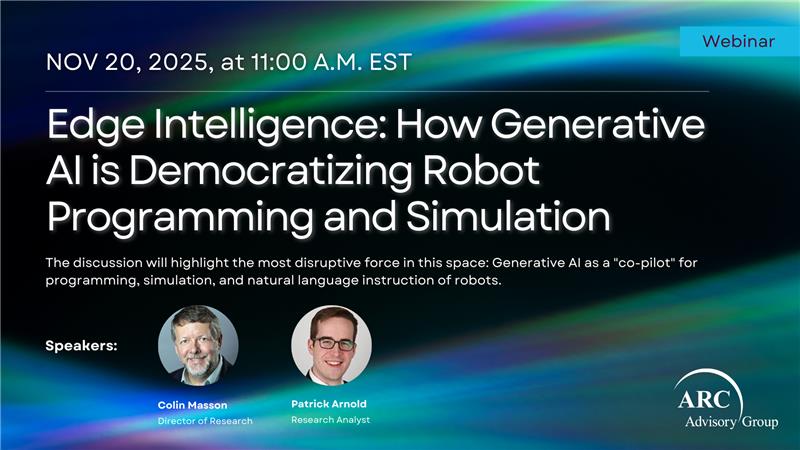
I'll be joined by my colleague Patrick Arnold to discuss "Physical AI"—the intersection of AI and robotics. We'll cut through the hype on humanoids (frankly, human forms aren't optimal for most manufacturing tasks!) and look at the real-world impact on automation.
WEBINAR 3 (Jan 15, 2026): The Human-Centric Factory: Redefining ROI with Augmented Intelligence
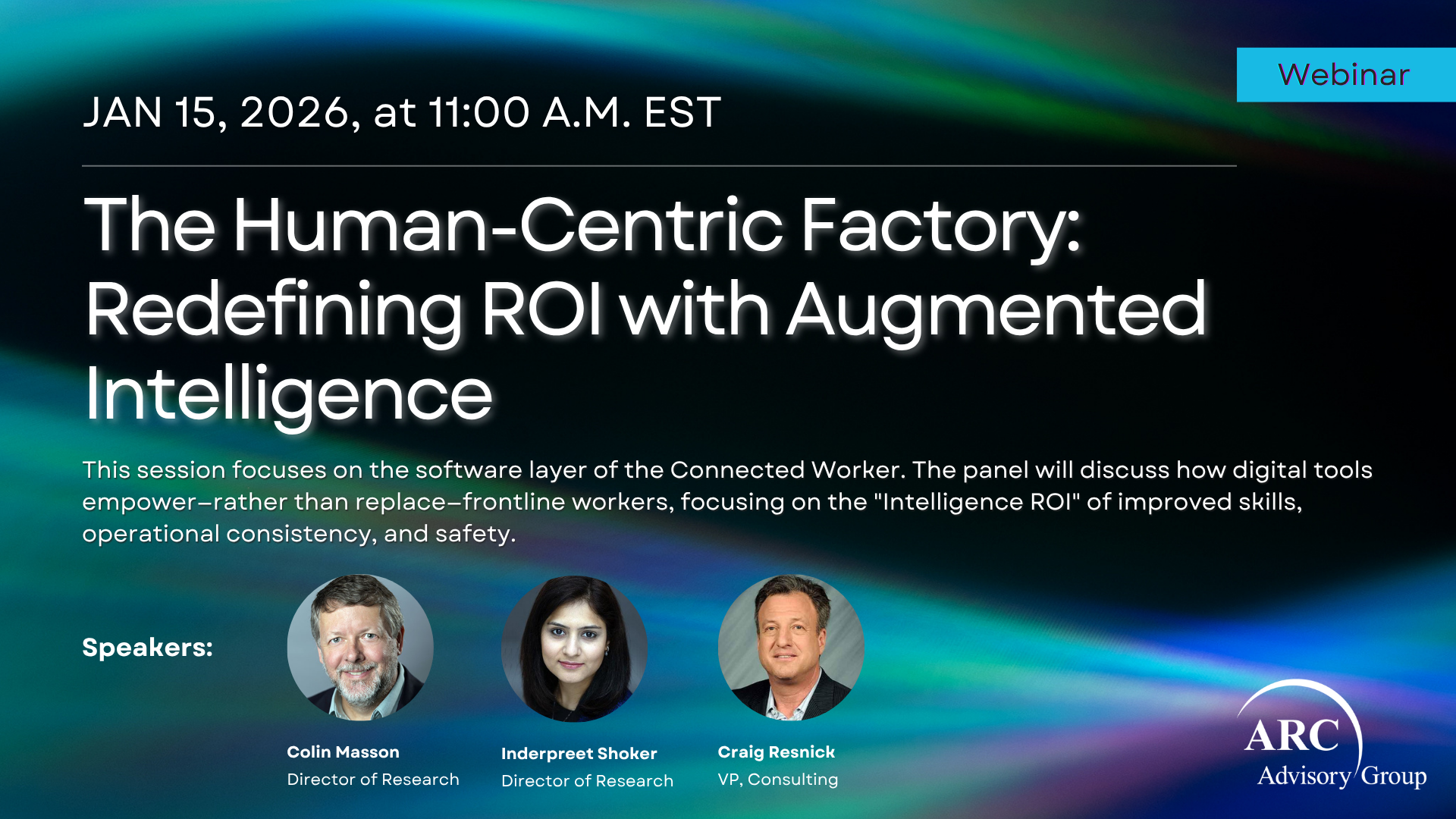
I'll host a panel with Craig Resnick and Inderpreet Shoker to discuss the "symbiotic factory." As Mike and I agreed, smart companies aren't getting rid of experts; the experts are what make the AI work. We'll discuss this new "Intelligence ROI."
And most importantly, this all culminates at the 30th Annual ARC Industry Leadership Forum in Orlando, Florida, from February 9–12, 2026. Mike and I will be hosting our keynotes, and we'll be joined by the Pacesetters who are actually building these systems.
I look forward to seeing you at the next webinar.