Representative End User Clients







Representative Automation Clients







Representative Software Clients








Siemens announced the acquisition of Canopus AI on 4 February 2026, reinforcing its broader push into industrial artificial intelligence and digital transformation. Canopus AI, a French startup founded in 2021 in Grenoble, specializes in AI-driven metrology and inspection software for semiconductor manufacturing. By integrating Canopus AI’s technology, Siemens aims to extend its electronic design automation portfolio, particularly the Calibre platform, with AI-based wafer and mask inspection capabilities.
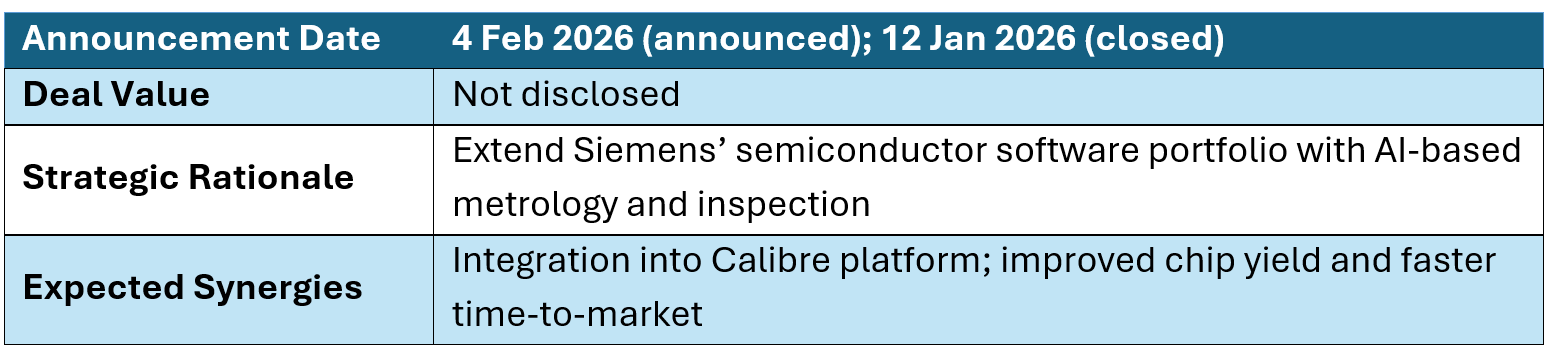
The acquisition aligns with Siemens’ long-term objective of applying AI to improve industrial processes. In semiconductor manufacturing, it addresses a growing challenge: as device features continue to shrink, conventional quality-control methods struggle to maintain accuracy and efficiency. Canopus AI’s “Metrospection” approach applies machine learning to bridge metrology and inspection, enabling chip manufacturers to improve precision and yield in advanced fabrication environments.
Siemens expects this capability to strengthen its semiconductor digital thread by supporting a more seamless flow of data from design through production. Improved integration between inspection, metrology, and design tools could enable more accurate digital twins of manufacturing processes. In practical terms, combining Canopus AI’s software with Siemens’ existing toolchain may help improve wafer pattern fidelity and accelerate yield ramp-up for leading-edge semiconductor nodes.
The deal also underscores Siemens’ continued investment in industrial AI, following recent initiatives such as partnerships focused on an industrial AI operating system and the introduction of AI copilots for manufacturing operations. For the broader industrial automation and AI landscape, the acquisition illustrates how AI-driven software is increasingly embedded into core production workflows, signaling its growing importance to competitiveness in high-technology manufacturing beyond semiconductors.