Representative End User Clients







Representative Automation Clients







Representative Software Clients








If you have been following our ongoing seven-part series charting the deep architectural transitions reshaping industrial operations, welcome back.
Over our opening three installments, we examined the foundational compute frameworks, enterprise data canvases, and engineering context layers emerging from the major technology disclosures of NVIDIA, Microsoft, and Siemens. We then synthesized those movements to map out the macro landscape of the Industrial AI (R)Evolution, detailing a multi-model software blueprint currently dividing our sector into distinct adoption cohorts, before delivering a financial playbook in Blog 5 to show how localized processing can systematically shield corporate balance sheets from the variable cost loops of cloud-metered computing.
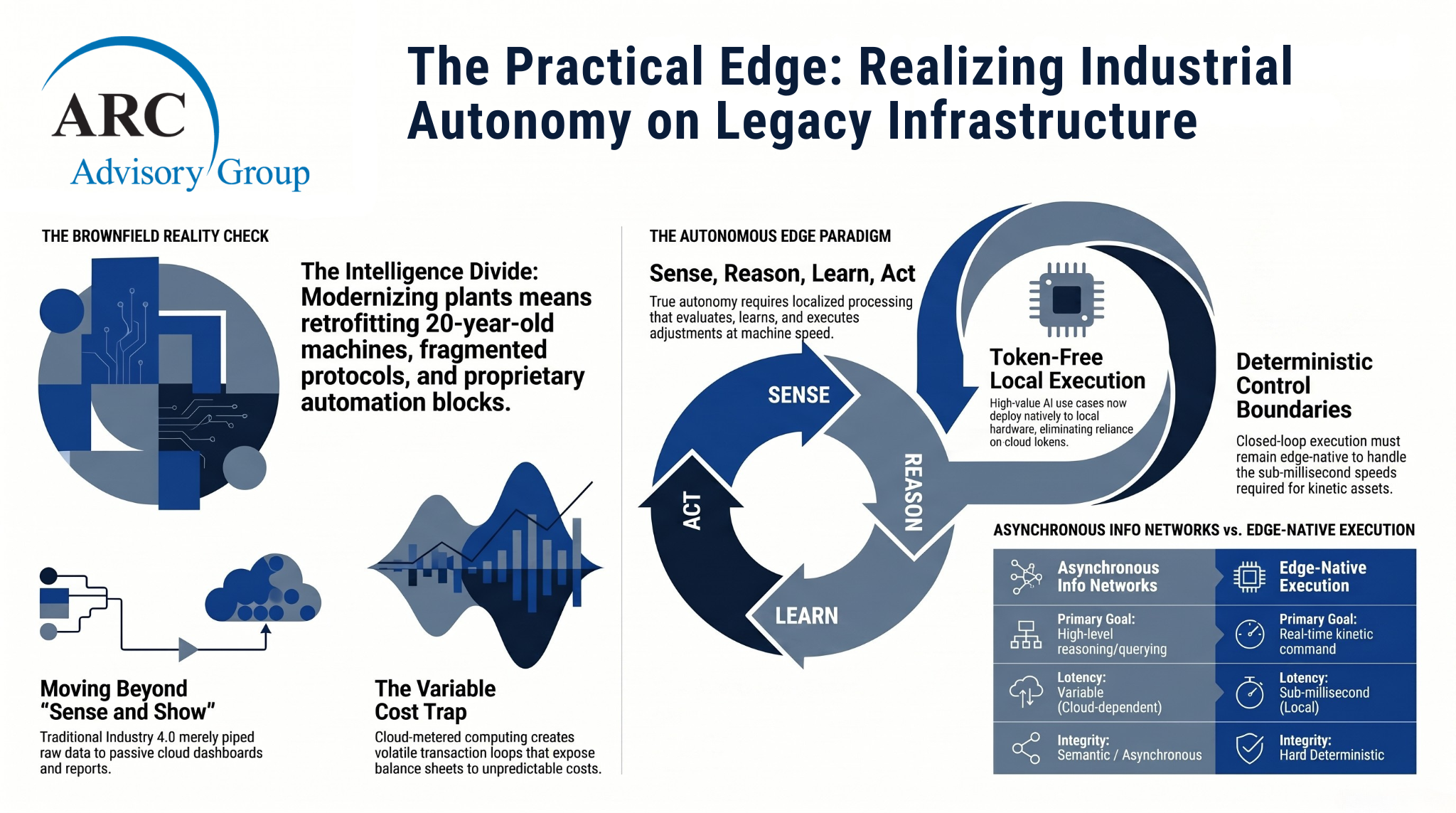
However, as we move into the physical execution phase of our campaign, it is time to establish an essential reality check. While the marketing keynotes from horizontal technology providers frequently focus on gigawatt-scale infrastructure, multi-billion-parameter models, and hyper-premium GPU clusters, the operational technology (OT) universe lives in a completely different world. Greenfield automation is a straightforward engineering exercise when an enterprise is blessed with an unrestricted capital budget and a clean sheet of paper. But the multi-trillion-dollar global production base functions in a brownfield trench warfare environment.
When we talk about crossing the intelligence divide, we are talking about retrofitting plants populated by 20-year-old machines, fragmented communication protocols, legacy historians, and proprietary automation blocks. This operational transition marks a clean break from the legacy “Sense and Show” dashboards that characterized early Industry 4.0—where the primary objective was simply piping raw data up to passive cloud dashboards and static reports. Instead, we are entering an era defined by active “Sense, Reason, and Act” environments—though many of us in the trenches would argue that “Learn” must be explicitly added to that loop if true autonomy is the goal.
As we highlighted during our recent executive panels at the ARC Industry Leadership Forum, software platforms do not deploy themselves. Moving out of isolated pilot purgatory is systematically bottlenecked by a human integration chasm. The core objective of this installment in our series is to explore what computational capability actually belongs on the industrial plant floor.
The critical takeaway for industrial leadership teams is that deploying edge intelligence does not require waiting for massive, hyper-costly hardware architectures or exposing your balance sheet to volatile transaction loops. A significant class of high-value industrial AI use cases is already deploying natively to standard industrial computing infrastructure, driven entirely by deep domain expertise and localized execution rather than continuous, cloud-metered token metrics. In this environment, domain expertise and vertical innovation are more valuable than ever.
To design a highly defensible edge execution strategy, data science and operational technology executives must step away from horizontal software definitions and evaluate the fundamental mathematical divide between offline physical modeling and real-time kinetic action. In our third blog covering Siemens Realize LIVE, we examined how Physics-Informed Neural Networks (PINNs) and geometric surrogates inside Designcenter X are accelerating design validation. PINNs represent an important milestone for engineering simulation because they embed explicit differential equations directly into the network’s loss function. In many industrial settings, that makes them less practical for live optimization when ambient conditions, feed characteristics, and equipment health are continuously changing.
However, these models are computationally heavy, require extensive compilation times, and are primarily optimized to act as offline safety boundaries or simulation validation gates. They struggle to execute live optimization policies at machine speed inside a dynamic process loop that is constantly buffeted by fluctuating ambient pressures, shifting raw feed qualities, and physical equipment wear.
This operational constraint is precisely where Imubit’s Deep Learning Process Control (DLPC) shifts the architectural paradigm. Imubit focuses entirely on the execution policy, utilizing Deep Reinforcement Learning (RL) trained directly on a facility’s historical time-series data streams and sensor logs to optimize complex operations locally. Imubit does not attempt to compute idealized first-principles differential equations from scratch; instead, its models discover the actual, unmodeled, real-world physics of an asset implicitly from the data stream.
By evaluating the non-linear interactions across hundreds of multivariable process tags simultaneously, Imubit’s optimization engine bypasses the traditional boundaries of the Purdue Model. Operating as a localized Level 4 Autonomous Execution Agent within the ARC Advisory Group Industrial AI Models Taxonomy, it calculates optimized adjustments and writes them straight back as setpoint corrections into legacy distributed control systems (DCS) and SCADA networks.
Because the model executes entirely on existing local edge appliances, it runs continuously at machine speed without consuming external cloud tokens or requiring a multi-million-dollar reconstruction of the underlying automation hardware. This native, token-free localized processing serves as a direct execution of the token mitigation strategies we designed in Blog 5.
While continuous process operations utilize reinforcement learning to stabilize live setpoints, discrete and batch manufacturers face a parallel brownfield barrier: mechanical asset reliability and escalating maintenance complexity. This is the operational environment targeted by Avathon. Avathon represents a clear example of a software-first overlay engineered explicitly to target existing legacy infrastructure, completely bypassing the capital-intensive hardware cost wall that traditionally stalls digital transformation initiatives.
In many brownfield environments, plant engineers are overwhelmed by alarm fatigue, while data science teams spend upward of 80 percent of their time simply cleaning and formatting noisy sensor outputs. Avathon resolves this data friction by injecting predictive and causal machine learning directly into your existing operational historians and enterprise asset management (EAM) databases.
Instead of demanding that a facility undergo a multi-year sensorization project, Avathon’s analytics engine reasons across structured and unstructured operational data—including time-series tags, event logs, maintenance records, and raw acoustic or thermal telemetry streams—to pinpoint exact root causes. It moves the facility past simple predictive alerts (“this pump will fail in ten days”) to deliver automated, prescriptive maintenance interventions.
Prescriptive Shift Example: Instead of merely alerting that a component will fail, the platform delivers precise adjustments, such as throttling a valve by 15% to eliminate cavitation and extend seal life by three weeks.
This software-defined overlay allows asset-heavy enterprises to maximize the structural uptime of legacy machinery while ensuring that frontline field technicians are armed with contextualized, actionable repair instructions before a failure can stall production.
As we actively conduct the comprehensive research for our upcoming ARC Advisory Group 3-Axis Industrial AI Models Taxonomy Market Analysis Report (MAR) and compile our corresponding MarketMaps for Industrial Copilots and Autonomous Execution Agents, our team is continuously engaging with the broader technology ecosystem. What follows is a representative sampling of innovative vendors we have been briefed by recently. These profiles demonstrate how highly targeted, domain-specific capabilities are helping brownfield operators bypass generic information technology constraints to achieve localized, trusted operational outcomes.
(As a quick reminder to the vendor community: if your organization has not yet responded to our active RFI, or if you are an emerging player looking to ensure your specific architecture is accurately mapped within this research, please reach out to our analyst team directly.)
The Operational Friction: The primary roadblock to executing any sophisticated multi-model strategy on a brownfield plant floor is the sheer complexity of raw data operations.
The Solution: HighByte resolves this friction via its Intelligence Hub, an open-standard, system-agnostic DataOps platform designed to model, blend, and contextualize edge streams before they are routed into broader cloud or database environments.
Marketplace Validation: A critical milestone validating this pragmatic edge paradigm was the recent announcement that HighByte has officially joined the Siemens Industrial Edge Marketplace. This commercial and technical integration allows manufacturing teams to deploy the HighByte Intelligence Hub as a native, containerized application directly alongside Siemens edge devices and physical controllers.
Protocols and Standards: By providing native, first-to-market support for the Model Context Protocol (MCP) and championing the i3X semantic standard, HighByte enables multi-agent architectures to auto-discover and map data structures across multi-vendor equipment networks without custom code.
Real-World Impact: This was a core piece of the architecture driving the massive Vivix Vidros Planos glass manufacturing success story we analyzed in Blog 3. Similarly, global innovators like Bayer deploy HighByte at the edge to securely structure and stream data out of legacy historians, piping it straight into natural-language agent interfaces on AWS to unlock instant process insights.
Compliance Constraints: In safety-critical, highly regulated spaces like life sciences and biopharmaceuticals, unverified algorithmic logic is an immediate compliance failure under strict regulatory guidelines.
The Framework: Aizon AI answers this challenge through its GxP-compliant adaptive validation platform. Rather than advocating for completely unmanaged loop execution, Aizon pairs predictive machine learning with trusted human-on-the-loop oversight.
Process Execution: In chemical synthesis and biotech facilities, Aizon evaluates critical process values directly from the SCADA layer to predict yield trajectories and display optimal setpoint corrections on an operator’s terminal.
Proven Metrics: By keeping the expert operator strictly informed to verify recommendations, this framework successfully handles data drift and recently advanced a major CDMO’s compliance metrics to 90 percent of batches being Right First Time (RFT).
The Model Class: Operating squarely within Axis 2 (AI Model Class) as a specialized control innovator, Luffy AI delivers an alternative to rigid, traditional Advanced Process Control (APC) systems that frequently degrade the moment a physical asset undergoes mechanical wear.
Dynamic Adaptation: Rather than relying on static mathematical models, Luffy AI utilizes adaptive, neuro-inspired control architectures. Its algorithms run natively at the extreme edge, continuously learning and adjusting to changing system dynamics in real time.
Brownfield Benefit: For brownfield operators, this means a control loop can dynamically compensate for physical component degradation or sliding operational envelopes without requiring an on-site team of control engineers to manually recalibrate the system, serving as an agile, self-tuning companion directly alongside legacy PLCs.
The Bandwidth Bottleneck: In high-precision manufacturing environments, quality monitoring is frequently bottlenecked by the immense data costs of streaming high-definition machine video or sensor arrays up to centralized cloud environments.
Localized Verification: Ethon AI targets this friction point by deploying edge-native quality management and operational risk analytics. By executing vision-based defect inspection and advanced statistical anomaly detection locally on ruggedized edge hardware, Ethon AI maps surface signatures and identifies process drift right at the production line.
Financial Protection: This localized approach allows manufacturers to catch visual anomalies in real time, preventing scrap cascades without incurring the steep cloud storage and bandwidth fees that typically derail large-scale vision deployments.
Operational Risk: For heavy industrial plants where unexpected rotating equipment failure can stall an entire production line, Infinite Uptime delivers a highly specialized, turnkey approach to asset performance management.
Advanced Telemetry: Positioned within our taxonomy as an automated predictive and prescriptive maintenance specialist, Infinite Uptime couples non-invasive, edge-native sensor arrays with advanced diagnostic models.
Prescriptive Health Scoring: Instead of merely generating high-level alerts that add to a plant manager’s alarm fatigue, its platform calculates explicit prescriptive health scores. It analyzes vibration and triaxial thermal telemetry locally to determine not just when an asset will fail, but precisely why it is degrading, providing maintenance divisions with direct, actionable instructions to protect plant reliability and capture immediate uptime without custom codebase traps.
The Data Fragment Trap: The primary roadblock to deploying an effective Industrial Data Fabric is the sheer fragmentation of the underlying data streams; a single factory floor might run across dozens of different vendor tools, historians, and operational databases.
The Visual Layer: XMPro resolves this friction by delivering a composable event intelligence and Digital Twin orchestration platform. XMPro functions as the visual orchestration layer of the data fabric, allowing IT, OT, and data science teams to rapidly wire together real-time edge telemetry with prescriptive multi-agent workflows without writing brittle, custom integration code.
Unified Framework: It serves as a composable application framework, allowing plants to contextualize streams instantly, match incoming events to predefined business rules, and trigger automated agent interventions across multi-vendor operations seamlessly.
The primary challenge of deploying sophisticated vertical applications like Imubit, Avathon, and our taxonomy innovators across a global fleet of brownfield facilities is the severe risk of platform fragmentation and configuration drift. Corporate IT architects require strict governance, standardized security patches, and centralized access controls, while plant OT teams demand complete local survivability, zero dependency on cloud connections, and a hardened physical chassis that can withstand harsh factory conditions.
This deep IT/OT deadlock has been broken through a highly coordinated infrastructure partnership combining Red Hat and EdgeScale AI. Red Hat delivers the critical enterprise IT governance layer by integrating containerized agent containment systems—including NVIDIA OpenShell blueprints—directly into its full-stack Red Hat Enterprise Linux (RHEL) AI and OpenShift AI platforms. This integration allows corporate infrastructure teams to manage, monitor, and standardize advanced autonomous agent policies across thousands of distributed plant networks using familiar, highly secure DevSecOps container orchestration workflows.
This software chassis is housed directly within EdgeScale AI’s “Cube,” a ruggedized Virtual Connected Edge (VCE) private AI appliance engineered explicitly for uncarpeted industrial environments. Built on an immutable, hardened Red Hat Enterprise Linux CoreOS base, the Cube is designed as a plug-and-play appliance that can be drop-shipped straight to a remote plant floor without requiring on-site data science personnel. Red Hat describes the combined solution as a plug-and-play approach for extending private AI and cloud-native software into operating sites with minimal local IT overhead.
Once connected to the local plant network, the Cube automatically executes local asset and protocol discovery loops, maps incoming tag streams, and hosts secure, OpenAI-compatible APIs entirely locally on its own high-density edge silicon. This edge appliance represents the physical realization of the CapEx capital-shielding strategy we designed in Blog 5. Because all computing cycles and algorithmic inference execute locally within the physical chassis, the facility completely cuts its reliance on metered public cloud connections, securing software-like margins while remaining entirely insulated from cloud network latency, security exposure, and hyperscaler variable token bills.
As we synthesize these brownfield breakthroughs, our core strategic conclusions focus on the real-time control boundaries that limit open software adoption across the industrial plant floor:
The Information vs. Control Boundary: The widespread market adoption of open protocols like the Model Context Protocol (MCP) and semantic layers like CESMII's i3X represents an exceptional step forward for global data integration, allowing intelligent agents to query and locate unstructured context across multi-vendor enterprise toolsets. MCP and similar semantic frameworks are exceptionally valuable for asynchronous context exchange and cross-vendor interoperability, but they are not substitutes for the hard real-time, deterministic environments required to operate physical assets safely and reliably.
The Limits of Asynchronous Frameworks: Operations executives must maintain an uncompromised commitment to plant-floor determinism. MCP and similar semantic frameworks are asynchronous, query-driven information routing channels; they are fundamentally incapable of handling the sub-millisecond, hard real-time execution loops required to safely command a spinning kinetic asset or manage a high-pressure chemical reaction.
A Strict Division of Architectural Labor: True cyber-physical autonomy demands a clear division of labor within your software infrastructure. High-level agentic planning and semantic reasoning can safely run via asynchronous data networks, but the final closed-loop execution policy must be handed off directly to edge-native, containerized virtual PLCs (vPLCs) and secure private edge appliances like the EdgeScale AI Cube.
Bypassing the Technical Debt Wall: By grounding your closed-loop optimization software directly on local iron next to the machine face, your organization successfully bridges the human integration chasm, bypasses the legacy technical debt of the factory floor, and unlocks scalable autonomy on your existing brownfield asset base today—without waiting for hyper-premium, costly greenfield infrastructure additions.
Up Next in the Series, Blog 7: “Geopolitics of the Autonomous Factory: The Hyperscaler Divide, Sovereign Networks, and the Synapse Workforce Shift.”
We will bring our seven-part master series to a definitive conclusion by zooming out to the global competitive map. We will evaluate the multi-billion-dollar infrastructure rift between Microsoft and AWS, analyze the construction of "Fortress Europe" through sovereign federated data spaces like Catena-X, and outline the profound labor reorientation transforming traditional knowledge workers into elite Context Engineers. Stay tuned.
The Industrial AI (R)Evolution is moving faster than ever. To dive deeper into the frameworks and data shaping the future of the industrial sector, explore my latest research:
Navigating the AI Wars and the escalating Industrial Robot Wars
Closing the Digital Divide by Embracing Industrial AI
Assembling your Industrial-Grade Data Fabric
Charting the new frontier of Physical Intelligence and transitioning to a Cyber-Physical Industrial Architecture (CPIA)
Mapping your maturity and strategy with ARC's 3-Axis Industrial AI Models Taxonomy
Take our Industrial AI Assessment to benchmark your organization's maturity, identify critical gaps in your IT/OT/ET convergence, and get actionable recommendations to accelerate your path to becoming an Industrial AI Pacesetter.
Don't guess what your global operations or prospective customers need. Use empirical data to align your stakeholders and de-hype the market with ARC Advisory Group's Voice of Market Service.
For tailored recommendations on governing and guiding major people, process, and technology decisions across the enterprise, cloud, industrial edge, and AI, please contact Colin Masson at [email protected].
Or, set up a meeting with my fellow Analysts and I at ARC Advisory Group to find out more about our Executive Insights Service for Industrial organizations and our Industrial AI Insights Service for Vendors.