Representative End User Clients







Representative Automation Clients







Representative Software Clients








The true driver of open interoperability isn't software vendor positioning—it is demand from enterprise manufacturers. ARC recommends evaluating i3X and open protocols as an architectural contract that empowers frontline personnel to solve local operational problems safely without adding custom IT technical debt.
In Blog 2 of this master series ("The Open Architecture Contract: How MCP and i3X Act as the Drainage Pumps of the Autonomous Plant"), we established why open protocols like Anthropic's Model Context Protocol (MCP) and CESMII's Industrial Information Interoperability Exchange (i3X) serve as the universal, non-negotiable plumbing required to drain the "agentic swamp."
While technical demonstrations showing 32+ automation vendors interoperating live on a single stage are deeply satisfying for an enterprise architect, the real story of modern manufacturing transformation isn't written in vendor engineering labs. It is written by the people who actually run the plants.
During Act IV ("Manufacturers Speak: Business Value") of the recent Scaling Smart Manufacturing & Industrial AI Interoperability Forum (co-hosted by CESMII and the Manufacturing Leadership Council), executive leaders from General Mills, Toyota, ExxonMobil, and GE Appliances stepped up to the microphone.
What transpired was an extraordinary, unvarnished look at why open interoperability has evolved from an IT integration headache into a board-level business imperative. Below is my analysis of the five core operational shifts unveiled by these manufacturing leaders—and why their message signals a permanent end to vendor-dictated software silos.
For four decades, industrial software standards were largely written by automation vendors and handed down to manufacturers as proprietary, take-it-or-leave-it monoliths. If a plant wanted to connect an MES from Vendor A to a SCADA system from Vendor B and a cloud lakehouse from Vendor C, the manufacturer picked up the tab for hundreds of thousands of dollars in brittle, custom API glue code.
During the forum, Brian Perlstein, Digital Manufacturing Innovation Leader at Owens Corning summarized the exact moment this legacy dynamic snapped in a message sent directly to CESMII leadership:
For years, hardware and software vendors have largely dictated manufacturing standards. CESMII/i3X represents a fundamental shift: it’s the manufacturing community defining the requirements, with technology providers enabling the vision, not driving it. Looks like you’re finally solving manufacturing’s toughest challenge… forced interoperability alignment.
—Brian Perlstein, Digital Manufacturing Innovation Leader, Owens Corning
Brian hit the nail on the head. Manufacturers are no longer willing to serve as the passive integration buffer between competing software vendor ecosystems. As CESMII CEO John Dyck rightly noted, IT/OT convergence was treated for years like an uncomfortable organizational merger. i3X proves that what we actually needed was an architectural contract that standardizes the open semantic primitives so technology providers can differentiate on functional value, not on custom plumbing.
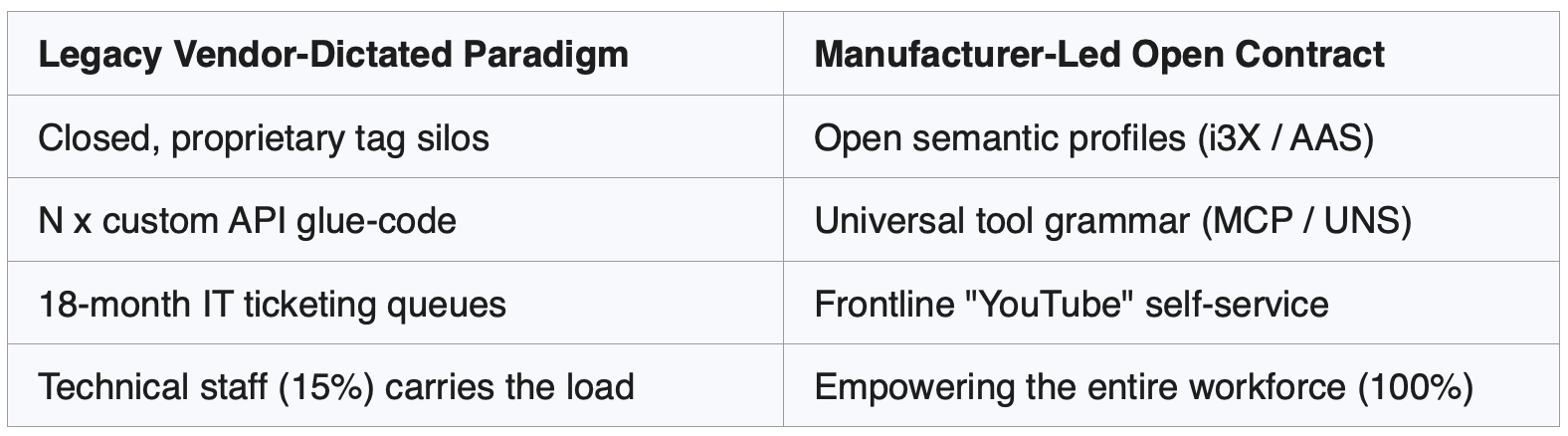
One of the most fascinating themes to emerge from the panel was the profound generational shift occurring across plant-floor personnel.
Matthew Parris, Director at GE Appliances, delivered a sharp reality check on how the incoming workforce approaches problem-solving:
We’ve started to notice a generational change where people are more interested in solving their own problems. It used to be that you engage a platform team and have them go develop a dashboard... Today, an upcoming crop of people joining the manufacturing workforce are used to going on the internet, going to YouTube and learning how to change parts out on a car, and they’re going to do the same on the factory floor. With AI, they aren't waiting on IT—they have the application on their computer, they just need access to the data.
—Matthew Parris, Director, GE Appliances
Lisa Zasada, Senior Engineering & Manufacturing Exec at General Mills, echoed this exact sentiment, pointing out that post-COVID operational demands require meeting workers where they are:
Our next generation entering the workforce expects the same digital experience at work that they have everywhere else. They learn with AI, they watch YouTube videos, and they expect information to be available instantly. Interoperability is about connecting people with the information that allows them to make better decisions.
—Lisa Zasada, Senior Engineering & Manufacturing Exec, General Mills
Think about the implications for your enterprise architecture: if your data is trapped behind proprietary PLCs, closed historian schemas, or complex SQL queries that require a three-week IT ticket to unlock, you aren't just creating operational latency—you are actively alienating your newest generation of engineers and operators.
AI reasoning engines and low-code workbenches allow workers to "vibe code" local solutions in minutes. But if those tools have to waste thousands of cloud tokens constantly rebuilding custom adapters just to read a temperature tag, your digital transformation budget will vanish into the "Tokenpocalypse". Open i3X profiles give those self-service tools a standardized "electrical plug"—allowing operators to plug in, query the context, and solve the problem immediately.
In most industrial organizations, the dedicated central engineering and IT team represents perhaps 10 percent to 15 percent of the total site headcount. The remaining 85 percent consists of operators, material handlers, line leads, and maintenance technicians who live on the shop floor every single day.
Chris Crotts, GM at Toyota, shared an inspiring story illustrating what happens when you unlock operational data for that 85 percent:
We’re watching people from the plant floor build applications—people who have been working on paper systems for 15 to 20 years and have never been able to do anything digitally. We're starting to see them so motivated that they look forward to coming into work because they feel empowered to solve problems... If you truly want to innovate and scale, you can't do it with just the 10 percent or 15 percent technical staff. You have to enable the other 45,000 people in manufacturing.
—Chris Crotts, GM, Toyota
When an operator who has filled out a grease-stained paper log sheet for two decades is suddenly handed an intuitive, context-aware digital app that they helped configure, job satisfaction skyrockets. But as Chris rightly cautioned, frontline enthusiasm dies quickly if the data foundation isn't there. If every new operator app requires bespoke backend data mapping, the central team becomes an insurmountable bottleneck once again.
One of the most profound realities of Operational Technology (OT) is the massive divergence in technology lifecycles. A consumer smartphone or cloud AI model is updated or replaced every 12 to 24 months. A primary chemical reactor, stamping press, or Distributed Control System (DCS) is expected to run reliably for 30 to 40 years.
Michael Hotaling, Executive Advisor at ExxonMobil, addressed this brownfield technical debt head-on:
The technical debt associated with legacy systems is probably one of the biggest lifts we have. The life cycle of a PLC or a process control environment is 30 or 40 years... With open interoperability and semantic layers, data duplication disappears. It allows an ecosystem of best-in-class startups and software providers to deliver capabilities without requiring a massive, multi-million-dollar 'rip and replace' of the asset owner's underlying infrastructure.
—Michael Hotaling, Executive Advisor, ExxonMobil
This is where the "greenfield fantasy" of horizontal cloud vendors collapses against brownfield reality. You cannot tell a refinery or an automotive stamping plant to replace 400 operational PLCs simply because a new cloud analytics package requires a REST interface.
By placing edge DataOps hubs and CESMII i3X wrappers on top of legacy brownfield iron, you wrap 30-year-old signals in modern, type-safe JSON schemas. The legacy PLC continues running its deterministic, sub-millisecond control loop untouched, while the upstream AI agent queries the asset's i3X profile safely, insulated from physical risk.
When software integration is expensive, brittle, and custom-coded, corporate governance responds rationally: it slows everything down. Executive committees demand multi-year ROI business cases, exhaustive risk assessments, and lengthy vendor evaluations before approving a single pilot. Innovation becomes conservative, defensive, and slow.
General Mills’ Lisa Zasada reframed open interoperability not merely as a cost-saving measure, but as an engine for organizational confidence:
The economics aren't just about money, although that is a big part of it. It’s about confidence. When innovation is expensive in an enterprise, organizations play it safe—they take only a handful of bets. But when interoperability makes innovation easier to scale, teams naturally start to experiment more and learn faster. There’s a willingness to try 10 ideas rather than 1. Interoperability lowers the cost of sharing knowledge so we learn together and continuously improve.
—Lisa Zasada, Senior Engineering & Manufacturing Exec, General Mills
This is the ultimate business case for open standards like MCP and i3X. By collapsing the marginal cost of data integration toward zero, you transform your enterprise from a cautious, bureaucratic "Programmed Machine" into a fluid, experimenting Adhocracy.
As your leadership team reviews its 2027 digital transformation and AI roadmaps, bring these end-user insights into your next executive session:
Are we empowering the 85 percent or overloading the 15 percent?
The Test: Is our digital strategy relying entirely on a centralized data engineering team to build custom dashboards, or are we providing open semantic layers (i3X/UNS) that allow frontline domain experts to solve local problems safely?
Are we funding bespoke glue code or demand-driven standards?
The Test: When procuring new MES, APM, or AI software, are we allowing vendors to charge us for custom API integration scripts, or are we mandating native MCP Server and i3X Profile compliance in our RFI/RFP specifications?
How are we bridging our 30-year asset lifespan gap?
The Test: Are we attempting expensive "rip-and-replace" hardware upgrades to satisfy cloud AI prerequisites, or are we deploying edge DataOps overlays to wrap brownfield PLC tags in open semantic profiles?
Are we organizing around departmental silos or operational outcomes?
The Test: As Toyota’s Chris Crotts pointed out, if your teams remain structured in rigid functional silos (Logistics vs. Maintenance vs. Quality), they will continue to build siloed software. Are your multi-agent AI networks orchestrated across cross-functional value streams?
The verdict from Owens Corning, General Mills, Toyota, ExxonMobil, and GE Appliances is unanimous: the age of vendor-locked, proprietary data stovepipes is over.
Interoperability is no longer a technical feature to be debated in an architecture subcommittee; it is the fundamental business mechanism that converts isolated plant inventions into enterprise-wide, reusable capabilities.
If you want your enterprise to lead the autonomous era, stop asking your vendors which proprietary cloud ecosystem you should join. Start demanding that every software provider, machine builder, and system integrator sign up to the Open Architecture Contract—standardizing the foundation with i3X and MCP so your frontline workers can democratize innovation at scale.
The Industrial AI (R)Evolution is moving faster than ever. To dive deeper into the frameworks and data shaping the future of the industrial sector, explore my latest research:
Navigating the AI Wars and the escalating Industrial Robot Wars
Closing the Digital Divide by Embracing Industrial AI
Assembling your Industrial-Grade Data Fabric
Charting the new frontier of Physical Intelligence and transitioning to a Cyber-Physical Industrial Architecture (CPIA)
Mapping your maturity and strategy with ARC's 3-Axis Industrial AI Models Taxonomy
Surviving the SaaSpocalypse and Taming the Tokenpocalypse by Mastering Multi-Agent Industrial Governance
Organizational Design and the Future of Industrial Work in the era of Agentic AI
Where do YOU Stand in the Industrial AI (R)Evolution?
Take our Industrial AI Assessment to benchmark your organization's maturity, identify critical gaps in your IT/OT/ET convergence, and get actionable recommendations to accelerate your path to becoming an Industrial AI Pacesetter (and Download the 2026 Report).
Don't guess what your global operations or prospective customers need. Use empirical data to align your stakeholders and de-hype the market with ARC Advisory Group's Voice of Market Service.
For tailored recommendations on governing and guiding major people, process, and technology decisions across the enterprise, cloud, industrial edge, and AI, please contact Colin Masson at [email protected].
Or, set up a meeting with my fellow Analysts and I at ARC Advisory Group to find out more about our Executive Insights Service for Industrial organizations and our Industrial AI Insights Service for Vendors.