Representative End User Clients







Representative Automation Clients







Representative Software Clients









KEYWORDS: Energy Storage, Industrial Energy Management, Industrial Decarbonization, Electrification, Energy Flexibility, Thermal Energy Storage, Operational Resilience
Behind-the-meter energy storage is emerging as a strategic enabler for industrial companies seeking to electrify operations, integrate renewable energy, and strengthen resilience in the face of grid constraints and energy price volatility. As industrial energy systems become more complex, storage can help reduce peak demand, improve self-consumption of on-site generation, and align energy availability with production requirements.
Industrial energy management offers major opportunities, but its complexity demands solutions beyond familiar technologies and tailored to each site’s operational realities.
However, the technology landscape is broad and highly application-specific. Batteries, thermal storage, mechanical systems, and chemical storage each offer different trade-offs in maturity, duration, efficiency, cost, and integration potential. This means there is no universal solution. Successful deployment depends on matching technologies to site-specific operational needs and decarbonization goals.
Industry examples show that energy storage is already moving from concept to implementation across sectors, including chemicals, food and beverage, and manufacturing. These use cases highlight storage not only as a decarbonization tool, but also as a source of flexibility, competitiveness, and long-term energy security.
Electrification has become a cornerstone of industrial decarbonization strategies. Companies are increasingly replacing fossil-fuel-based processes with electric alternatives while expanding on-site renewable generation. However, many industrial sites face practical constraints, including limited grid connection capacity, rising demand charges, volatile electricity prices, and mismatches between renewable generation and production schedules. These challenges can delay electrification projects and increase operational costs.
In this context, behind-the-meter energy storage is becoming a strategic asset. By storing energy on-site, industrial companies can reduce peak demand, increase self-consumption of renewable electricity, improve resilience against supply disruptions, and gain operational flexibility. As a result, energy storage is increasingly viewed not only as a decarbonization enabler but also as a tool to improve competitiveness and energy security. For industrial facilities, storage can support voltage stability, ride-through capability, backup power, and continuity for sensitive production processes.
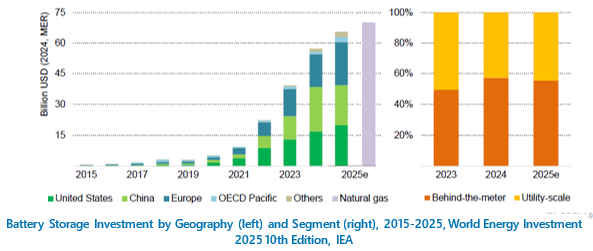
This trend is reflected in global investment patterns. According to the IEA, battery storage investments have grown rapidly over the past decade and are approaching investment levels seen in gas-fired power generation, with a significant share deployed in behind-the-meter applications. While the IEA data focuses on batteries, industry interest extends well beyond battery technologies. Thermal, mechanical, chemical, and other long-duration storage solutions are increasingly being evaluated to address specific industrial requirements, particularly where heat demand, long storage durations, or process integration are critical. The following sections discuss these technologies.
ARC Advisory Group clients can view the complete report at the ARC Client Portal.
Contact Us if you would like to speak with the author.
Obtain more ARC In-depth Research Market Analysis.