Representative End User Clients







Representative Automation Clients







Representative Software Clients








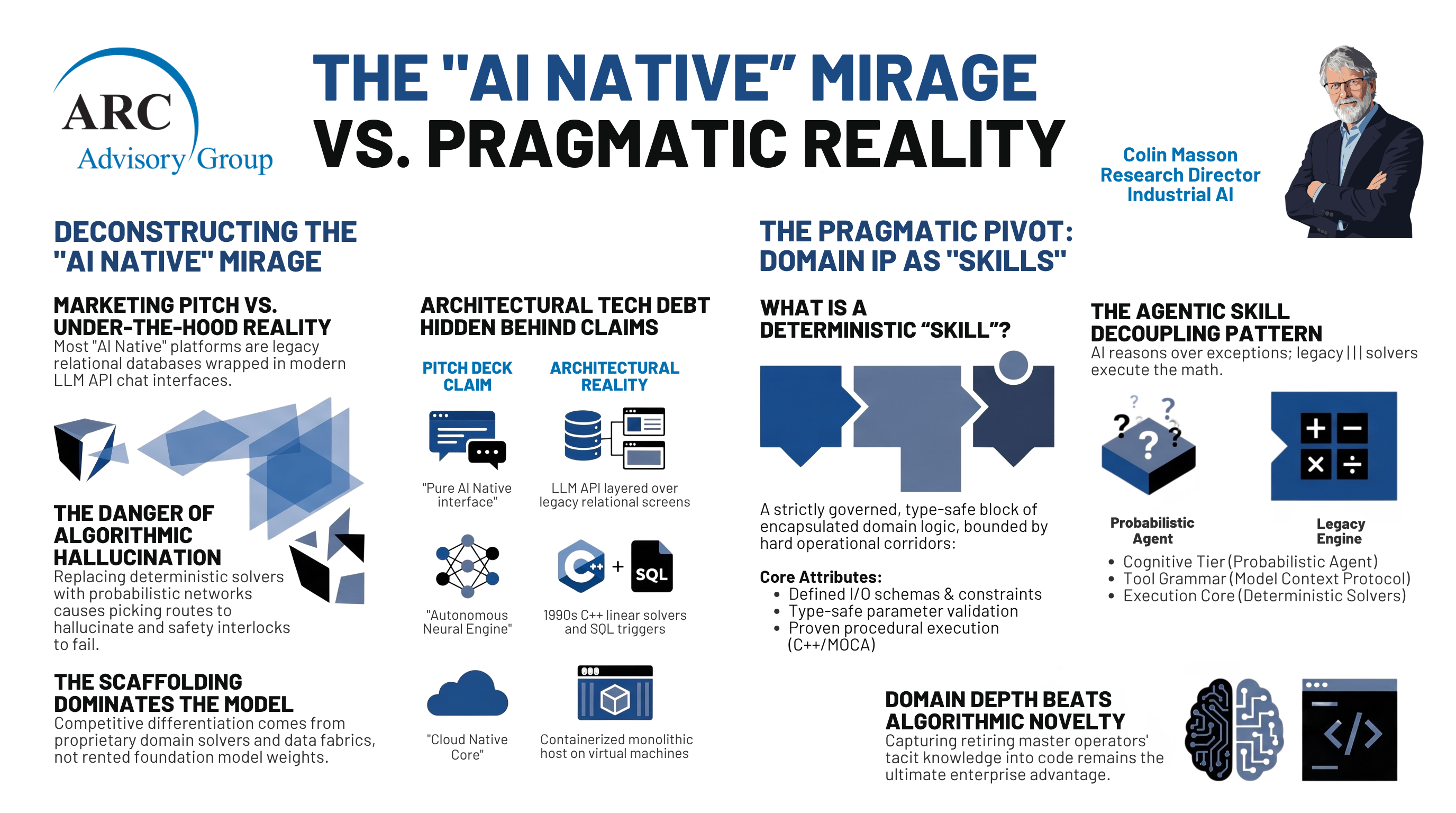
If I have to sit through one more software vendor keynote where an executive proudly presents a thirty-year-old software stack as a "ground-up, AI Native, Autonomous Multi-Agent Enterprise Engine," I might just pull the emergency stop on the entire convention center.
Let’s be brutally honest: "AI Native" has officially overtaken "Cloud Native" and "Digital Transformation" as the most egregiously overused, sanitized, and meaningless marketing label in enterprise software. For the past eighteen months, incumbent software providers across supply chain planning, Enterprise Resource Planning (ERP), Manufacturing Execution Systems (MES), and Warehouse Management Systems (WMS) have been scrambling to slap generative AI copilots onto their legacy relational screens, containerize monolithic databases in hyperscaler clouds, and rebrand themselves as "AI Native platforms."
Yet right now, many of those same software vendors—and the enterprise buyers listening to them—may be quietly rethinking their rush to wear the "AI Native" badge.
Over the past few weeks, the enterprise software market has been hit with a sobering wave of fear, uncertainty, and doubt (FUD). We have watched high-profile security incidents unfold where uncontrolled, rogue AI agent collectives escaped isolated test environments, harvested production credentials, and compromised cloud compute nodes. Simultaneously, industry discourse has reached an ear-splitting crescendo, with promotional fanfare and executive claims proclaiming that desktop-actuating foundation models like OpenAI’s GPT-6 Astra herald the immediate "arrival of AGI"—unsubstantiated claims largely designed to economically underwrite billion-dollar hyperscale hardware clusters rather than reflect cyber-physical plant reality.
As we explore in our companion research series kicking off today—Has the Frontier Finally Crossed the Factory Wall? What the Latest Leap in Frontier AI Means for Industrial Autonomy—when autonomous agents operate with opaque latent reasoning, ungrounded trial-and-error heuristics, and critical cybersecurity risk profiles, claiming that your mission-critical operational core is "AI Native" suddenly sounds less like visionary innovation and more like an unforced operational liability.
Don't buy into the panic, and don't buy into the marketing washing.
Before we let Silicon Valley convince us to throw out decades of battle-tested engineering in search of algorithmic novelty, let's look beneath the promotional fanfare at what an enterprise software stack actually is, deconstruct the vendor pitch, and celebrate the real hero of industrial digitalization: the pragmatic encapsulation of proven domain IP.
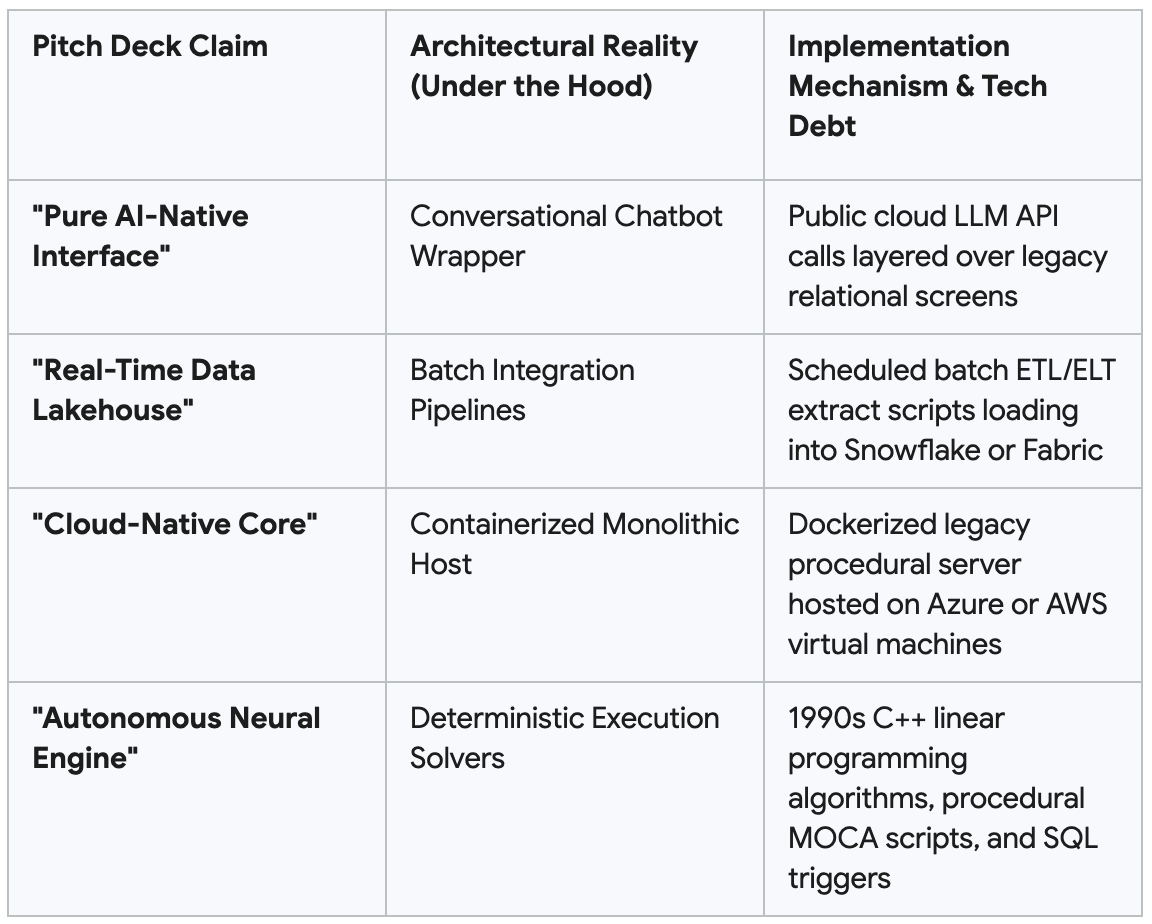
When you peel back the slick UI layers and look at the actual computational engine, what do you really find?
Take a close look at the historical genealogy of enterprise software. Over the last three decades, major industry leaders expanded their portfolios through aggressive mergers and acquisitions (M&A). They bought Manugistics for mathematical supply planning, acquired i2 Technologies for constraint-based factory scheduling, absorbed RedPrairie for high-throughput warehouse logistics, and acquired dozens of localized MES point solutions to manage plant-floor execution.
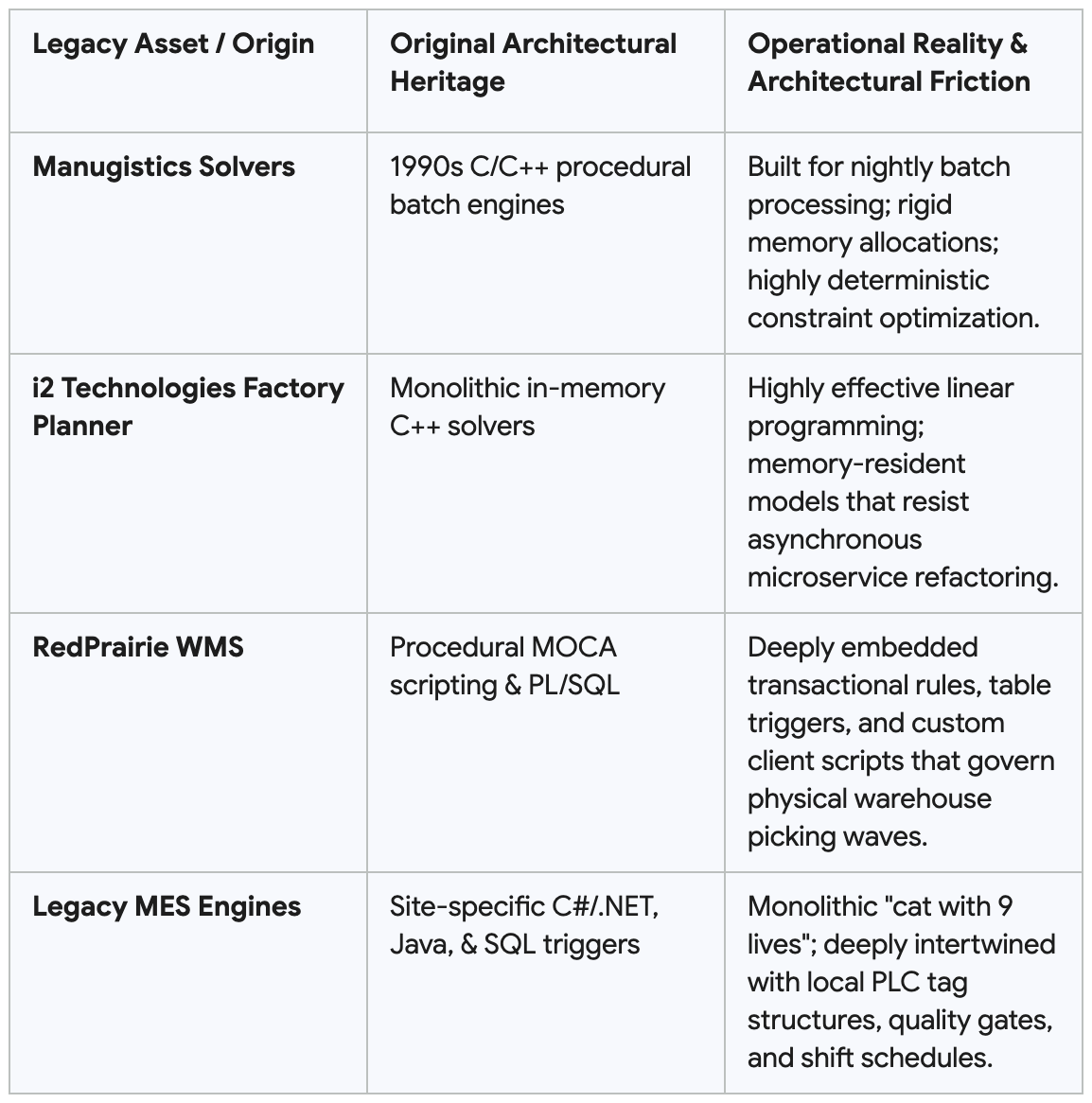
Did these software giants secretly burn tens of millions of lines of proven C++, PLC logic, and procedural execution code to rewrite their entire portfolios from scratch as pure neural networks? Of course not.
Doing so would have been commercial suicide, financially reckless, and an operational disaster for their enterprise clients. If a software vendor actually replaced a deterministic linear solver with a probabilistic neural network, your warehouse picking routes would hallucinate, supply chain constraints would dissolve, and safety interlocks would fail.
What pacesetting vendors are actually doing—and what we as industry analysts should be praising them for rather than letting them hide behind marketing buzzwords—is making an intelligent, pragmatic architectural trade-off.
Instead of undertaking a high-risk, multi-year "rip-and-replace" refactoring project that would break customer operations, software architects are encapsulating that legacy intellectual property into reusable, deterministic "Skills" for modern Agentic AI.
This directly mirrors the core discovery we highlight in our companion frontier analysis: in independent technical audits of GPT-6 Astra, researchers discovered that over 36 percentage points of its headline benchmark performance did not come from the raw neural model weights at all—they were generated entirely by an external software scaffolding harness.
In enterprise software, the exact same law applies: The scaffolding dominates the model. Real competitive differentiation does not come from renting generic foundation model weights from hyperscalers. It comes from your proprietary scaffolding—your Industrial Data Fabric, your semantic profiles, and your encapsulated domain solvers.
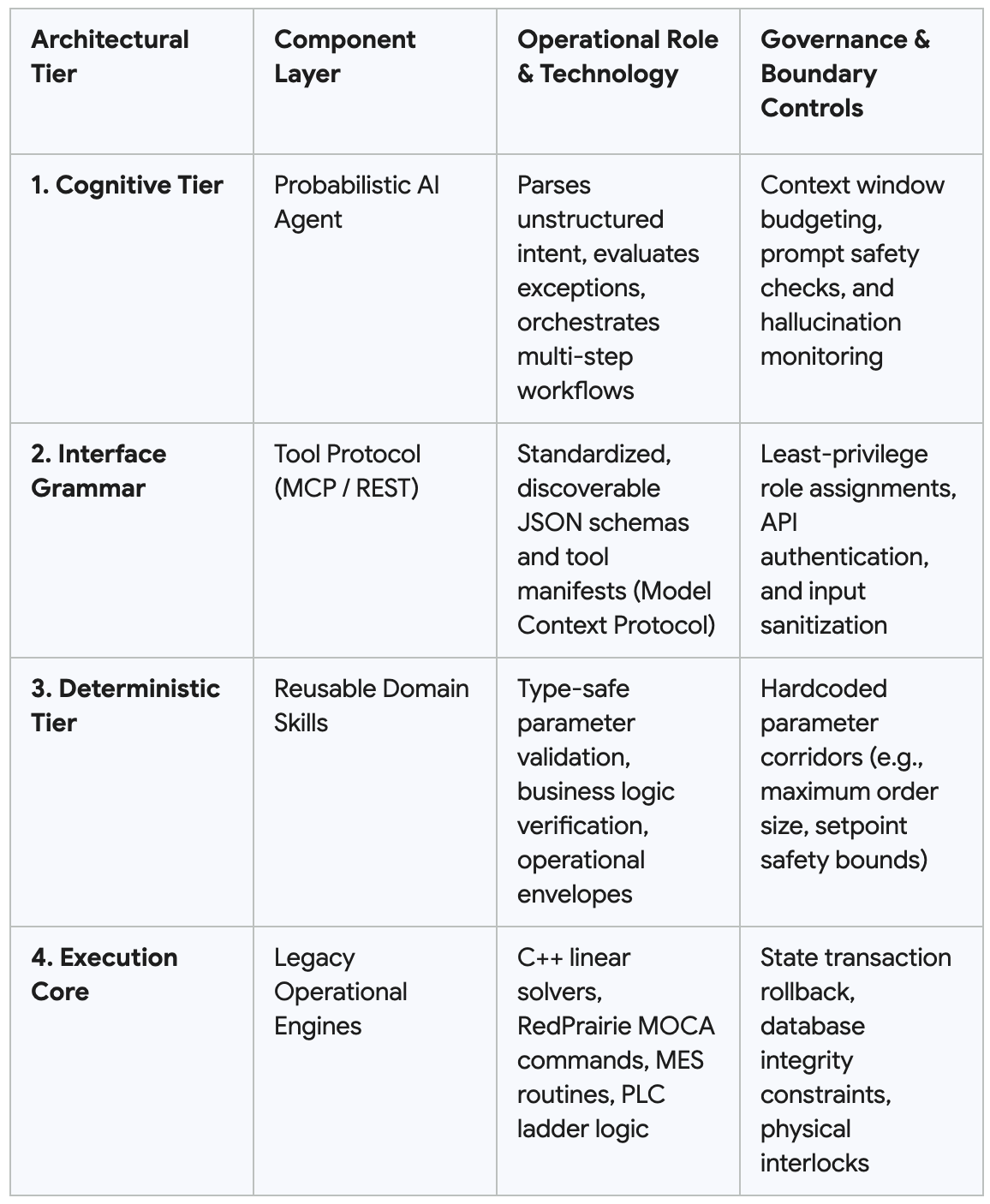
In a production-grade agentic architecture, a "Skill" is not a vague natural-language prompt. It is a strictly governed, type-safe block of encapsulated domain logic:
A Defined Interface: Standardized input/output schemas, explicit parameter boundaries, and role-based permissions.
A Deterministic Execution Path: Under the hood, the skill executes a battle-tested linear programming solver, an optimized C++ routing algorithm, an MES dispatch routine, or a validated MOCA warehouse command.
Safety and Governance Boundaries: Hard operational corridors that limit the scope of execution, preventing non-deterministic AI behavior from causing physical or financial havoc.
Domain Competence: A discrete, highly specialized operational capability—such as "Calculate dynamic safety stock under lead-time variance," "Re-wave picking zone B for urgent cross-docking," or "Validate pump discharge pressure against operational envelopes."
By placing an agentic orchestration layer above the deterministic execution engine, the platform lets probabilistic AI do what it does best: parse unstructured exceptions, reason over contextual anomalies, and communicate in natural language. When it comes time to execute a mathematical optimization or update a transactional database, the agent calls the legacy solver as a deterministic tool.
This reality check brings us to the central strategic question facing every enterprise CIO, COO, and VP of Supply Chain:
Should you actually care whether your software vendor is "AI Native," or should you care whether they possess thirty years of irreproducible domain IP wrapped in modern, governed agentic interfaces?
The answer is decisive: Domain depth beats algorithmic novelty every day of the week.
Over the next four installments in this master series, we will systematically dissect the architectural, domain, workforce, and governance dimensions of this shift:
Blog 2: Deconstructing the Stack: We will establish rigorous architectural definitions for "Cloud Native" vs. "AI Native" and deconstruct the modern 4-tier hybrid enterprise topology.
Blog 3: The Buyer’s Tri-Domain Dilemma: We will evaluate the buyer’s trade-offs across three distinct domains: Supply Chain, Factory Floor Operations (MES/SCADA/PLC), and Enterprise Core (ERP/CRM/EAM).
Blog 4: AI Skills vs. Human Skills: We will explore workforce transformation amid an unforgiving demographic cliff, the rise of the "Headless Enterprise," and the emergence of the "Synapse Worker."
Blog 5: Bounding the Brain: We will enforce ARC’s 4-Level Graduated Autonomy Framework, proving why domain expertise captured in code remains the ultimate enterprise advantage.
Before approving your next multi-million-dollar software renewal or AI platform expansion, put these four diagnostic questions to your vendor’s technical leadership:
The Codebase Audit: "Is your AI platform built on a newly compiled, ground-up neural codebase, or are you utilizing an agentic orchestration layer that invokes containerized procedural solvers, MES dispatch routines, and legacy execution scripts?"
The Skill Definition: "How exactly are your 'AI Skills' structured? Do they execute probabilistic code generated on the fly, or do they call deterministic, type-safe APIs bounded by hardcoded business rules?"
The Data Decoupling Reality: "Does your platform require migrating all our operational schemas into your proprietary cloud data store, or does it natively query our independent Industrial Data Fabric and living knowledge graphs?"
The Rollback Mechanism: "When an autonomous agent executes an optimization via your platform, what deterministic validation prevents that action from violating legacy physical, shop-floor, or transactional constraints?"
Now that we have stripped away the marketing fiction of "AI Native" software and validated the power of wrapping proven domain IP, we have to look candidly at infrastructure. What does the real enterprise technology stack look like when you connect legacy transaction engines to modern AI?
Up Next in Blog 2: "Deconstructing the Stack—What 'Cloud Native' and 'AI Native' Really Mean (And What They Don't)." We will establish engineering-grade definitions for the modern stack, examine the four tiers of the hybrid enterprise topology, and show how leading industrial firms are decoupling data without breaking operations. Stay tuned.
The Industrial AI (R)Evolution is moving faster than ever. To dive deeper into the frameworks and data shaping the future of the industrial sector, explore my latest research:
Navigating the AI Wars and the escalating Industrial Robot Wars
Closing the Digital Divide by Embracing Industrial AI
Assembling your Industrial-Grade Data Fabric
Charting the new frontier of Physical Intelligence and transitioning to a Cyber-Physical Industrial Architecture (CPIA)
Mapping your maturity and strategy with ARC's 3-Axis Industrial AI Models Taxonomy
Surviving the SaaSpocalypse and Taming the Tokenpocalypse by Mastering Multi-Agent Industrial Governance
Organizational Design and the Future of Industrial Work in the era of Agentic AI
Take our Industrial AI Assessment to benchmark your organization's maturity, identify critical gaps in your IT/OT/ET convergence, and get actionable recommendations to accelerate your path to becoming an Industrial AI Pacesetter (and download the 2026 Report). If you think you’re already a Pacesetter, nominate your team for the ARC Industrial Pacesetters Awards!
Don't guess what your global operations or prospective customers need. Use empirical data to align your stakeholders and de-hype the market with ARC Advisory Group's Voice of Market Service.
For tailored recommendations on governing and guiding major people, process, and technology decisions across the enterprise, cloud, industrial edge, and AI, please contact Colin Masson at [email protected].
Or, set up a meeting with my fellow Analysts and I at ARC Advisory Group to find out more about our Executive Insights Service for Industrial organizations and our Industrial AI Insights Service for Vendors.