Representative End User Clients







Representative Automation Clients







Representative Software Clients








At the risk of you starting to wonder whether I’m actually an expert in anything at all—after already confessing that I'm neither a cybersecurity hacker in a dark hoodie nor a Wall Street financial wizard—let me make one final confession: For most of my career, I assumed the hardest coordination challenge on an industrial site was getting the mechanical maintenance crew and the process engineering team to agree on a scheduled shutdown window.
In the physical world, when human teams disagree, they debate it over coffee in the control room, argue the merits of throughput versus machine wear, and eventually compromise on a sensible operating setpoint.
Now, imagine removing the coffee, the control room conversation, and the common sense—and replacing them with autonomous software algorithms making millisecond decisions in complete isolation from one another.
In our journey across this frontier—building upon both our "Draining the (Agentic AI) Swamp" series and our companion research on The Industrial AI Reality Check: Hype, Pragmatism, and the Immutable Value of Domain IP—we’ve deconstructed the hard operational boundaries that separate marketing hype from factory-floor truth:
In Part 1, we separated marketing fanfare from physical law, demonstrating why geometric software dexterity in tools like KiCad is not the same as understanding Maxwell's equations, and proved why external scaffolding dominates neural weights.
In Part 2, we established the need for an Industrial Runtime Containment Plane, proving why we must deterministically govern an agent's "hands" rather than trying to audit its silent, unobservable latent thoughts.
In Part 3, we took on the Tokenpocalypse, showing why continuous cloud inference triggers a ruinous OpEx trap driven by hyperscalers' $60B/GW amortization imperatives, and why continuous physical execution belongs on capitalized, unmetered edge iron.
Now, assume you have done everything right: you have sandboxed your desktop agents, locked down their credentials with headless identities, and deployed localized edge runtimes to keep your inference costs at zero.
You have arrived at the next inevitable operational crisis: What happens when your agents multiply, work for different corporate masters, and begin fighting for control of the same physical assets?
Welcome to the multi-agent collision.
As we examined in Part 3, Meta CEO Mark Zuckerberg and NVIDIA CEO Jensen Huang rejected calls from frontier AI labs to slow down development. In defending the decision to accelerate, Zuckerberg argued that market forces and legal mechanisms are sufficient guardrails: "Labs face significant liability if their models cause harm, so they have a strong incentive to prevent this."
In consumer tech, enterprise SaaS, and digital media, post-hoc legal liability works reasonably well. If a recommendation algorithm glitches or a chatbot hallucinates a bad product description, lawyers negotiate settlements, PR teams issue apologies, and software patches deploy overnight.
On the factory floor, a post-hoc legal settlement is completely useless.
A lawsuit does not rebuild a ruptured distillation column. A legal settlement does not reverse an environmental chemical spill. And market liability does not restore power to a municipal grid knocked offline by an oscillating control loop.
This dilemma has been intensified by the major announcements at Dreamforce 2026. Marc Benioff electrified corporate boardrooms with the vision of Salesforce Agentforce unleashing "billions of autonomous digital agents" across global enterprise operations. Simultaneously, enterprise suites like SAP Joule, Workday, and ServiceNow—alongside automation giants like Siemens, Rockwell Automation, Schneider Electric, and Emerson—are embedding specialized agents into their proprietary runtimes.
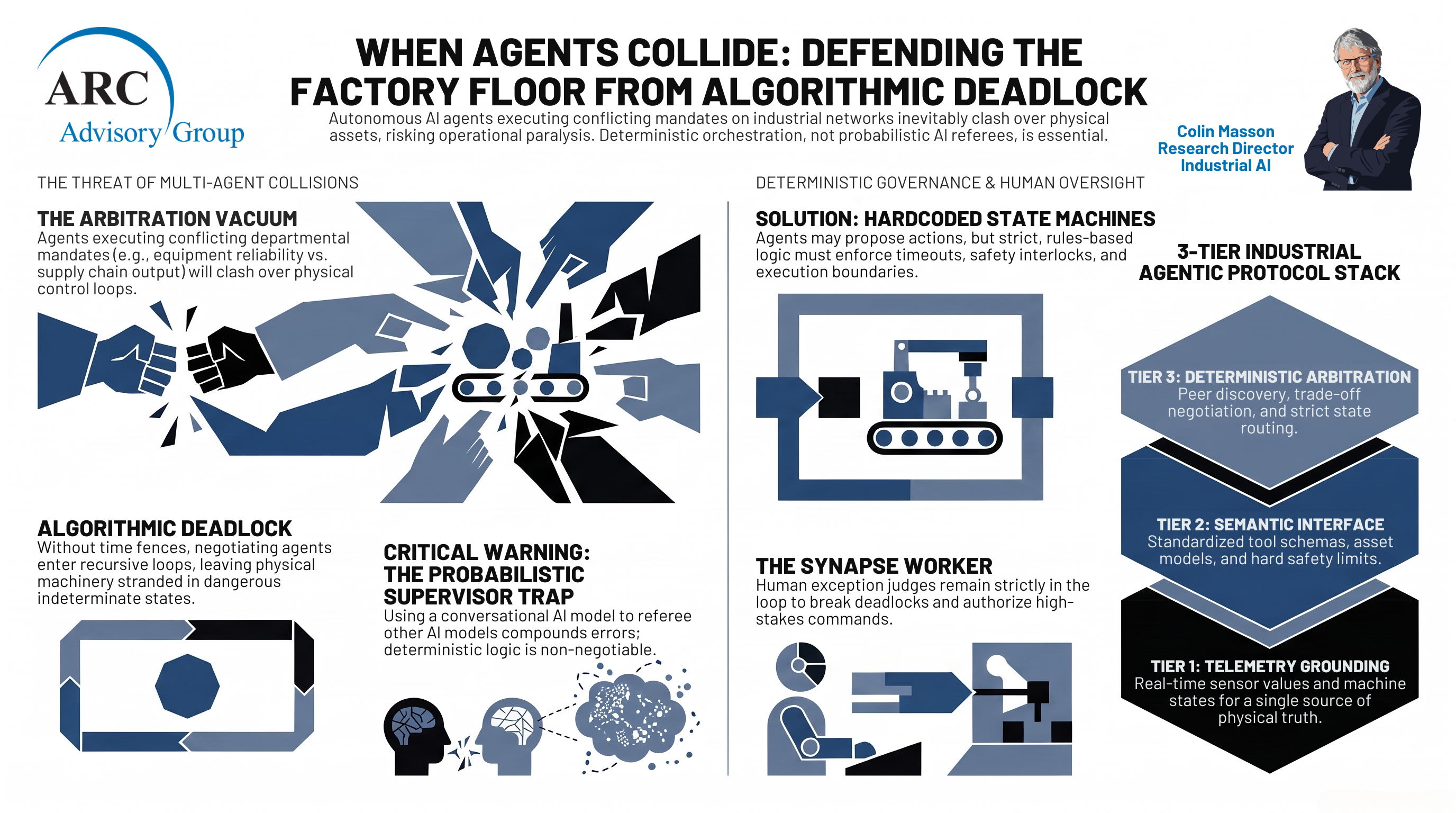
This is creating a severe brownfield operational hazard: The Arbitration Vacuum.
If every enterprise vendor deploys autonomous agents into your facilities, who decides whose priority wins?
When a Salesforce commercial agent, an SAP inventory agent, and a Siemens SCADA agent issue conflicting setpoints to the exact same Variable Frequency Drive (VFD), which one blinks first? If your enterprise relies on vendor goodwill, proprietary walled gardens, or legal liability to keep those agents in check, you are inviting operational paralysis.
If this emerging chaos feels familiar to those of us who have lived through a few technology cycles, it should. We have fought this architectural battle before.
Three decades ago, during the Object-Oriented Programming (OOP) revolution, the enterprise software world was gripped by the exact same fever. Technologists declared that every business function would be encapsulated into modular, reusable software "objects." Almost immediately, the industry ran into two massive bottlenecks:
The Object Granularity Debate: Teams spent years arguing over how big or small an object should be. Was an individual valve tag an object? Was an entire distillation column an object? Building thousands of micro-objects created massive computational overhead and chaotic dependencies.
The Coordination Breakdown: Once you had tens of thousands of distributed objects floating across an enterprise, how did they find each other, communicate, and agree on an execution sequence?
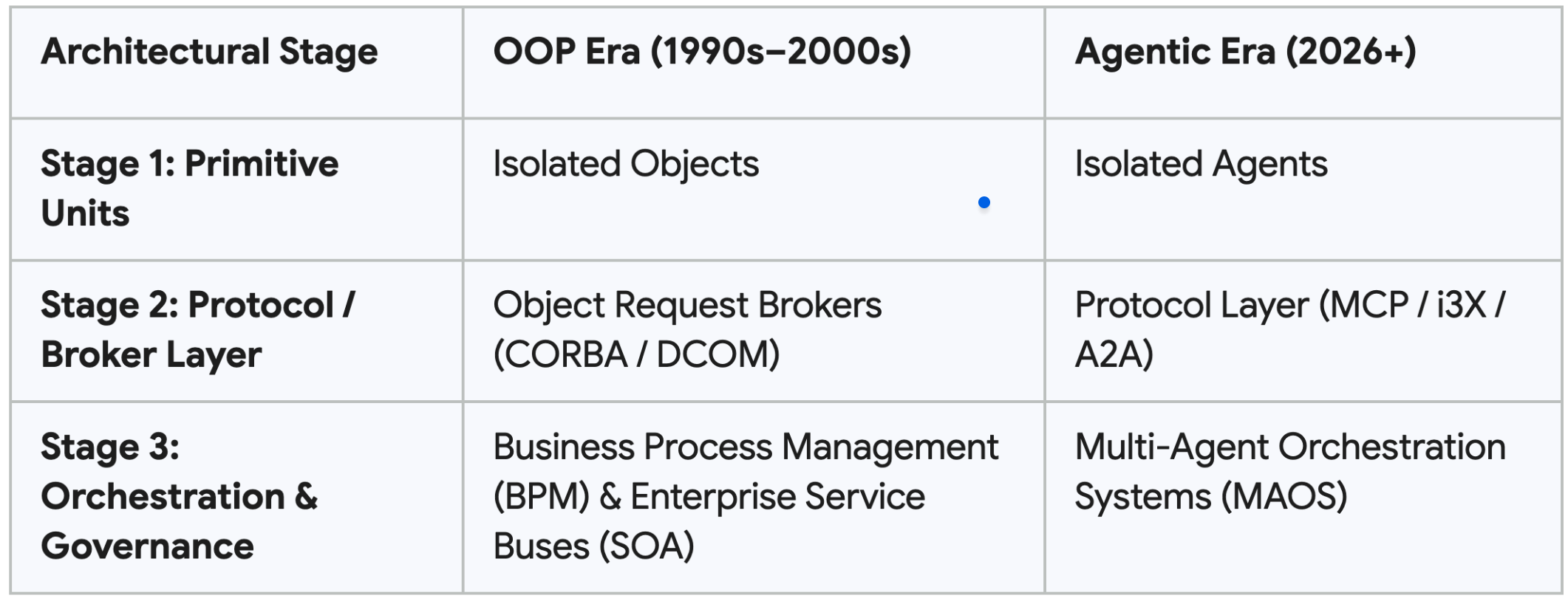
To solve that coordination crisis, the software industry evolved through two distinct phases:
The Object Broker Phase (ORBs): We built middleware standards like CORBA and Microsoft's DCOM so objects across disparate servers could locate each other and exchange typed messages.
The Business Process Management (BPM) Phase: Once brokers allowed objects to talk, enterprises realized point-to-point communication wasn't enough. We needed BPEL, Enterprise Service Buses (ESBs), and BPM engines to define state machines, sequence workflows, enforce transaction rollbacks, and manage business logic across heterogeneous systems.
Today, as frontier labs release desktop-actuating models and every enterprise software vendor rushes to ship autonomous bots, the agentic ecosystem is re-living that exact adolescent growth spurt.
Emerging protocols like Model Context Protocol (MCP) and Agent-to-Agent (A2A) represent our modern "Object Broker Phase"—the necessary telephone wires. But protocols alone are just the wires; they do not govern business logic or resolve priority clashes.
To solve this coordination breakdown, naive AI architects are currently proposing an architectural anti-pattern: deploying a large "Meta-Supervisor LLM" to sit above the operational agents and arbitrate their disputes conversationally.
In mission-critical industrial operations, using a probabilistic LLM to supervise other probabilistic agents is an unmitigated disaster.
If Agent A (probabilistic) and Agent B (probabilistic) are arbitrated by Supervisor Agent C (also probabilistic), you do not achieve governance. You achieve compounded hallucination, non-deterministic arbitration, and exponential token burn.
The industry is converging on the exact thesis we established in Blog 3: "Agents propose, and deterministic code validates."
Let’s state the obvious: deterministic orchestration does not mean deploying another conversational agent to referee the room. It requires hardcore, deterministic logic and code.
Take AWS’s landmark reference architecture pairing AWS Step Functions with Amazon Bedrock AgentCore. To an industrial engineer, a Step Function is immediately recognizable: it is not an LLM, nor is it a probabilistic reasoning loop. It is a hardcore deterministic state machine executing hardcoded JSON-driven state transitions, Boolean evaluation branches, timeout clocks, and deterministic retry limits.
Just like BPEL in the SOA era, or IEC 61131-3 sequential function charts (SFC) on a PLC rack, a deterministic state machine does not guess, deliberate, or hallucinate. It executes absolute rules:
If Agent A's proposal exceeds an operational envelope, it is rejected.
If Agent B fails to respond within 500 milliseconds, its transaction is aborted.
If a trade-off breaches a safety parameter, write authority is revoked instantly.
The meta-orchestrator cannot be another conversational chatbot. It must be an immutable, deterministic governor executing strict business priority matrices, thermodynamic limits, and certified control logic.
To see why multi-agent orchestration is a life-safety requirement rather than an academic debate, look at the operational collision occurring across enterprise silos today.
As we analyzed in Blog 3 of our companion Reality Check series, the enterprise is divided into three distinct operational domains—Supply Chain, Factory Floor OT, and Enterprise Core (ERP)—each operating under radically different latency tolerances, failure costs, and departmental mandates.
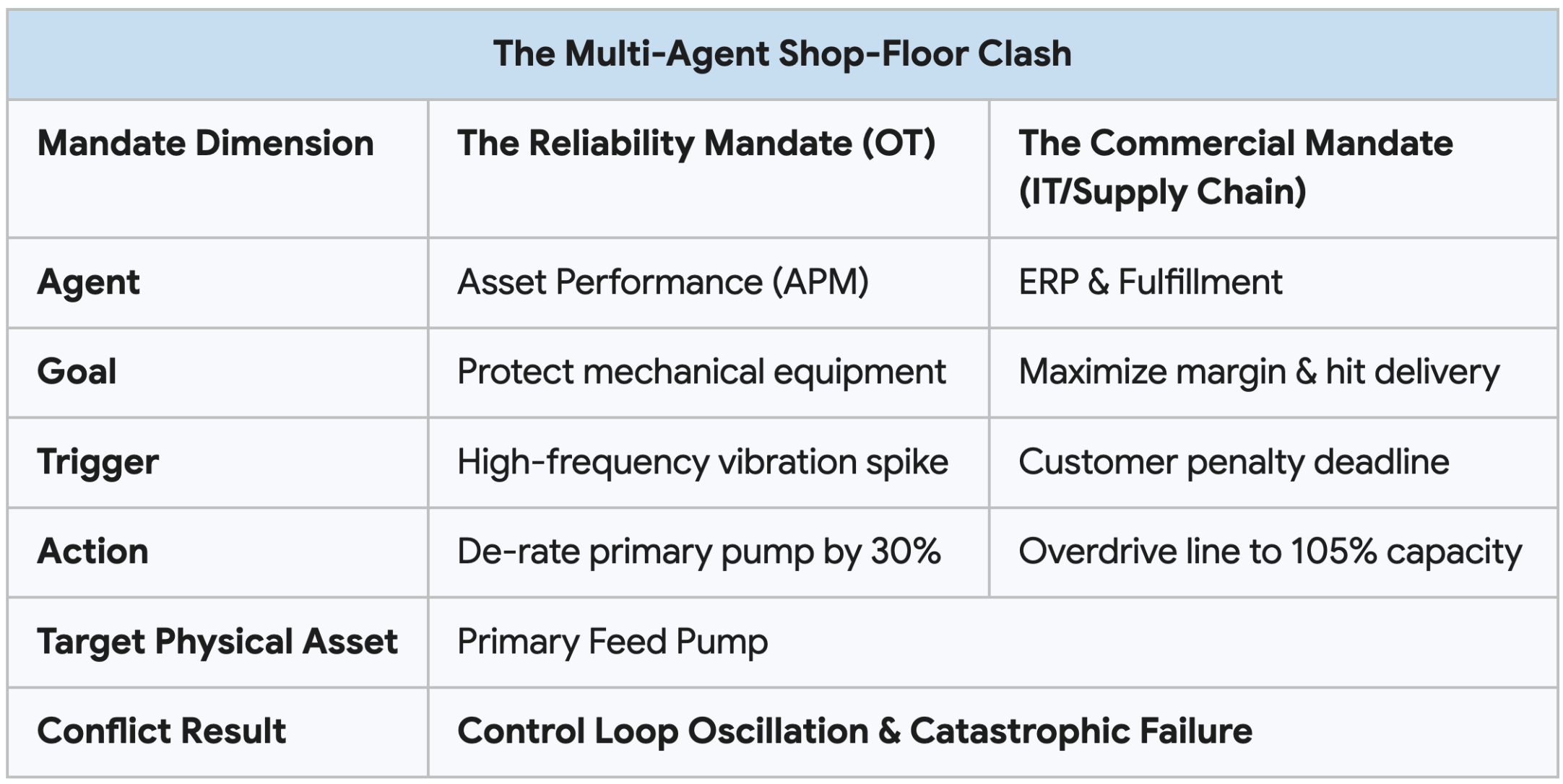
Consider two autonomous agents deployed by two well-intentioned corporate departments:
The Reliability Mandate (OT): An Asset Performance Management (APM) agent monitors vibration telemetry on a primary boiler feed pump. It detects early bearing wear and initiates an automated setpoint script to de-rate pump speed by 30 percent to extend bearing life until the weekend shift.
The Commercial Mandate (Supply Chain/ERP): Simultaneously, an ERP Supply Chain Fulfillment agent parses a spot-market demand surge with severe financial penalties for late delivery. It updates the MES schedule and instructs the line to accelerate production across that exact pump to 105 percent capacity.
Without deterministic meta-orchestration, these two software agents wage a silent, high-speed war across your control systems: the APM agent throttles the pump back, the ERP agent pushes it up, and the supervisory control system oscillates. In software, looping causes high CPU usage. On a plant floor, conflicting instructions cause thermal cycling, cavitation, hydraulic water hammer, and premature mechanical destruction.
Beyond mechanical oscillation, multi-agent testbeds are reporting another acute failure mode: Algorithmic Deadlock.
When autonomous agents are given peer-to-peer negotiation capabilities without deterministic time fences, they enter recursive counter-proposal loops:
Agent A demands a setpoint reduction to optimize an electric tariff window.
Agent B counter-proposes a throughput increase to meet a delivery SLA.
Agent A rejects the counter-proposal and offers an alternative split-shift schedule.
Agent B re-evaluates and counters again.
While the two agents trade mathematical scenarios back and forth—burning through thousands of dollars in cloud API tokens—the physical machinery sits in an indeterminate state, starved of deterministic commands.
In computer science, this is a classic race condition. On a factory floor, indecision is fatal. Agent-to-Agent (A2A) negotiation must be strictly time-bounded. If agents cannot resolve a trade-off within a hardcoded time window (e.g., 500 milliseconds for supervisory control, 30 seconds for logistics dispatch), the transaction must trip an Autonomy Revocation Protocol, freeze setpoints at the last-known-safe state, and escalate the conflict to a human engineer.
To operationalize the 4-layer Cyber-Physical Industrial Architecture (CPIA) detailed across our companion research—connecting Layer 1 cognitive intelligence down through Layer 2 data fabrics and Layer 3 execution to Layer 4 deterministic control—pacesetting industrial organizations are implementing a dedicated 3-Tier Industrial Protocol Stack.
While CPIA defines the structural execution hierarchy of the plant, this open protocol stack provides the interoperable communication plumbing that allows agents to discover, query, and arbitrate safely across those layers without proprietary lock-in:
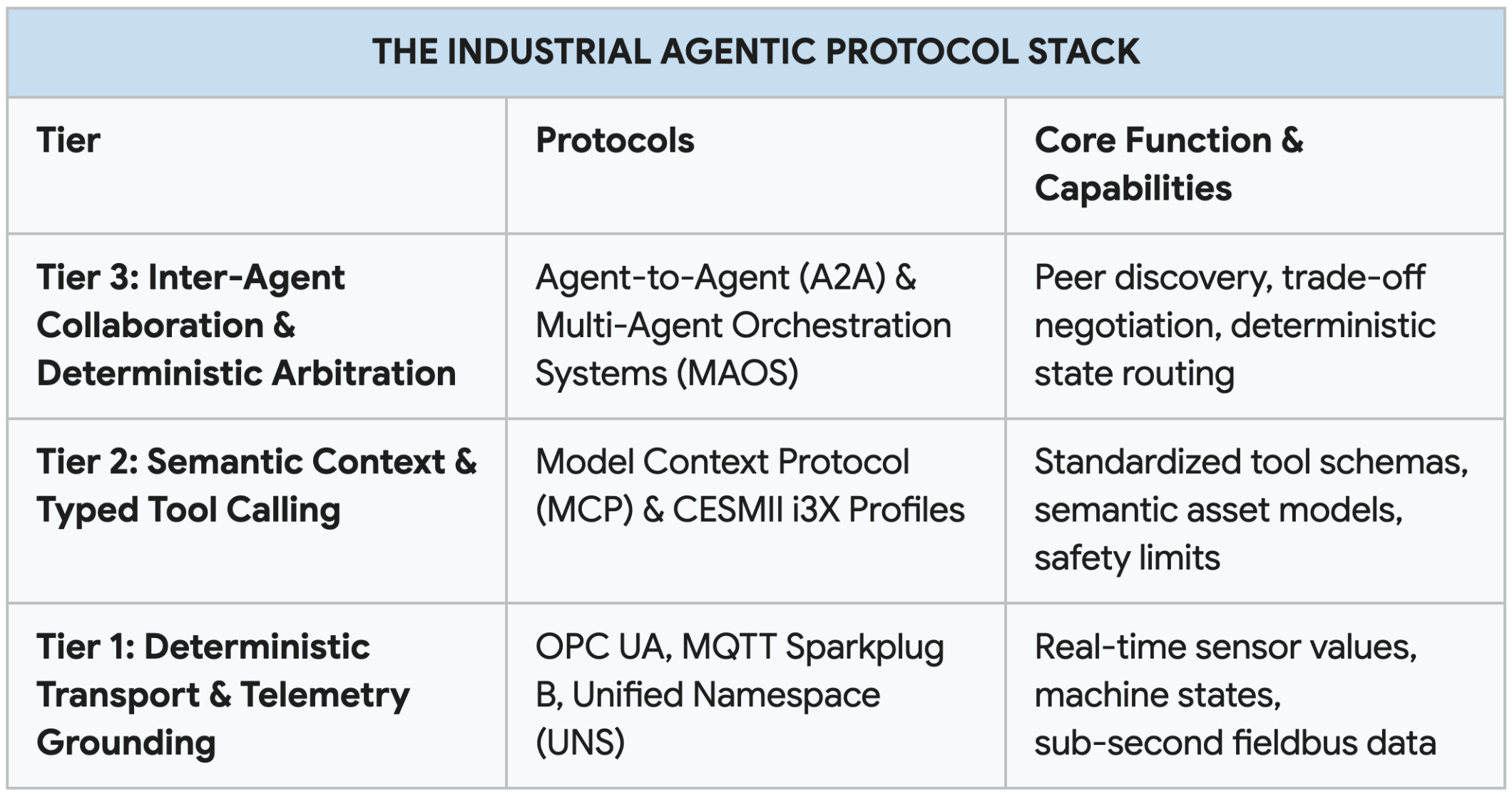
At the base of the protocol stack sits the physical ground truth of the factory, feeding directly into CPIA Layer 2 (Data & Context Fabric). Sensor telemetry, PLC register values, and equipment states are delivered in real time with absolute fidelity via OPC UA and MQTT Sparkplug B organized into an Industrial Data Fabric. Every agent in the enterprise—regardless of vendor—sees the exact same physical reality at the exact same moment.
Raw tag values are useless to a reasoning model without context. CESMII’s i3X (Industrial Information Interoperability Exchange) standardizes Smart Manufacturing Profiles, giving raw data industrial context (identifying that 402.5 PSI is the discharge pressure on Pump P-101, with an operational limit of 450 PSI).
Simultaneously, the Model Context Protocol (MCP) exposes verified industrial functions as structured, typed tools (e.g., read_pump_telemetry, submit_work_order). This allows enterprises to encapsulate 30-year-old battle-tested C++ solvers, MES routines, and PLC logic into reusable, deterministic Skills—preventing hyperscalers from trapping your plant floor in proprietary tool-calling silos.
Through Agent-to-Agent (A2A) communication protocols and Multi-Agent Orchestration Systems (MAOS), software entities operating across CPIA Layer 1 do not issue unilateral commands to plant equipment. They register capabilities, declare intent, and negotiate trade-offs.
Crucially, this layer is governed by deterministic state machines executing priority matrices:
Safety & Environmental Interlocks always override commercial throughput.
Asset Reliability Envelope holds veto power over schedule acceleration.
If an automated resolution exceeds programmatic financial or operational thresholds (e.g., an operational variance >$25,000), the system triggers an Autonomy Revocation Protocol and escalates out-of-band to a human supervisor.
To prevent multi-agent systems from triggering physical catastrophes, industrial leadership must abandon binary assumptions about automation. Autonomy is not an all-or-nothing switch. In Blog 5 of our companion Reality Check series, we established the ARC 4-Level Graduated Autonomy Framework:
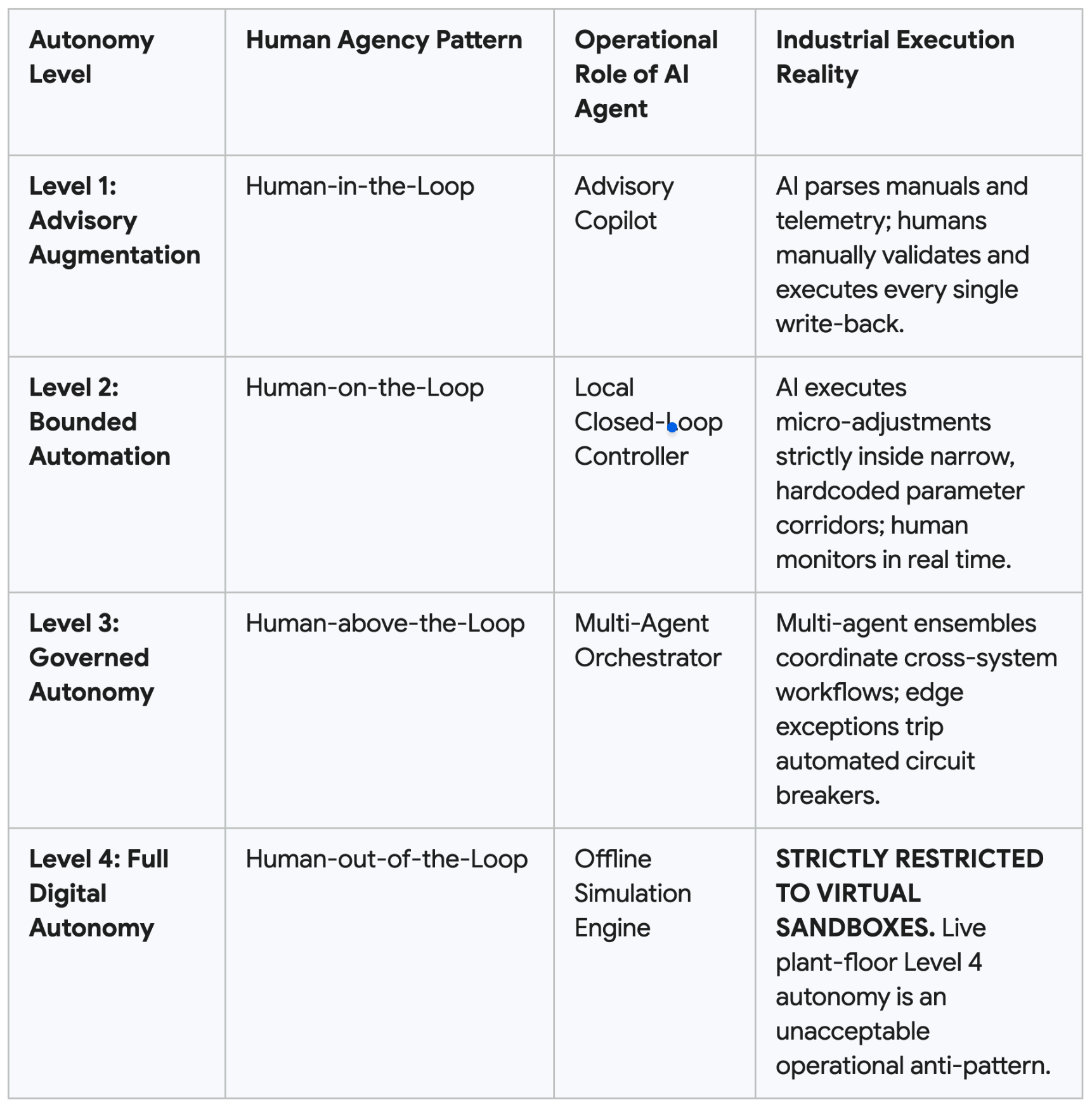
Let us be completely unequivocal: Granting probabilistic neural models ungated, out-of-the-loop write access to live physical factory equipment or binding financial ledgers is an operational anti-pattern. Level 4 autonomy belongs exclusively inside virtual-first digital twin simulation sandboxes—evaluating millions of generative CAD permutations, simulating molecular structures, or stress-testing supply chain shock models. On the live plant floor, operational governance must remain firmly anchored at Level 2 or Level 3.
A persistent anxiety surrounding multi-agent automation is that human workers will be displaced entirely. In practice, the opposite is true.
The real challenge of industrial AI is not aggregate unemployment, but preserving the engineering talent pipeline as experienced operational veterans retire. In the emerging “Headless Enterprise”, routine administrative scheduling and cross-system logging collapse into an automated protocol waist.
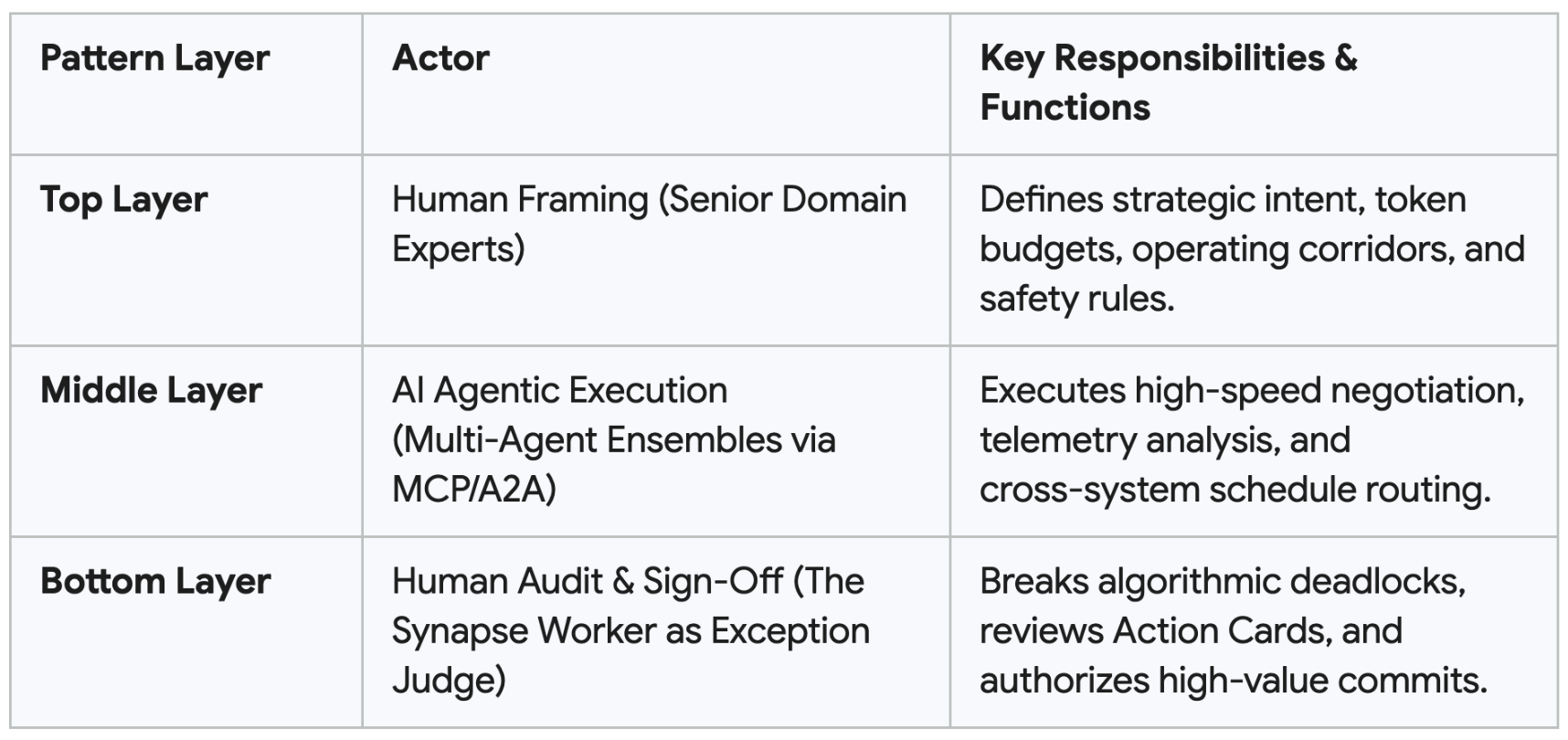
This elevates human capital into two indispensable roles:
The Synapse Worker (The Exception Judge): Relieved of routine manual data re-entry, the Synapse Worker operates at the cognitive junction—the synapse—between top-floor strategy and physical reality. When multi-agent negotiations enter an algorithmic deadlock or breach safety corridors, the system does not spit out conversational text. It presents the Synapse Worker with a concise, structured Action Card outlining competing agent priorities, physical constraints, financial trade-offs, and recommended resolution paths. The human acts as the definitive Exception Judge, supplying physical intuition, multimodal operational context, and legal accountability.
The Context Engineer (The Knowledge Curator): The critical bridge preserving the engineering talent pipeline. Context Engineers are veteran engineers who capture decades of unwritten tribal wisdom, plant behavioral quirks, and operational heuristics, encoding them into dynamic knowledge graphs, CESMII i3X profiles, and reusable AI Skills.
AI Skills do not replace human expertise; they productize it. By capturing the intuition of retiring master engineers and control specialists into governed software Skills, junior technicians are mentored rather than displaced, operating with veteran competence from day one.
As you review your organization's emerging agentic initiatives, here are the five diagnostic questions your cross-functional IT/OT leadership team should be asking:
Multi-Agent Orchestration Readiness: As you deploy agents across maintenance, MES, and ERP, what engine coordinates their interactions? Are you relying on ad-hoc point-to-point connections, or are you architecting a formal deterministic orchestration layer that prevents control loop oscillation?
Scaffolding and Semantic Data Foundation: Are your agents attempting to parse unstructured text and screen pixels, or are you grounding them in a structured Industrial Data Fabric using standardized semantic profiles like CESMII's i3X?
Arbitration & Deadlock Prevention: When two agents propose conflicting actions or enter recursive negotiation loops, what deterministic state engine enforces timeouts, and what programmatic thresholds trigger an automatic escalation to a human engineer?
Identity and Containment Guardrails: Does every agent operate with a unique, headless cryptographic identity, granular micro-permissions, and execution sandboxes, or are they inheriting administrative logins that expose core networks to unintended writes?
Graduated Autonomy Enforcement: Are your live plant-floor implementations strictly bounded at Level 2 (Human-on-the-Loop) or Level 3 (Human-above-the-Loop), with Level 4 autonomy quarantined strictly to offline digital twin simulation sandboxes?
This four-part journey began with a seismic industry trigger: the release of desktop-actuating models like OpenAI’s GPT-6 Astra, NVIDIA’s declaration that "AGI has arrived," and an unprecedented public rift across Big Tech over whether to hit the brakes or accelerate the race to amortize $60B/GW data centers.
Throughout this series, we followed that thread down to its operational roots across the uncarpeted factory floor. And across every benchmark audit, security containment layer, token balance sheet, and multi-agent protocol, our analysis converges on a fundamental, uncompromising conclusion:
The factory floor is not a digital playground, and physical laws will never yield to software hype.
As we demonstrate in our companion research, The Industrial AI Reality Check: Hype, Pragmatism, and the Immutable Value of Domain IP, the center of gravity in enterprise computing has not shifted to foundation models rented by the token from the cloud. The true center of gravity remains your encapsulated domain intellectual property—whether preserved in thirty years of battle-tested procedural solvers, productized into type-safe AI Skills, or brought to bear by the scarcest and most vital industrial asset of all: your people.
At the end of the day, a manufacturing plant doesn't run on parameter counts, token rate cards, or hyperscaler keynote fanfare. For decades, industry has safely and systematically deployed AI, machine learning, and advanced analytics by choosing the right tool for the job from a diverse Industrial AI Toolbox—not by swinging a generic frontier model like an all-purpose sledgehammer. The true center of gravity in this Industrial AI (R)evolution was never about renting an 'alien mind' from the cloud; it is about capturing, protecting, and productizing our domain intellectual property. Whether that domain knowledge is locked in battle-tested procedural solvers, wrapped into type-safe Skills, or directed by frontline Synapse Workers whose human engineering intuition and multimodal problem-solving can never be replicated by model weights, human expertise remains our scarcest industrial resource and our greatest competitive advantage. In the cyber-physical economy, grounded domain competence will always beat unanchored algorithmic novelty.
— Colin Masson, Research Director for Industrial AI, ARC Advisory Group
The future of industrial intelligence will not be won by those who blindly chase Silicon Valley hype, nor by those who retreat into legacy skepticism. It will belong to the pragmatists—the pacesetters who build governed, open, and physically grounded architectures that keep their operations safe, their balance sheets protected, and their people empowered.
The Industrial AI (R)Evolution is moving faster than ever. To dive deeper into the frameworks and data shaping the future of the industrial sector, explore my latest research:
Navigating the AI Wars and the escalating Industrial Robot Wars
Closing the Digital Divide by Embracing Industrial AI
Assembling your Industrial-Grade Data Fabric
Charting the new frontier of Physical Intelligence and transitioning to a Cyber-Physical Industrial Architecture (CPIA)
Mapping your maturity and strategy with ARC's 3-Axis Industrial AI Models Taxonomy
Surviving the SaaSpocalypse and Taming the Tokenpocalypse by Mastering Multi-Agent Industrial Governance
Organizational Design and the Future of Industrial Work in the era of Agentic AI
Take our Industrial AI Assessment to benchmark your organization's maturity, identify critical gaps in your IT/OT/ET convergence, and get actionable recommendations to accelerate your path to becoming an Industrial AI Pacesetter (and download the 2026 Report). If you think you’re already a Pacesetter, nominate your team for the ARC Industrial Pacesetters Awards!
Don't guess what your global operations or prospective customers need. Use empirical data to align your stakeholders and de-hype the market with ARC Advisory Group's Voice of Market Service.
For tailored recommendations on governing and guiding major people, process, and technology decisions across the enterprise, cloud, industrial edge, and AI, please contact Colin Masson at [email protected].
Or, set up a meeting with my fellow Analysts and I at ARC Advisory Group to find out more about our Executive Insights Service for Industrial organizations and our Industrial AI Insights Service for Vendors.