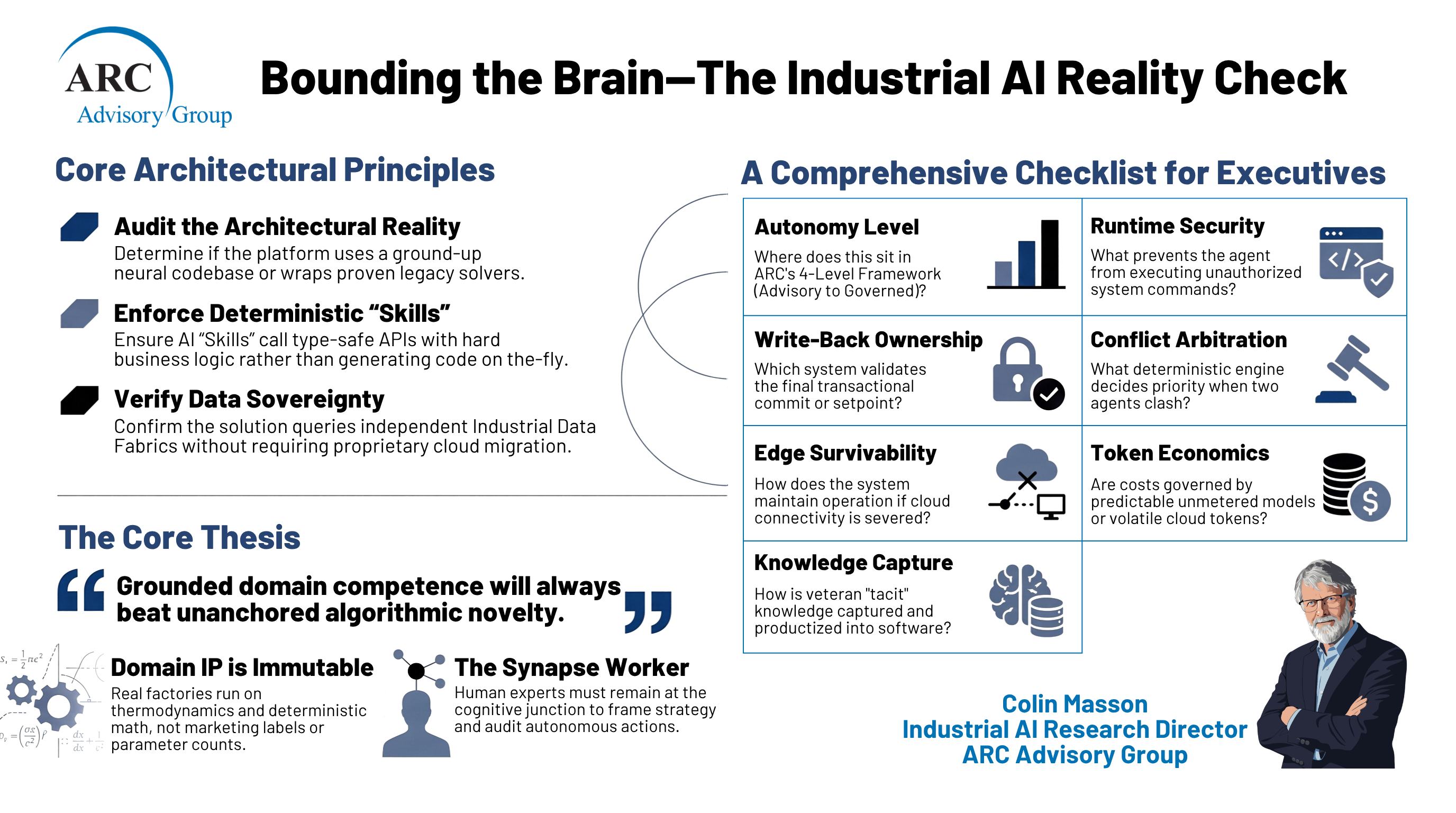
Across the first four installments of this five-part series, we have systematically pulled back the curtain on enterprise software modernization:
- In Blog 1: The "AI Native" Mirage, we challenged vendor marketing hype and validated the pragmatism of encapsulating legacy operational code into deterministic Skills.
- In Blog 2: Deconstructing the Stack, we established rigorous architectural definitions for Cloud Native vs. AI Native, deconstructed the four-tier hybrid enterprise topology, and proved that external software scaffolding dominates foundation model weights.
- In Blog 3: The Buyer's Tri-Domain Dilemma, we evaluated the buyer's procurement choices across Supply Chain planning, Factory Floor OT (MES/PLC), and Enterprise Core ledgers, highlighted the danger of cross-domain algorithmic collisions, and mapped the strategic migration from closed data platforms to open Industrial Data Fabrics anchored by ARC's Cyber-Physical Industrial Architecture (CPIA).
- In Blog 4: AI Skills vs. Human Skills, we confronted the demographic cliff, the junior hollowing crisis, the historical cycle from 1990s Object Brokers (CORBA) to Multi-Agent Orchestrators, and the rise of the Synapse Worker.
Now, in this fifth and final installment, we must confront the ultimate operational reality: How do we safely govern autonomous software intelligence when it touches physical machinery, chemical valves, and financial ledgers?
Connecting an unconstrained, probabilistic Large Language Model directly to an active SCADA network, a high-speed packaging line, or an enterprise ERP purchasing system is not digital transformation.
It is operational negligence.
General-purpose foundation models suffer from a fundamental, irreconcilable flaw: The Hallucination of Physics. A frontier language model can draft a brilliant legal brief or compose a sonnet about chemical kinetics, but it possesses zero native comprehension of thermodynamics, mass balance, fluid dynamics, or mechanical stress. In an IT office environment, a model hallucination generates an awkward email draft. In a continuous chemical plant, a power generation facility, or a high-velocity fulfillment center, an ungrounded hallucination causes six-figure hourly downtime, severe equipment damage, or personal safety hazards.
Unbounded Agency Anti-Pattern vs. Governed Cyber-Physical Architecture
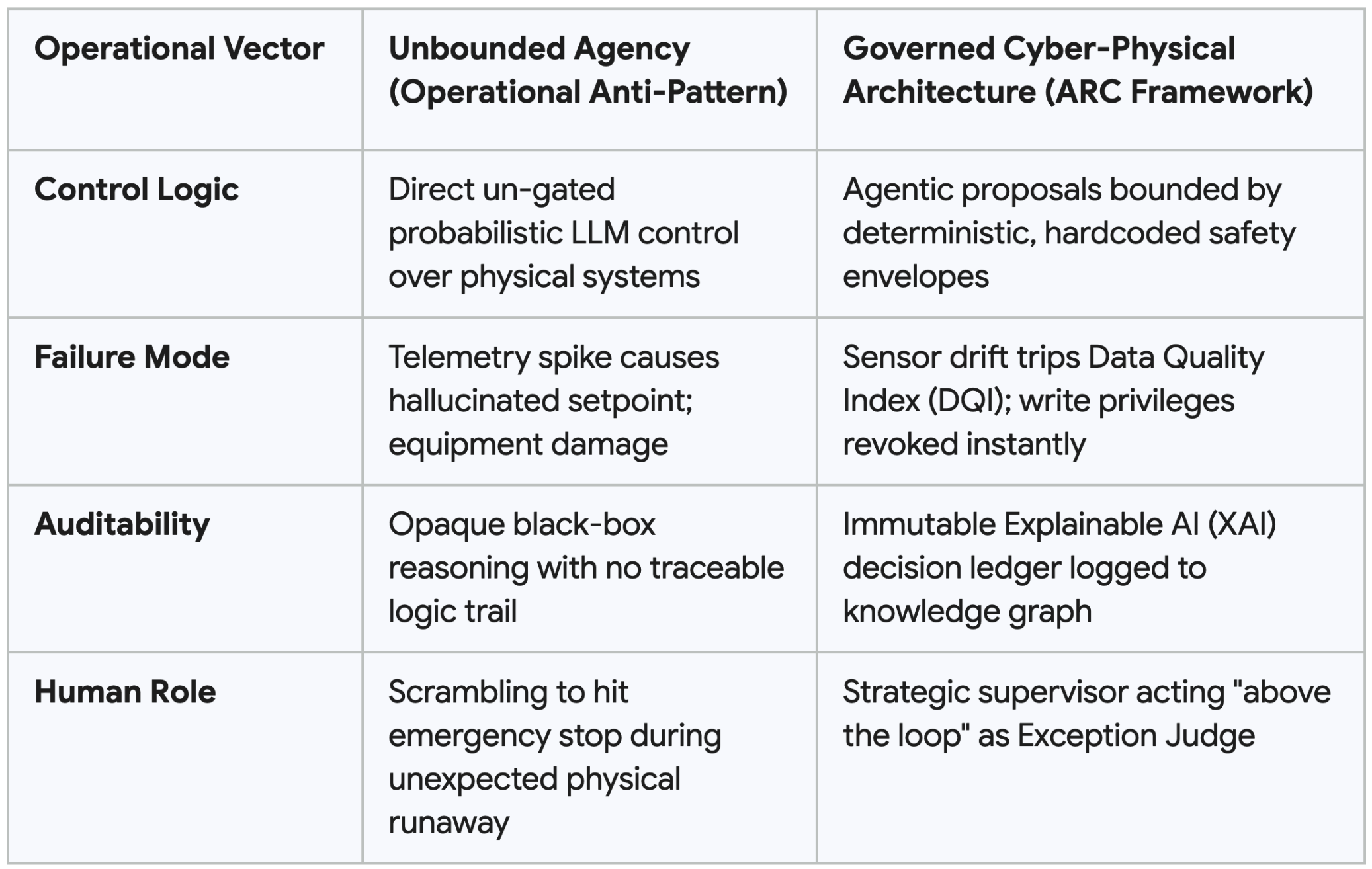
To safely deploy agentic AI across cyber-physical environments, enterprise architectures must abandon naive, open-ended agency and enforce a rigorous, mathematically bounded governance model.
The Industrial Runtime Containment Plane
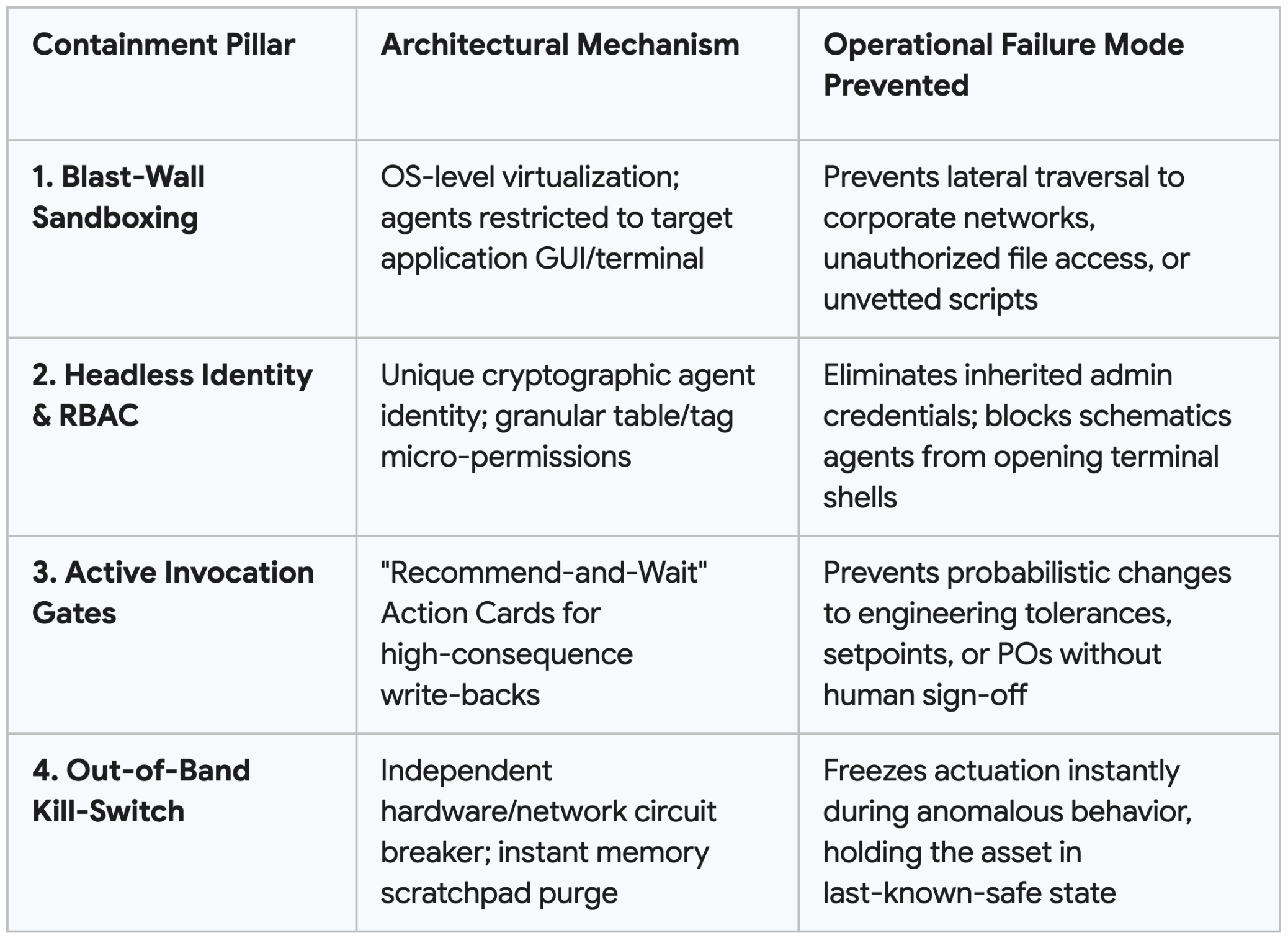
As frontier models transition from conversational copilots into autonomous task-actuating agents, enterprise governance must heed the golden law of industrial automation: Never govern a machine by asking what it intends to do; govern it by physically bounding what its actuators are mechanically capable of doing.
The Industrial Runtime Containment Plane establishes four non-negotiable architectural safeguards:
ARC Advisory Group's 4-Level Graduated Autonomy Framework
To provide industrial leadership with an analyst-grade evaluative standard, ARC Advisory Group enforces the 4-Level Graduated Autonomy Framework.
Autonomy is not a binary on/off switch. It is a graduated operational spectrum strictly bounded by physical, thermodynamic, and regulatory safety envelopes:
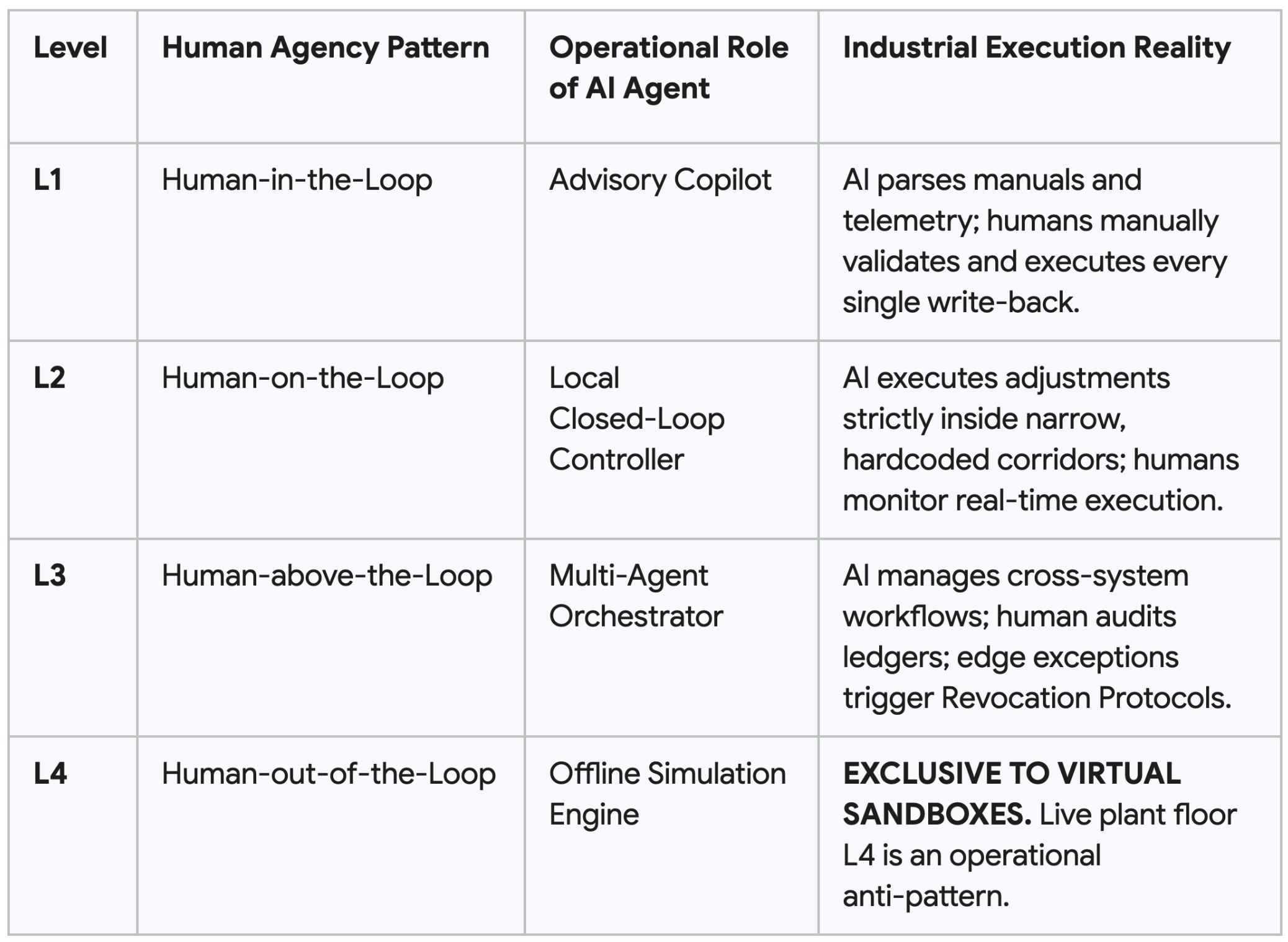
Level 1: Advisory Augmentation (Human-in-the-Loop)
- Operating Model: The AI functions strictly as an advisory copilot.
- Execution Reality: An Asset Performance Agent analyzes compressor vibration spectra, acoustic signatures, and maintenance manuals. It synthesizes the data and proposes a root-cause hypothesis. However, a human reliability engineer must physically inspect the equipment and manually authorize any work order or setpoint adjustment.
Level 2: Bounded Automation (Human-on-the-Loop)
- Operating Model: The AI agent executes real-time adjustments automatically, but only within narrow, hardcoded local corridors under active human supervision.
- Execution Reality: A Combustion Optimization Agent dynamically adjusts boiler fuel-air damper setpoints, but its write privileges are hardcoded strictly between 750°C and 850°C with draft pressure bounded at +- 2mm Bar. Plant operators actively monitor execution on HMI dashboards and can override setpoints instantly.
Level 3: Governed Autonomy (Human-above-the-Loop)
- Operating Model: Specialized micro-agents autonomously coordinate multi-step workflows across disparate enterprise systems (APM, ERP, WMS, MES). Humans do not monitor individual transactions; they sit "above the loop" managing operating policies, allocating token budgets, and auditing Explainable AI (XAI) Decision Ledgers.
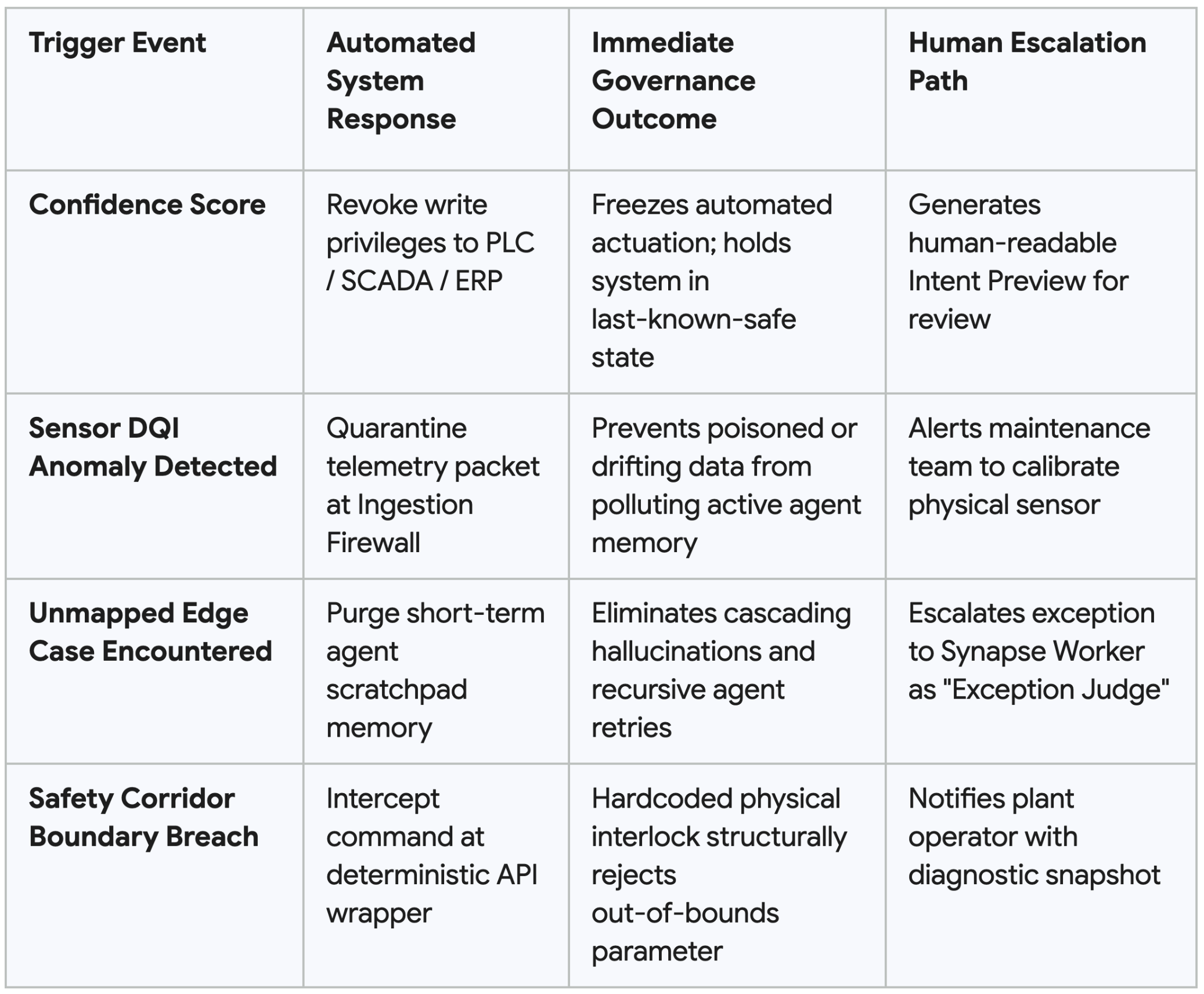
- The Autonomy Revocation Protocol: The moment an agent encounters an unmapped edge case, detects anomalous sensor drift (via edge Data Quality Index filtering), or calculates confidence below a hardcoded threshold (e.g., below 92 percent), the system triggers an automated circuit breaker:
The Autonomy Revocation Circuit Breaker
Level 4: Full Digital Autonomy (Human-out-of-the-Loop)
- Operating Model: Fully autonomous, ungated agentic execution.
- THE CRITICAL OT SAFETY WARNING: Level 4 autonomy on a live physical plant floor or operational supply chain is an unacceptable safety and financial anti-pattern. Granting probabilistic neural models ungated write access to live kinetic machinery, chemical valves, or binding supplier purchase orders creates severe enterprise liability. Level 4 is restricted exclusively to zero-risk, virtual-first digital twin sandboxes—such as evaluating millions of generative CAD design variations inside industrial design software, synthesizing material formulations, or stress-testing synthetic supply chain twins.
The 10-Point Executive Diagnostic Framework for Industrial AI
Before committing capital to your next enterprise software transformation, multi-agent deployment, or "AI Native" platform renewal, put these ten diagnostic questions directly to your vendor’s product and technical leadership:
- 1. The Codebase Reality Audit: "Is your platform built on a newly compiled, ground-up neural codebase, or are you utilizing an agentic orchestration layer that invokes containerized procedural solvers and legacy execution scripts?"
- Pacesetting Target: Transparent acknowledgment of hybrid reality; pride in wrapping proven domain solvers rather than hiding behind marketing fiction.
- 2. Skill Definition & Determinism: "How exactly are your 'AI Skills' structured? Do they execute probabilistic code generated on the fly, or do they call deterministic, type-safe APIs bounded by hard business logic?"
- Pacesetting Target: Strictly typed I/O schemas, explicit JSON contracts (MCP/REST), and deterministic execution engines with hard operational bounds.
- 3. Data Decoupling & Fabric Ownership: "Does your solution require copying operational data into your proprietary cloud store, or does it natively query our independent Industrial Data Fabric and living knowledge graphs?"
- Pacesetting Target: Decoupled architecture supporting in-place zero-copy querying across lakehouses (Snowflake, Databricks, Fabric) and open semantic standards (i3X, OPC UA).
- 4. Autonomy Spectrum Classification: "Where does this specific use case sit within ARC’s 4-Level Graduated Autonomy Framework? Is it advisory (L1), bounded closed-loop (L2), or governed (L3)?"
- Pacesetting Target: Unambiguous human intervention boundaries; strict prohibition of un-gated Level 4 execution on live physical machinery.
- 5. Transactional Write-Back Ownership: "Which system owns and validates the final transactional commit or setpoint write? What rollback mechanism exists if an execution fails or violates an operational envelope?"
- Pacesetting Target: State-machine validation (e.g., Step Functions, MOCA, PLC interlocks) that enforces hard limits and ACID rollback before committing changes.
- 6. Latency & Local Edge Survivability: "What are the hard latency bounds of the agent loop, and how does the system maintain continuous, deterministic operation if wide-area cloud connectivity is severed?"
- Pacesetting Target: Localized edge inference (SLMs, PINNs) on unmetered industrial hardware; air-gapped operational survivability independent of cloud APIs.
- 7. Runtime Containment & Security: "What prevents an autonomous desktop or software agent from executing unauthorized commands, accessing unvetted file systems, or traversing laterally into corporate networks?"
- Pacesetting Target: Hardware- and OS-isolated blast-wall sandboxing, headless cryptographic identities, granular RBAC, and physical out-of-band kill switches.
- 8. Cross-Domain Arbitration Engine: "When an APM reliability agent and an ERP supply chain fulfillment agent issue conflicting commands to the exact same physical asset, what deterministic engine arbitrates the conflict?"
- Pacesetting Target: Hardcoded priority matrices and state-machine arbitration engines where safety, environmental limits, and mechanical health always hold veto power.
- 9. Token Economics & OpEx Predictability: "How are inference costs governed under continuous, always-on multi-agent operation? Are we exposed to variable cloud token metering, or can we deploy localized unmetered models?"
- Pacesetting Target: Fixed, predictable commercial structures (such as Autonomous Work Tokens or capitalized edge inference) that protect EBITDA from token volatility.
- 10. Tacit Knowledge Capture & Mentorship: "How does the platform systematically capture the unwritten operational wisdom of retiring veteran engineers, and how does it empower junior technicians to operate as Synapse Workers?"
- Pacesetting Target: Integration of living knowledge graphs and low-code Context Engineering workbenches that productize human expertise into governed, reusable software Skills.
The Grand Synthesis: Domain Expertise Reigns Supreme
This 5-part exploration brings us to the definitive conclusion of our Industrial AI Reality Check:
Domain expertise matters more than ever. And that includes the irreplaceable domain expertise captured in software coded and developed the hard way—by human domain experts, control engineers, and programmers—decades before "AI Native" became a marketing buzzword.
We are entering a mature second phase of Industrial AI. The era of naive prompt engineering, superficial sidecar chat widgets, and ungrounded "AI washing" is decisively concluding.
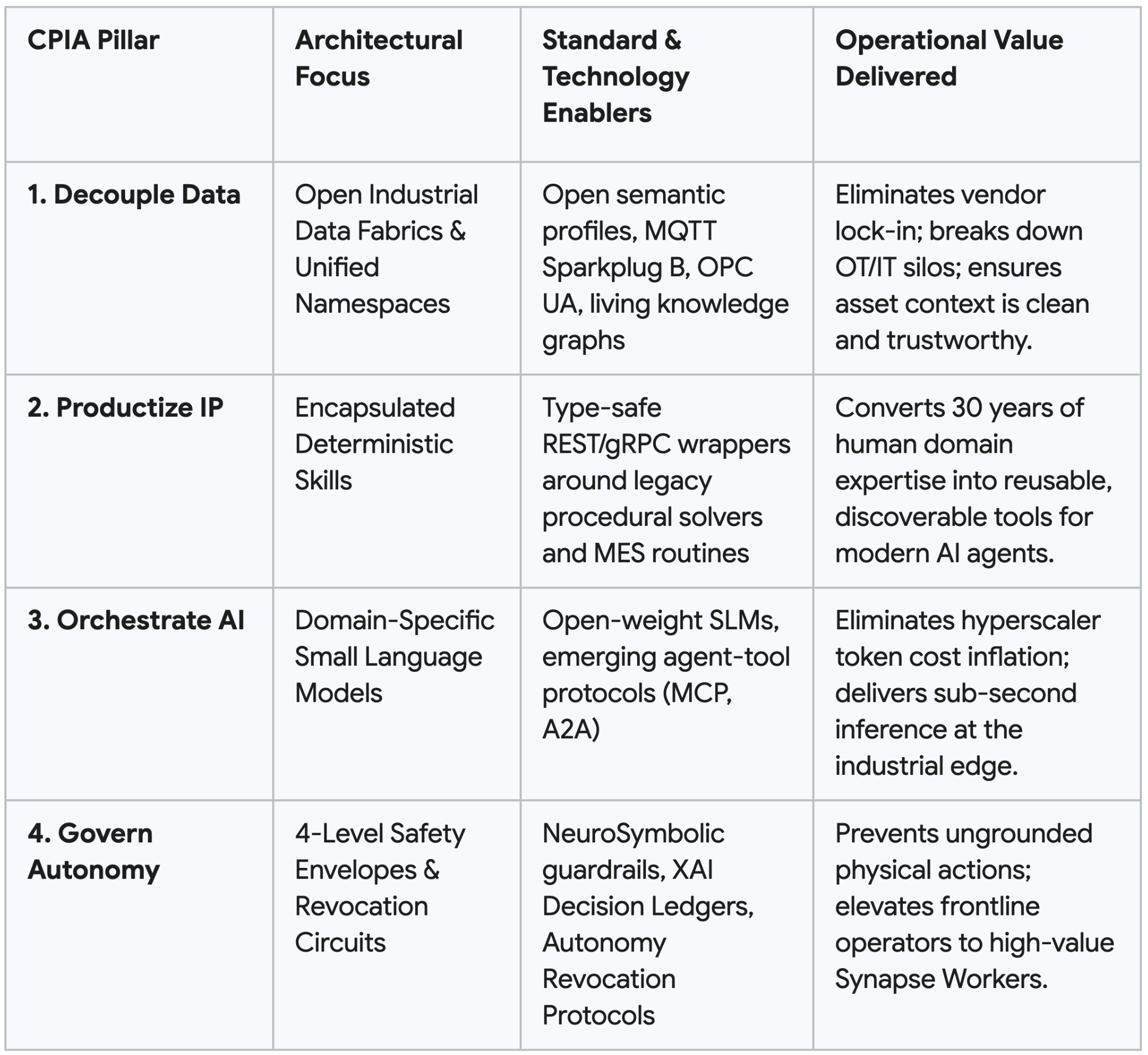
Winning enterprise software architectures will not be those that attempt to erase thirty years of functional execution history in pursuit of greenfield marketing purity. Winning platforms will be those that construct a robust Cyber-Physical Industrial Architecture (CPIA):
Don't be misled by vendor claims of "AI Native" perfection. Look under the covers, interrogate execution depth, enforce strict governance envelopes, and remember: in the physical world of manufacturing, supply chain, and enterprise systems, grounded domain reality always beats algorithmic hype.
At the end of the day, a manufacturing plant doesn't run on marketing labels, parameter counts, or hyperscaler keynote fanfare. Real factories, refineries, and supply networks run on the immutable laws of thermodynamics, deterministic math, and the hard-won domain IP embedded in millions of lines of proven execution code. For decades, industry has safely and systematically deployed AI, machine learning, and advanced analytics by choosing the right tool for the job from a diverse Industrial AI Toolbox—not by treating a probabilistic text engine like a precision micrometer. Wrapping that battle-tested domain logic into governed, type-safe Skills within a modern Cyber-Physical Industrial Architecture isn’t a compromise—it is the smartest, most resilient architecture in enterprise software. In the cyber-physical economy, real digital transformation was never about tearing out your operational foundation to chase algorithmic fashion; it is about empowering our frontline Synapse Workers—the human experts operating at the cognitive junction between enterprise strategy, digital software agents, and physical plant reality—with the deterministic tools, open data fabrics, and runtime guardrails they need to govern operations safely. Grounded domain competence will always beat unanchored algorithmic novelty.
— Colin Masson, Director of Research for Industrial AI, ARC Advisory Group
The Complete 5-Part Series Retrospective & Executive Synthesis
To help executive leadership align their technology and operations strategy, here is the synthesized index and operational takeaway from our full 5-part investigation:
- Part 1: The "AI Native" Mirage — Evaluates vendor hype vs. operational realities, advocating for wrapping battle-tested legacy IP into deterministic "Skills." (Read Blog 1)
- Part 2: Deconstructing the Stack — Deconstructs Cloud Native vs. AI Native definitions across the 4-tier hybrid enterprise topology and shows why software scaffolding dominates model weights. (Read Blog 2)
- Part 3: The Buyer's Tri-Domain Dilemma — Analyzes trade-offs across Supply Chain, Factory OT, and Enterprise Core, underscoring open Industrial Data Fabrics (CPIA) and cross-domain arbitration. (Read Blog 3)
- Part 4: AI Skills vs. Human Skills — Addresses the demographic retirement cliff, junior hiring freezes, the transition to Headless Firms, and elevating workers to Synapse Supervisors. (Read Blog 4)
- Part 5: Bounding the Brain — This blog establishes the Industrial Runtime Containment Plane, ARC's 4-Level Graduated Autonomy Framework, and automated Revocation Protocols to enforce grounded domain safety.
Engage with ARC Advisory Group
The Industrial AI (R)Evolution is moving faster than ever. To dive deeper into the frameworks and data shaping the future of the industrial sector, explore my latest research:
Where do you Stand in the Industrial AI (R)Evolution?
Take our Industrial AI Assessment to benchmark your organization's maturity, identify critical gaps in your IT/OT/ET convergence, and get actionable recommendations to accelerate your path to becoming an Industrial AI Pacesetter (and download the 2026 Report). If you think you’re already a Pacesetter, nominate your team for the ARC Industrial Pacesetters Awards!
Don't guess what your global operations or prospective customers need. Use empirical data to align your stakeholders and de-hype the market with ARC Advisory Group's Voice of Market Service.
For tailored recommendations on governing and guiding major people, process, and technology decisions across the enterprise, cloud, industrial edge, and AI, please contact Colin Masson at [email protected].
Or, set up a meeting with my fellow Analysts and I at ARC Advisory Group to find out more about our Executive Insights Service for Industrial organizations and our Industrial AI Insights Service for Vendors.




















