Representative End User Clients







Representative Automation Clients







Representative Software Clients








Manufacturing operational challenges abound in all industries. That’s what keeps automation suppliers in business. Water and waste water is no exception and share some common challenges. Unlike many manufacturing organizations that operate for profit, however, the water and waste water industry consists of two main types of entities; government-run and cost center in private companies. The processes themselves are generally quite simple: filter the water and chemically treat it. The chemistry makes it tricky. The business model is inherently problematic because the drivers are different.
Strategic planning for water & wastewater infrastructure investments and transitioning the operation and management of existing assets to incorporate new advances in technology is critical. The challenges and issues the industry must address include:
Employing digital transformation concepts in key operations can enable better water and chemicals management operations because digital technologies enable the collection of information needed to document evidence of proper treatment and to detect causes of wasted chemicals, energy, and water. The results include increased plant productivity; reduced water waste, energy, and overuse of chemical treatments; and the ability to document operations for better reporting.
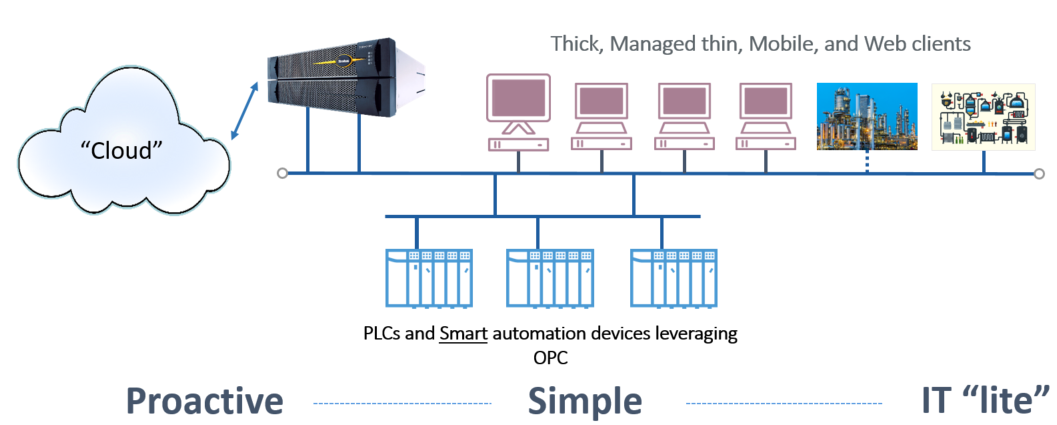
None of the industry challenges addressed with modern technologies can be deployed without the convergence of operations technology (OT) and information technology (IT). This has led to a rapid learning curve for both IT and OT groups. The side effect of OT/IT convergence has meant that IT personnel often must learn what terms such as “real time,” “non-stop,” and “deterministic” mean in the operations context, and OT personnel are rapidly discovering the advantages of leveraging the latest IT-based approaches. This convergence helps address the change in expertise, increase overall equipment availability, and improves data flow because legacy automation assets often need IT technology to be connected to the Cloud or to act as edge devices. Continuously available real-time or near real-time data is essential for any water and waste water organization to provide safe water on demand. This OT/IT convergence trend increases integration and provides better information flow to and from all assets, including legacy automation systems. It also contributes to the ease of adoption of cloud computing and Big Data applications that help eliminate unscheduled downtime.
OT/IT convergence also helps enable edge control, which is a converged control architecture that gives facilities the critical capability to manage their assets on premise as well as from the Cloud based on their needs. This includes connected control platforms with remote access, advanced automation, and operator override capabilities. Local control and firewall protection for cybersecurity are also available to maximize the benefits, especially for mission-critical applications. Edge control applications can be deployed for energy monitoring, equipment automation, and process automation systems that provide monitoring, control, and safety management.
Facilities deploying a simpler OT/IT infrastructure can reduce both technical and business risks by deploying solutions that are easier to maintain by operations and maintenance personnel. OT/IT infrastructure enables a very reliable integration of disparate equipment and system information for end-to-end production visibility and traceability, along with automated data collection for efficiency and analysis. A flexible and robust OT/IT infrastructure is also the easiest path to address both existing application needs, as well as leveraging digital transformation to meet business challenges.