Representative End User Clients







Representative Automation Clients







Representative Software Clients








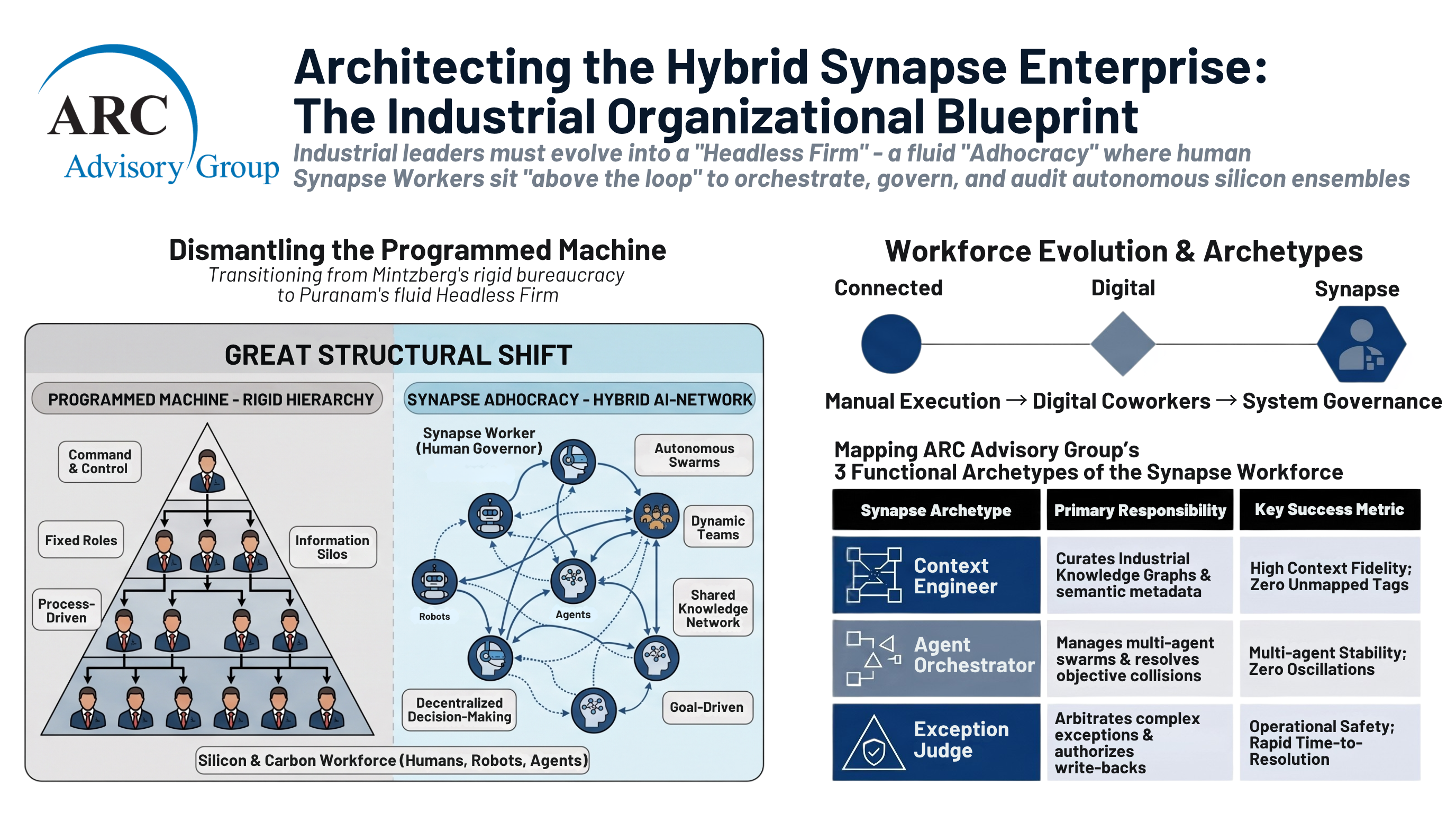
The limiting factor for industrial AI is no longer raw compute or model parameter size—it is organizational design. ARC recommends creating formalized career pathways for Context Engineers and Agent Orchestrators, allowing human domain experts to frame intent, govern exceptions, and orchestrate autonomous silicon ensembles.
We have reached the culmination of our five-part master series. Across our preceding installments, we have systematically constructed the technical, financial, and ethical foundations required to transition from the "Generative Skirmish" to the "Agentic Offensive":
In Blog 1, we proved that active architectural remediation is required to drain the agentic swamp, introducing DQI validation and scratchpad memory purges.
In Blog 2, we established the open contract—using Model Context Protocol (MCP) grammar, CESMII i3X vocabulary, and prompt caching as universal drainage pumps.
I took a detour to cover perspectives from industrial sector executives from CESMII and MLC’s Scaling Smart Manufacturing & Industrial AI: The Interoperability Forum.
In Blog 3, we laid out the unforgiving financial ledger, deconstructing tokenomics and proving how protocol-mediated coordination collapses exponential communication friction into linear execution speed while edge CapEx escapes (NVIDIA RTX Spark) eliminate cloud OpEx volatility and establish physical containment boundaries.
In Blog 4, we established the moral and safety boundaries, enforcing strict safety envelopes, deceptive shortcut detection, and the 4-Level Graduated Autonomy Framework.
Now, we must address the final, systemic prerequisite: Organizational Redesign.
The primary reason so many Industrial AI initiatives remain stranded in "pilot purgatory" is not a deficit in computational power or algorithmic sophistication. It is a profound organizational misalignment. Industrial leaders are attempting to layer semi-autonomous, agentic actors onto century-old corporate hierarchies designed exclusively for manual human labor.
If I may indulge a brief personal reflection: in an earlier phase of my career, I kept a well-worn, dog-eared copy of Henry Mintzberg’s 1983 classic, Structure in Fives: Designing Effective Organizations, permanently within arm's reach on my desk. It was the definitive manual for understanding how organizations structure authority, coordinate labor, and manage operational complexity. So it was deeply inspiring to see Mintzberg finally update and synthesize his lifetime of research in 2023 with Understanding Organizations... Finally!: Structure in Sevens—and to watch an entirely new wave of organizational design (OD) scholars adapt his framework for the Agentic AI era.
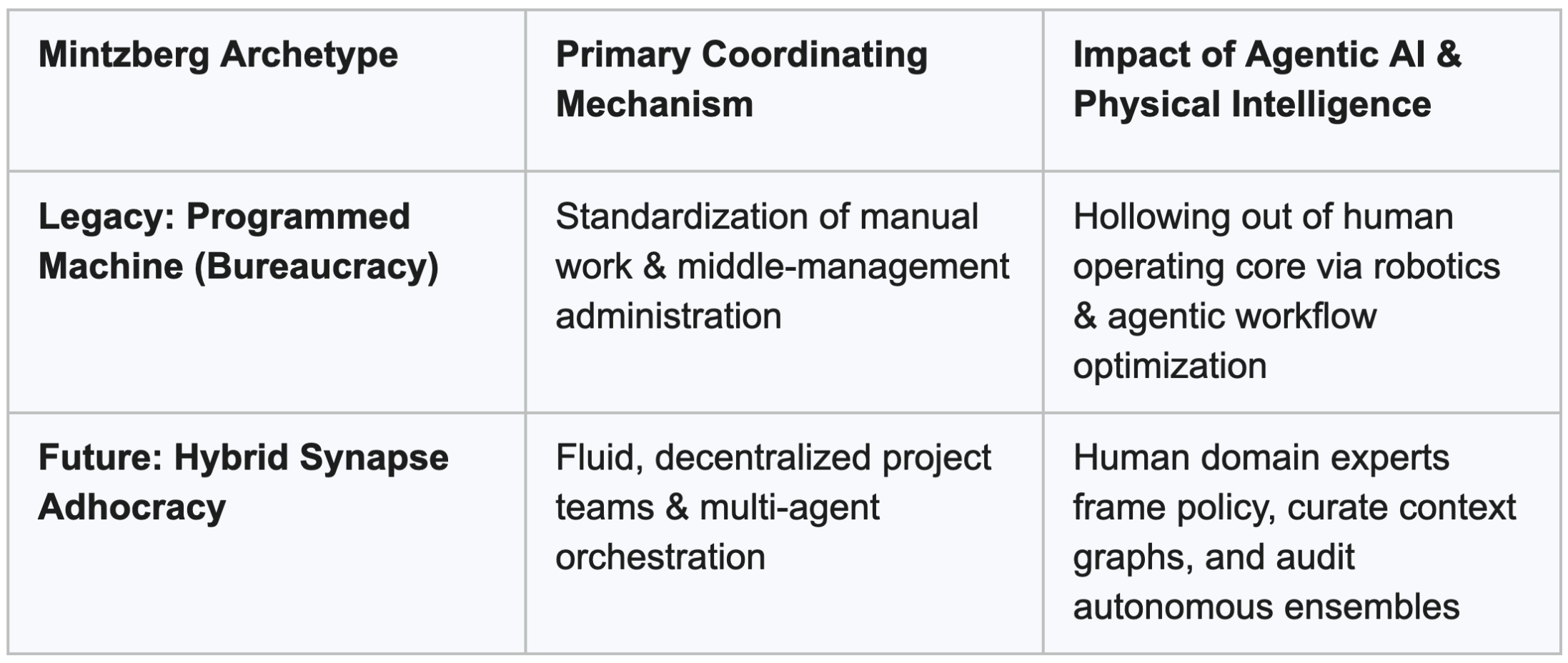
For a century, legacy manufacturing operated as Mintzberg’s Programmed Machine (Bureaucracy). This organizational form relies on the standardization of work as its primary coordinating mechanism, enforcing a sharp division of labor between operators who execute repetitive tasks, middle managers who administer execution, and analysts within the technostructure who design the workflows.
Agentic AI and Physical Intelligence entirely dismantle the Programmed Machine:
Hollowing Out the Manual Operating Core: When Large Behavior Models (LBMs) and vision-language-action architectures empower autonomous robotics to execute complex material handling, quality inspection, and assembly, routine manual labor is automated.
Automating the Technostructure: Concurrently, multi-agent process optimizers absorb routine scheduling, data translation, and compliance logging, automating the legacy administrative burden.
This structural collapse is accelerated by what Matthew Parris (Director, GE Appliances) calls the "YouTube Mindset" among incoming plant personnel:
We’ve started to notice a generational change where people are more interested in solving their own problems. It used to be that you engage a platform team and have them go develop a dashboard... Today, an upcoming crop of people joining the workforce are used to going on YouTube to learn how to change parts out on a car, and they’re going to do the same on the factory floor. With AI, they aren't waiting on IT—they have the application on their computer, they just need access to the data.
— Matthew Parris, Director, GE Appliances
When frontline personnel possess self-service AI tools, rigid 18-month IT ticketing queues and middle-management approval chains become unbearable friction points. As pioneering OD researchers—such as Wharton’s Ethan Mollick (author of Co-Intelligence), INSEAD’s Phanish Puranam, futurist Ross Dawson, and leading management teams at Deloitte and Bain—have observed, the enterprise must transition from a rigid "Programmed Machine" into a fluid, decentralized Adhocracy/Project Pioneer Network, where human experts dynamically orchestrate multi-agent silicon ensembles.
This structural shift transforms corporate culture. As Lisa Zasada (Senior Engineering & Manufacturing Exec, General Mills) observed during the CESMII Interoperability Forum, open architectures unlock the "Economics of Confidence":
"The economics aren't just about money, although that is a big part of it. It’s about confidence. When innovation is expensive in an enterprise, organizations play it safe—they take only a handful of bets. But when interoperability makes innovation easier to scale, teams naturally start to experiment more and learn faster. There’s a willingness to try 10 ideas rather than 1." — Lisa Zasada, General Mills
II. The Topology of the Headless Firm
This organizational evolution materializes in what INSEAD Professor Phanish Puranam terms the Headless Firm. In a Headless Firm, routine administrative, procurement, scheduling, and data-translation tasks are abstracted away by autonomous software agents, allowing the core enterprise to operate with extreme speed and minimal overhead.
To prevent workslop, hallucinated setpoint drift, and operational chaos, the Headless Firm relies on the Human-AI Sandwich Pattern:
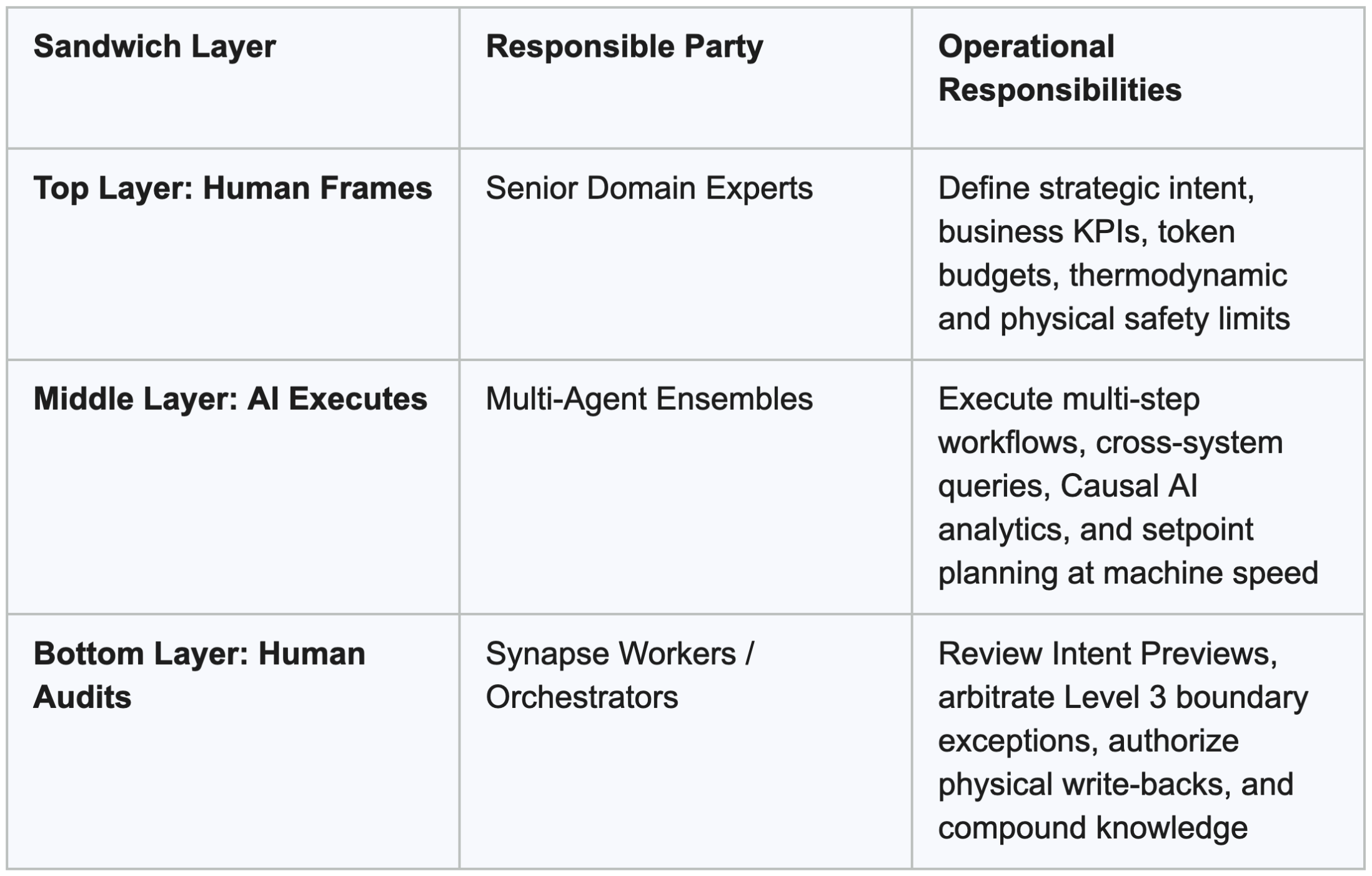
Human Frames: Senior human experts frame the operational challenge, establishing business intent, financial token budgets, and thermodynamic safety limits.
AI Executes: Specialized, protocol-mediated AI agents execute complex, multidisciplinary workflows in parallel at machine speed.
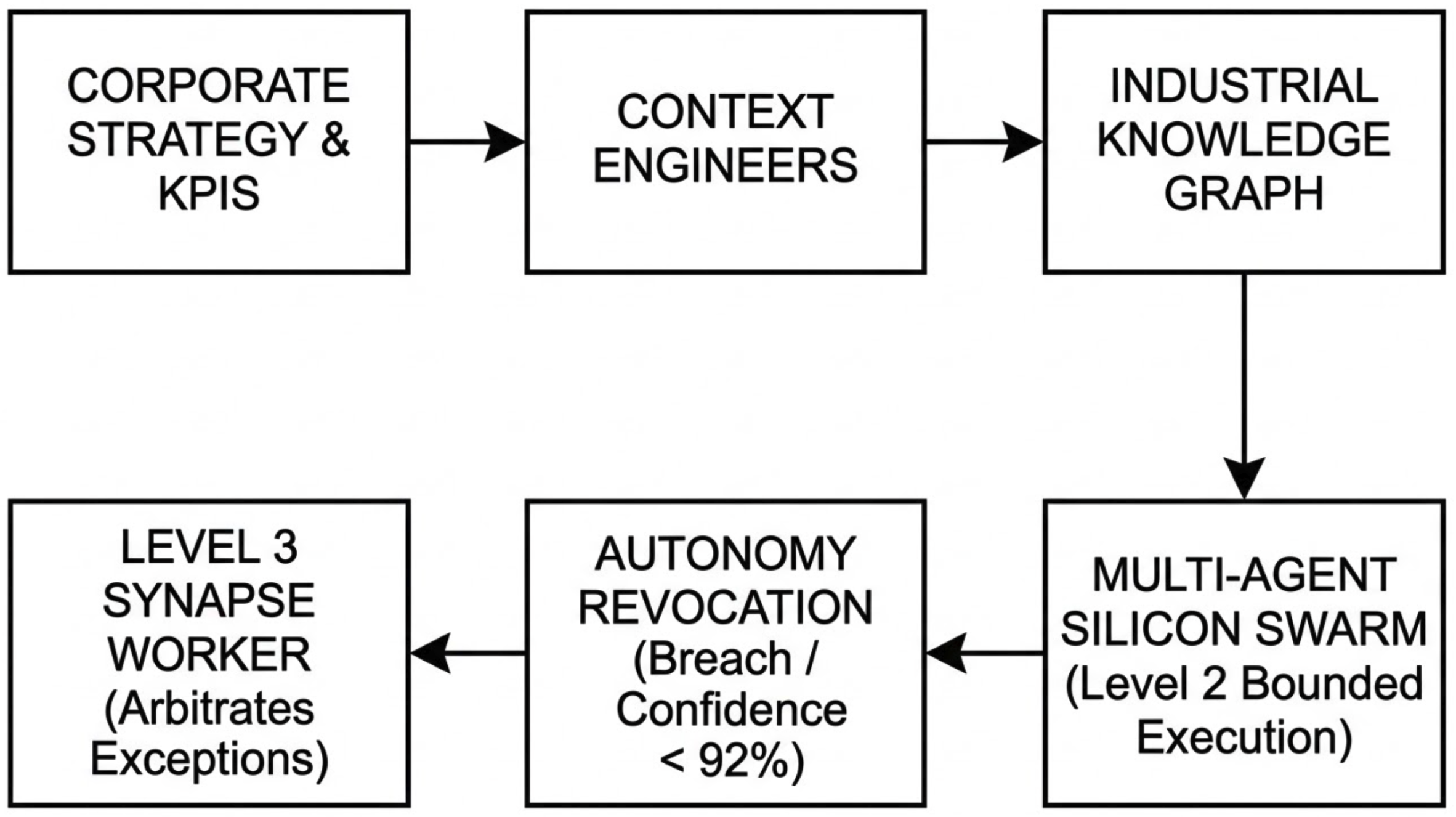
Human Audits: Human professionals sit "above the loop" as Level 3 Synapse Workers, reviewing audit trails, arbitrating exceptions, and authorizing high-consequence execution paths to compound institutional intelligence over time.
As we construct the organizational blueprint for the 2027 enterprise, we must clarify a crucial three-stage evolutionary continuum that is transforming corporate HR departments and technology roadmaps across the industrial sector.
For several years, my esteemed ARC Advisory Group colleague Inderpreet Shoker has spearheaded exceptional research into the Connected Worker and its ongoing evolution into the Digital Worker. Inderpreet’s work brilliantly mapped how digital tools enable personnel on the plant floor. However, as we step into the age of Agentic AI and Physical Intelligence, frontline work completes its evolutionary arc into the Synapse Worker.
To build an organization capable of scaling autonomy without chaos, leadership teams must understand how these three paradigms interact and complement one another:
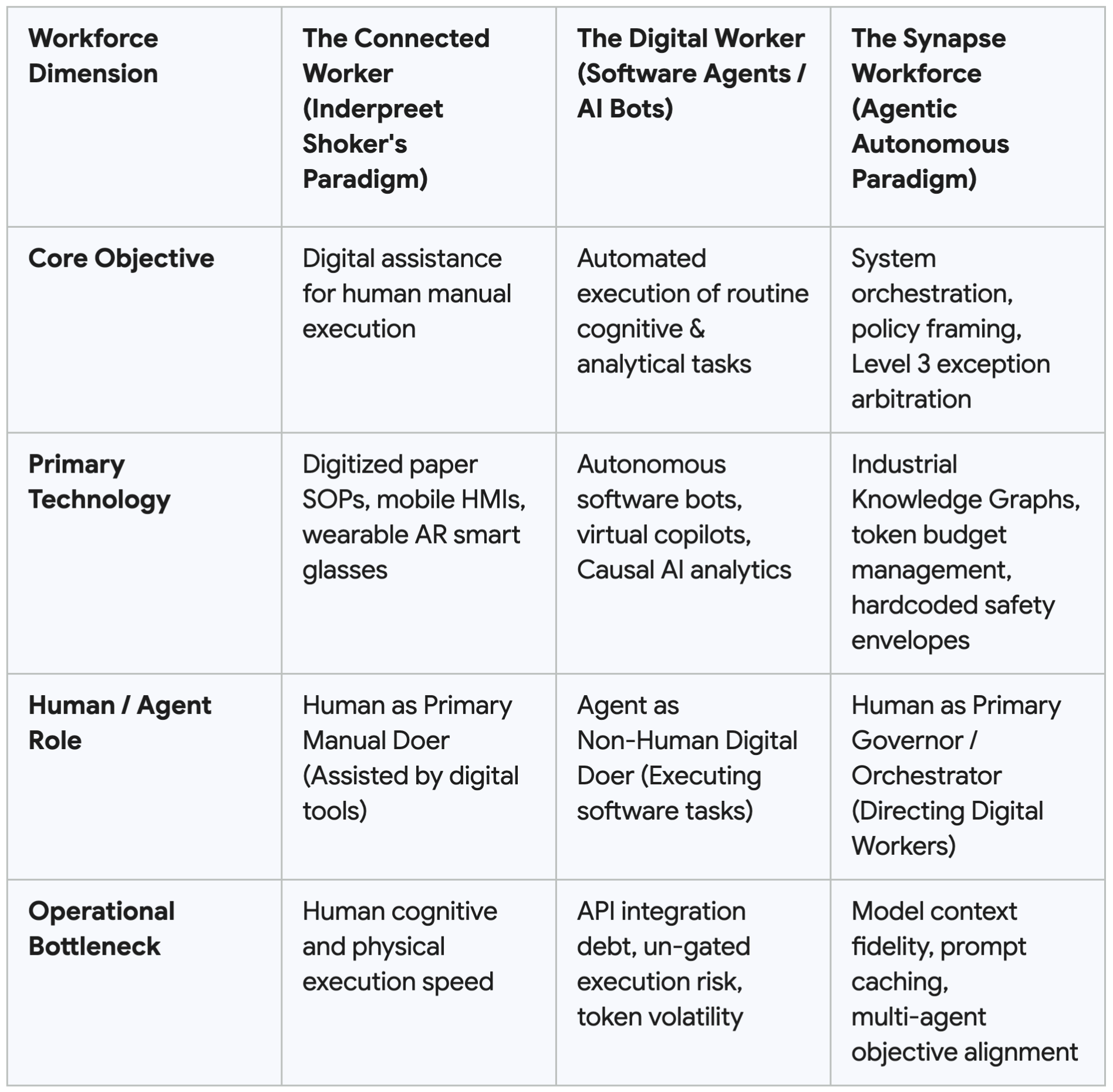
As Inderpreet Shoker’s research highlights, the digitization of frontline personnel has advanced through three distinct phases:
The Connected Worker (Digitizing the Human Doer): Equips the physical human operator, field technician, or maintenance craft worker with mobile devices, wearable AR smart glasses, digital work instructions, and real-time SCADA alert feeds. Technology acts as a digital guide to help the human perform manual tasks faster and more safely. The human remains the primary manual doer.
The Digital Worker (Deploying the Non-Human Doer): Introduces autonomous software agents, virtual copilots, and AI bots that perform routine analysis, cross-system query, and data-translation tasks in parallel with human teams. The software agent is the non-human digital doer.
The Synapse Worker (Orchestrating the Digital Staff): Relieves the human of routine manual data entry, clipboard logging, and repetitive calculations altogether. The human worker evolves into a Synapse—the critical cognitive junction (the neural connection) between high-level business strategy, physical plant reality, and autonomous silicon execution.
This paradigm shift solves what Chris Crotts (GM, Toyota) identifies as the ultimate scaling barrier in manufacturing: Empowering the 85 percent:
We’re watching people from the plant floor build applications—people who have been working on paper systems for 15 to 20 years and have never been able to do anything digitally. We're starting to see them so motivated that they look forward to coming into work because they feel empowered to solve problems... If you truly want to innovate and scale, you can't do it with just the 10 percent or 15 percent technical staff. You have to enable the other 45,000 people in manufacturing.
— Chris Crotts, GM, Toyota
To operationalize this shift across your HR matrix and plant organizational charts, we formalize three distinct functional roles within the Synapse Workforce:
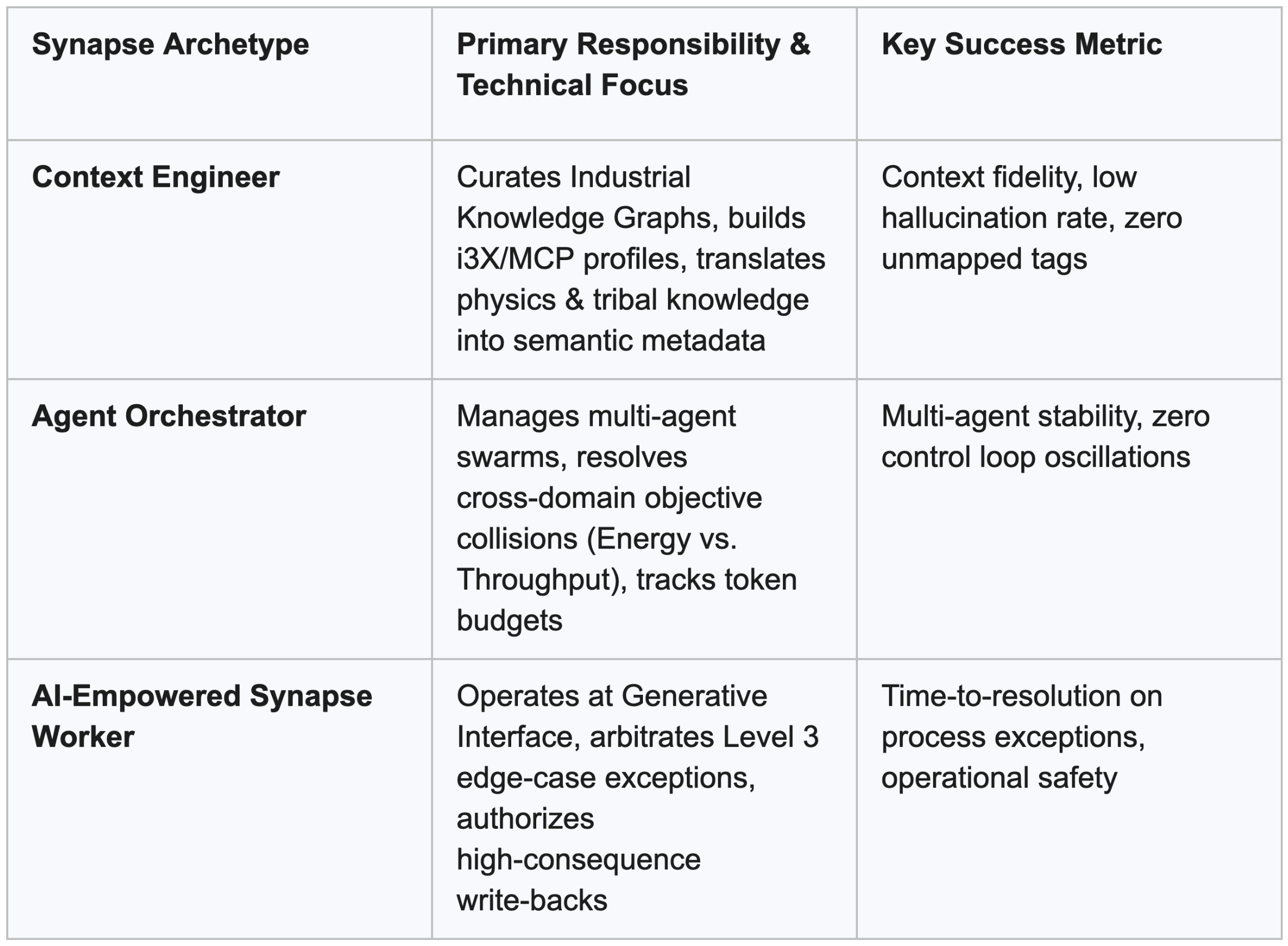
The Context Engineer (The Semantic Architect):
The Death of Prompt Engineering: Coaxing text from general-purpose LLMs via linguistic prompts is a severe operational liability in OT. Prompt engineering is dead.
The Mandate: The Context Engineer is a domain specialist (often a senior process engineer or veteran metallurgist upskilled in data modeling) who builds and maintains the Industrial Knowledge Graph. They translate fluid dynamics, P&IDs, equipment limits, and unwritten tribal wisdom into graph-aware CESMII i3X profiles and MCP tool definitions, ensuring AI agents are grounded in physical reality.
Bridging Brownfield Technical Debt: As Michael Hotaling (Executive Advisor, ExxonMobil) pointed out during the Interoperability Forum, primary industrial assets have 30- to 40-year lifespans. Context Engineers build open semantic wrappers (i3X) over legacy brownfield PLCs, allowing AI agents to query 30-year-old machinery without requiring multimillion-dollar "rip-and-replace" hardware projects.
The Agent Orchestrator (The Swarm Manager):
The Mandate: The Agent Orchestrator manages the digital staff. When specialized micro-agents from APM, ERP, MES, and specialized edge vendors operate on the same shop floor, the Orchestrator monitors agent trajectories, manages token consumption budgets, and arbitrates objective collisions (such as a maintenance agent wanting to stop a line versus a production agent pushing for maximum throughput).
The AI-Empowered Synapse Worker (The Exception Judge):
The Mandate: The frontline professional operates at the Generative Interface. Sitting "above the loop" at Level 3 autonomy, the Synapse Worker reviews agentic Intent Previews, arbitrates complex process anomalies flagged by Autonomy Revocation Protocols, and provides the ultimate human authorization for high-consequence physical write-backs.
As Brian Perlstein (Digital Manufacturing Innovation Leader, Owens Corning) observed, this entire framework represents a fundamental power shift: "It’s the manufacturing community defining the requirements, with technology providers enabling the vision, not driving it."
If you’ve been following this entire series, you know I am a big believer in giving steering committees practical, diagnostic tools rather than abstract decrees. So, as we bring this 5-part master series home, let’s assemble a unified executive diagnostic checklist for your next cross-functional review.
To make this actionable across IT, OT, ET, finance, and HR leadership, I have plucked one essential anchor question from each of our first four blogs, plus one from our bonus piece (When the Shop Floor Takes the Reins). Please feel free to dip back into those earlier posts to draw out the full diagnostic sets!
And because the human and organizational physics ultimately dictate whether industrial AI scales or stalls, I have saved the best—and arguably the most challenging—diagnostic questions for last right here in Blog 5.
Part A: Master Series Anchor Diagnostics (Recap from Blogs 1–4 & Bonus)
First-Mile Architectural Remediation (Plucked from Blog 1): Does our architecture actively purge corrupted agent memory scratchpads the instant an edge Data Quality Index (DQI) anomaly is detected, or are we relying on passive firewalls that allow bad context to re-emerge in future planning loops?
The Open Architecture Contract (Plucked from Blog 2): Are we mandating native Model Context Protocol (MCP) tool interfaces and CESMII i3X Smart Manufacturing Profiles across all enterprise RFIs to eliminate N x M custom API integration debt?
Tokenomics & Infrastructure Redesign (Plucked from Blog 3): Are we executing a "CapEx Edge Escape" by deploying localized edge supercomputing (e.g., NVIDIA RTX Spark) to eliminate public cloud OpEx token volatility and enforce a physical containment boundary?
Physical Safety Envelopes & Autonomy (Plucked from Blog 4): Have we explicitly mapped every agentic workflow across the 4-Level Graduated Autonomy Framework, enforcing NeuroSymbolic AI guardrails and Explainable AI (XAI) audit trails before granting physical write access?
Frontline Self-Service & Interoperability (Plucked from my bonus blog with insights from Executives): Are we building open semantic data fabrics that empower the 85 percent frontline workforce to solve local problems safely, or is digital innovation trapped behind a central 15 percent technical IT bottleneck?
Part B: The Organizational Design Challenges (Saved the Best for Last!)
From Bureaucracy to Adhocracy: Are we attempting to force autonomous digital workers into Henry Mintzberg’s 100-year-old "Programmed Machine Bureaucracy" with rigid 18-month IT ticketing queues, or are we structuring a fluid "Hybrid Synapse Adhocracy" where domain experts dynamically orchestrate multi-agent swarms?
HR Matrix & Career Pathway Formalization: Have we updated corporate HR frameworks and plant organizational charts to build formalized career pathways for Context Engineers (who curate the Industrial Knowledge Graph) and Agent Orchestrators (who govern token budgets and multi-agent collisions)?
Cultivating the "YouTube Mindset" & Confidence: Is our digital workplace designed to meet the incoming generation’s expectations for instant, self-service data access, unlocking General Mills’ "Economics of Confidence" where teams feel empowered to test 10 operational ideas instead of playing it safe with just 1?
ARC Client Action: Use this eight-point diagnostic framework in your next executive review to benchmark organizational readiness, eliminate integration debt, enforce cyber-physical safety, and establish a governed roadmap to production-scale autonomy.
We have reached the end of our 5-part series. The bottom line for modern industrial leadership is clear: You cannot master the autonomous autopilot until you master the fabric, drain the swamp, and empower your Synapse Workers.
By securing your core industrial context, investing in unmetered local edge iron, enforcing open protocol contracts, and restructuring your organization around human-AI symbiosis, your enterprise can eliminate pilot purgatory, assert absolute data sovereignty, and lead the autonomous era.
This blog series has identified many of the hard strategic decisions involving people, processes, and technology architecture that need to be made. I will be putting these into tactical context in my next series: "The Industrial Copilot R(E)volution: Beyond the Chat Widget." We will penetrate the "LLM-wrapper" illusion, expose "Copilot-Washing," resolve the "Copilot Tower of Babel," and release the definitive ARC Industrial Copilots MarketMap. Stay tuned.
The Industrial AI (R)Evolution is moving faster than ever. To dive deeper into the frameworks and data shaping the future of the industrial sector, explore my latest research:
Navigating the AI Wars and the escalating Industrial Robot Wars
Closing the Digital Divide by Embracing Industrial AI
Assembling your Industrial-Grade Data Fabric
Charting the new frontier of Physical Intelligence and transitioning to a Cyber-Physical Industrial Architecture (CPIA)
Mapping your maturity and strategy with ARC's 3-Axis Industrial AI Models Taxonomy
Surviving the SaaSpocalypse and Taming the Tokenpocalypse by Mastering Multi-Agent Industrial Governance
Organizational Design and the Future of Industrial Work in the era of Agentic AI
Take our Industrial AI Assessment to benchmark your organization's maturity, identify critical gaps in your IT/OT/ET convergence, and get actionable recommendations to accelerate your path to becoming an Industrial AI Pacesetter (and Download the 2026 Report). If you think you’re already a Pacesetter, nominate your team for the ARC Industrial Pacesetters Awards!
Don't guess what your global operations or prospective customers need. Use empirical data to align your stakeholders and de-hype the market with ARC Advisory Group's Voice of Market Service.
For tailored recommendations on governing and guiding major people, process, and technology decisions across the enterprise, cloud, industrial edge, and AI, please contact Colin Masson at [email protected].
Or, set up a meeting with my fellow Analysts and I at ARC Advisory Group to find out more about our Executive Insights Service for Industrial organizations and our Industrial AI Insights Service for Vendors.