Representative End User Clients







Representative Automation Clients







Representative Software Clients








While much of Automate 2026 focused on robots, AI, and autonomous systems, a visit to the Emerson booth served as a reminder that successful automation depends on far more than the robot itself.
Behind every automated system lies a complex network of components that make machines move, sense, feed, assemble, and operate reliably. Emerson's discrete automation portfolio demonstrated how these foundational technologies continue to evolve as manufacturers pursue smarter, more connected operations.
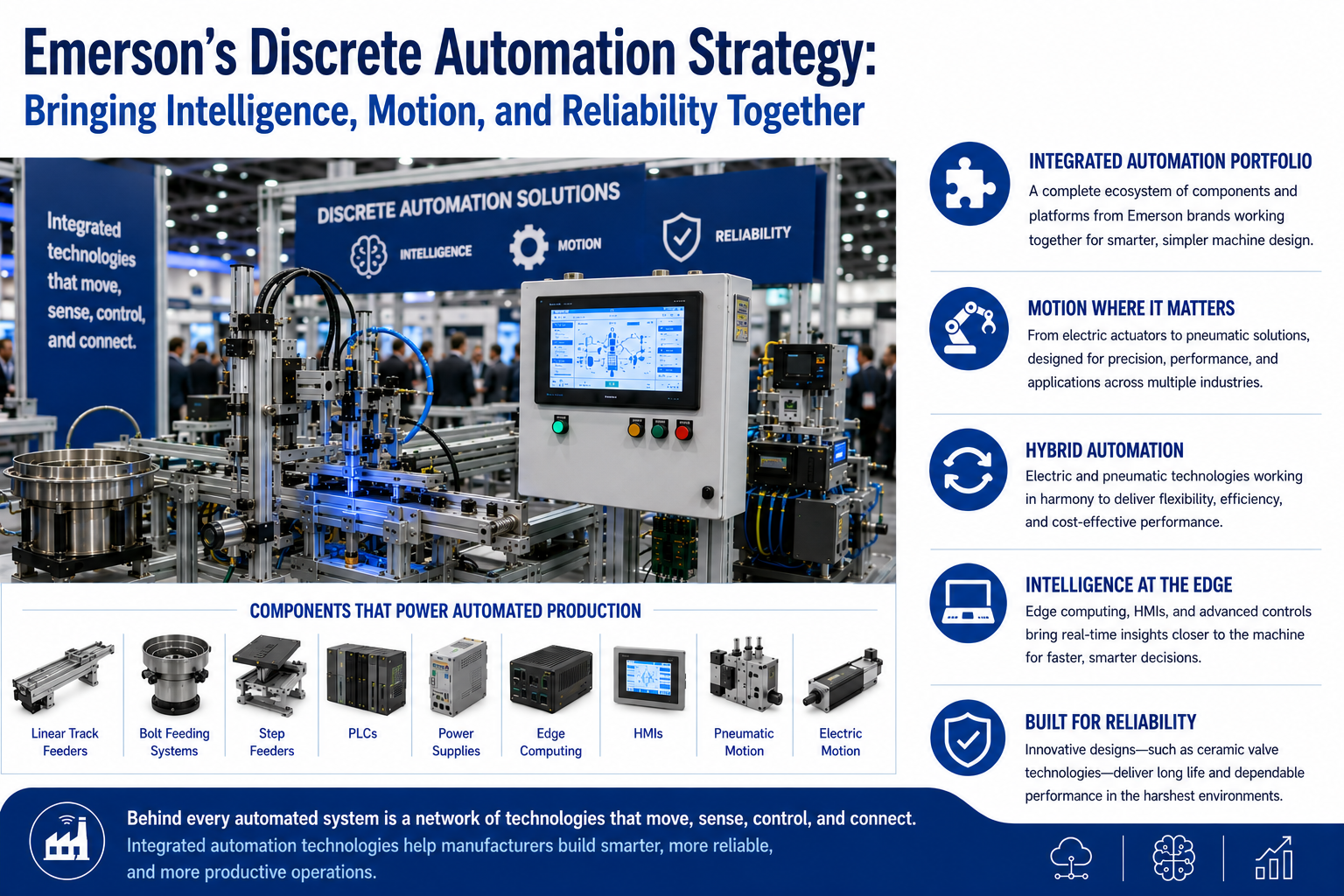
One of the most interesting aspects of the Emerson exhibit was that the company wasn't showcasing a single standalone product. Instead, it demonstrated how multiple technologies work together to create complete automation solutions.
The demonstration included:
Linear track feeders.
Bolt feeding systems.
Step feeders.
PLCs.
Power supplies.
Edge computing platforms.
Human-machine interfaces (HMIs).
Pneumatic and electric motion components.
According to Emerson representatives, virtually every component in the demonstration cell originated from one of Emerson's automation brands.
This reflects the company's broader strategy of building an integrated automation portfolio through both organic development and acquisitions.
Like many industrial technology leaders, Emerson has expanded its automation portfolio through acquisitions over time.
The booth highlighted technologies from several Emerson business units, including:
Aventics – pneumatic actuators and motion solutions.
Afag – feeding and handling technologies.
Emerson controls, computing, and automation platforms.
The result is an increasingly comprehensive portfolio that allows machine builders to source multiple automation technologies from a single supplier.
For manufacturers facing labor shortages and engineering resource constraints, integration and simplification continue to be powerful value propositions.
When asked about target markets, the Emerson team emphasized that its technologies are applicable almost anywhere motion control is required.
Examples included:
Medical device manufacturing.
Pharmaceutical production.
Consumer electronics.
Packaging machinery.
Consumer packaged goods.
Automotive manufacturing.
The common thread is straightforward:
Wherever products need to move, sort, assemble, feed, position, or package, motion control technologies play a critical role.
While robots often receive most of the attention, many manufacturing applications still depend heavily on feeders, actuators, conveyors, positioning systems, and pneumatic devices operating behind the scenes.
Another theme at the booth was the concept of hybrid motion.
Rather than viewing electric and pneumatic technologies as competitors, Emerson demonstrated how the two can complement each other within a single system.
The exhibit featured:
Electric actuators.
Pneumatic valves.
Rotary systems.
IO-Link-enabled devices.
Power and communication platforms.
Manufacturers increasingly seek architectures that combine:
Flexibility.
Energy efficiency.
Simplicity.
Cost-effectiveness.
Hybrid automation allows engineers to select the most appropriate technology for each task rather than forcing a one-size-fits-all solution.
One demonstration centered around a surprisingly familiar product: a pen.
The machine assembled pens using:
Feeders.
Rotary actuators.
Sorting mechanisms.
Motion control technologies.
At first glance, pen manufacturing may seem simple. In reality, it highlights the complexity hidden within many consumer products.
Emerson's role is not manufacturing the final product itself, but providing the technologies that machine builders use to automate production.
This distinction is important.
Much of industrial automation occurs behind the scenes, enabling manufacturers to improve throughput, reduce labor requirements, and maintain quality at scale.
One particularly interesting technology showcased at the booth was a ceramic valve design developed for harsh industrial environments.
Unlike conventional spool-and-sleeve valves, the design uses precision-machined ceramic components.
The benefits include:
Improved resistance to dust and contamination.
Longer service life.
Increased reliability in abrasive environments.
Potential applications include:
Mining.
Pulp and paper.
Cement production.
Heavy industrial processing.
In environments where fine particles can damage conventional valves, ceramic technologies offer a more durable alternative.
This serves as a reminder that innovation in automation is not limited to AI and software. Materials science and mechanical engineering continue to play vital roles in improving system performance.
Another notable element of the Emerson display was the inclusion of edge computing within the automation architecture.
The booth showcased systems using:
Edge computers.
HMIs.
PLCs.
Sensor networks.
As industrial organizations continue deploying AI and analytics, edge computing is becoming increasingly important.
Benefits include:
Faster response times.
Reduced network traffic.
Improved resiliency.
Localized processing and control.
Rather than sending every data point to the cloud, many organizations are moving intelligence closer to the production process.
The Emerson demonstrations reinforce a key reality:
Industrial transformation is not driven by a single technology.
Successful automation requires the integration of:
Motion technologies.
Feed systems.
Sensors.
Controls.
Industrial software.
Computing platforms.
Data infrastructure.
While AI, robotics, and digital transformation continue to dominate industry discussions, manufacturers must also focus on the foundational technologies that enable production systems to operate reliably every day.
One lesson from Automate 2026 is that automation innovation occurs at every level of the technology stack.
Robots may capture headlines, but the systems feeding them, controlling them, powering them, and coordinating them are equally important.
Emerson's discrete automation portfolio illustrates how modern manufacturing increasingly depends on integrated ecosystems rather than individual products.
As factories pursue greater intelligence, flexibility, and productivity, the companies that successfully connect motion, control, sensing, and computing may prove just as influential as those building the robots themselves.
In the race toward smarter manufacturing, it is often the technologies behind the scenes that make the biggest difference.
Emerson’s discrete automation portfolio highlights a broader shift in manufacturing, as motion, sensing, control, edge computing, and Industrial AI become more closely connected. To explore more of ARC’s coverage on the technologies enabling smarter automation, read ARC’s related insights:
Machine Vision Gets Smarter: How Cognex Is Bringing AI to Industrial Inspection
Taming the Agentic Swamp: Anchoring Autonomy with Industrial-Grade Data Fabric
These related insights provide additional context on how automation, AI, edge intelligence, machine vision, and industrial data architectures are reshaping manufacturing operations.