Representative End User Clients







Representative Automation Clients







Representative Software Clients









At Automate 2026, one of the more interesting trends was not robotics itself, but the technology increasingly enabling robots and automation systems to make better decisions: machine vision.
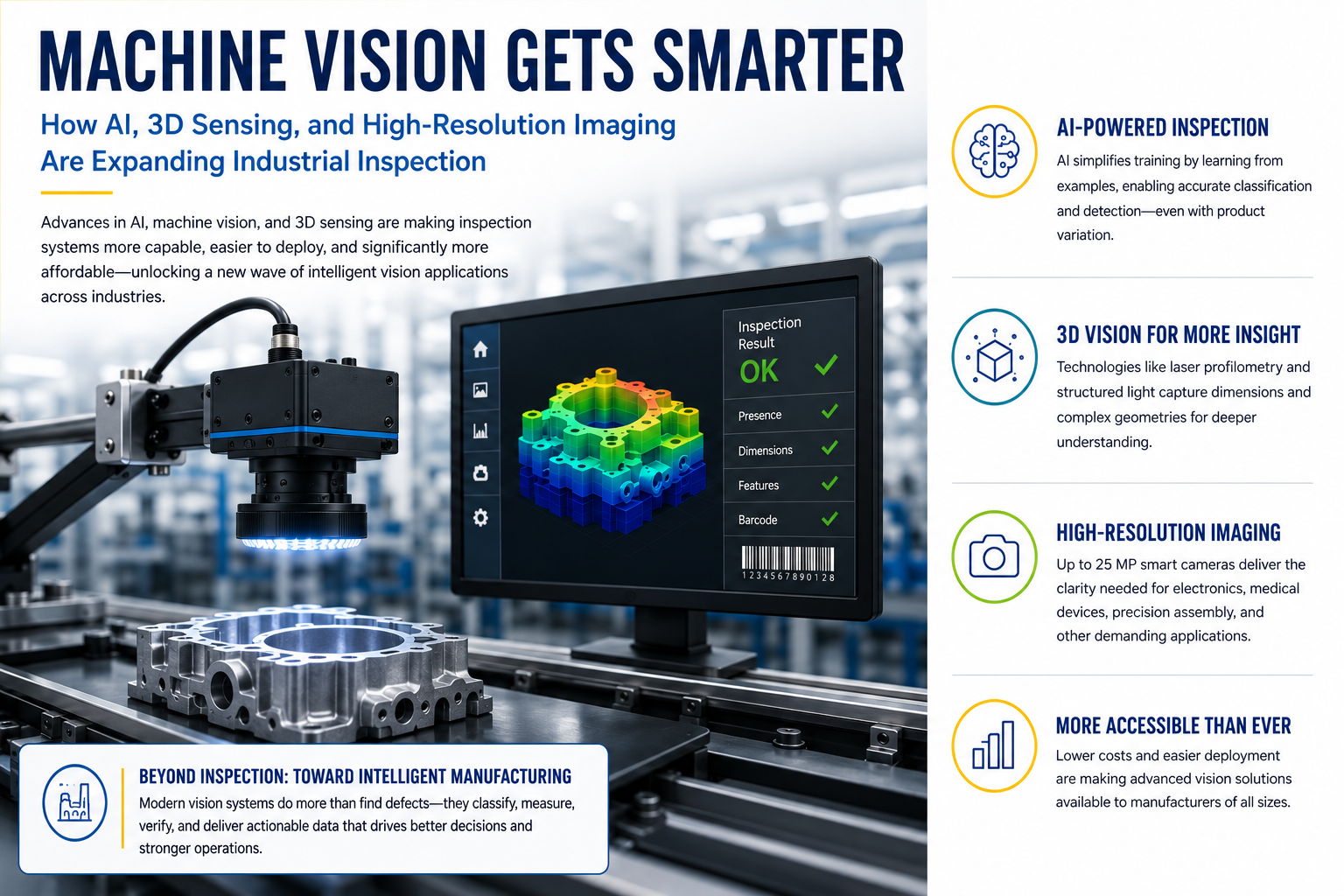
A discussion with the Cognex team highlighted how advances in AI, machine vision, and 3D sensing are making inspection systems more capable, easier to deploy, and significantly more affordable than in previous generations.
The result is a new wave of vision applications that extend beyond traditional quality inspection and into intelligent classification, measurement, and process optimization.
Historically, advanced vision systems were expensive and often reserved for large manufacturing operations.
A decade ago, deploying a machine vision system could easily require six-figure investments when hardware, software, integration, and engineering services were included.
Today, that picture is changing.
According to Cognex, many vision solutions now fall into a range of approximately:
$3,000–$4,000 for entry-level applications.
$15,000–$20,000 for more advanced 3D inspection systems.
Higher prices for specialized high-resolution configurations.
This dramatic reduction in cost is helping expand adoption across a much broader range of industrial applications.
Increased competition, improved hardware economics, and more streamlined deployment models have helped transform machine vision from a niche technology into a mainstream automation tool.
Traditionally, vision systems depended on highly structured programming and rule-based inspection methods.
Today, AI is changing that model.
One demonstration showed how Cognex uses AI to classify food products, including:
Chicken nuggets.
Apple slices.
Carrots.
Grilled cheese sandwiches.
Rather than relying on hard-coded rules, operators train the system using images of specific products.
This approach allows manufacturers to:
Build custom datasets.
Train systems on their own products.
Adapt quickly to new product variations.
The process resembles training an AI model rather than programming a traditional inspection system.
Importantly, there is no universal library of products.
The customer defines what the system should recognize and then teaches it through examples.
Cognex also showcased its latest smart camera platform, capable of resolutions up to 25 megapixels.
High-resolution imaging is particularly important in applications such as:
PCB inspection.
Electronics manufacturing.
Precision assembly.
Medical devices.
The systems can inspect:
Screws and fasteners.
LED placement.
Component presence.
Barcodes.
Dimensional features.
As manufacturing tolerances become tighter and products more complex, resolution continues to play an important role in inspection accuracy.
While 2D machine vision remains the largest market segment, 3D inspection is rapidly gaining momentum.
The discussion highlighted two primary approaches:
Laser-based systems generate precise profiles and dimensional measurements.
However, they typically require motion:
The part moves.
Or the sensor moves.
This approach remains widely used for dimensional inspection and measurement applications.
An alternative approach uses structured light to create a 3D point cloud of the object being inspected.
The key benefit is that the system can capture dimensional information without requiring the same type of scanning motion used by laser systems.
Potential advantages include:
Simpler deployment.
Reduced mechanical complexity.
Faster acquisition of complex geometries.
The technology remains a developing market, but interest is growing rapidly as manufacturers seek more comprehensive inspection capabilities.
One important takeaway from the discussion was that AI does not replace the fundamentals of image quality.
Successful machine vision still depends on:
Proper lighting.
Appropriate lenses.
Correct camera resolution.
Well-designed optical systems.
As one participant noted:
The most advanced AI in the world cannot compensate for poor image acquisition.
Cognex's ownership of Moritex reflects the continued importance of optics in advanced vision systems.
In machine vision, AI may provide intelligence, but image quality remains the foundation.
The broader significance of these developments extends beyond quality control.
Modern vision systems are increasingly becoming sources of operational intelligence.
Instead of simply identifying defects, AI-enabled vision platforms can:
Classify products.
Verify assembly operations.
Measure dimensional characteristics.
Detect process deviations.
Generate actionable manufacturing data.
As AI capabilities continue to improve, machine vision is evolving from a passive inspection tool into an active contributor to operational decision-making.
Manufacturers continue to face pressure to improve:
Quality.
Productivity.
Labor efficiency.
Traceability.
Machine vision directly addresses all four.
At the same time, falling costs and easier deployment are opening the technology to companies that previously viewed vision systems as too expensive or too complex.
As AI becomes embedded in vision platforms, the biggest shift may be that inspection systems are no longer simply answering the question:
Is this part good or bad?
Instead, they are beginning to answer:
What is this object, what is happening, and what should we do next?
That evolution could make machine vision one of the most important enabling technologies in the next generation of industrial automation.
Machine vision is becoming a critical enabler of smarter, more adaptive industrial automation. To explore how vision systems, AI-based inspection, 3D sensing, and Physical AI are reshaping manufacturing operations, read ARC’s related coverage:
The Future of Machine Vision: From Inspection to Intelligence
The Shift from Feasibility to Scalability: AI’s Role in Modern Machine Vision
Beyond Inspection: How 3D Vision Is Transforming Food Manufacturing Automation
These insights point to a broader shift in machine vision, as AI, 3D sensing, and improved system design expand its role from defect detection to deeper manufacturing intelligence.