Representative End User Clients







Representative Automation Clients







Representative Software Clients








India is often referred to as the “pharmacy of the world,” reflecting its role as a major global supplier of generic medicines. India accounts for around 20 percent of global generic drug supply by volume and is one of the largest providers of generics worldwide. Indian pharmaceutical manufacturers also play a critical role in global healthcare systems, supplying a significant share of vaccines and meeting a substantial portion of generic drug demand in regulated markets such as the US¹.
However, the next phase of growth for India’s pharmaceutical industry—projected to expand significantly over the next decade—is being shaped by a different set of challenges². As the industry moves beyond high-volume generics toward more complex therapies, manufacturers must balance cost competitiveness with increasing expectations around quality, consistency, and regulatory compliance.
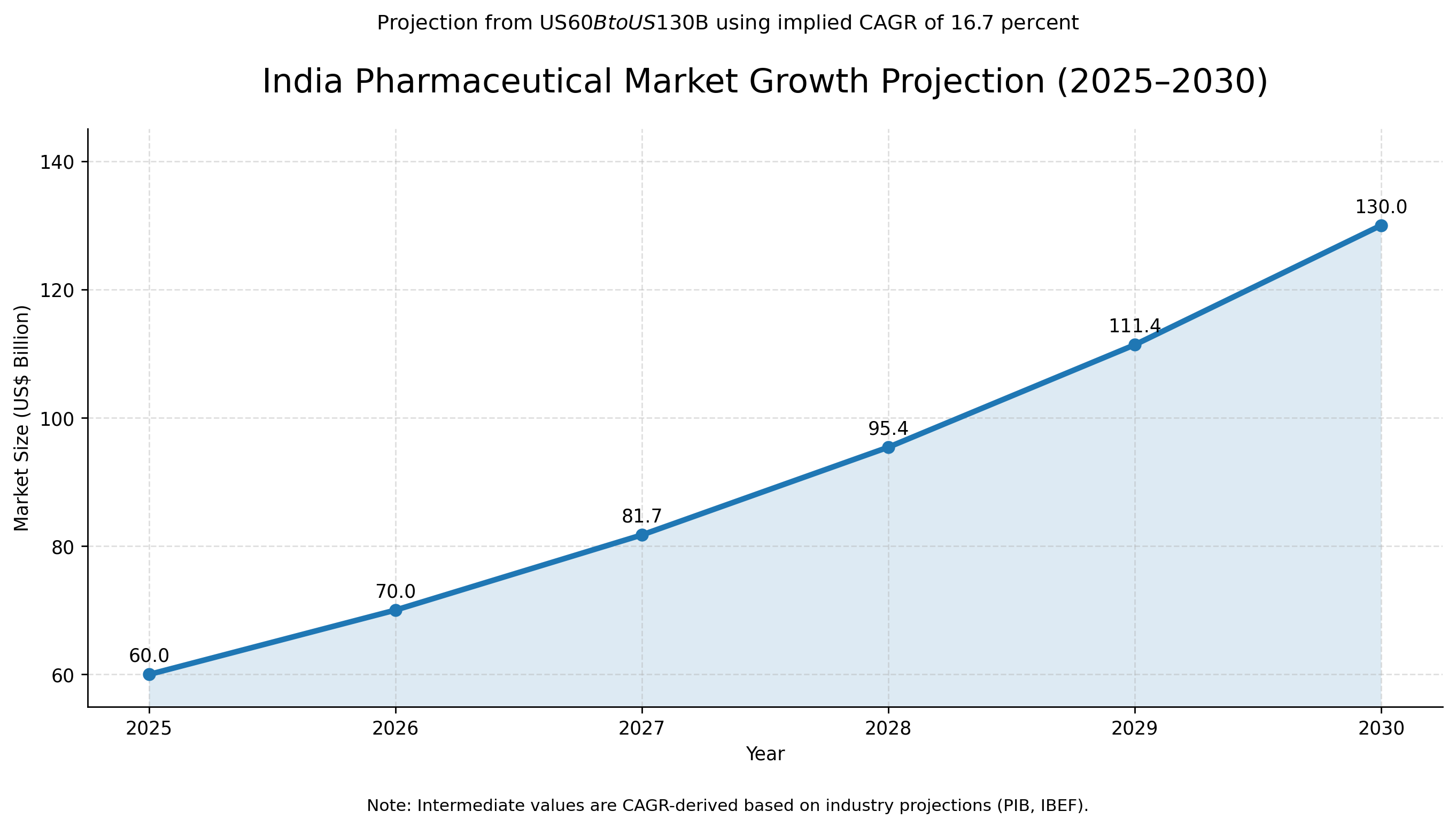
The global demand for GLP-1 therapies such as semaglutide highlights this shift. As patent landscapes evolve across regions, interest in expanding manufacturing capabilities for such therapies is increasing, particularly as the market is projected to reach approximately US$130 billion by 2030³. Recent developments indicate that multiple Indian pharmaceutical companies are entering this space, with growing competition contributing to lower-cost alternatives in certain markets⁴.
This is not simply a question of market access. It reflects a deeper transition in how pharmaceutical manufacturing is evolving. Producing complex therapies at scale introduces new levels of process sensitivity, variability, and regulatory scrutiny. In this context, traditional manufacturing approaches are often insufficient to maintain both efficiency and compliance.
Industrial AI is increasingly emerging as a key enabler in addressing these challenges—not as a standalone solution, but as part of a broader shift toward more intelligent, data-driven manufacturing operations.
The growing demand for complex therapies, combined with pricing pressure in global generics markets and evolving regulatory expectations, is accelerating the need for more advanced manufacturing capabilities. For Indian pharmaceutical companies, this marks a shift from a model defined primarily by scale and cost efficiency to one increasingly shaped by manufacturing sophistication.
This transition is where Industrial AI is beginning to play a more strategic role.
As manufacturing processes become more sensitive and multi-step in nature, maintaining consistency across batches becomes more challenging. Industrial AI can help identify subtle process variations and support more stable and predictable production outcomes.
Pharmaceutical manufacturers operate under strict oversight from regulatory bodies such as the US Food and Drug Administration and the European Medicines Agency. In this environment, the ability to detect deviations early and maintain reliable production records is critical to ensuring inspection readiness and compliance.
High-demand therapies can create pressure to increase production rapidly. Industrial AI can support scale-up efforts by improving process understanding and reducing the likelihood of variability during production ramp-up.
Manufacturing environments depend on critical equipment operating within tightly controlled parameters. Improving reliability and reducing unplanned disruptions is essential to maintaining both efficiency and product quality.
Export-driven pharmaceutical manufacturing requires the ability to respond to shifting global demand. Data-driven approaches can help improve planning and responsiveness across supply chains.
While Industrial AI use cases such as anomaly detection and predictive maintenance are becoming more common, the more significant shift lies in how these capabilities are being driven by changing market dynamics rather than purely technological adoption.
For many pharmaceutical manufacturers, the challenge is no longer whether to adopt AI, but how to integrate it into core manufacturing operations in a way that supports both performance and compliance.
As India’s pharmaceutical industry continues to evolve, competitive advantage is no longer defined solely by cost efficiency or production scale. Instead, it is increasingly shaped by the ability to manufacture complex therapies reliably, consistently, and at scale.
The developments around therapies such as semaglutide provide an early indication of how global demand, pricing pressure, and manufacturing complexity are converging. For Indian manufacturers, this convergence is driving a broader shift toward more intelligent, resilient, and scalable production environments.
Industrial AI is not the only factor in this transition—but it is becoming an increasingly important one.
As Industrial AI shifts from pilot initiatives to core manufacturing capability, pharmaceutical manufacturers need a more structured and execution-focused approach. The challenge is no longer identifying use cases, but operationalizing them within highly regulated, complex production environments.
Key priorities include:
Define policies for data integrity, model validation, auditability, and regulatory compliance to support deployment in GMP environments.
Connect data across MES, process systems, quality systems, and enterprise platforms to create a contextualized foundation for AI-driven decision-making. ARC’s analysis of data decoupling and context engineering highlights the importance of separating data from monolithic systems and embedding operational context through digital twins and abstraction layers.
Focus on areas where Industrial AI can directly improve process consistency, quality outcomes, and production scale-up.
Align IT, OT, quality, and operations teams to enable deployment within existing manufacturing workflows. As ARC highlights in its analysis of why centralized AI strategies fail across regions, Industrial AI deployments must account for local operational realities, regulatory environments, and infrastructure constraints rather than relying on one-size-fits-all approaches.
Develop repeatable approaches to move from isolated use cases to embedded, production-grade capabilities, a transition explored in ARC’s analysis of Industrial AI in pharmaceutical manufacturing.
ARC Advisory Group works with manufacturers on these challenges, particularly in areas such as data architecture, context engineering, and scaling Industrial AI into regulated production environments. A broader set of ARC perspectives on Industrial AI trends, architectures, and deployment strategies can be found in its Industrial AI viewpoints.
Press Information Bureau: India’s Pharmaceutical Industry and Global Supply Role, 2026. Confirms India’s ~20 percent share of global generics and overall global supply contribution.
India Brand Equity Foundation: Indian Pharmaceutical Industry Analysis. Highlights projected CAGR above 10 percent and market growth to US$120–130 billion by 2030, along with India’s role in global vaccine supply.
The Times of India: India’s pharma sector projected to reach US$130 billion by 2030.
Reuters: Coverage on semaglutide and emerging competition in India’s pharmaceutical market (used for trend-level insight on GLP-1 expansion).