Representative End User Clients







Representative Automation Clients







Representative Software Clients








Welcome back to the final installment of our impromptu series on the Model Context Protocol (MCP). Colin Masson here once more, as I explore the potential of MCP to simplify and accelerate the Industrial AI R(E)volution—particularly within the context of Agentic AI and the pursuit of Unified Namespaces (UNS).
In Part 1, I introduced the Model Context Protocol (MCP) as a potential translator for industrial AI, highlighting its role in standardizing data access for AI models across diverse industrial systems. Part 2 followed with a look at the crucial role of Unified Namespaces (UNS) in establishing a solid data foundation for smart manufacturing, serving as a centralized and real-time hub for industrial data. Now, in this final part, I’ll examine the powerful synergies that emerge when MCP and UNS converge—and explore the significant role that the Smart Manufacturing Institute (CESMII) could play in this evolving landscape of Industrial AI.
Having explored the individual contributions of the Model Context Protocol (MCP) and Unified Namespaces (UNS) to the landscape of Industrial AI, it’s time to examine their potential synergies in enabling advanced applications. Envision MCP as the standardized plug, offering a consistent method for AI to access data and tools, while UNS acts as the universal socket, providing a centralized and organized location for that data to reside. This combination creates a powerful foundation for the development and deployment of sophisticated industrial AI solutions. MCP ensures that AI models can interact with industrial data in a structured and predictable manner, while UNS guarantees that this data is readily available, contextualized, and consistent across the industrial enterprise.
Let’s now introduce the organization that acts as a key orchestrator in advancing smart manufacturing and data interoperability: CESMII – the Smart Manufacturing Institute. CESMII’s mission is to accelerate the democratization of smart manufacturing across the U.S., with a strong emphasis on promoting data integration and interoperability within the manufacturing ecosystem.
CESMII actively pursues this mission through several initiatives, including the development and promotion of Smart Manufacturing Profiles—standardized blueprints for industrial data that provide a common language and structure for describing manufacturing assets and processes. Additionally, CESMII has established the Smart Manufacturing Innovation Platform (SMIP)—a collaborative environment where these profiles and other smart manufacturing technologies converge. These efforts demonstrate CESMII’s proactive approach to providing tangible tools and platforms that facilitate data integration in smart manufacturing.
Given the shared goals of MCP in standardizing data access for AI and CESMII’s mission to promote interoperability, potential collaboration between the two seems not only possible but promising. MCP could serve as a valuable tool within CESMII’s interoperability framework, offering a standardized protocol for AI applications to interact with CESMII-defined data models.
This synergy could allow AI applications built using MCP to seamlessly access the standardized data structures defined by CESMII’s Smart Manufacturing Profiles—unlocking the full potential of Industrial AI.
MCP also has the potential to enhance the CESMII SMIP by providing a consistent, standardized method for AI agents to interact with platform data and functionalities—making it more accessible and powerful for AI-driven applications. Conversely, SMIP, with its focus on interoperability and its ecosystem of Smart Manufacturing Profiles, could further support MCP as a leading interoperability standard. This alignment could foster a more unified approach to integrating AI into smart manufacturing environments, ultimately reducing complexity and accelerating adoption of advanced AI-powered solutions.

While AWS hasn't issued a dedicated press release trumpeting its support for MCP, a closer look reveals that the protocol is quietly but effectively being integrated into the AWS ecosystem. Notably, Amazon Bedrock, the platform providing access to Anthropic’s Claude models, inherently supports the use of tools via MCP. This means developers can build sophisticated applications on Bedrock that allow Claude to interact with external databases, APIs, and other services in a standardized way.
Furthermore, the AWS community has been active in exploring and documenting MCP’s potential within the AWS environment, with blogs and tutorials demonstrating practical implementations. This implicit support, coupled with AWS’s significant investment in Anthropic, suggests that MCP is a key piece of the puzzle in realizing the full potential of this powerful partnership—enabling more context-aware and actionable AI applications for AWS customers.
“Agentic systems offer possibilities that extend far beyond today’s chatbots and will drive innovations we can’t even anticipate. These autonomous systems will be transformational, but to reach their full potential, agents need the right data and tools and must be able to connect with each other. Having a standard protocol across agents, tools, and resources gives developers easy access to a vast ecosystem to improve agents and agentic systems, while tool providers gain from greater discoverability from agents. This is why, at AWS, we’re committed to supporting popular open-source protocols for agents like Model Context Protocol (MCP) proposed by Anthropic, which provides a standardized way to connect AI models to different data sources and tools at run-time.”
— Swami Sivasubramanian, VP AWS Agentic AI, via LinkedIn
MCP’s adoption isn’t limited to AWS. OpenAI has announced that it will incorporate support for MCP in its products—including its proxy SDK, the upcoming ChatGPT desktop application, and its response API. This signals a growing consensus around MCP as a foundational protocol for AI integration.
Meanwhile, Microsoft has announced MCP integration across Microsoft Copilot Studio and Azure AI services. This integration simplifies how AI agents connect with existing knowledge servers and APIs. In Copilot Studio, connecting to an MCP server automatically adds actions and knowledge to the agent—streamlining development and reducing maintenance time. Microsoft’s Azure AI Foundry blog even outlines how to build an MCP Server using Azure AI Agent Service, reinforcing the company’s commitment to the protocol.
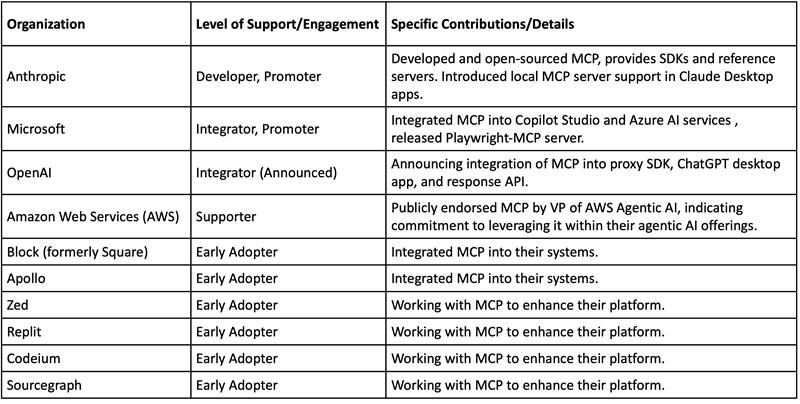
The Model Context Protocol is gaining rapid momentum and holds immense potential to simplify and accelerate the Industrial AI R(E)volution—particularly in the era of Agentic AI. Announcements from industry leaders like OpenAI, Microsoft, and AWS strengthen MCP’s position as a foundational standard for AI integration.
By providing a standardized way for AI models to access and interact with industrial data and tools, MCP helps address the long-standing challenge of data integration—unlocking new levels of intelligence and automation. It’s increasingly clear that MCP will play a significant role in helping us realize the full promise of Industrial AI—and may be a critical enabler in the journey toward truly Unified Namespaces in the industrial sector.
The convergence of MCP, UNS, and CESMII’s initiatives could create a powerful symphony—unlocking significant advancements in Industrial AI deployment at scale, and ushering in unprecedented levels of efficiency, productivity, and innovation across the industrial sector.
For ARC Advisory Group recommendations for Navigating the AI Wars, Closing the Digital Divide by Embracing Industrial AI, assembling your Industrial-Grade Data Fabric, and governing and guiding major decisions about enterprise, cloud, industrial edge, and AI software, please contact Colin Masson at [email protected] or set up a meeting with me, or my fellow Analysts at ARC Advisory Group.