Representative End User Clients







Representative Automation Clients







Representative Software Clients








When we began this series, we viewed Axis 1 (Application Domain) of ARC Advisory Group’s 3-Axis Industrial AI Models Taxonomy as a horizontal menu of operational theaters. However, as part of our ongoing Voyage of Discovery, rigorous testing with our network of clients and vendors has forced a necessary evolution. We have fundamentally restructured Axis 1 into a hierarchical "Reverse ISA-95" framework—an Escalation Ladder of Physical Consequence.
This ladder ascends from Level 0 (Enterprise Business & Sales), where errors are merely financial inefficiencies, up through Level 1 (Supply Chain Planning), Level 2 (Supply Chain Execution), Level 3 (Workforce, Service & Operations Management), Level 4 (Operations & Process Control), and ultimately to Level 5 (Engineering, R&D, and Design), where flawed foundations cascade into catastrophic physical or regulatory failure downstream.
By applying this newly refined hierarchy to the convergence of our 3 axes, the chaotic, overcrowded vendor landscape suddenly snaps into sharp focus. We begin to see distinct, highly specialized solution archetypes emerge.
In our forthcoming Industrial AI Models Strategy Report, we are actively mapping well over 120 global vendors to these specific archetypes. Due to the massive depth of this vendor landscape, we are exploring the archetypes in the next three blogs before we recap the full ARC Advisory Group 3-Axis Industrial AI Models Taxonomy and its benefits.
A Crucial Note on Our Voyage of Discovery: It is critical to state that we are still actively on this research journey. We are only sharing a few representative examples here across legacy titans, well-funded specialists, and agile startups. Furthermore, in this highly fluid market, readers should not infer that vendors only appear in a single silo; their architectural capabilities frequently span multiple archetypes as their corporate strategies evolve.
Today, let's look at the first of our 6 Industrial AI archetypes.
Before diving into the vendors dominating this space and mapping them against the 3-Axis Taxonomy, it is worth revisiting exactly how we define this archetype. As established earlier in this series:
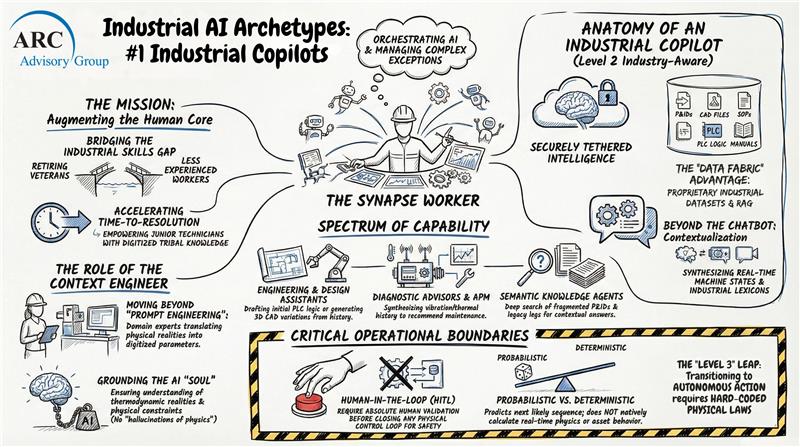
"At ARC Advisory Group, we define an Industrial Copilot as a highly contextualized, human-in-the-loop AI interface securely tethered to an organization's proprietary engineering, IT, and operational data. Unlike generic conversational AI, an Industrial Copilot is explicitly engineered to ingest complex industrial lexicons, digitize tribal knowledge, and synthesize real-time machine states. It actively guides frontline workers through complex troubleshooting, maintenance, and operational workflows, acting as an expert digital colleague that accelerates time-to-resolution while strictly requiring human validation before closing the physical loop."
— Colin Masson, ARC Advisory Group
The Mission: Augmenting human capacity, accelerating onboarding, and aggressively bridging the widening industrial skills gap caused by retiring experts.
Application Domain (The "What" & The Risk): These systems are anchored primarily in Domain Level 3 (Workforce, Service, & Operations Management) and can span down into Domain Level 0 (Enterprise Business). Why? Because these copilots deal heavily with prescriptive augmentation, cognitive automation, and field service guidance. They explicitly stop short of autonomous kinetic execution on the factory floor, keeping physical and regulatory consequences safely managed.
Axis 2: AI Model Class (The "How"): How do they reason? They primarily utilize Generative Models (Large Language and Code Models) combined with emerging Multi-Agent Systems. They are uniquely weaponized to parse massive volumes of complex, unstructured data—such as legacy OEM manuals, maintenance histories, and code repositories—translating it into conversational, actionable guidance.
Axis 3: Governance & Specificity (The "Context"): Where do they sit on the trust spectrum? These are definitively Level 2 (Industry-Aware) systems. They rely on a strong contextual baseline, typically utilizing Retrieval-Augmented Generation (RAG) securely tethered to gated proprietary data (the "Contextual Advantage"). Crucially, they mandate a "human-in-the-loop" governance model, requiring expert validation before any physical process is altered.
This archetype represents the epicenter of the current "Generative Skirmish," heavily populated by an array of vendors seeking to democratize their own proprietary data systems.
Legacy Titans: Siemens (Industrial Copilot) integrates with the TIA Portal for deterministic PLC code generation and debugging. Rockwell Automation leverages FactoryTalk Design Studio to bridge the gap between design and physical control. AVEVA utilizes its Industrial AI Assistant on the CONNECT platform to seamlessly link field engineers with 1D/2D schematics and incredibly heavy 3D CAD content pulled from the PI System.
Enterprise Orchestrators: SAP positions its Joule Copilot securely within global enterprise resource planning and supply chain financial networks, empowering procurement and logistics analysts.
Frontline & APM Specialists: Augmentir deploys its "Augie" GenAI Assistant to guide frontline workers through digital SOPs and "5-Why" root cause coaching. InSkill utilizes copilots securely tethered to gated proprietary service procedures to assist field technicians with complex equipment troubleshooting; notably, its website currently claims the largest installed base of active industrial copilots in the market today. SymphonyAI uses persona-based IRIS Foundry Copilots for rapid root-cause anomaly detection. IFS applies the IFS.ai Copilot to Enterprise Asset Management, drastically simplifying complex reliability engineering tasks like Failure Modes, Effects, and Criticality Analysis (FMECA). Seeq is pushing the boundaries of time-series data analysis by integrating agentic workflows directly into its ecosystem. Moving from pure analytics to enterprise decision intelligence, Seeq captures subject matter expert (SME) knowledge to deploy highly capable Industrial AI Concierges that accelerate problem-solving across the plant floor.
The Hyperscaler Toolchains (The DIY Route): For organizations possessing deep internal data science talent that want to construct their own bespoke solutions, the major cloud providers—such as Microsoft (Azure AI Studio/Copilot Studio), AWS (Amazon Bedrock/AgentCore), and Google Cloud (Vertex AI)—offer the foundational LLMs and orchestration frameworks required for in-house teams to build custom Copilots from the ground up.
Interestingly, the boundaries between these Industrial AI archetypes are highly fluid, reflecting a rapidly evolving market. A prime example is Imubit. Traditionally recognized as a vanguard of closed-loop Advanced Process Control (fitting squarely into our next archetype, the Process Optimizer), Imubit recently briefed ARC on a notable strategic evolution. While retaining its deep optimization roots, it is placing less emphasis purely on its Deep Learning Process Control (DLPC) engine, pivoting to become more of an AI workflow and operator decision support tool. By focusing on guiding plant personnel through complex, non-linear process states and empowering the workforce with intelligent advisories, Imubit is successfully extending its reach directly into the realm of the advanced Industrial Copilot.
In our next post, we will continue our exploration of the Industrial AI archetypes we’re mapping out against the ARC 3-Axis Taxonomy, moving up the Axis 1 escalation ladder—discussed at the beginning of the blog—exploring the specialized domain of Process Optimizers and Deep Science Generators.
The Industrial AI (R)Evolution is moving faster than ever. To dive deeper into the frameworks and data shaping the future of the industrial sector, explore my latest research:
Navigating the AI Wars and the escalating Industrial Robot Wars
Closing the Digital Divide by Embracing Industrial AI
Assembling your Industrial-Grade Data Fabric
Charting the new frontier of Physical Intelligence and transitioning to a Cyber-Physical Industrial Architecture (CPIA)
Mapping your maturity and strategy with ARC's 3-Axis Industrial AI Models Taxonomy
Where do you stand in the Industrial AI (R)Evolution? Take our Industrial AI Assessment to benchmark your organization's maturity, identify critical gaps in your IT/OT/ET convergence, and get actionable recommendations to accelerate your path to becoming an Industrial AI Pacesetter.
Don't guess what your global operations or prospective customers need. Use empirical data to align your stakeholders and de-hype the market with ARC Advisory Group's Voice of Market Service.
For tailored recommendations on governing and guiding major people, process, and technology decisions across the enterprise, cloud, industrial edge, and AI, please contact Colin Masson at [email protected].
Or, set up a meeting with my fellow Analysts and I at ARC Advisory Group to find out more about our Executive Insights Service for Industrial organizations and our Industrial AI Insights Service for Vendors.