Representative End User Clients







Representative Automation Clients







Representative Software Clients








Flow measurement has long been considered a foundational element of process control. For decades, flowmeters have fulfilled a clearly defined role: measuring the movement of liquids and gases to support operational stability, process efficiency, and regulatory compliance. While the underlying measurement principles of many technologies have remained consistent, the environment in which they operate is undergoing a fundamental transformation.
Today, flow technologies are evolving beyond their traditional role as measurement devices. They are becoming intelligent, connected, and increasingly adaptable components of a larger digital ecosystem. This shift reflects a broader transition across industrial automation, where instrumentation is no longer evaluated solely on measurement performance, but on its ability to contribute to insight, decision-making, and system-wide optimization.
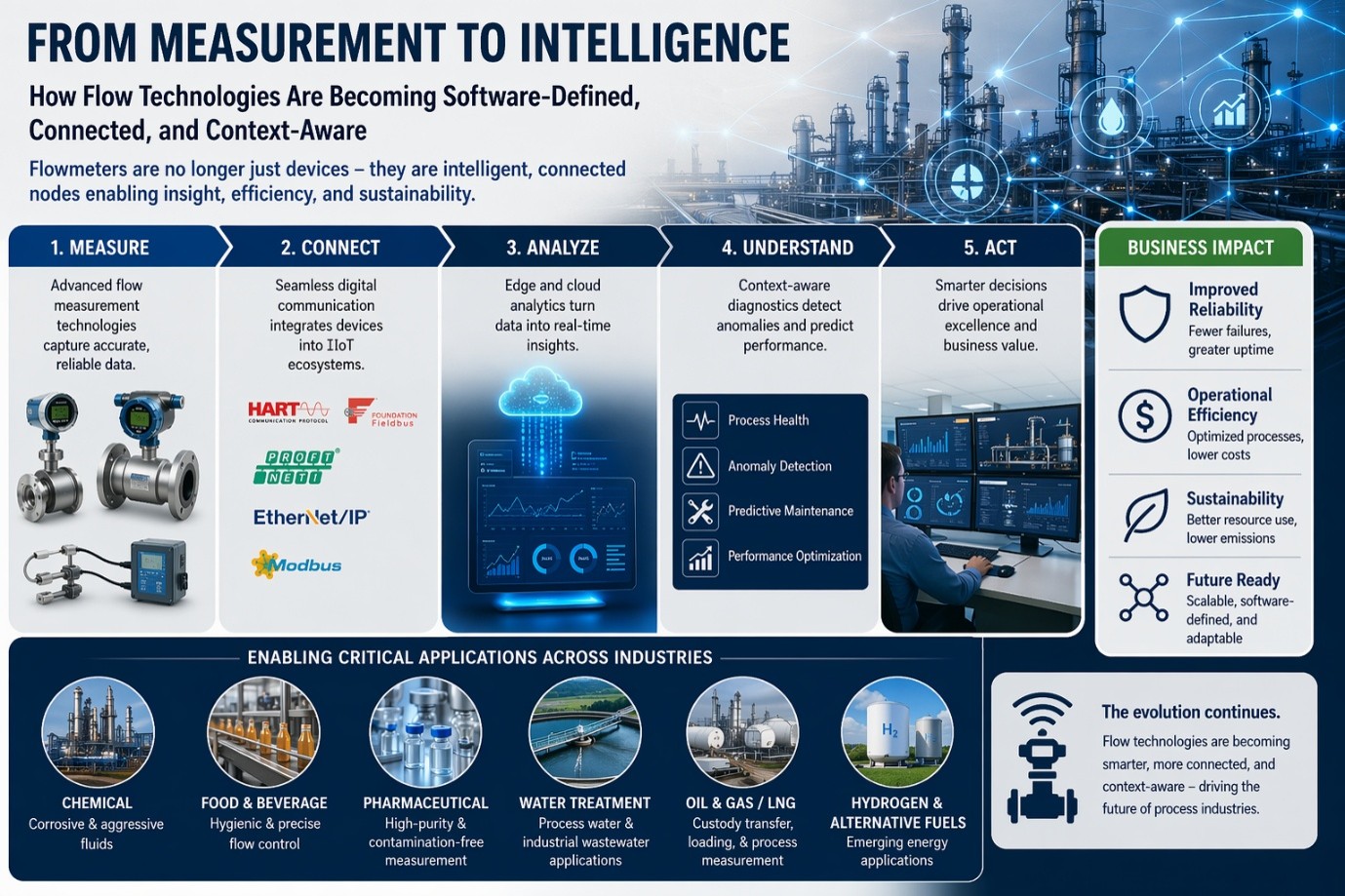
Historically, flowmeters were deployed as isolated devices. They measured flow, transmitted signals, and relied on centralized control systems for interpretation and action. Data flow was largely unidirectional, moving from the instrument to the control system with limited feedback or contextual analysis.
This architecture is rapidly changing.
Modern flow technologies are now integrated into connected industrial networks, where they operate as continuous data sources rather than periodic measurement points. Instead of simply reporting flow rates, these devices contribute to a broader stream of operational data used across plant-wide systems. This shift also reflects the growing complexity of instrumentation decisions and the need to align technology selection with process requirements, as outlined in ARC’s blog, Choosing the Right Flow and Level Technology: Why One Size Does Not Fit All in Modern Process Plants.
This transformation marks a fundamental shift: flowmeters are no longer standalone instruments; they are becoming nodes within a connected system.
One of the most visible drivers of this transformation is the rapid expansion of industrial connectivity. The growth of Industrial IoT platforms has enabled the integration of field instruments into real-time monitoring and analytics environments.
Flow technologies are increasingly designed to:
Integrate with digital communication protocols.
Provide real-time access to measurement data.
Support remote monitoring and configuration.
Enable seamless data exchange across systems.
This connectivity allows measurement data to be shared across operations, maintenance, and engineering functions, improving visibility and supporting more informed decision-making. Measurement technologies are increasingly influencing broader operational performance and business outcomes, as discussed in ARC’s blog, From Sensors to Strategy: Why Measurement Technology Is Becoming a Business Decision.
Another major development is the movement of computational capability closer to the measurement point.
Edge computing is transforming how data is processed in industrial environments. Rather than transmitting all measurement data to centralized systems, modern flow technologies can process and analyze information locally, at or near the instrument itself.
This enables:
Faster detection of anomalies.
Reduced dependence on external systems.
Real-time response to changing process conditions.
As a result, flowmeters are beginning to operate not just as sensors, but as intelligent devices capable of interpreting their own data.
A defining characteristic of next-generation flow technologies is their ability to become context-aware.
Context awareness refers to the ability of an instrument to interpret measurement data in relation to the process environment. Instead of simply measuring flow, the device can identify patterns, detect deviations, and relate those deviations to potential process issues.
Recent developments show that instruments are evolving to:
Compare real-time data against expected process behavior.
Identify abnormal conditions such as fouling or instability.
Provide actionable insights rather than raw data.
This represents a shift from reactive measurement to proactive understanding. Instruments are no longer passive observers; they are beginning to contribute to process intelligence.
One of the most significant and emerging concepts in industrial measurement is software-defined instrumentation.
In this model, the functionality of a flowmeter is no longer fixed by hardware alone. Instead, capabilities can be:
Updated through software.
Adapted to different applications.
Enhanced with new analytical or diagnostic functions.
This allows instrumentation to evolve without requiring physical replacement. Devices become programmable nodes within a digital system, capable of supporting changing process requirements and new operational strategies.
Another emerging trend is the shift from single-sensor measurement to integrated, multi-sensor approaches.
In complex process environments, relying on a single measurement principle can introduce limitations. New approaches combine multiple sensing technologies to improve overall measurement reliability and accuracy.
These integrated systems enable:
Better cross-validation of measurement data.
Increased resistance to process variability.
More comprehensive understanding of system behavior.
This evolution reflects a broader transition toward structured measurement system design, where instruments function as part of a coordinated framework, as described in ARC’s blog, Measurement Architecture Becomes a Priority in Process Plants.
The transformation of flow technologies has significant implications for process industries.
Improved operational visibility: Connected and intelligent flowmeters provide continuous insight into process behavior.
Enhanced reliability and maintenance: Context-aware diagnostics enable earlier identification of issues, supporting predictive maintenance strategies.
Greater adaptability: Software-defined capabilities allow instruments to evolve alongside process requirements.
Stronger system integration: Flow measurement becomes part of a larger ecosystem that supports analytics, optimization, and operational decision-making.
The evolution of flow technologies reflects a broader transformation in industrial automation. While traditional measurement capabilities remain essential, they are no longer sufficient on their own.
Flowmeters are becoming:
Connected through Industrial IoT ecosystems.
Intelligent through local processing and diagnostics.
Context-aware through process insight.
Adaptable through software-driven functionality.
This progression signals a shift from measuring flow to understanding and managing processes through flow data.
In this new paradigm, the value of flow technologies lies not just in their ability to measure, but in their ability to enable smarter, more responsive, and more efficient industrial operations.