Representative End User Clients







Representative Automation Clients







Representative Software Clients









At Automate 2026, much of the attention was focused on humanoid robots, autonomous systems, and the rapid acceleration of Industrial AI. Yet one of the most important discussions on the show floor centered on a less visible—but equally critical—topic: the components and supply chains that make modern robotics possible.
During a conversation with representatives from MISUMI and Fictiv, one theme emerged repeatedly: the future of robotics depends as much on supply chain excellence and component availability as it does on AI and software innovation.
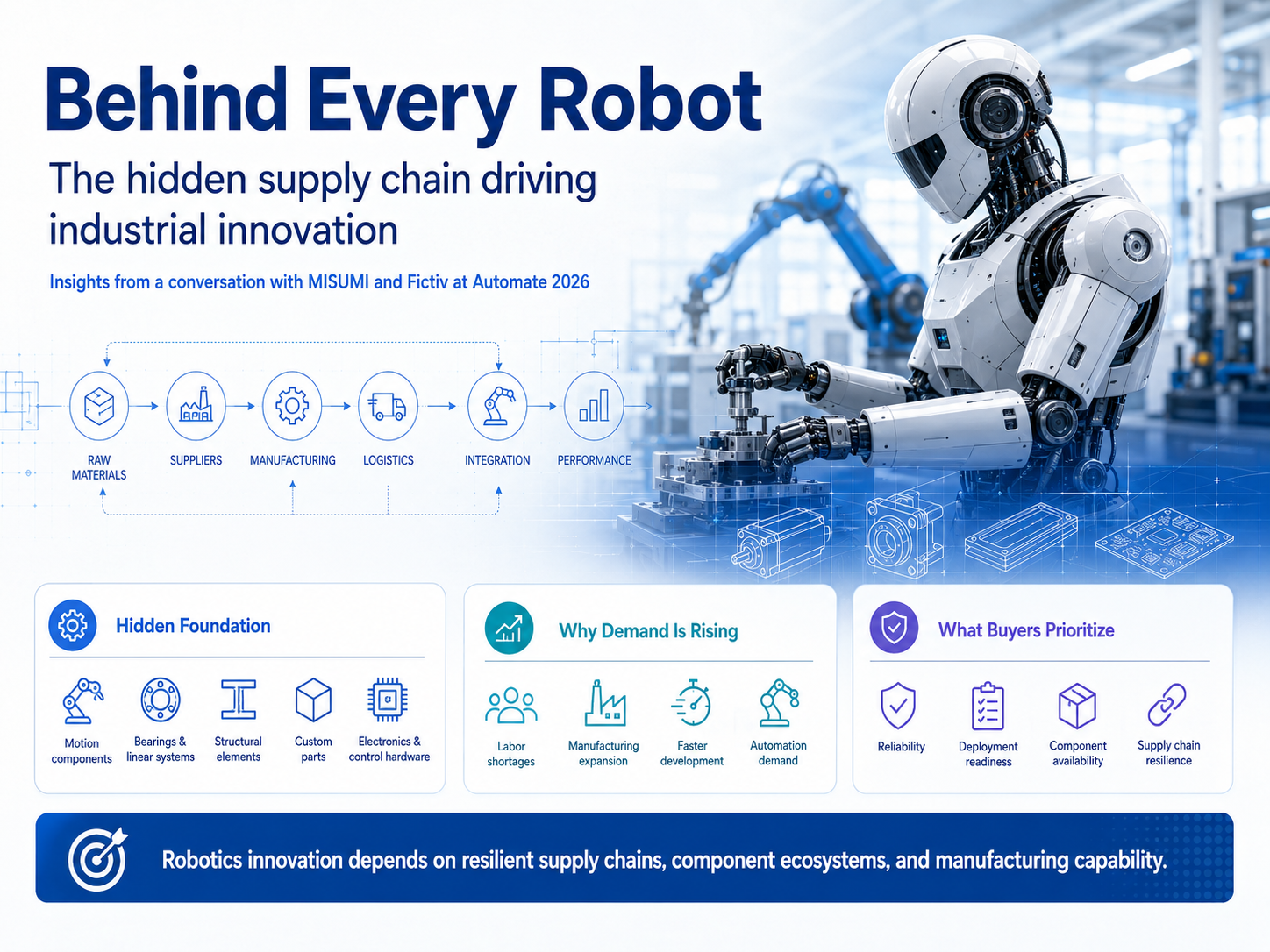
When most people see a robot, they see the finished product—the humanoid walking across a factory floor, the mobile robot navigating a warehouse, or the robotic arm assembling equipment. What remains largely invisible are the thousands of components that enable those systems to function reliably.
As one participant noted, robotics is a bit like a duck gliding across the water. The visible motion appears effortless, but underneath the surface, there is tremendous activity.
The discussion highlighted a growing reality across industrial markets: while advances in AI continue to receive most of the headlines, many robotics companies today identify mechanical components and supply chain constraints as some of their most significant challenges.
Not surprisingly, companies developing humanoid robots, mobile robots, and industrial automation systems are increasingly focused on securing access to high-quality components, reducing sourcing risks, and accelerating product development cycles.
The conversation quickly shifted to broader manufacturing trends.
As industries attempt to increase domestic production capacity, many manufacturers continue to face significant labor shortages. Skilled machinists, technicians, and manufacturing specialists remain difficult to find, creating additional pressure to automate operations and improve productivity.
Yet automation itself requires an extensive ecosystem of suppliers.
Whether components originate from North America, Europe, Japan, or China, industrial companies still depend on complex global supply networks for:
Mechanical assemblies.
Motion components.
Bearings and linear systems.
Structural elements.
Custom-manufactured parts.
Electronics and control hardware.
This reality creates an interesting paradox. Efforts to expand manufacturing capacity often increase demand for automation technologies, which in turn increases demand for the very supply chains required to build those automation systems.
The discussion also reflected broader trends visible throughout Automate 2026.
Investment in robotics remains exceptionally strong. New humanoid robotics startups continue to emerge, supported by significant venture capital and strategic investment. Many exhibitors showcased technologies aimed at industrial, logistics, service, and retail applications.
Interestingly, several attendees noted the growing presence of Chinese robotics companies exhibiting in the US, many of which are actively seeking partnerships and market expansion opportunities.
This reflects a larger global trend: robotics is increasingly viewed as a strategic technology area at both the corporate and national levels.
At the same time, industrial buyers are becoming more pragmatic. While humanoids generate excitement, actual purchasing decisions often come down to practical considerations such as:
Reliability.
Cost.
Deployment readiness.
Serviceability.
Component availability.
Supply chain resilience.
The conversation also provided insight into how component suppliers are adapting to these market changes.
The combination of MISUMI's configurable and standardized industrial components with Fictiv's custom manufacturing capabilities creates a broader platform for serving machine builders, robotics developers, and product innovators.
Rather than viewing standard and custom manufacturing as separate worlds, the combined approach enables customers to source everything from catalog components to highly specialized custom parts through a more integrated ecosystem.
This is particularly valuable in industries such as:
Robotics.
Aerospace.
Medical devices.
Clean energy.
Advanced manufacturing.
As robots become more sophisticated and product development cycles accelerate, engineering teams increasingly seek suppliers capable of supporting both rapid prototyping and large-scale production.
A particularly interesting portion of the discussion focused on workforce concerns.
Some younger workers increasingly worry that AI will replace future jobs. Yet history suggests the relationship between technology and employment is far more nuanced.
One participant reflected on similar concerns surrounding automation decades ago. Predictions that industrial automation would eliminate manufacturing jobs did not materialize as expected. Instead, automation often increased productivity while creating new roles and opportunities.
Today's AI revolution may follow a similar pattern.
Manufacturing facilities continue to require:
Skilled technicians.
Process engineers.
Maintenance specialists.
Automation experts.
CNC programmers.
Robotics operators.
AI is increasingly becoming a tool that augments human expertise rather than eliminating the need for it altogether.
A Positive Outlook for Industrial Manufacturing
Perhaps the most encouraging takeaway from the conversation was a sense of optimism.
For decades, industry observers have discussed the decline of manufacturing and the migration of production capacity overseas. Today, however, many companies are beginning to see tangible signs of renewed industrial investment.
Manufacturing activity, automation spending, infrastructure expansion, energy projects, and AI-driven capital investment are all contributing to increased demand across industrial sectors.
If the AI boom ultimately drives new factory construction, energy infrastructure development, and greater automation adoption, the resulting opportunities could benefit manufacturers, suppliers, and technology providers alike.
Automate 2026 made one thing clear: robotics innovation is not just about AI, software, or humanoid robots.
The companies that will shape the next generation of automation are also those building the supply chains, component ecosystems, and manufacturing capabilities that make these technologies possible.
Robots may be the visible face of industrial transformation, but behind every robot is an extensive network of suppliers, engineers, manufacturers, and innovators working together to turn ambitious ideas into operational reality.
As robotics adoption accelerates, the importance of resilient supply chains and component ecosystems will only continue to grow. The winners of the next industrial era may not simply be the companies building the most advanced robots—they may be the companies enabling those robots to be built at scale.
Robotics innovation depends not only on AI and software, but also on the component ecosystems, manufacturing capabilities, and supply chains required to bring automation systems into real-world operation. To explore more of ARC’s coverage on robotics, Physical AI, and industrial automation trends, read ARC’s related insights:
Humanoid Robots vs. Industrial Reality: What Actually Matters?
Navigating the Ecosystem of Industrial Humanoids: Early Movers and Key Partnerships
These insights point to a broader industrial shift, as robotics, AI, supply chain resilience, and advanced manufacturing capabilities become increasingly connected.