Representative End User Clients







Representative Automation Clients







Representative Software Clients








For decades, manufacturers have built their reputations on one simple promise: every product leaving the factory meets the highest quality standards. Whether producing automotive components, electronics, medical devices, semiconductors, or industrial equipment, consistent quality has been the foundation of long-term customer relationships.
Today, maintaining that promise has become significantly more challenging. Product portfolios continue to expand, production cycles are becoming shorter, labor shortages persist across manufacturing industries, and customers expect near-zero defects. Traditional inspection methods, while effective in the past, are increasingly struggling to keep pace with modern manufacturing environments.
Machine vision has evolved from an automation tool for defect detection into an intelligent quality assurance platform that continuously adapts to changing production conditions. The emergence of autonomous machine vision represents the next stage of this evolution.
Manufacturing has become more dynamic than ever before. A single production line may manufacture dozens of product variants, often switching between batches multiple times a day. At the same time, manufacturers must maintain tighter tolerances while increasing throughput.
Historically, manual inspection has played a critical role in ensuring quality. Skilled inspectors can identify scratches, dents, missing components, dimensional inconsistencies, and cosmetic defects that automated systems may struggle to detect. However, manual inspection introduces unavoidable variability. Fatigue, repetitive work, changing lighting conditions, and operator experience can all influence inspection consistency.
Conventional machine vision addressed many of these limitations by automating repeatable inspection tasks. Rule-based systems delivered consistent results under tightly controlled conditions by comparing captured images against predefined parameters.
However, production environments rarely remain static.
Minor changes in lighting, material finish, supplier inputs, surface reflectivity, or product positioning often require inspection systems to be recalibrated or reprogrammed. As product diversity increases, maintaining hundreds of inspection rules becomes increasingly complex and expensive.
The challenge is no longer whether manufacturers should automate inspection. It is whether inspection systems themselves can adapt to the realities of modern production.
Artificial intelligence has significantly expanded the capabilities of machine vision.
Unlike conventional rule-based inspection systems, AI-enabled vision systems learn acceptable product variations instead of relying solely on fixed thresholds. This enables them to distinguish between normal manufacturing variation and genuine defects while reducing false rejects.
AI is also transforming how manufacturers deploy vision systems.
Traditional AI implementations often required thousands of labeled images, extensive defect libraries, data scientists, and lengthy model development cycles. While these solutions remain valuable for highly complex applications, they can create barriers for manufacturers seeking faster deployment and easier maintenance.
The industry is now witnessing the emergence of autonomous machine vision systems that simplify implementation while retaining the benefits of AI-driven inspection.
Autonomous machine vision shifts the focus from programming inspection rules to teaching systems what constitutes an acceptable product.
Instead of requiring extensive coding and image-processing expertise, operators train the system using representative samples of acceptable parts. The vision system then automatically learns product characteristics, acceptable tolerances, and natural process variations.
Multiple AI capabilities work together throughout the inspection process:
Intelligent image acquisition automatically optimizes camera settings and imaging parameters.
Object recognition identifies products despite variations in orientation or positioning.
Deep learning algorithms differentiate between acceptable variations and actual defects.
Continuous adaptation helps inspection performance remain robust despite changing production conditions.
This approach significantly reduces engineering effort while improving inspection flexibility.
For manufacturers that frequently introduce new products or manage high-mix, low-volume production, this represents a major operational advantage.
One of the biggest changes occurring in the machine vision market is not necessarily the development of better algorithms. It is improved accessibility.
Historically, deploying machine vision often required specialized vision engineers, extensive programming, prolonged commissioning periods, and substantial integration costs. These factors limited adoption, particularly among small and medium-sized manufacturers.
Modern autonomous vision platforms are reducing these barriers by enabling faster setup, simplified training, and easier integration with existing automation infrastructure.
Instead of treating machine vision as a large engineering project, manufacturers can increasingly evaluate inspection applications through pilot deployments, validate performance under actual production conditions, and expand implementation once measurable value has been demonstrated.
This lower-risk approach is accelerating adoption across industries that previously viewed AI-based inspection as too complex or resource-intensive.
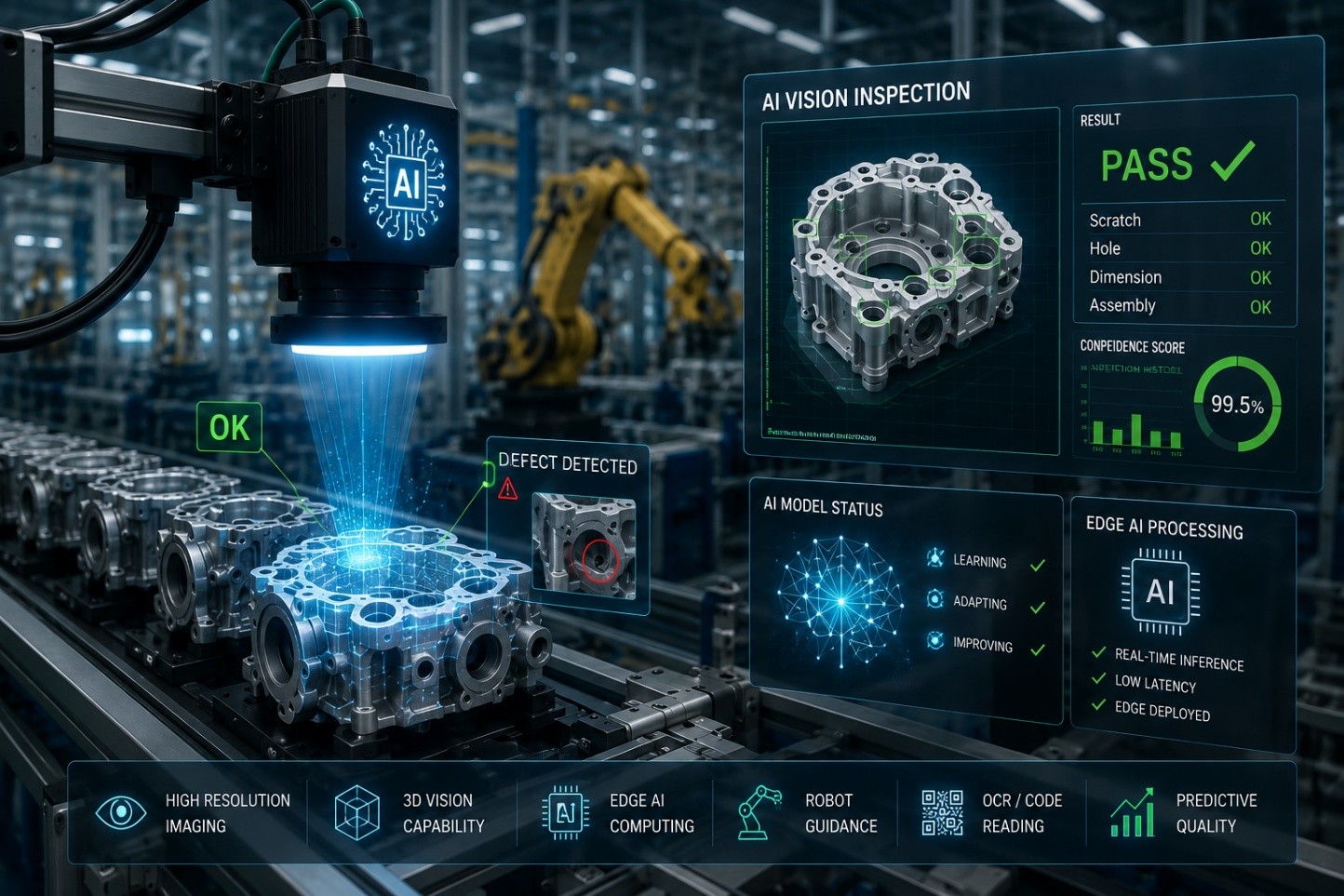
Machine vision is expanding beyond traditional quality inspection. AI-powered systems now support dimensional gauging, assembly verification, optical character recognition (OCR), barcode reading, robot guidance, and predictive quality monitoring.
At the same time, 3D vision technologies—including structured light, laser triangulation, stereo vision, and time-of-flight imaging—are enabling applications such as robotic bin picking, semiconductor inspection, battery manufacturing, and precision assembly.
The adoption of edge AI is further improving real-time inspection by processing images directly on smart cameras and edge devices, reducing latency and improving production responsiveness.
As manufacturing becomes increasingly automated and data-driven, inspection systems must evolve from static, rule-based solutions into intelligent platforms that continuously adapt to changing products and operating conditions.
Autonomous machine vision combines AI, advanced imaging, and simplified deployment to help manufacturers improve quality, reduce engineering effort, and increase operational flexibility. Rather than replacing human expertise, it enhances it, allowing skilled workers to focus on higher-value tasks while ensuring consistent quality across increasingly complex manufacturing environments.
As AI technologies continue to mature, autonomous machine vision will become a key enabler of smarter, more resilient, and more efficient factories.
Machine Vision Gets Smarter: How Cognex Is Bringing AI to Industrial Inspection
The Future of Machine Vision: From Inspection to Intelligence
Together, these ARC insights highlight how advances in AI, edge computing, 3D vision, and simplified deployment are expanding the role of machine vision across quality control and intelligent manufacturing.