Representative End User Clients







Representative Automation Clients







Representative Software Clients








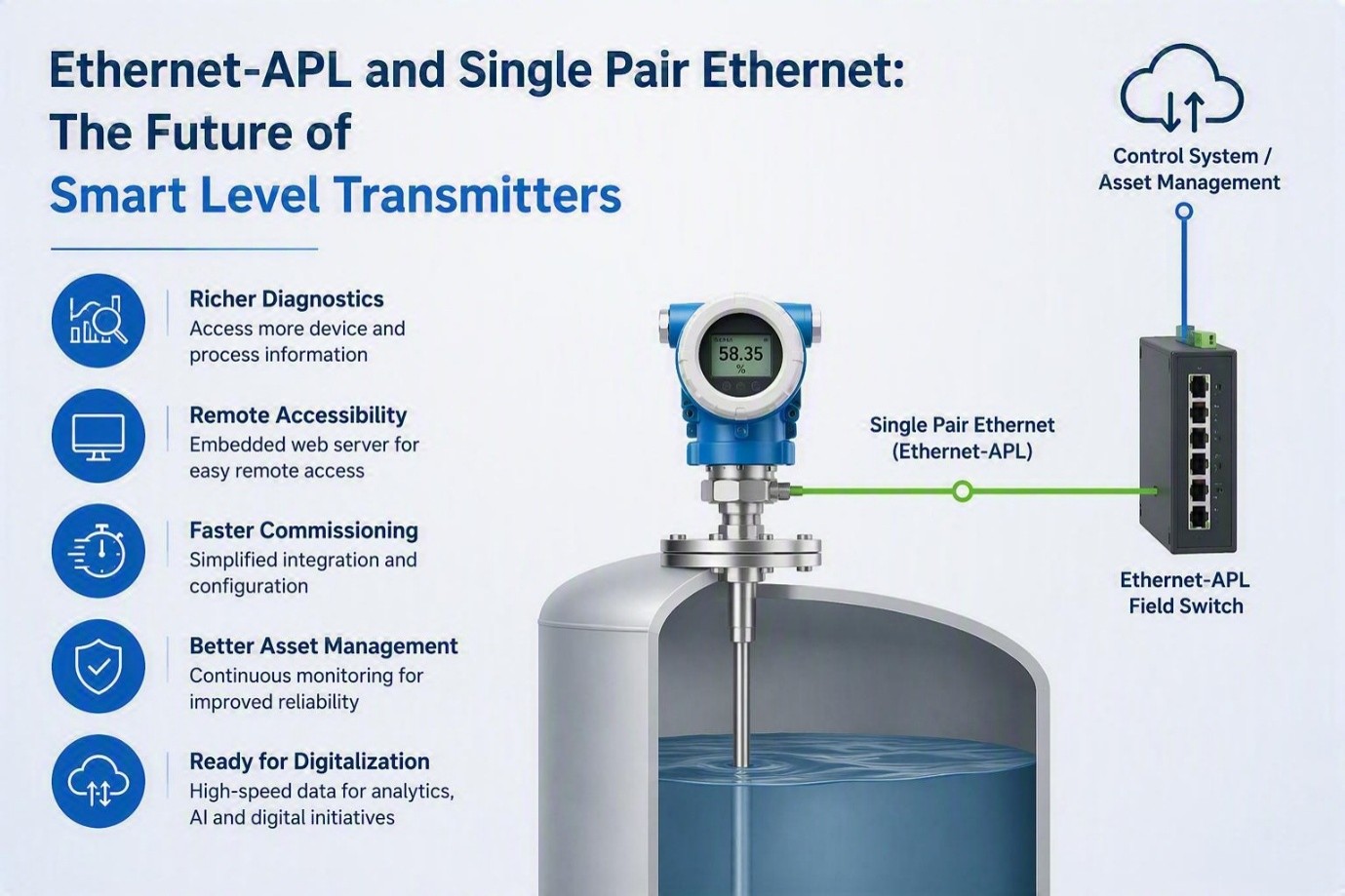
For decades, level transmitters have relied on proven communication technologies such as 4-20 mA, HART, FOUNDATION Fieldbus, and PROFIBUS PA. These technologies continue to serve process industries effectively, providing reliable measurements in applications ranging from storage tanks and reactors to separators and distillation columns. However, as industrial organizations accelerate their digital transformation initiatives, expectations for field instrumentation are changing. End users increasingly seek faster access to diagnostic information, simpler system integration, and greater visibility into instrument health across the plant.
This is where Single Pair Ethernet (SPE) and Ethernet-APL (Advanced Physical Layer) enter the picture.
While these technologies are often discussed in the context of networking infrastructure, their long-term impact may be most visible at the field device level. For level transmitters, Ethernet-APL has the potential to enable a new generation of connected, intelligent instrumentation capable of delivering far more than a process variable.
Ethernet-APL is a two-wire Ethernet technology developed specifically for process automation environments. Built on Single Pair Ethernet technology, it enables both power and high-speed data communication over a single cable while supporting long cable distances and hazardous-area installations. Unlike conventional Ethernet, Ethernet-APL is designed to meet the requirements of process plants, including intrinsic safety and field-level deployment.
The technology allows Ethernet connectivity to extend directly to field instruments such as flowmeters, pressure transmitters, temperature devices, and level transmitters, creating a continuous digital communication path from the sensor to higher-level control and information systems.
This evolution reflects a broader industry shift from selecting instruments individually toward designing integrated measurement ecosystems. As discussed in ARC's article Measurement Architecture Becomes a Priority in Process Plants, measurement strategies are increasingly focused on how devices interact, share information, and contribute to plant-wide operational goals rather than functioning as isolated instruments.
Conventional communication architectures have proven reliable, but they were not originally designed to support the enormous amount of diagnostic and contextual data available from today's smart instruments.
Modern radar and guided wave radar level transmitters continuously generate information related to signal quality, device condition, configuration status, and process performance. Much of this data remains underutilized because communication bandwidth, integration complexity, or network architecture limitations often restrict access.
As facilities pursue predictive maintenance strategies and asset performance initiatives, the ability to obtain richer information from field devices becomes increasingly important.
Increasingly, users are recognizing that measurement technologies influence far more than process control. The strategic value of measurement data now extends into reliability improvement, maintenance optimization, operational efficiency, and business performance. This trend was explored in ARC's blog, From Sensors to Strategy: Why Measurement Technology Is Becoming a Business Decision.
The most significant benefit of Ethernet-APL may not be faster communication alone. Instead, its value lies in transforming level transmitters from measurement devices into continuously connected information sources.
Advanced level transmitters already contain sophisticated diagnostics capable of identifying coating buildup, signal disturbances, device faults, and application-related issues. Ethernet-APL enables rapid access to this information, helping maintenance personnel identify developing problems before measurement performance is affected.
Instead of troubleshooting after a failure occurs, plant personnel can move toward condition-based maintenance strategies driven by real-time instrument health data.
This evolution mirrors broader developments across measurement technologies, where diagnostics are becoming a key source of operational value. Rather than simply reporting measurements, instruments are increasingly expected to provide health status, maintenance alerts, and actionable process insight.
Many Ethernet-APL-enabled instruments support embedded web server functionality that allows users to access configuration, status information, and diagnostic tools remotely through standard Ethernet networks.
For level measurement applications located in difficult-to-access areas, this capability can significantly reduce commissioning and maintenance effort.
Remote accessibility also supports the growing need for centralized asset monitoring and intelligent device management, allowing engineering teams to make more informed decisions using real-time information from field instruments.
Commissioning large numbers of field devices can be time-consuming, particularly in complex process facilities. Ethernet-APL's standardized Ethernet connectivity can simplify device integration and support modern engineering workflows.
As digital project execution becomes more common, direct Ethernet connectivity at the instrument level can help reduce engineering complexity and improve configuration consistency across the plant.
The broader industry movement toward intelligent devices, predictive maintenance, and Industrial IoT-enabled operations continues to reinforce the value of open digital communication platforms and connected instrumentation.
The industrial sector continues to explore new applications for data analytics, artificial intelligence, and digital twins. These initiatives require access to high-quality operational data from field devices.
Future level transmitters connected through Ethernet-APL could provide significantly more process and diagnostic information to higher-level analytics platforms, enabling improved asset monitoring and operational insights.
As industrial AI and advanced analytics mature, the ability to access rich diagnostic data directly from field devices may become increasingly important. The value of a level transmitter may no longer be determined solely by measurement accuracy, but by the quality of information it contributes to broader plant optimization initiatives.
Radar level technology has become one of the preferred solutions for many demanding process applications due to its accuracy, reliability, and suitability across a wide range of operating conditions.
As discussed in ARC's article Why Radar Level Measurement Is Redefining Reliability in Process Plant Design, reliability increasingly depends not only on the measurement technology itself but also on the quality of information available to operators and maintenance personnel. Ethernet-APL can help extend the value of radar measurement by making diagnostic and asset information more accessible throughout the organization.
This could enable faster issue identification, improved maintenance planning, and greater confidence in measurement performance across critical applications.
Although Ethernet-APL adoption remains in its early stages, several instrumentation suppliers have already introduced Ethernet-APL-capable field devices. Available offerings include measurement technologies such as radar level instruments, flowmeters, and temperature transmitters designed for Ethernet-based process automation architectures.
The introduction of Ethernet-APL-ready level products suggests that suppliers view Ethernet connectivity as an increasingly important requirement for future field instrumentation strategies.
Despite its promise, widespread adoption is unlikely to occur overnight.
Process facilities typically maintain installed assets for many years, and existing HART, FOUNDATION Fieldbus, and PROFIBUS PA infrastructures continue to provide substantial value. Replacing communication infrastructure solely for networking improvements may not always be economically justified.
In addition, many organizations remain focused on extracting greater value from existing digital assets before investing in next-generation communication architectures.
Technology selection in process industries rarely follows a one-size-fits-all model. As discussed in Choosing the Right Flow and Level Technology: Why One Size Does Not Fit All in Modern Process Plants, the optimal solution depends on process requirements, lifecycle considerations, operational objectives, and existing infrastructure. The same principle applies to Ethernet-APL adoption.
As a result, Ethernet-APL is likely to coexist with traditional communication technologies for an extended period rather than immediately replacing them.
The future of level measurement will be shaped not only by advances in sensing technologies but also by how effectively instruments communicate information throughout the enterprise.
Ethernet-APL represents an important step toward fully digital field instrumentation. By combining power and high-speed Ethernet communication over a single pair of wires, it creates opportunities for smarter diagnostics, improved connectivity, enhanced asset management, and tighter integration with industrial digitalization initiatives.
While adoption will vary by industry, plant modernization strategy, and project economics, the technology has the potential to redefine what users expect from level transmitters in the years ahead. Rather than serving solely as measurement devices, future level instruments may become intelligent digital assets that contribute directly to plant performance, reliability, and operational decision-making.
For end users evaluating digital transformation roadmaps, the key question may no longer be whether Ethernet reaches the field, but how quickly field instruments can take advantage of it.
For additional ARC perspectives on Ethernet-APL, field-level connectivity, and the evolution of digital process instrumentation, see:
Ethernet-APL: Transforming Industrial Connectivity for the Process Industries
Unified Ethernet Standard Advances Single Pair Ethernet and Ethernet-APL for Industrial Automation
ABB Completes Integration of Ethernet-APL Connectivity to Flowmeter Portfolio
Together, these ARC resources provide broader context on the standards, supplier activity, market development, and process automation requirements shaping Ethernet-APL adoption as Ethernet connectivity moves closer to the field device level.