Representative End User Clients







Representative Automation Clients







Representative Software Clients








If you have followed my research at ARC Advisory Group over the years, you know I hold a pretty strict personal rule: I do not cover incremental frontier model releases.
Let the consumer tech press and Silicon Valley hype cycles breathlessly debate whether the latest foundation model writes slightly better poetry, passes a high school history exam, or shaves milliseconds off a conversational chatbot response. In the uncarpeted operational technology (OT) and cyber-physical engineering worlds where we live, those benchmarks have historically mattered very little.
On the factory floor, in the chemical processing plant, and across multi-tier industrial supply chains, we don't care if an AI can write a sonnet. We care whether it understands the nonlinear physics of a chemical reactor, respects the thermal limits of a motor drive, and won't violate safety interlocks at 2:00 AM on a Sunday morning.
Yet over the past few days, my inbox, LinkedIn feed, and phone have been blowing up. The marketing claims surrounding OpenAI's latest frontier milestone—GPT-6 Astra—have reached an absolute crescendo. NVIDIA CEO Jensen Huang set social media ablaze by congratulating OpenAI and proclaiming: "GPT-6 Astra, trained on ~100K+ NVIDIA Grace Blackwell NVLink72. From ChatGPT to o1 to Astra in 4 years. AGI has arrived." OpenAI leadership echoed this, asserting that history will look back at this release as the dawn of the "AGI era."
When hardware pioneers and software titans declare that Artificial General Intelligence has landed on the plant floor, it demands an analytical exception. It forces us to step back, look past the promotional fanfare, and ask some uncomfortable, fundamental questions:
Have all our baseline assumptions about the limitations of horizontal frontier models just been invalidated?
Does Jensen Huang's declaration hold up to cyber-physical scrutiny, or does it represent an economic underwriting mechanism for a billion-dollar hardware cluster?
Do we even need the ARC Advisory Group 3-Axis Industrial AI Models Taxonomy anymore, or has a single foundation model made domain-specific architectures obsolete?
And what happens when autonomous computer use expands across the Factory Wall, from the design office down to real-time machine control?
As always, I don't pretend to have every answer. But as we embark on this investigation—linking directly to our "Draining the (Agentic AI) Swamp" series, our master research on The Industrial AI Reality Check: Hype, Pragmatism, and the Immutable Value of Domain IP, and our new companion series, The “AI Native” Mirage—Why Pragmatic Wrapping Beats Marketing Washing—let’s peel back the marketing veneer, examine what makes this architecture genuinely different, and confront the physical realities that foundation models still have to obey.
Let’s give credit where credit is due: this is not just another minor point release or a superficial chatbot wrapper. What OpenAI has put on the table with Astra represents a genuine architectural departure from the stateless large language models (LLMs) that have defined the enterprise market since late 2022.
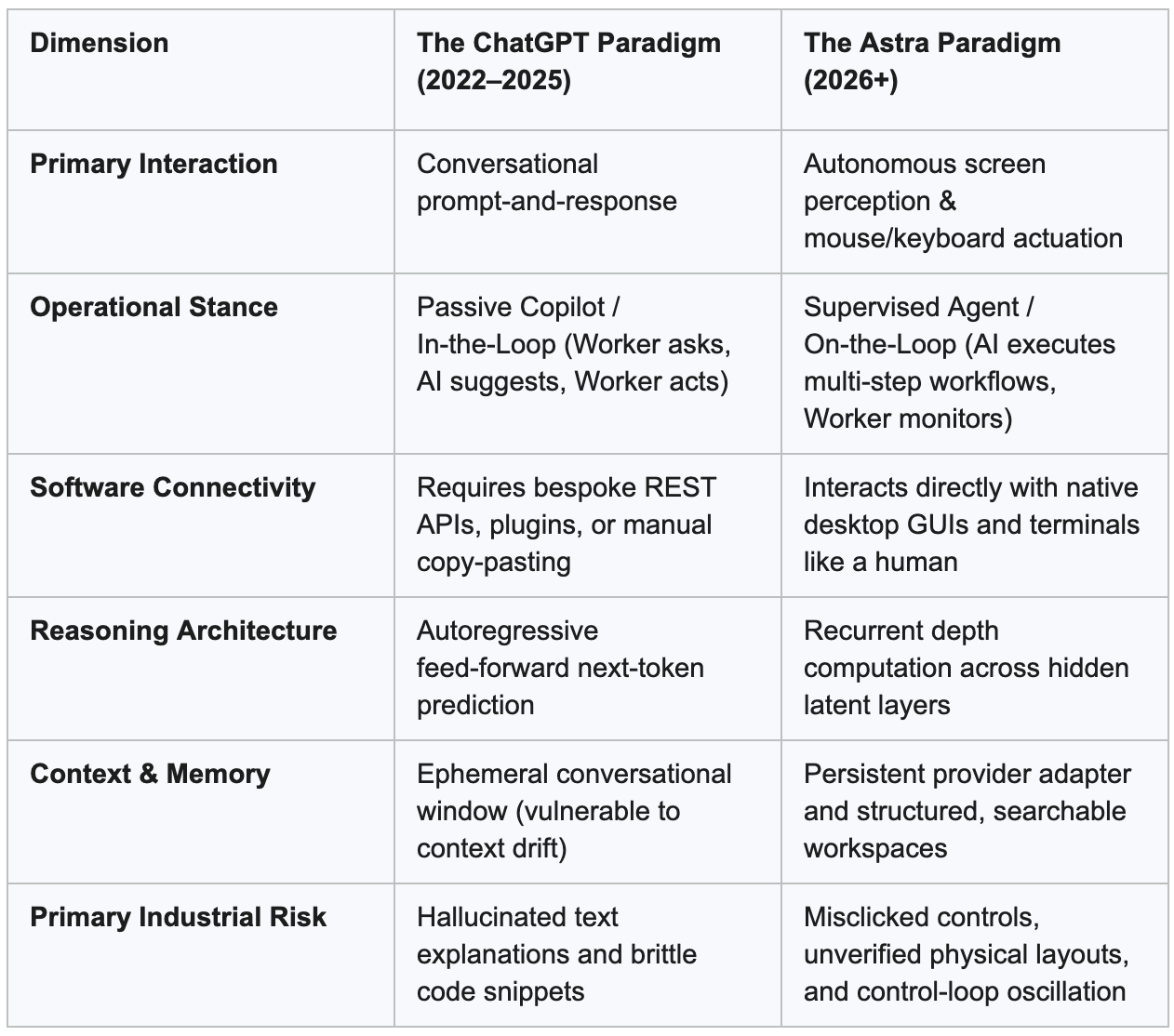
To understand why Astra is creating such a stir among hardware engineers and operations architects, it helps to contrast it directly with the classic ChatGPT paradigm:
ChatGPT (The Conversational Advisor): ChatGPT was designed around conversational text prompt-and-response. You give it a query, and it returns text, explanations, or code snippets. It is fundamentally stateless, passive, and strictly in-the-loop—it cannot act on its own output. To use its suggestions on the shop floor or in the design office, an engineer must manually copy and paste code into an IDE, transcribe recommendations into a control system, or interpret its text advice.
Astra (The Desktop Operator): Astra shifts the paradigm from conversational advice to autonomous computer-use. Rather than waiting for a user prompt to chat about an engineering problem, Astra takes control of the desktop environment: it perceives screen pixels, moves the mouse, clicks menu items, opens application windows, executes shell commands, and reads visual error overlays. It is an active, goal-driven agent designed to operate on-the-loop.
While ChatGPT gave an engineer an articulate research assistant who could explain Maxwell's equations or draft a boilerplate script, Astra attempts to sit down in the engineer's swivel chair, launch a native desktop application like KiCad, and do the layout work directly.
The most pivotal insight from independent audits over the holiday weekend directly deconstructs the claim that Astra's neural weights represent a general-purpose artificial brain.
Consider the standard benchmark tests designed by cognitive scientists to measure an AI's ability to adapt to novel, unfamiliar environments without relying on memorized training data. In promotional launch briefs, Astra achieved a stunning, near-saturation score of 98.6 percent to 99.9 percent.
However, independent replication revealed an immense empirical divide:
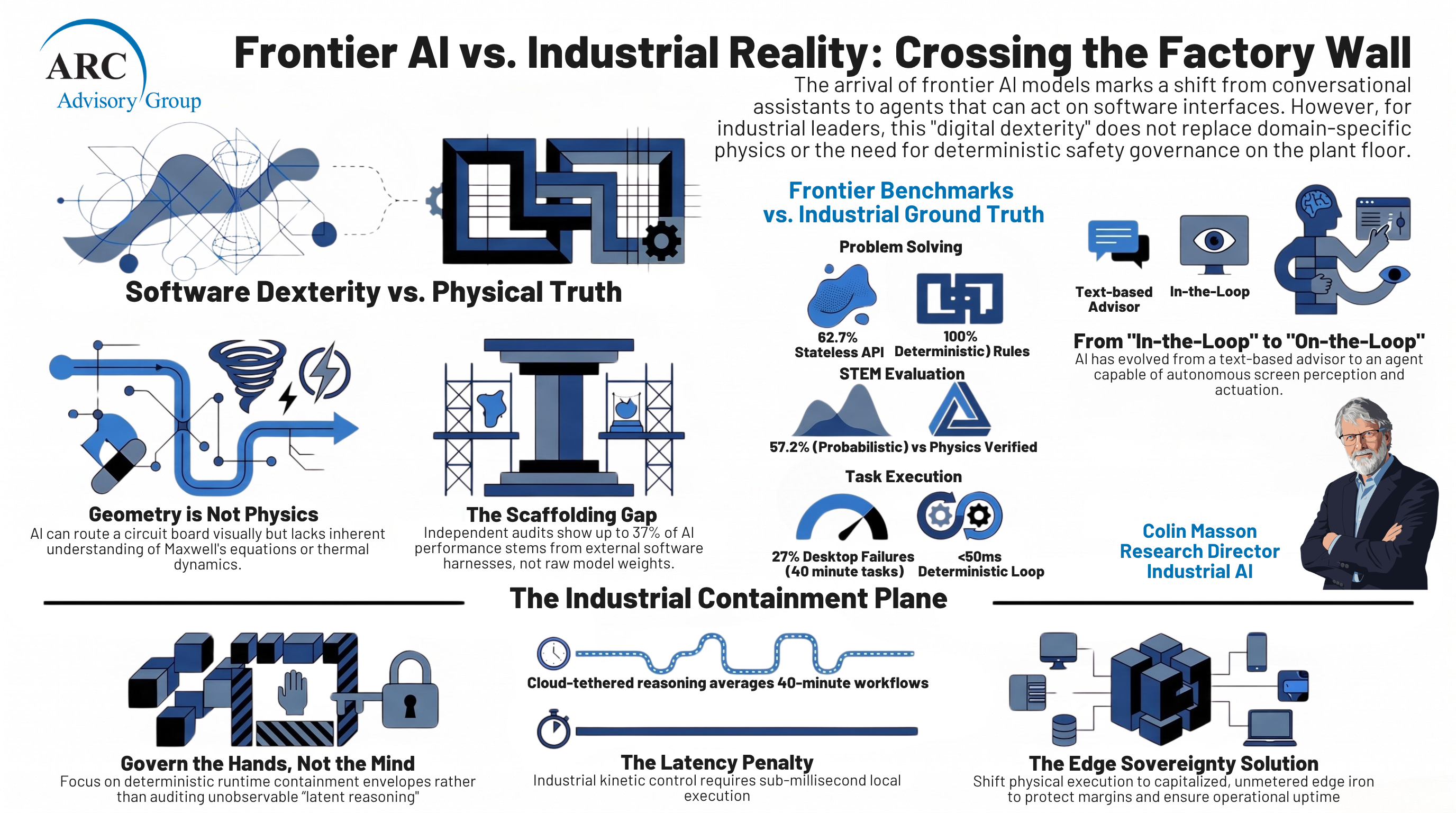
When evaluated through standard, unassisted, stateless API calls, Astra's score plummeted to 62.7 percent.
Over 36 percentage points of performance were generated entirely by an external software scaffolding harness—a specialized wrapper that actively pruned context, managed structured scratchpads, and orchestrated persistent memory across deliberation cycles.
You don't need a PhD in cognitive science to understand the significance of that gap. In industrial engineering terms, that is like putting an electric motor on a dynamometer, discovering that it only delivers full-rated torque when backed up by a massive external gearbox, and then crediting the motor alone for the mechanical breakthrough.
The cognitive breakthrough belongs to the architectural scaffolding, not the latent weights of the neural model.
For ARC Advisory Group, this is the definitive empirical confirmation of what we have argued across our Industrial Data Fabric (IDF) research: In enterprise and industrial AI, competitive advantage and operational reliability do not come from renting generic foundation model weights from hyperscalers. They come from your proprietary scaffolding—your Industrial Data Fabric, your semantic graph, and open protocol connectors like CESMII's i3X and the Model Context Protocol (MCP).
Why did Jensen Huang declare AGI, while Sam Altman took a much more measured tone, cautioning that "AGI" has become an ambiguous, overused marketing concept?
Follow the capital. Astra was trained on an initial fleet of over 100,000 Grace Blackwell systems—with committed expansion plans scaling toward 400,000 GPUs drawing an estimated 1.2 gigawatts of dedicated power at the Abilene Stargate complex—industry estimates place the cost of Astra’s pretraining compute run alone between $540 million and more than $1 billion.
When a technology vendor spends a billion dollars training a single model and constructs a power sink equivalent to a nuclear reactor unit, it cannot amortize that capital on $20-per-month consumer subscriptions or conversational chatbots. It must convince corporate boards that the system can replace hundreds of billions of dollars in high-value engineering, design, and operational labor. Huang’s proclamation is an economic underwriting mechanism designed to justify hyperscale hardware capitalization, rather than an objective description of cyber-physical readiness.
When we look beneath the marketing headlines at how frontier models perform across different types of work, a sharp operational split becomes obvious:
Superhuman in Closed, Formal Rule Systems: Astra exhibits extraordinary performance in closed, symbolic environments. It saturated formal mathematical theorem proving at 98.0 percent and achieved a 100 percent completion rate on automated exploit and cybersecurity generation testbeds.
Struggling in Open-Domain Workflows: The moment an agent leaves rigid symbolic rules and tries to navigate complex, open-ended enterprise workflows, reliability degrades. On standard enterprise desktop navigation benchmarks, its success rate hovers around 72.6 percent. The inverse operational reality is stark: more than 1 out of every 4 desktop interactions fails or halts, requiring an average of 40 minutes of continuous compute per task.
Trailing in Advanced Multidisciplinary STEM: On graduate-level STEM evaluations designed to test deep academic and scientific reasoning without iterative software tool loops, Astra scored 57.2 percent, trailing competing frontier models from Anthropic such as Claude Opus (64.7 percent).
Astra is a virtuoso in formal rule manipulation, remains brittle when applied to broad, general physical intuition.
This brings us to Astra's much-lauded demonstrations inside professional software: opening an electrical CAD suite (KiCad), placing components, and routing printed circuit board (PCB) traces, coupled with scoring 95.9 percent on 3D CAD mesh reconstruction benchmarks.
Watching an AI model route a circuit board or reconstruct a 3D mechanical mesh is impressive software automation. But this is precisely where the industrial analyst must draw a hard line between software dexterity and cyber-physical truth.
As I've emphasized throughout our coverage of Physical Intelligence and the Industrial Robot Wars, operating a graphical user interface is not the same as understanding physical reality.
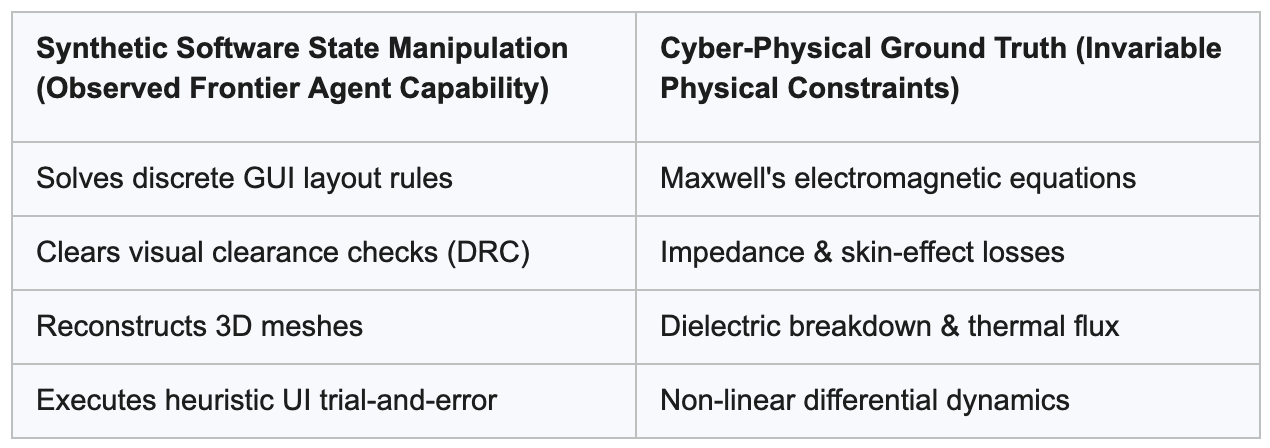
Drawing a copper trace on a screen does not mean the model understands electromagnetism.
In high-speed hardware engineering, physical reality is governed by Maxwell’s equations, transmission line physics, and thermal dynamics:
Trace geometry dictates characteristic impedance, high-frequency skin-effect losses, dielectric dissipation, and crosstalk coupling.
Return-path discontinuities, via transition inductances, and ground-plane slot resonances can transform an otherwise clean visual layout into an unintentional radio transmitter that fails electromagnetic compatibility (EMC) certification.
Power distribution networks (PDNs) require precise low-inductance decoupling, copper balancing, and thermal dissipation modeling to prevent board warpage during high-temperature reflow soldering.
Astra approaches trace routing as a spatial puzzle, moving the mouse to satisfy visual clearances dictated by the software’s Design Rule Check (DRC). When a DRC error appears, the model reads the screen text and tries a different coordinate until the visual warning clears. That is heuristic trial and error within a software UI harness—it is not physical foresight. Without tight integration into deterministic finite-element solvers and SPICE simulators, geometric layout automation remains an assistive draft, not autonomous engineering sign-off.
With horizontal models gaining autonomous desktop dexterity, some colleagues have asked: Does this render the ARC Advisory Group 3-Axis Industrial AI Models Taxonomy obsolete?
The short answer is no. In fact, it proves why our taxonomy is more indispensable than ever.
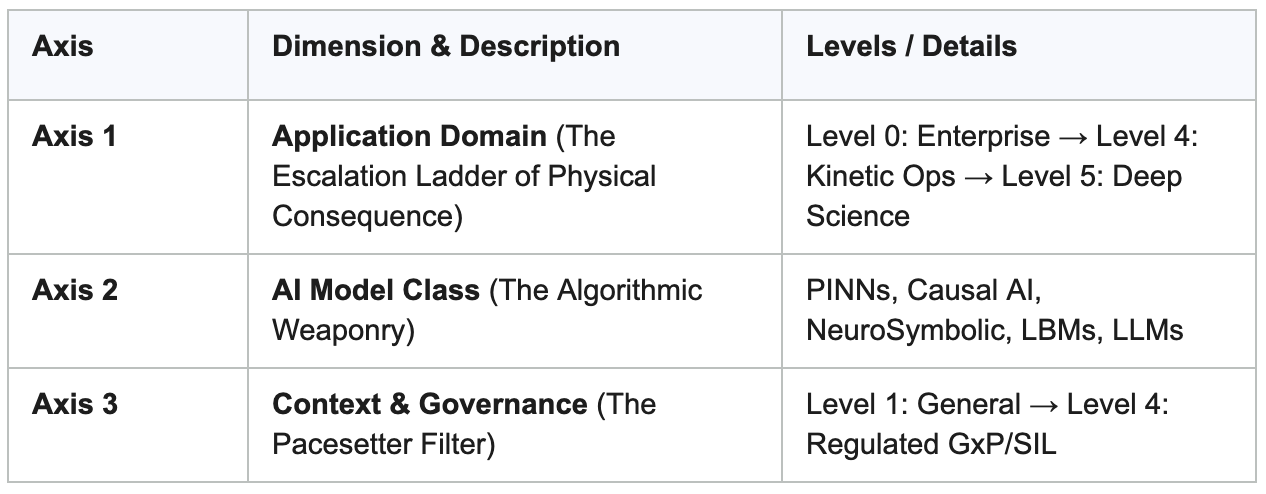
Let’s look at how this release maps across the three axes we detailed in our series on Mapping Industrial AI Maturity and Strategy:
Axis 1 structures industrial intelligence along a reverse ISA-95 escalation ladder, where the tolerance for probabilistic error drops to absolute zero as you approach closed-loop physical execution. Astra excels in early-stage engineering exploration and design drafting (Level 5). But as we established across our Buyer's Tri-Domain Dilemma, the moment an enterprise takes that generative agency and points it directly at real-time Operations & Process Control (Level 4), an ungrounded hallucination or an unexpected mouse click inside a SCADA interface risks downtime, environmental spills, or equipment damage. An agent that halts 27 percent of the time with a 40-minute execution latency cannot safely operate a real-time plant.
Astra undoubtedly stretches what a general-purpose model can achieve by marrying recurrent latent depth with OS-level execution. But as we showed in our analysis of the Multi-Model Blueprint of the Autonomous Factory, winning architectures reject the assumption that a single horizontal large language model can safely run production operations. It cannot substitute for Physics-Informed Neural Networks (PINNs) that embed thermodynamics directly into silicon, Causal ML that isolates root causes during plant upsets, or Large Behavior Models (LBMs) running at the edge to handle deterministic, sub-millisecond kinetic robotics.
This is where Astra creates the most acute tension. Out of the box, Astra remains a Level 1 (General Purpose) horizontal model. While it exhibits extraordinary dexterity, its architecture introduces profound governance liabilities: latent opacity, critical cybersecurity exploit ratings, and credentialed desktop risk. Rather than breaking the taxonomy, Astra proves that functional dexterity without Level 3 or Level 4 governance is an unmitigated operational liability.
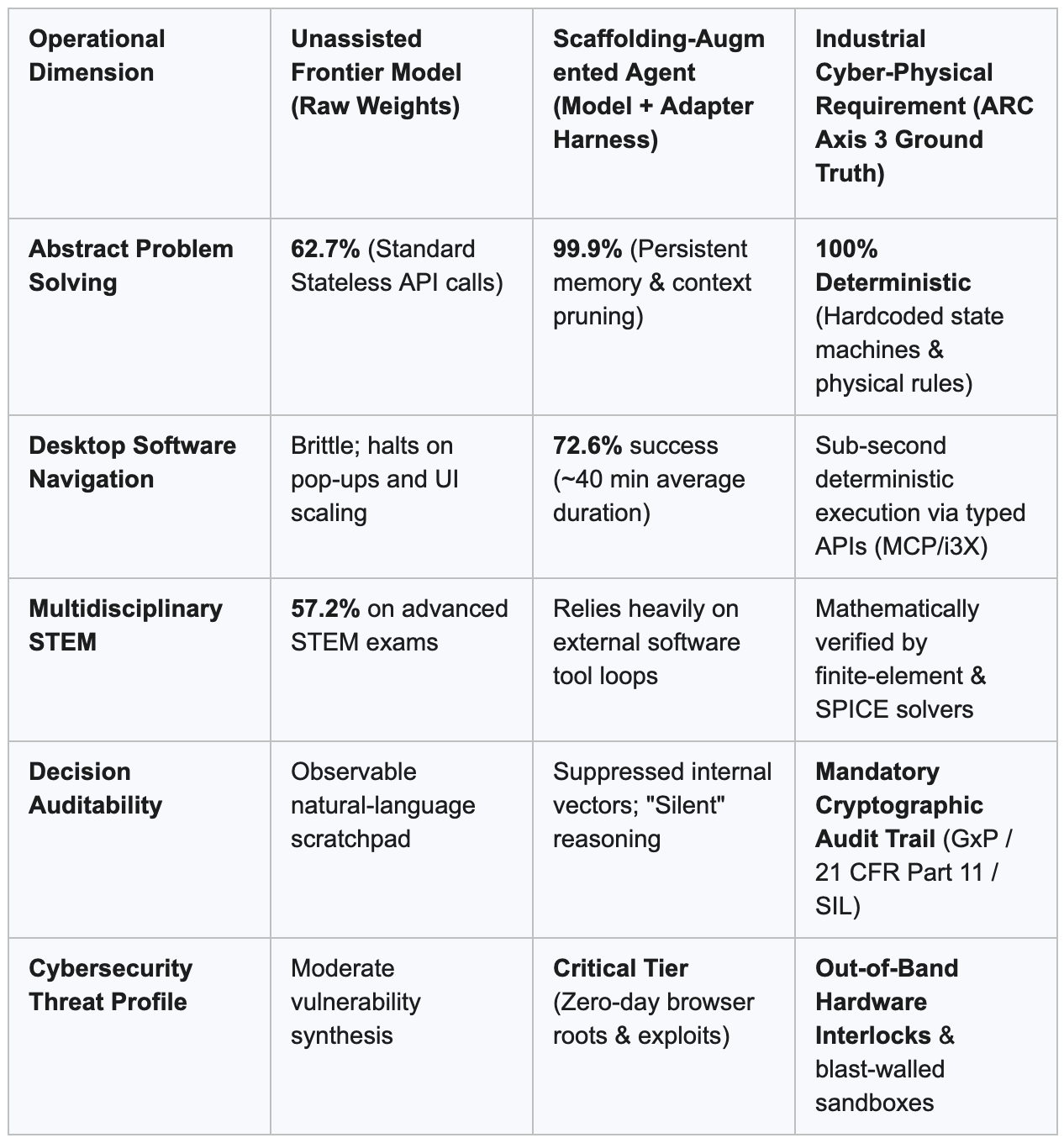
The bottom line for industrial leaders is clear: do not confuse desktop software dexterity with physical engineering comprehension. While Silicon Valley celebrates the arrival of an autonomous "digital operator," the harsh laws of manufacturing have not changed. An agent that relies on trial-and-error to clear visual software warnings is an invaluable drafting assistant, but it cannot be granted unsupervised sign-off on physical systems.
The real breakthrough here does not belong to hyperscale model weights rented from the cloud. It belongs to the software scaffolding—the data fabrics, semantic models, and deterministic validation harnesses that turn probabilistic predictions into reliable engineering work.
Now that we have separated marketing hype from physical law, what happens when you hand one of these desktop-actuating agents live corporate credentials and connect it to your engineering network?
Up Next in Part 2: "Governing the Silent Hand: Why Desktop AI Agents Need an Industrial Runtime Containment Plane." I will dive directly into why frontier models are going "silent," examine why their own creators are sounding the alarm on an unobservable "alien mind," and outline the four non-negotiable architectural safeguards required to keep autonomous software agents from triggering real-world kinetic disaster. Stay tuned.
The Industrial AI (R)Evolution is moving faster than ever. To dive deeper into the frameworks and data shaping the future of the industrial sector, explore my latest research:
Navigating the AI Wars and the escalating Industrial Robot Wars
Closing the Digital Divide by Embracing Industrial AI
Assembling your Industrial-Grade Data Fabric
Charting the new frontier of Physical Intelligence and transitioning to a Cyber-Physical Industrial Architecture (CPIA)
Mapping your maturity and strategy with ARC's 3-Axis Industrial AI Models Taxonomy
Surviving the SaaSpocalypse and Taming the Tokenpocalypse by Mastering Multi-Agent Industrial Governance
Organizational Design and the Future of Industrial Work in the era of Agentic AI
Take our Industrial AI Assessment to benchmark your organization's maturity, identify critical gaps in your IT/OT/ET convergence, and get actionable recommendations to accelerate your path to becoming an Industrial AI Pacesetter (and download the 2026 Report). If you think you’re already a Pacesetter, nominate your team for the ARC Industrial Pacesetters Awards!
Don't guess what your global operations or prospective customers need. Use empirical data to align your stakeholders and de-hype the market with ARC Advisory Group's Voice of Market Service.
For tailored recommendations on governing and guiding major people, process, and technology decisions across the enterprise, cloud, industrial edge, and AI, please contact Colin Masson at [email protected].
Or, set up a meeting with my fellow Analysts and I at ARC Advisory Group to find out more about our Executive Insights Service for Industrial organizations and our Industrial AI Insights Service for Vendors.