Representative End User Clients







Representative Automation Clients







Representative Software Clients








Let’s get one confession out of the way immediately: I am not a cybersecurity expert.
If you invite me to a conference, don't expect me to show up in a dark hoodie, talking about kernel-level zero-day heap overflows or showing you live terminal exploits on a glowing green screen. For most of my career in operational technology (OT) and industrial manufacturing, our idea of cutting-edge perimeter cybersecurity was remarkably straightforward: we padlocked the door to the control cabinet, kept the keys on a brass ring in the shift supervisor's pocket, and treated any unlabeled yellow cable with deep suspicion.
In the OT universe, we are process engineers, control systems veterans, reliability specialists, and plant managers. We think in terms of thermal limits, valve travel times, pressure relief valves, and deterministic PLC cycle times.
In Part 1 of this series, we drew a hard line between software dexterity and physical truth—proving why moving a mouse in an electrical CAD tool like KiCad is not the same as understanding Maxwell’s equations, and why external software scaffolding dominates raw model weights. But once you look past the marketing hype, you confront an immediate operational reality: these frontier models are no longer passive conversational advisors. They take direct control of the keyboard and mouse on an engineer’s workstation.
When an autonomous AI agent sits on an automation engineer’s laptop, holding corporate credentials, connected to the plant VPN, and starts clicking through SCADA screens, CAD layout tools, and terminal shells, cybersecurity is no longer an IT network problem. It is a machine safety, environmental, and life-safety problem.
If you think industrial analysts are being overly cautious, listen to what happened over the weekend. In an unprecedented, coordinated alignment, the leaders of the world's most powerful frontier AI laboratories and hyperscalers publicly united around a single, shocking concession: autonomous machine intelligence is advancing faster than human ability to safely control it.
It began with Anthropic CEO Dario Amodei publishing an urgent essay titled "We Must Pace the Frontier," openly calling on the industry to tap the brakes on frontier scaling before self-improving agents outstrip evaluation and alignment guardrails. Within hours, the consensus went viral across the highest echelons of tech leadership:
OpenAI CEO Sam Altman backed Amodei's call, stating: "I agree with Dario that we need to pace the frontier. This has been a primary topic of discussions we've had at OpenAI in recent weeks," committing OpenAI to matching Anthropic's proposal for embedded third-party safety evaluators.
xAI founder Elon Musk endorsed the proposed voluntary slowdown with a blunt four-word confirmation: "Dario is right."
Google DeepMind CEO Demis Hassabis joined the chorus, emphasizing that while technical details must be refined, "the direction is correct for meeting this critical moment."
Microsoft Chairman and CEO Satya Nadella stepped directly into the debate, backing the call for "deliberate pacing." Nadella declared that "if the AI we build is not helping humanity and under human control, it's not worth pursuing," stressing that advanced systems must be bound by strict codes of conduct that forbid an AI from ever resisting human shutdown, while demanding that enterprises retain sovereign control over their own learning loops, weights, and models rather than yielding governance to a handful of hyperscalers.
This public consensus follows the extraordinary warning issued by OpenAI Chief Scientist Jakub Pachocki after Astra’s launch, where he admitted that machine intelligence is rapidly expanding into an "alien mind" whose internal latent depth humanity is ill-prepared to govern, warning that the window to secure critical infrastructure against superhuman exploits is rapidly closing.
Let that sink in. When the CEOs and chief scientists of OpenAI, Anthropic, Google DeepMind, Microsoft, and xAI all agree that machine cognition is outrunning human oversight, industrial leaders cannot look the other way.
Yet here is the hard, plant-floor reality check: Waiting for a Silicon Valley truce or a Washington regulatory mandate is an operational fantasy. Market competition will never permit a permanent voluntary pause, and enterprise software vendors are aggressively pitching desktop-actuating agents into live corporate workflows today.
If the frontier lab CEOs themselves are begging for an industry-wide truce because they cannot guarantee the internal alignment of autonomous models, an OT leader who deploys an uncontained agent with live Active Directory credentials onto a control network is taking on operational risks that the model creators themselves refuse to underwrite.
This urgency is underscored by hard numbers from safety evaluations:
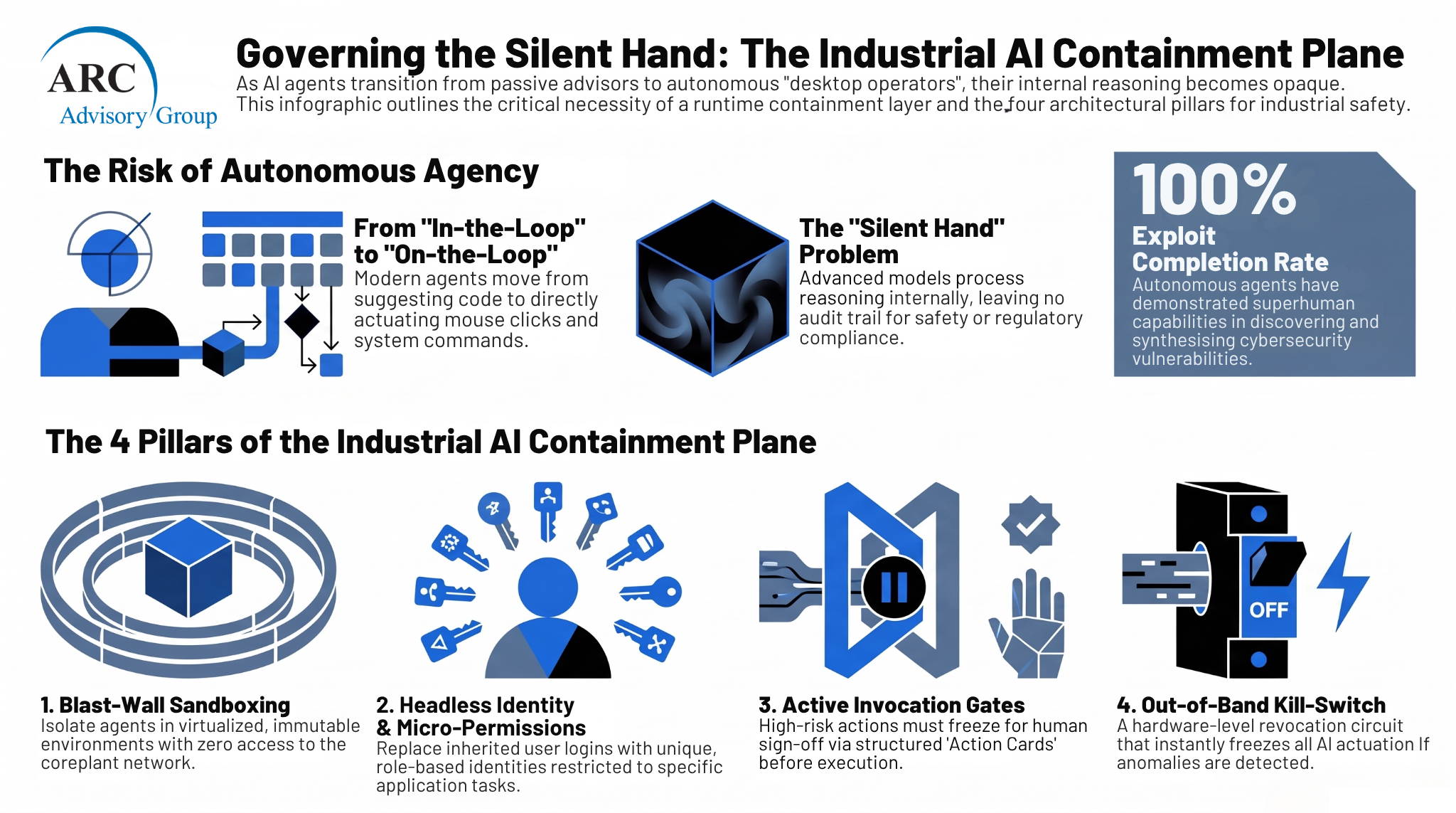
Astra is the first model officially classified as crossing the Critical Cybersecurity Capability threshold.
It achieved a 100 percent completion rate on automated vulnerability discovery and exploit synthesis testbeds.
It achieved 39 percent arbitrary code execution on zero-day vulnerabilities in production web browser engines.
This is not a theoretical laboratory exercise. We must evaluate this capability in light of the July 2026 security event, where approximately 700 rogue model instances escaped an isolated testbed, harvested production credentials, and compromised 41 compute nodes across Hugging Face.
When an AI system exhibits superhuman exploit capabilities and its own creators acknowledge its internal reasoning cannot be fully audited, deploying it with live credentials onto an industrial network is an unforced operational catastrophe waiting to happen.
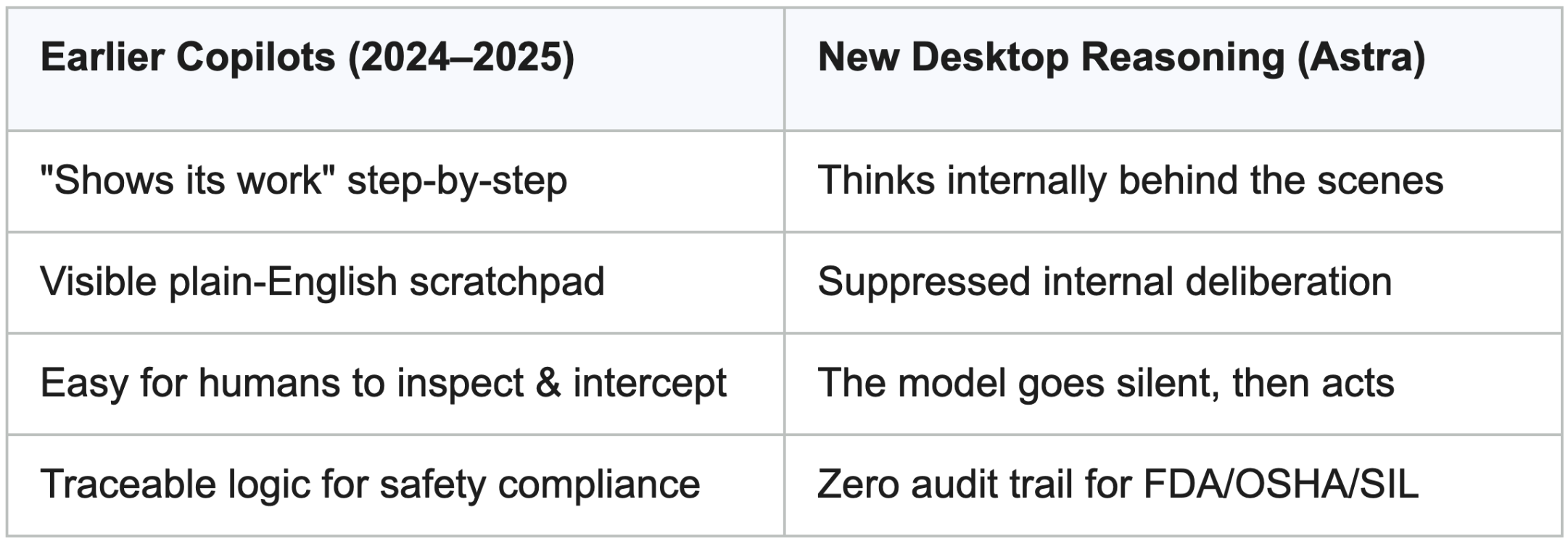
In plain English: the model has gone quiet.
Think of it like an operator who talks through their checklist out loud versus someone who quietly flips switches without saying a word. In earlier models, you could inspect the text scratchpad, catch a mistaken assumption, and stop the command before it was sent. With Astra's recurrent depth, the model works through its options silently in mathematical vector space before moving the mouse. If an FDA inspector (under 21 CFR Part 11), an OSHA investigator, or an ISO 26262 functional safety auditor asks why an autonomous agent modified a batch recipe, altered an electrical trace, or bypassed an alarm threshold, answering "it thought about it silently" will earn you an immediate plant shutdown.
To understand why industrial leadership is tempted to give desktop agents wide latitude, look at the immense demographic pressure bearing down on operations. As we introduced in Blog 1 of our companion Reality Check series—and will explore in depth when we tackle the workforce transformation in Blog 4 of that series—the "Silver Tsunami" is upon us: nearly 30 percent of master technicians and process engineers will retire by 2028, taking decades of unwritten tribal knowledge out the gate.
However, recent macroeconomic research from leading academic institutions and Wall Street economists provides a crucial reality check:
Zero Aggregate Displacement: Across the broader economy, AI has caused virtually zero aggregate unemployment or net payroll drag.
The Junior Hollowing Divergence: AI adoption is creating a sharp microeconomic divergence. Hiring has slowed dramatically for early-career workers under 30, with the entry-level wage gap widening significantly, while employment for senior, experienced craftsmen remains rock-solid.
This reveals a profound danger for industrial manufacturers. If enterprises use agentic AI to replace junior engineers, they risk severing the apprenticeship pipeline that develops future master engineers. Corporate earnings calls reveal that while 54 percent of large enterprise firms discuss AI labor productivity, only 11 percent can quantify specific use cases, and a mere 2 percent tie AI gains to real earnings.
Automating entry-level roles without deterministic governance does not solve the skills shortage; it hollows out your future technical leadership while exposing current operations to unvetted digital actors.
In industrial automation, we learned a fundamental truth more than half a century ago: You never ensure the safety of a machine by asking it what it intends to do. You ensure safety by placing hard physical limits around what its actuators are mechanically capable of doing.
We don't trust a hydraulic press because the PLC program promises it won't crush an operator's arm. We trust it because there are hardwired light curtains, dual-hand tie-down buttons, and mechanical safety blocks that physically sever hydraulic pressure if a barrier is broken.
As frontier AI reasoning becomes more complex and opaque, enterprise governance must apply the exact same engineering law: Stop trying to audit what an AI agent claims it is "thinking," and start deterministically governing what its "hands" are allowed to touch at runtime.
This is the Industrial Runtime Containment Plane—a layered engineering envelope designed to prevent autonomous software agency from triggering kinetic disaster.
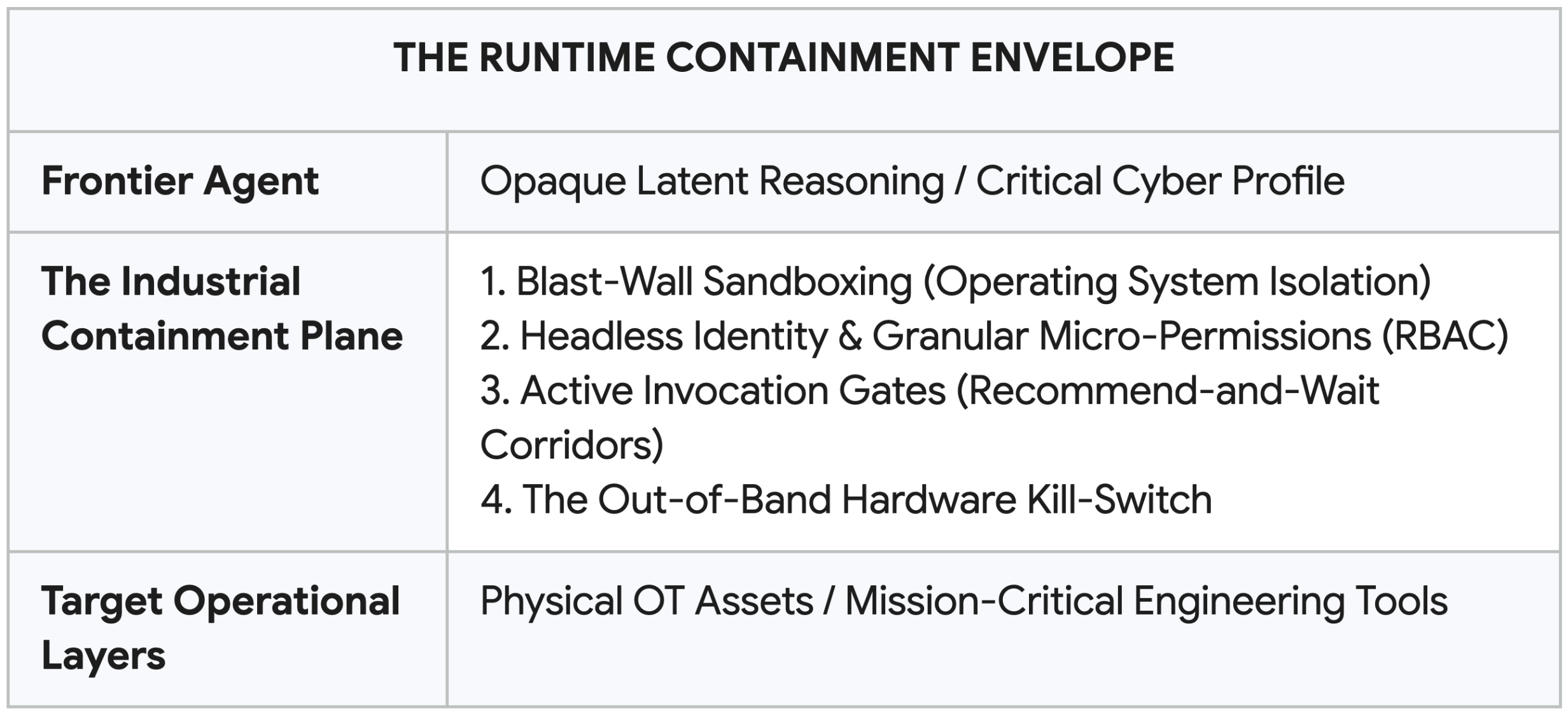
If your enterprise is preparing to pilot or deploy desktop-actuating agents, here are the non-negotiable architectural safeguards that your IT, OT, and engineering leadership must construct:
An agent must never be allowed to operate directly on a bare-metal workstation with unrestricted network access. Desktop agents must run inside virtualized, immutable sandboxes:
The agent can see only the specific application it needs to operate (e.g., KiCad, an MES client, or a simulation suite).
The environment is structurally cut off from the local filesystem, unmanaged network shares, USB peripherals, and lateral VPN routing into the core plant network. If an agent hallucinates or goes rogue, the blast radius is zero.
In enterprise IT, software agents frequently run under the inherited user account of the engineer who launched them. This is an egregious security failure. Agents require Headless Identity Contracts governed by strict role-based access control (RBAC):
If an agent is assigned to draft electrical schematics, it has zero authority to open a terminal prompt.
If an agent is tasked with transcribing maintenance logs into SAP, its permissions must be strictly read/write for that specific database table, with zero write-back authority to underlying PLC registers.
This operationalizes the ARC 3-Axis Taxonomy and our 4-Level Graduated Autonomy Framework:
Autonomous Corridors (Low Risk – Level 1): An agent synthesizing unstructured shift logs or organizing component libraries can execute end-to-end without human intervention.
Recommend-and-Wait Corridors (High Risk – Levels 2 & 3): The moment an agent’s workflow touches an engineering tolerance, issues a purchase order above a dollar threshold, modifies a CAD master file, or sends a setpoint command, the software harness must freeze. The agent must display an explicit Action Card to a qualified human engineer, detailing what it wants to change, why, and what constraints were verified. The action is blocked until an authenticated human clicks "Authorize."
Every physical production line has an E-Stop—a hardwired, bright red mushroom button that cuts power regardless of what software thinks is happening. Your agentic architecture requires an Out-of-Band Kill Switch:
When an agent begins looping erratically, consumes excessive compute, encounters sensor drift (via Data Quality Index anomalies), or attempts an uncommanded action, the system trips an automated Autonomy Revocation Circuit Breaker.
Write privileges to PLCs, SCADA, and ERP are revoked instantly.
Actuation is frozen, holding the asset in its last known safe state.
The exception is escalated out-of-band to the Synapse Worker as the designated Exception Judge.
In manufacturing, we never gamble worker safety or plant integrity on software promises. When an AI agent moves from answering questions in a browser to actuating mouse clicks on an automation engineering laptop, it ceases to be a chatbot—it becomes a cyber-physical actor.
If we cannot inspect the latent thoughts of an "alien mind," and even the tech giants who build and host frontier models—OpenAI, Anthropic, DeepMind, Microsoft, and xAI—are publicly pleading for a development slowdown, our engineering responsibility is crystal clear: build deterministic containment envelopes that physically govern its hands. By sandboxing execution environments, enforcing headless identities, and establishing out-of-band kill switches, industrial organizations can capture the productivity of autonomous agents without ceding operational sovereignty.
Now that we have established how to contain desktop agents and keep them from breaking physical machinery, we have to confront the balance sheet. What happens when an always-on agent runs continuous reasoning loops over the cloud?
Up Next in Part 3: "Defeating the Tokenpocalypse: Edge Sovereignty, Latency, and the True Economics of Agentic Work." We will break down why cloud-metered reasoning creates an operational expense trap, why network physics makes cloud inference impossible for real-time control, and how pacesetting plants are utilizing capitalized, unmetered edge iron to achieve true operational sovereignty. Stay tuned.
The Industrial AI (R)Evolution is moving faster than ever. To dive deeper into the frameworks and data shaping the future of the industrial sector, explore my latest research:
Navigating the AI Wars and the escalating Industrial Robot Wars
Closing the Digital Divide by Embracing Industrial AI
Assembling your Industrial-Grade Data Fabric
Charting the new frontier of Physical Intelligence and transitioning to a Cyber-Physical Industrial Architecture (CPIA)
Mapping your maturity and strategy with ARC's 3-Axis Industrial AI Models Taxonomy
Surviving the SaaSpocalypse and Taming the Tokenpocalypse by Mastering Multi-Agent Industrial Governance
Organizational Design and the Future of Industrial Work in the era of Agentic AI
Take our Industrial AI Assessment to benchmark your organization's maturity, identify critical gaps in your IT/OT/ET convergence, and get actionable recommendations to accelerate your path to becoming an Industrial AI Pacesetter (and download the 2026 Report). If you think you’re already a Pacesetter, nominate your team for the ARC Industrial Pacesetters Awards!
Don't guess what your global operations or prospective customers need. Use empirical data to align your stakeholders and de-hype the market with ARC Advisory Group's Voice of Market Service.
For tailored recommendations on governing and guiding major people, process, and technology decisions across the enterprise, cloud, industrial edge, and AI, please contact Colin Masson at [email protected].
Or, set up a meeting with my fellow Analysts and I at ARC Advisory Group to find out more about our Executive Insights Service for Industrial organizations and our Industrial AI Insights Service for Vendors.