Representative End User Clients







Representative Automation Clients







Representative Software Clients








Summary 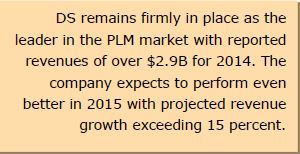 Dassault Systèmes (DS) held its annual analyst update at the company's headquarters in Vélizy (Paris), where it provided an overview of the company's accomplishments since it announced its "3DEXPERIENCE Experience" strategy in 2012 together with the revamp of its industry strategies. Bernard Charlès, CEO, provided a state-of-the-company overview, discussed ongoing business strategies, and provided some reasons for DS's very healthy revenue growth (over 12 percent year-over-year from 2013 to 2014).
DS remains firmly in place as the leader in the PLM market with reported revenues of over $2.9 billion for 2014. The company expects to perform even better in 2015 with projected revenue growth exceeding 15 percent. Mr. Charles pointed out some very specific reasons for the company's strong growth:
The Next Global Market: "The Age of Experience"
Monica Menghini, EVP and Chief Strategy Officer for Global Industry, presented the DS direction and industry strategy outlook. Ms. Menghini's message was clear: we are entering the age of experience, where experiences (for the engineer, designer, manufacturing, and consumer) are the new economic offering. According to Menghini, in this "experience economy," the product will no longer be enough. Menghini maintains that consumers buy experiences, and experiences are the new innovation. This new creative/innovative economy will drive, and actually need to precede smart connected manufacturing. Menghini pointed out that the world's industrialized countries all have some type of manufacturing initiative that will drive the experience economy: US - Manufacturing Renaissance; Germany - Industrie 4.0; France - Industry of the Future, UK - High Value Manufacturing; Italy - Fabrica Intelligente; China - Intelligent Manufacturing; Japan - Innovation '25 Program; and others.
Additionally, Menghini maintains that while technology-driven innovation has built global economic growth; design-driven innovations will drive economic growth in the future. She regards design as an overall business strategy for innovation. Design-driven innovation evolves in a company from no design, to design as styling, to design as process, and – ultimately - to design as a strategy. Design as a strategy involves the product experience and the holistic experience, with design as a part of the ecosystem.
Experience Thinking Business Strategy
DS's business strategy is based on what it calls "experience thinking." This revolves around the product, service, content, usage, ownership, awareness, and buying, all in the context of the experience. Experience thinking inspired the company's 2021 strategy, M&A activity, and will be the new framework for innovation going forward.
For its next three-year strategy cycle, DS wants to shift the focus away from technology and more toward people (customers). It's about "people in business and business by people." DS projects that 30 percent of its revenue in the next five years will come from new industry sectors like life sciences; architecture, engineering, and construction (AEC); CPG and retail; energy, process, and utilities (EPU); natural resources; and high tech.
Multi-Level IoT Strategy
DS has Internet of Things (IoT) strategies at both a high level and at lower-levels focused on product development and manufacturing. At a high level, DS refers to this as "The Internet of Experiences" for people and businesses, and IoT-enhanced industry solution experiences. DS regards IoT as an architecture of layers that starts at the lowest level of objects, devices, and products, which represent the design layer, i.e., designing smart connected products. This layer is also the sensing/actuator layer where M2M is enabled.
The top level of this IoT architecture is both the experience layer and the application layer. This is where the smart product, factory, city, infrastructure, energy, building, or home are encountered and experienced. The architectural layers in between the design layer and the experience layer are communication, network, and platform layers, which are mostly provided by the hardware and software technology suppliers. The Internet of Experience is enabled by the Analytics of Things, Dashboard of Things, Optimization of Things, and Programming of Things.
DS divides the IoT into three major areas: 1) the building blocks of technological components (applications, networks, platforms, devices; 2) the sectors served (smart factories, cities, homes, utilities, health, etc.; and 3) the experience itself at the individual, community, and societal levels.
Expanded Solutions
DS made some significant acquisitions in 2014 with Quintiq supply chain management software and Modelus for systems engineering modeling. DS is taking a strong systems engineering approach to smart connected product development to support IoT. Additionally, since DS dominates the automotive design space, its systems engineering solutions are very robust and comprehensive in this industry.
DS's digital manufacturing and production operations management brand, DELMIA, has seen some significant expansion and upgrading in the last two years. One of the most significant changes has been the acquisition of Apriso manufacturing operations management (MOM), and the integration of this solution into the DELMIA manufacturing suite. Phillip Charlès, CEO of the DELMIA brand, pointed out five major trends impacting manufacturing today: mobility, big data, the cloud, social media, and industrial IoT with its embedded intelligence and connected devices.
Charlès divides the DELMIA solution set into three major areas: digital manufacturing, or "planning" (virtual production simulation, process planning, etc.); manufacturing operations management (MOM) or "executing"; and manufacturing optimization. The latter two areas were expanded significantly as a result of the Apriso acquisition. DELMIA Apriso 9.7 includes the first integration of DELMIA digital manufacturing and Apriso applications. This combines the manufacturing process planning and work instructions of DELIMA with production execution of the manufacturing plans of Apriso. DELMIA also includes CAM/NC programming execution and robotic work cell simulation and virtual commissioning. DELMIA has introduced a complete solution set for additive manufacturing, including hybrid additive/machining solutions.
Conclusion
The overall PLM market is experiencing good growth globally and ARC research indicated that DS is leading this growth among PLM suppliers. Especially significant is that new and forecast revenue growth will come from the non-traditional industry segments for PLM such as energy, process, and utilities (EPU); retail & consumer goods; CPG; natural resources; AEC; and life sciences. While the traditional industry markets like A&D, automotive & transportation, and machinery & industrial equipment continue to do well, the future for PLM appears to encompass a much broader range of industries.
Dassault Systèmes is poised to offer technologies and solutions that will enable its customers to engage and profit from the Experience Economy.
All signed-in ARC Advisory Group clients can view this report in pdf format at this Link
If you would like to buy this report or obtain information about how to become a client, please Request ARC Info
Keywords: Experience Thinking, Design-Driven Innovation, IoT, Systems Engineering, ARC Advisory Group.