Representative End User Clients







Representative Automation Clients







Representative Software Clients








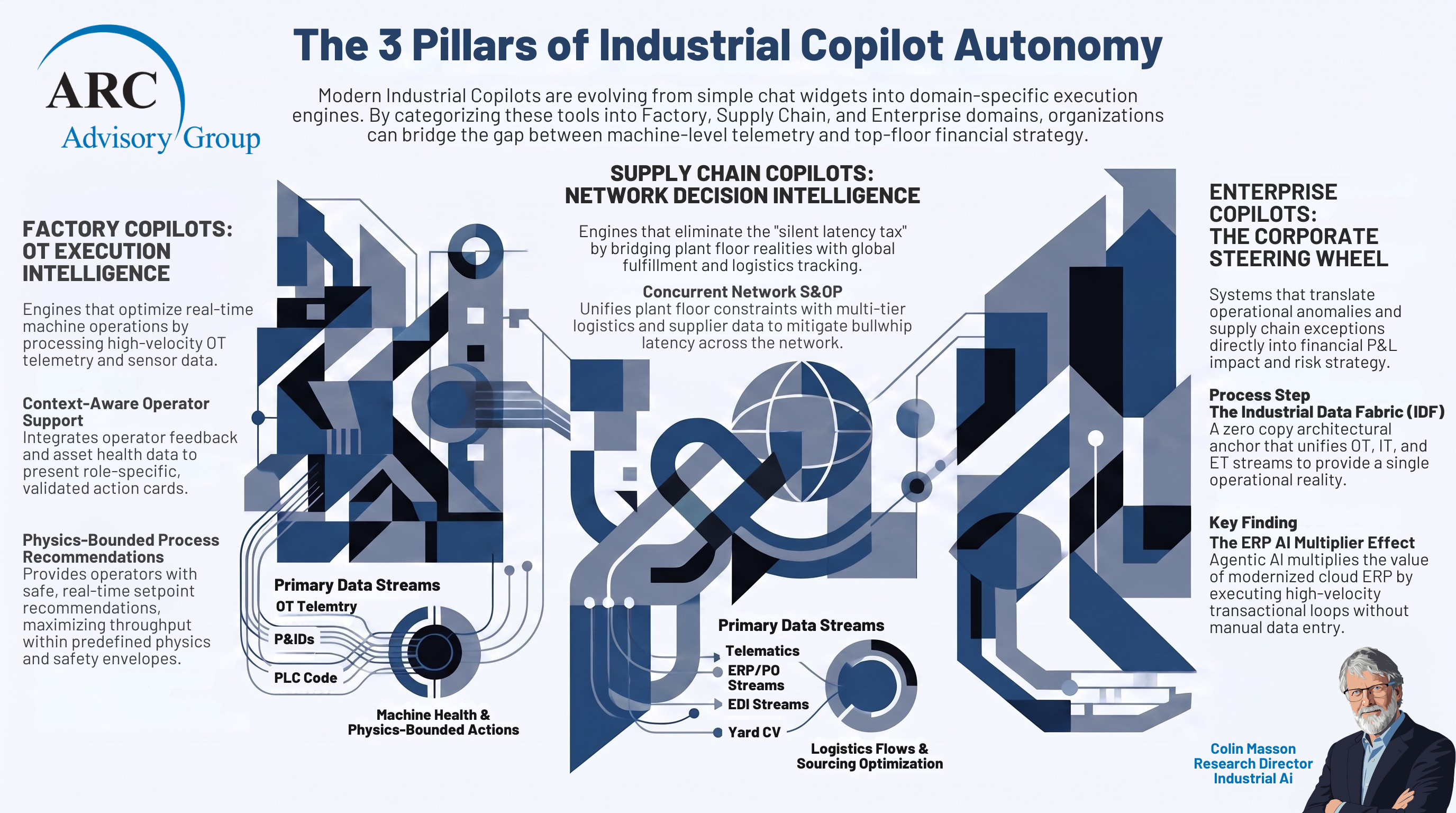
Enterprise Copilots operate at the intersection of ERP, Enterprise Asset Management (EAM), Field Service Management (FSM), and corporate orchestration. They convert shop-floor anomalies into financial insights, manage global risk, and provide the governance frameworks required for enterprise-wide autonomy.
If Factory Copilots (Blog 3) maintain sub-second machine stability and Supply Chain Copilots (Blog 4) optimize logistics flows, Enterprise Copilots act as the corporate steering wheel.
When an unplanned outage occurs on a primary extrusion line at Plant 2, the plant manager cares about MTTR and line safety; the logistics planner cares about carrier detention and customer OTIF; the CFO and CIO care about quarter-end margin targets, revenue at risk, and e-signature auditability.
Enterprise Copilots bridge this divide. Tethered to systems of record (S/4HANA, Infor OS, IFS Cloud, Maximo), they convert physical OT anomalies and logistics exceptions directly into P&L impact, balance cash flow, enforce ESG/carbon compliance, and govern multi-agent security across the global enterprise.
| Financial & ERP Suite | EAM & Asset Lifecycle | Hyperscale Builder Platforms |
|---|---|---|
| SAP Joule | IFS.ai Loops | Microsoft Azure AI / Fabric |
| Infor Velocity Suite | IBM Maximo / watsonx | AWS Bedrock / Strands SDK |
| Oracle/Epicor | Google Cloud Vertex AI |
ARC categorizes EAM leaders (IFS, IBM Maximo) and hyperscalers (Microsoft, AWS, Google Cloud) alongside ERP giants in Enterprise Copilots. While EAM platforms manage physical equipment, their strategic AI value operates at the levels of corporate asset lifecycle management, balance sheet depreciation, and field service dispatch. Hyperscalers, meanwhile, provide the foundational security sandboxing (Windows Execution Containers, AWS Bedrock single-tenant isolation), identity governance, and enterprise data fabrics (Microsoft Fabric, GCP BigQuery, Databricks, Snowflake) required to safely execute multi-agent swarms across global business units.
A prevalent misconception in tech media suggests that autonomous AI agents will render traditional Enterprise Resource Planning (ERP) systems obsolete. ARC’s empirical research leads to the exact opposite hypothesis: far from diminishing ERP, agentic AI dramatically multiplies the ROI of modernized cloud ERP platforms.
Why? Because autonomous agents cannot operate in an ungrounded vacuum. An AI agent recommending a raw material reroute, a production schedule acceleration, or an asset replacement requires a single, immutable source of truth for master data, the chart of accounts, credit limits, and compliance audit trails.
Think back to my webcast with Chase Christensen, CIO at Jabil (Scaling Industrial AI: From Pilot Models to Enterprise Value), and my ARC research on SAP Digital Manufacturing. Jabil demonstrated that scaling industrial AI across hundreds of global facilities is impossible with fragmented legacy IT/OT stovepipes. It requires a modernized "Clean Core" ERP architecture (such as SAP S/4HANA paired with SAP Digital Manufacturing on BTP) to act as the authoritative transactional backbone.
When an organization keeps its core ERP modernized, AI agents do not bypass the ERP—they become high-velocity power users of it. Agents execute transactional loops, update work orders, and reconcile supply chain ledgers via APIs in milliseconds, eliminating manual data entry while maintaining complete financial and e-signature integrity. Modern ERP vendors (SAP, Infor, IFS, Oracle) deserve immense credit: by embedding agentic orchestrators directly into their enterprise platforms, they ensure that top-floor financial strategy remains strictly aligned with shop-floor physical reality.
While deep domain expertise takes center stage in industrial operations, the entire copilot ecosystem relies heavily on hyperscaler cloud and AI infrastructure. For industrial enterprises committed to building custom models, proprietary digital twins, or specialized agentic swarms, hyperscalers serve as foundational architectural partners.
Crucially, ARC research confirms that most industrial organizations actively hedge their bets through multi-cloud adoption—distributing workloads across AWS, Microsoft Azure, and Google Cloud to avoid single-vendor lock-in, meet regional data sovereignty mandates, and match specialized workloads to best-of-breed engines.
Microsoft (Platform Enabler & Enterprise Integration): Microsoft powers the copilot offerings of major OT incumbents (Siemens, Schneider Electric, Rockwell, ABB, Sight Machine). Through Azure AI, M365 Copilot, Copilot Studio, and Microsoft Fabric Real-Time Intelligence, Microsoft provides seamless integration with enterprise IT. Its introduction of Windows Execution Containers delivers OS-enforced sandboxing for secure edge agent execution.
Amazon Web Services (AWS Builder's OS & Growing OT Momentum): AWS provides an open, model-agnostic builder’s operating system (AWS Bedrock, Strands Agent SDK, AWS IoT SiteWise, Amazon TwinMaker) powered by custom Trainium/Inferentia silicon. AWS is gaining massive traction among major OT incumbents—including Siemens (Siemens Xcelerator & Mendix on AWS), Rockwell Automation, AVEVA (building CONNECT on AWS using Amazon Bedrock and Bedrock AgentCore), Emerson, and ABB. Furthermore, following its strategic pivot toward open, containerized architectures, AWS is expanding rapidly into Physical AI and Industrial Robotics—pairing AWS Batch, Amazon SageMaker AI, and SageMaker Edge with ROS2 and NVIDIA Isaac Sim for AMR fleet orchestration and dexterous manipulation.
Google Cloud (GCP Data Fabric & Multimodal Intelligence): Google Cloud excels in big-data analytics and multimodal reasoning. Leveraging BigQuery zero-copy architecture, Vertex AI, and Gemini long-context models, GCP enables enterprise teams to execute complex multimodal reasoning across massive, high-velocity operational datasets, satellite telematics, and global supply chain knowledge graphs.
SAP Joule: SAP's multi-agent Joule architecture (powered by Anthropic Claude on SAP BTP) is embedded across more than 35 enterprise applications. Joule connects machine alarms directly to financial P&L impact—for example, evaluating how an unplanned outage on Line 2 affects quarterly margin targets while executing e-signature audit trails.
Infor Velocity Suite: Anchored by the Infor Agentic Orchestrator running on Infor OS. Infor deploys a prepackaged library of over 100 role-based micro-vertical agents tailored specifically to discrete manufacturing, distribution, and EAM. Infor leads the market in commercial transparency with an uncapped flat-fee subscription model.
IFS.ai & IFS Loops: An EAM-native enterprise copilot leader. IFS.ai automates complex FMECA (Failure Modes, Effects, and Criticality Analysis) studies, creating closed-loop "IFS Digital Worker Loops" that link equipment degradation records directly to field service dispatches under an asset-based licensing model.
Oracle, Epicor, IBM: Oracle Fusion Cloud SCM/Maintenance Advisor delivers predictive asset maintenance; Epicor Prism AI bridges shop-floor OT data via Advanced MES and the CF-MIU hardware edge device; IBM watsonx integrates natively with Maximo Asset Management to accelerate work order planning and reliability engineering.
Microsoft, AWS, Google Cloud: Provide foundational model hosting, zero-copy data fabrics, custom inference silicon, and OS-enforced container sandboxing to isolate custom agentic code.
When evaluating candidate Enterprise Copilots, use these six essential diagnostic inquiries during vendor RFI reviews:
P&L Financial Lineage: Does your enterprise copilot convert OT machine alarms or logistics delays directly into financial P&L impact, margin risk, and balance sheet exposure in real time?
Clean Core ERP Integration: Can your multi-agent architecture execute transactional workflows across ERP/EAM apps (S/4HANA, CloudSuite) without corrupting core master data or violating e-signature audit trails?
ERP AI Multiplier Alignment: How does your platform leverage agentic AI to increase the velocity and value of core ERP transactional processes rather than creating disconnected sidecar data silos?
EAM-Native Asset Reliability Loops: Does your solution automate complex FMECA/RCM studies, creating closed-loop digital worker loops that link asset health records directly to field service dispatches?
Multi-Cloud & Sandboxing Strategy: Does your platform support multi-cloud deployment (AWS, Azure, GCP) and OS-enforced container sandboxing (Windows Execution Containers, AWS Bedrock) to isolate custom agentic code?
Open Inter-Agent Governance: How does your enterprise copilot arbitrate conflicting commands between Factory, Supply Chain, and Enterprise agents under strict human-in-the-loop sign-off?
Having completed our three deep dives across Factory, Supply Chain, and Enterprise copilots, we now turn to the human frontline.
In our next installment, "Blog 6: The Tribal Knowledge Trap & Generative UI: Retooling the Connected Frontline Worker," we examine why conversational text boxes fail on the shop floor and how Causal AI sanitizes tribal knowledge to prevent Knowledge Poisoning. Stay tuned.
The Industrial AI (R)Evolution is moving faster than ever. To dive deeper into the frameworks and data shaping the future of the industrial sector, explore my latest research:
Navigating the AI Wars and the escalating Industrial Robot Wars
Closing the Digital Divide by Embracing Industrial AI
Assembling your Industrial-Grade Data Fabric
Charting the new frontier of Physical Intelligence and transitioning to a Cyber-Physical Industrial Architecture (CPIA)
Mapping your maturity and strategy with ARC's 3-Axis Industrial AI Models Taxonomy
Surviving the SaaSpocalypse and Taming the Tokenpocalypse by Mastering Multi-Agent Industrial Governance
Organizational Design and the Future of Industrial Work in the era of Agentic AI
Take our Industrial AI Assessment to benchmark your organization's maturity, identify critical gaps in your IT/OT/ET convergence, and get actionable recommendations to accelerate your path to becoming an Industrial AI Pacesetter (and download the 2026 Report). If you think you’re already a Pacesetter, nominate your team for the ARC Industrial Pacesetters Awards!
Don't guess what your global operations or prospective customers need. Use empirical data to align your stakeholders and de-hype the market with ARC Advisory Group's Voice of Market Service.
For tailored recommendations on governing and guiding major people, process, and technology decisions across the enterprise, cloud, industrial edge, and AI, please contact Colin Masson at [email protected].