Representative End User Clients







Representative Automation Clients







Representative Software Clients








It is a well-established rule of industry analyst life that we are best kept in low-light environments, preferably tethered to our desks with a steady supply of black coffee and spreadsheets. Normally, my big annual pilgrimage to Europe is Hannover Messe in April. This year, however, a heavy schedule of ARC Advisory Group client commitments kept me firmly pinned to my desk and forced me to miss the journey.
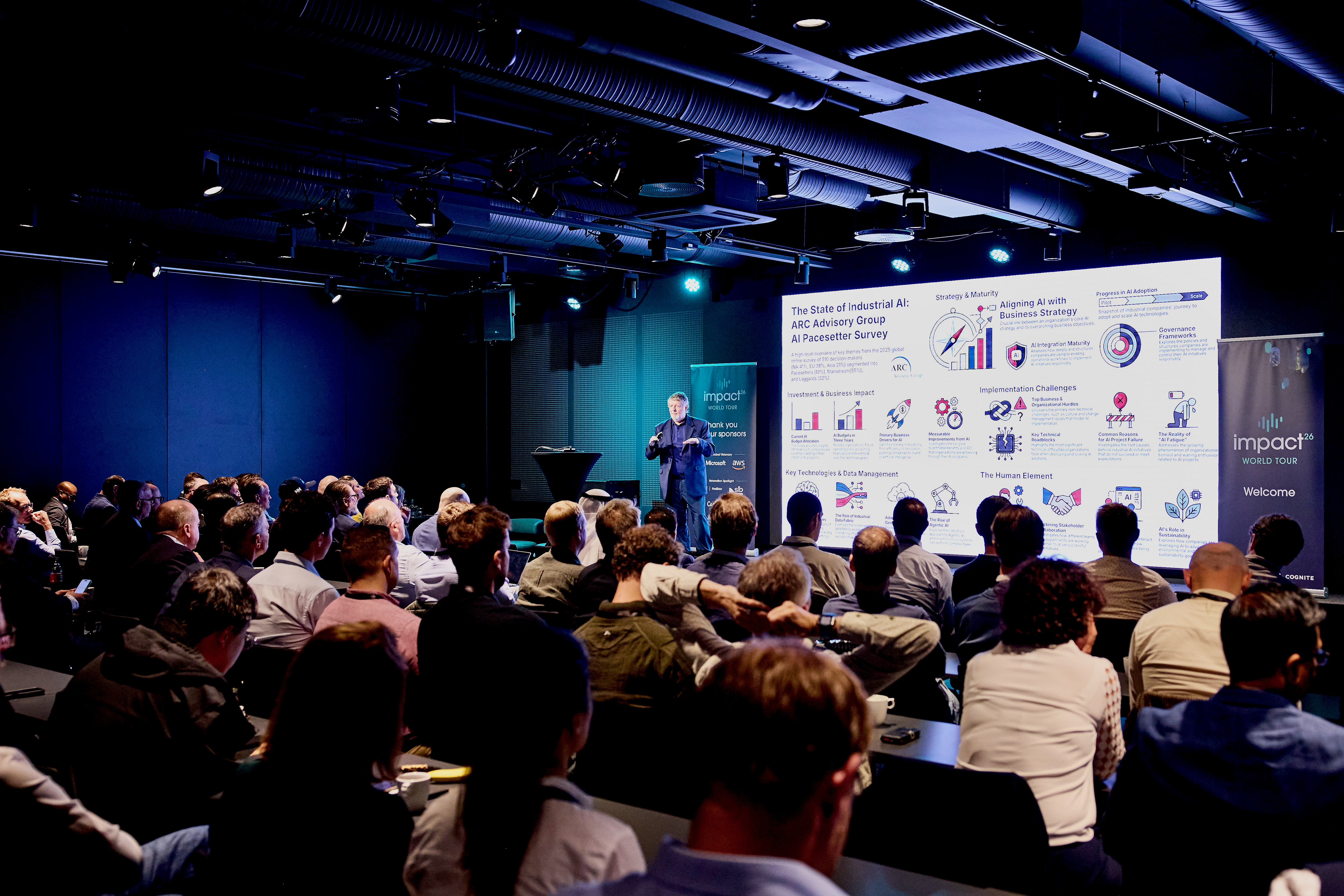
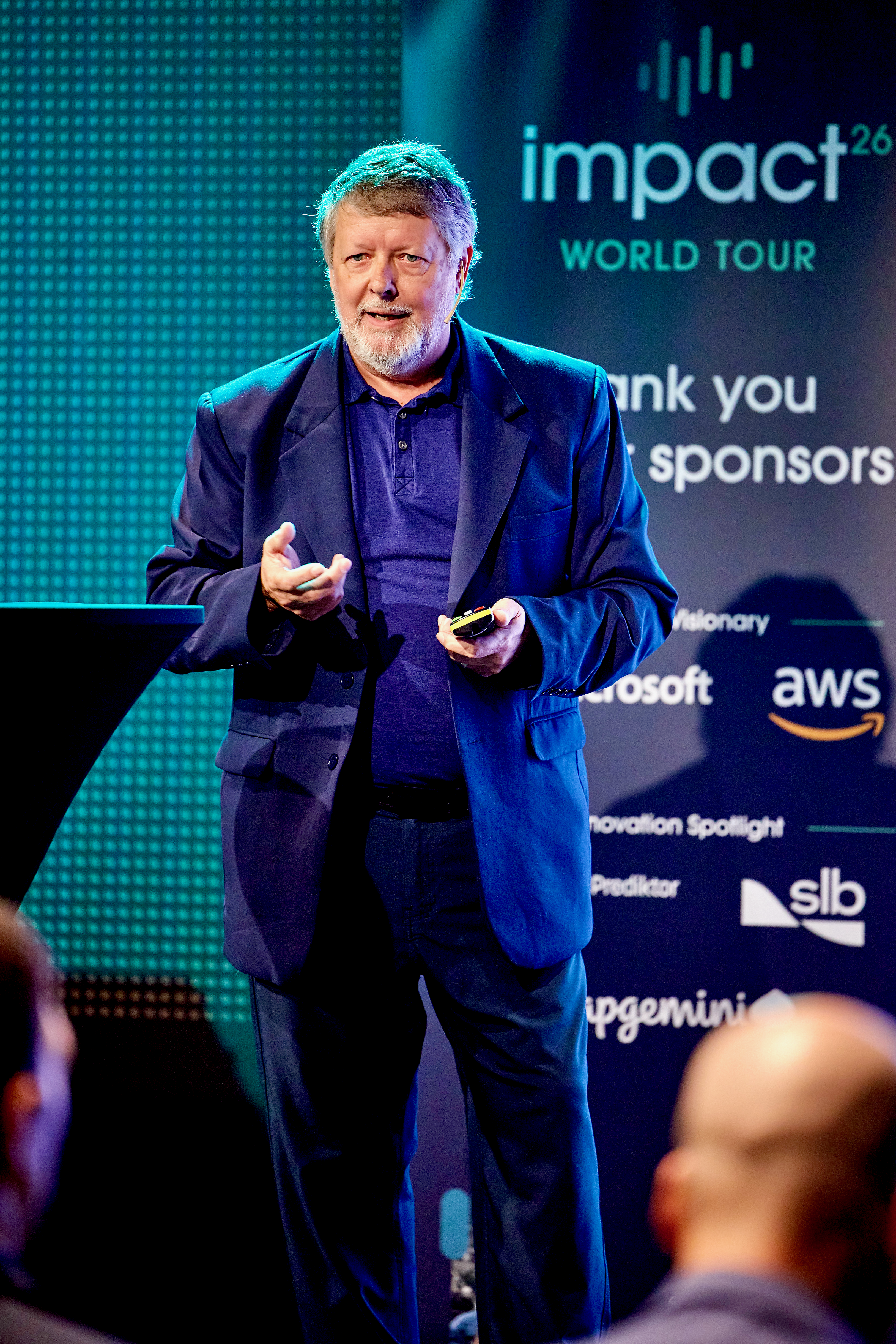
So, you can imagine my excitement when the opportunity arose to escape the office and head to a spectacularly sunny Norway to speak and moderate at the European leg of the Cognite Impact 2026 tour in Oslo.
Bypassing the usual desk-bound routine, I landed in Oslo ready to share some of ARC's latest research, moderate an executive panel on next-generation operations, and find out how the industry is actually turning AI hype into cold, hard operational value.
To understand why this Oslo event matters, we have to look back for a moment. Last year, I was in the sprawling heat of Houston for Cognite IMPACT 2025, where the headline was all about scaling the Industrial Data Fabric and pursuing an ambitious goal of delivering $100 billion in cumulative, validated customer value by 2035.
Shortly after, in May, I wrote about the launch of Cognite Flows, asking whether it might be the "Industrial IDE" the uncarpeted space has been waiting for. My argument then was simple: you cannot scale AI if your frontline engineers, the people who actually turn the wrenches, have to wait in a three-month IT queue just to build a simple data connection. Flows gave them a secure, low-code environment to build agentic workflows on top of clean, contextualized data.
In Oslo, we saw the logical evolution of these two milestones. The focus shifted from how we build the infrastructure to where we apply it to unlock the next massive portion of that $100 Billion prize.
The answer, it turns out, lies in bridging a chasm that has plagued heavy industry for half a century: the great divide between the factory floor and the supply chain.
The primary reason I escaped my analyst shackles was to moderate the afternoon executive panel on digital transformation and next-generation operations.
Moderating a panel of senior industry veterans is always an enjoyable balancing act. On one hand, you have decades of unparalleled wisdom. On the other, you have a group of highly distinguished, silver-haired professionals who are accustomed to being the ones calling the shots.
The stage dynamics became lively early on when Hunter Beck, one of Cognite's energetic product leaders, could not resist a cheeky dig at the collective age of the stage, suggesting that his presence was the only thing preventing the panel from qualifying as a vintage IT archaeological dig.
I had to remind young Hunter that while some of the panel possessed silver hair—and a couple of us sported highly aerodynamic, zero-hair configurations—that exact operational experience is what keeps us from falling for every passing technology hype cycle. After all, you need a few decades of grease under your fingernails to know when an AI agent is hallucinating versus when an underlying database is simply poorly engineered. Besides, as the rest of the panel chimed in, classic rock never goes out of style, and the veterans are the ones who actually know how to run the factories.
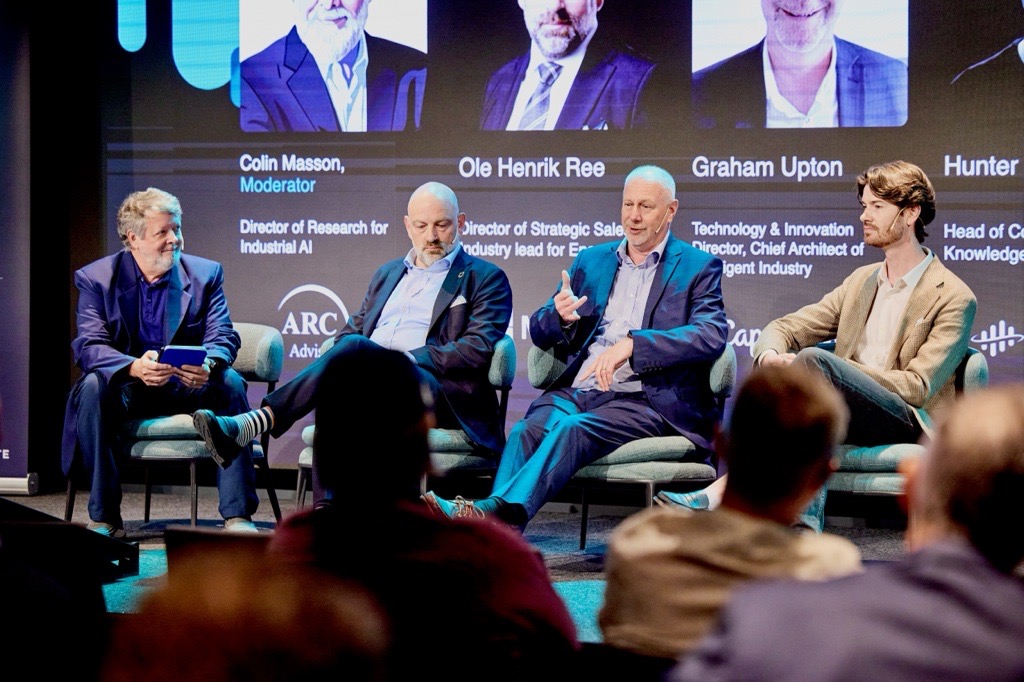
Once the banter settled, our three panel members delivered some remarkably balanced, deep, and well-aligned perspectives on what it takes to drive real value:
Hunter Beck (Head of Product, Industrial Knowledge Graph at Cognite): Hunter focused squarely on the architectural necessity of "context" in an era where everyone wants to throw generative models at raw data. He pointed out that AI agents simply cannot perform reliably in a vacuum of unstructured data lakes or flat files. Human operators are highly effective because they carry an implicit mental map of how the physical machinery connects, vibrates, and behaves. To make an AI agent even fractionally as capable, we must codify that relationship-based context into an Industrial Knowledge Graph. Without this foundational semantic layer, any attempt to deploy autonomous agents is just throwing expensive, cloud-metered algorithms at a legacy data swamp and hoping for a miracle.
Ole Henrik Ree (Industry Director at Microsoft Norway): Ole Henrik brought a vital, much-needed focus to the organizational and human realities of these digital deployments. He argued passionately that AI is not merely an IT project to be handed off to developers; it is a fundamental business and cultural transformation. You can procure the most advanced platform in the world, but if your frontline incentives are misaligned and your operations team doesn't actively trust the system, the technology will sit on the shelf. Escaping the pilot trap requires shifting our relationship with technology from basic task automation to what ARC calls a "designer-in-the-lead" paradigm, where human operators actively govern, validate, and orchestrate agentic workflows.
Graham Upton (Chief Technology Officer for Intelligent Industry at Capgemini): Graham delivered a masterclass in the hard-nosed pragmatism required to scale digital solutions across global, brownfield footprints. He warned against the "bespoke copy-paste trap," where a company celebrates a successful pilot at Plant A, only to see it completely fail at Plant B because the legacy data structures were formulated differently. True scale requires an architectural consistency of approach to data modeling, allowing digital twins to remain flexible. Furthermore, Graham emphasized that global manufacturers operate in a highly fragmented, hybrid, multi-cloud reality; success requires designing for seamless interoperability across diverse clouds and edge devices rather than forcing a single-vendor monolith.
With the red timer on the floor aggressively flashing to signal our session was drawing to a close, I forced our panel into a rapid-fire lightning round: Give me one key takeaway on how organizations can finally escape "pilot purgatory."
Their advice was incredibly sharp:
Ole Henrik Ree (Microsoft): "Stop chasing fragmented, flashy use cases and actually focus on building your enterprise data foundation."
Graham Upton (Capgemini): "Embrace the architectural reality of a hybrid, multi-cloud environment. Standardize your semantic models, but don't force a single-vendor monolith where it doesn't fit."
Hunter (Cognite): "No matter what you're buying, building, or integrating, make sure every connection is feeding relationship context into an industrial knowledge graph. That is your core IP going forward."
Beyond our stage antics, the event was anchored by some incredibly solid customer presentations.
The team from Aker BP—the undisputed front-runners of North Sea digital twin architecture—showed how they have moved far beyond basic remote monitoring. For them, a digital twin isn't a pretty 3D model to look at on a screen; it is a living, breathing semantic index that allows their engineers to run complex "what-if" scenarios across entire production assets in real time.
Meanwhile, Skagerak Kraft delivered a masterclass in turbine data modeling. They explained how they are taking raw, high-frequency time-series telemetry from remote hydropower assets and translating it into standardized, contextual data models. It proved a core ARC thesis: if you don’t get your data semantics right at the edge, your AI models upstream will spend all their time hallucinating.
This brings us to the big announcement of the day: Cognite Integrated Supply Chain.
Now, I know what you’re thinking. "Oh great, Colin. Another supply chain tool. Just what the world needs." But bear with me, because this represents a fundamental architectural departure from how the industry has traditionally approached this problem.
For decades, heavy industries have paid a "silent latency tax." When a critical asset fails on the uncarpeted plant floor, downstream logistics planning systems remain completely blind to the schedule shift. Conversely, when a raw material delivery gets delayed at sea, the plant floor runs blind, producing inventory that cannot be shipped or running assets at suboptimal throughput.
Historically, companies have tried to solve this by building massive, fragile, high-latency data integration pipelines (ETL) to force-feed plant telemetry into transactional planning systems. This approach is expensive, slow, and tends to break the moment someone changes a sensor on the shop floor.
Cognite’s approach is fundamentally different. It is not trying to build yet another transactional planning database. Instead, it places a real-time, non-disruptive semantic layer over existing systems.
Here is why this architecture represents a real shift:
Zero-Copy Integration: It leverages existing investments in modern cloud data warehouses. By utilizing bidirectional, zero-copy sharing, it bypasses the "data tax" of moving and duplicating massive datasets, providing immediate access to live operational reality.
Physical Grounding: Traditional supply chain planning tools are mathematically sophisticated at solving complex optimization problems, but they only optimize against rigid, hard-coded assumptions or static constraints inherited from high-latency ERP transactional databases. They have little visibility into the actual, real-time operating conditions of the plant floor. Cognite’s approach grounds supply chain execution in the live, physical realities of the assets. If the system recommends shifting production schedules to bypass a logistics bottleneck, it cross-references the live Industrial Knowledge Graph to verify whether a specific machine can actually handle the thermal or mechanical load of that grade mix without failing.
Active Operational Trade-Offs: Instead of showing you exceptions after they have occurred, unifying the operational topology of the plant with the transactional logic of the supply chain allows teams to simulate trade-offs across source, make, and deliver in real-time, presenting prevalidated solutions to the human operator before the bottleneck hits.
As Petteri Vainikka, President of Europe, Middle East, and Africa (EMEA) at Cognite, noted in his closing remarks: our shared language in the industrial world is the data model. Until we agree on how we name and connect our physical assets to our business objectives, we will always be fighting data friction.
We are moving away from the old model where humans do the repetitive data-gathering, toward a "designer-in-the-lead" paradigm. The technology does the heavy lifting of tracing root causes, triaging alerts, and projecting financial trade-offs, but the ultimate accountability—the human judgment—remains firmly with the operator on the floor.
Oslo proved that the tools to liberate and contextualize that data are no longer a three-year roadmap dream—they are running live on factory floors and remote operations centers today.
Now, if you'll excuse me, I hear the distinct sound of more ARC client commitments calling me back to my desk...
What are your thoughts? Is your organization still paying the "silent latency tax" between your operations and your supply chain? Drop me an email at [email protected] or let's connect to discuss how ARC can help you benchmark your Industrial AI maturity.
The Industrial AI (R)Evolution is moving faster than ever. To dive deeper into the frameworks and data shaping the future of the industrial sector, explore my latest research:
Navigating the AI Wars and the escalating Industrial Robot Wars
Closing the Digital Divide by Embracing Industrial AI
Assembling your Industrial-Grade Data Fabric
Charting the new frontier of Physical Intelligence and transitioning to a Cyber-Physical Industrial Architecture (CPIA)
Mapping your maturity and strategy with ARC's 3-Axis Industrial AI Models Taxonomy
Take our Industrial AI Assessment to benchmark your organization's maturity, identify critical gaps in your IT/OT/ET convergence, and get actionable recommendations to accelerate your path to becoming an Industrial AI Pacesetter.
Don't guess what your global operations or prospective customers need. Use empirical data to align your stakeholders and de-hype the market with ARC Advisory Group's Voice of Market Service.
For tailored recommendations on governing and guiding major people, process, and technology decisions across the enterprise, cloud, industrial edge, and AI, please contact Colin Masson at [email protected].
Or, set up a meeting with my fellow Analysts and I at ARC Advisory Group to find out more about our Executive Insights Service for Industrial organizations and our Industrial AI Insights Service for Vendors.