Representative End User Clients







Representative Automation Clients







Representative Software Clients








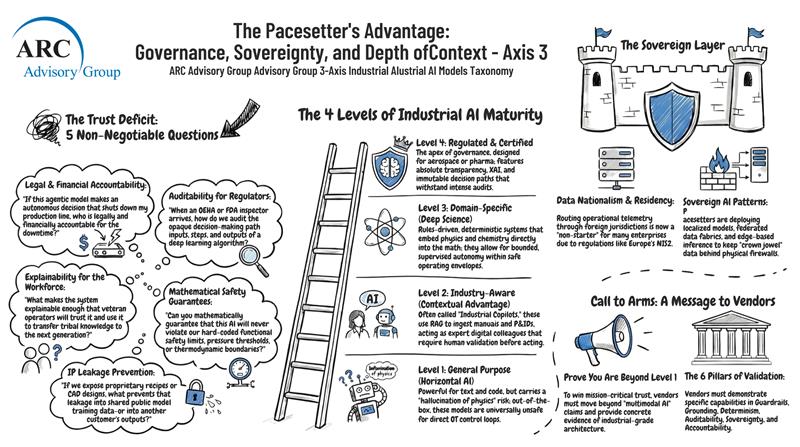
In our journey through the ARC 3-Axis Industrial AI Models Taxonomy, we’ve rigorously defined the operational domains (Axis 1) and mapped the specific algorithmic weaponry required for those battlefields (Axis 2). Today, we tackle the ultimate proving ground: Axis 3: Domain Specificity, Governance, and Sovereignty.
In my briefings with plant managers, safety engineers, and COOs, the conversation always pivots from technological capability to operational liability and workforce adoption. Our clients are actively asking us to pose these specific questions to the vendor community:
"If this agentic model makes an autonomous decision that shuts down my production line, who is legally and financially accountable for the downtime?"
"When an OSHA or FDA inspector arrives unannounced, how do we audit the opaque decision-making path—inputs, model steps, and outputs—of a deep learning algorithm?"
"What makes the system explainable and traceable enough that veteran operators will actually trust it, drive continuous improvement, and systematically transfer their hard-earned tribal knowledge to the next generation through it?"
"Can you mathematically guarantee that this AI will never violate our hard-coded functional safety limits, pressure thresholds, or thermodynamic boundaries?"
"If we expose proprietary batch recipes, setpoints, or 3D CAD designs to optimize yield, what prevents that leakage into shared public model training data—or into another customer’s outputs?"
You can possess the most elegantly designed neural network and point it at the most pressing operational challenge in your facility, but if you cannot trust the outputs, constrain its actions, persuade your workforce to adopt it, or legally defend its decision-making process to an auditor, the model is worse than useless—it is an active liability.
This is the decisive axis for safe Industrial AI at scale. It is the ultimate filter that separates generic, consumer-grade wrappers from highly deterministic, industrial-grade cyber-physical systems. Axis 3 evaluates a system's viability for mission-critical operations by categorizing its governance architecture across four distinct levels of maturity:
Let us be clear: we owe an immense debt to the providers of these horizontal foundation models. This includes the hyperscale pioneers (OpenAI, Google, Anthropic), the champions of open-weight and open-source architectures (Meta's Llama, Hugging Face), and the rapidly emerging sovereign and regional powerhouses (Mistral AI, Aleph Alpha, and DeepSeek). They are the engine room of the current AI revolution. By continuously pushing the boundaries of multi-modal capabilities (native vision, audio, text) and advanced logical reasoning, they are essentially forging the raw digital steel that the rest of the ecosystem builds upon. Their massive investments in compute and model architecture create a gravitational pull that accelerates innovation for everyone.
However, we must pragmatically define their boundaries. While they are incredibly articulate and excel at general knowledge retrieval, fast prototyping, or drafting Python scripts, they suffer from a profound "hallucination of physics." They can easily pass a bar exam, but they do not intuitively understand the fluid dynamics of a centrifugal pump or the thermal degradation of a gas turbine.
Because they fundamentally lack real-time OT grounding, hard constraints, and auditable procedures, these models carry an extremely high misapplication risk. Out-of-the-box, they are universally unsafe for direct OT control loops, predictive maintenance scheduling, or any unmonitored industrial actions. They represent magnificent raw potential, but possess zero industrial governance.
Models at this level have been heavily fine-tuned on broad industrial data. By utilizing techniques like Retrieval-Augmented Generation (RAG) against massive corpora of proprietary maintenance manuals, piping and instrumentation diagrams (P&IDs), and historical shift logs, organizations can establish a robust contextual advantage.
While the industry broadly defaults to calling these "Industrial Copilots" (and I must apologize for feeling obliged to constantly use Microsoft’s incredibly clever and ubiquitous 'Copilot' branding here, though we see everything from Assistants to Genies, Advisors, and Wizards being applied across the market), conversational interfaces are only one part of this level.
Level 2 actually encompasses a much broader spectrum of "Industry-Aware" applications that are fundamentally changing how we interact with industrial data. Beyond conversational Copilots, this maturity level includes:
Engineering & Design Models: AI assistants that dramatically accelerate system design by drafting initial PLC logic, generating 3D CAD variations, or assisting with complex simulation setups based on historical company designs.
Diagnostic Advisors & APM Dashboards: Advanced Asset Performance Management (APM) tools that synthesize decades of vibration, thermal, and acoustic history to recommend targeted maintenance interventions and identify anomalies, without actually scheduling the downtime or turning the wrench autonomously.
Semantic Knowledge Agents: Deep, semantic search engines capable of querying vast, fragmented repositories of P&IDs, legacy shift logs, and disparate ERP records to surface exact, contextualized answers for researchers and engineers.
So, how do we define the most visible of these—the Industrial Copilot?
"At ARC Advisory Group, we define an Industrial Copilot as a highly contextualized, human-in-the-loop AI interface securely tethered to an organization's proprietary engineering, IT, and operational data. Unlike generic conversational AI, an Industrial Copilot is explicitly engineered to ingest complex industrial lexicons, digitize tribal knowledge, and synthesize real-time machine states. It actively guides frontline workers through complex troubleshooting, maintenance, and operational workflows, acting as an expert digital colleague that accelerates time-to-resolution while strictly requiring human validation before closing the physical loop." — Colin Masson, Director of Research, Industrial AI, ARC Advisory Group
We are already seeing these capabilities manifest powerfully across the industry in a broad range of applications. Rather than focusing on specific vendor solutions here—which we will explore in detail when we reveal our AI Archetypes later in this series—it is more instructive to understand the breadth of their utility.
These tools are empowering automation engineers by rapidly generating and debugging complex PLC code. They are accelerating system design and control framework generation. They are helping operators effortlessly query massive operational data sets to instantly retrieve context-rich 3D plant models or P&IDs. Furthermore, they are augmenting subject matter experts by democratizing time-series data analysis, turning raw sensor trends into actionable process insights without requiring a data science degree.
Consider a practical scenario: a junior technician is facing an unfamiliar error code on a 20-year-old compressor. They can query their industrial copilot, which instantly pulls relevant manuals, prior work orders, and site SOPs to propose a step-by-step diagnostic and repair path. The technician then validates and executes.
However, while these systems are deeply "aware" of industrial concepts, they still stop short of closing the loop autonomously. They read and process text (and perhaps multi-modal imagery); they do not calculate real-time physics. They still lack the dynamic behavioral context of a specific, aging brownfield asset running under current loads. Human validation remains a strict requirement.
This is the target architecture for true Industrial Pacesetters. These are rules-driven, highly deterministic systems that embed proprietary physical, chemical, or complex engineering constraints directly into their underlying mathematical architecture. They establish a highly defensible domain foundation rather than just a document-retrieval layer.
Unlike a Level 2 model that merely retrieves correlations, a Level 3 Process Optimizer fundamentally understands underlying causation, whether that involves thermodynamic realities in a continuous chemical plant or the complex business logic of a discrete manufacturing supply chain. If the AI attempts to propose a state that violates conservation relationships, kinematic limits, or predefined enterprise operating envelopes, the system should reject it or require an explicit override by design.
An AI operating at this level can execute complex actions autonomously—adjusting setpoints on the factory floor or rerouting global logistics workflows—because it is tightly bounded by the immutable laws of physical reality and strict business process constraints. It represents the shift from human-in-the-loop assistance to bounded, supervised autonomy, where humans manage exceptions and approvals.
This represents the absolute apex of algorithmic governance. These AI systems are deployed in environments where human safety, product quality, or stringent legal compliance is the primary constraint, such as aerospace manufacturing, nuclear energy, or pharmaceutical batch production.
At Level 4, models are deployable AI that can withstand intense audits and validation regimes (e.g., ISO 26262 for automotive, IEC 61508 for industrial control, FDA 21 CFR Part 11, or GxP for life sciences). Uncontrolled "black-box" behavior is completely unacceptable here. Absolute transparency, rigorous change control (model/versioning), segregation of duties, Explainable AI (XAI), and immutable reconstructable decision paths are non-negotiable first-class system requirements.
At this tier, the algorithm itself is secondary; governance is the product. A regulatory auditor must be able to see the exact, traceable decision tree that led the AI to alter a specific batch process.
Crucially, Axis 3 also accounts for the fast-emerging reality of sovereignty. Data nationalism, sector security rules, and cross-border restrictions increasingly shape what is deployable. A centralized, one-size-fits-all AI strategy will inevitably fail if it ignores jurisdictional requirements such as Europe’s NIS2 directive and regional data localization mandates.
Many industrial enterprises now treat routing critical operational telemetry through foreign jurisdictions to reach a centralized hyperscaler as a non-starter. To counter this, Pacesetters are responding with sovereign AI patterns: localized deployments, federated data fabrics, and running AI inference natively on-premises at the industrial edge (including emerging "neo-cloud" approaches).
The goal is simple: defend IP, reduce leakage risk, and comply with local security and privacy regimes. In 2026, where your AI runs is often as important as how it reasons.
To the technology vendors reading this: yes—foundation models are extraordinary for multimodal interaction and rapid understanding of unstructured information. They are an excellent starting point.
But to win mission-critical industrial trust, you have to prove you operate beyond Level 1—beyond generic language capability and into governed, bounded, and defensible behavior.
Help us help you get the credit you deserve. In our upcoming Industrial AI Models MAR, don't just say "multimodal AI." Show us concretely:
Guardrails: What hard constraints exist (operating envelopes, interlocks, safety limits), and where are they enforced?
Grounding: What OT/IT sources are used, how is retrieval cited, and how do you prevent stale or incorrect context?
Determinism (Level 3): What causal, physics-based, neuro-symbolic, or rules-based layer bounds the system beyond language prediction?
Auditability (Level 4): Can you reconstruct inputs, model/version, approvals, and actions with immutable logs?
Sovereignty: Where does data move, where does inference run, and how do you support localization and residency requirements?
Accountability: What contractual and operational model defines liability, escalation, and human override?
Next, we’ll converge all three axes to reveal the market archetypes shaping the competitive Industrial AI vendor landscape in 2026.
The Industrial AI (R)Evolution is moving faster than ever. To dive deeper into the frameworks and data shaping the future of the industrial sector, explore my latest research:
Navigating the AI Wars and the escalating Industrial Robot Wars
Closing the Digital Divide by Embracing Industrial AI
Assembling your Industrial-Grade Data Fabric
Charting the new frontier of Physical Intelligence and transitioning to a Cyber-Physical Industrial Architecture (CPIA)
Mapping your maturity and strategy with ARC's 3-Axis Industrial AI Models Taxonomy
Where do you stand in the Industrial AI (R)Evolution? Take our Industrial AI Assessment to benchmark your organization's maturity, identify critical gaps in your IT/OT/ET convergence, and get actionable recommendations to accelerate your path to becoming an Industrial AI Pacesetter.
Don't guess what your global operations or prospective customers need. Use empirical data to align your stakeholders and de-hype the market with ARC Advisory Group's Voice of Market Service.
For tailored recommendations on governing and guiding major people, process, and technology decisions across the enterprise, cloud, industrial edge, and AI, please contact Colin Masson at [email protected].
Or, set up a meeting with my fellow Analysts and I at ARC Advisory Group to find out more about our Executive Insights Service for Industrial organizations and our Industrial AI Insights Service for Vendors.
Editor's Note: As Colin Masson emphasizes throughout this series, charting the Industrial AI landscape is an active "Voyage of Discovery." Since the initial publication of these early blogs, ARC Advisory Group has rigorously tested our taxonomy with our network of industrial clients and vendors. Based on this direct market feedback, we have significantly refined Axis 1 (Application Domain) from a flat menu of categories into a strict hierarchical "Escalation Ladder of Physical Consequence" (Levels 0 through 5). The AI Archetypes explored in the subsequent posts of this series reflect this newly updated, battle-tested taxonomy.