Representative End User Clients







Representative Automation Clients







Representative Software Clients








Located within Singapore’s Jurong Island petrochemical cluster, the Styrenic Resins Plant operated by Denka Singapore Pte Ltd, a subsidiary of Japan’s century-old Denka chemical company, is one of the world’s largest facilities for continuous polymerization and a major supplier of transparent polymers. And it was at Emerson Process Management’s recent Performance Without Compromise seminar (in Singapore), where H C Ng, maintenance manager, Denka Singapore, provided a welcome insight into a successful Industrial IoT project at the plant.
Why do I say welcome? Because from its many constituent technologies to standards (or lack of) to ecosystem partnerships to the potential for new business models, to name just a few aspects, there’s certainly no shortage of things to talk about when it comes to IIoT, and also plenty of thoughts and fierce opinions on all of the various issues. But when it comes to actual and successful applications out in industry, well, they’re a bit harder to find. As a member of advisory committees for Internet of Things conferences in Asia, I can vouch that locating manufacturing companies that have actually implemented IIoT projects in this region – and are willing to talk about them – is not an easy task.
So I am sure I was not the only one at the Emerson event pleased to finally get an end-user experience perspective on IIoT. And this project certainly seems to tick all the right boxes: a full set of technologies – sensors, 3G cellular network, analytics, cloud hosting – to create a remote asset monitoring application; a new business model for Emerson the supplier, one based on service provision rather than straight product sale; and real and quantifiable benefits for the end user, Denka.
Steam traps: Listen & learn
As the S in WAGES (Water, Air, Gas, Electricity, Steam), steam is one of the five major energy sources found (and paid for) in plants and is mainly used as a process heat source. A steam trap is a necessary, valve-like piece of equipment that provides for rapid removal of steam condensate along with non-condensable gases. An incorrectly operating steam trap results in lower heating efficiency and escape of live steam; and with industry studies showing steam-trap failure rate in the region of 20 percent a year, and given hundreds or even thousands of steam traps in the typical facility, the cost consequences associated with failure are significant.
As in most process facilities, Denka’s approach to monitoring of steam traps at its Styrenic Resins Plant was previously very manual, based largely on an annual inspection by a contractor. This conventional approach means it is inevitable that any failed steam traps will go unnoticed for a long time and contribute to wasted steam and wasted money. Indeed, Denka’s last yearly manual survey earlier in 2015 revealed 35 out of 210 steam traps (17 percent) as failed.
To automate the laborious process of steam trap monitoring and provide far more frequent updates on the health of steam traps in the Denka plant, Emerson Process Management, through its Asia Pacific HQ in Singapore, architected and deployed a native IIoT solution.
At the equipment level, to sense (i.e. listen for) steam leakage, Emerson’s Rosemount 708 wireless acoustic transmitters configured on a WirelesHART mesh network are attached to 148 of the most critical (high pressure, high capacity) steam traps in the facility. Data collected at the WirelessHART gateways are then transmitted via local telecom provider’s Singtel’s 3G cellular network to analytics software (hosted on a Microsoft Azure cloud platform) for generation of steam trap performance reports.
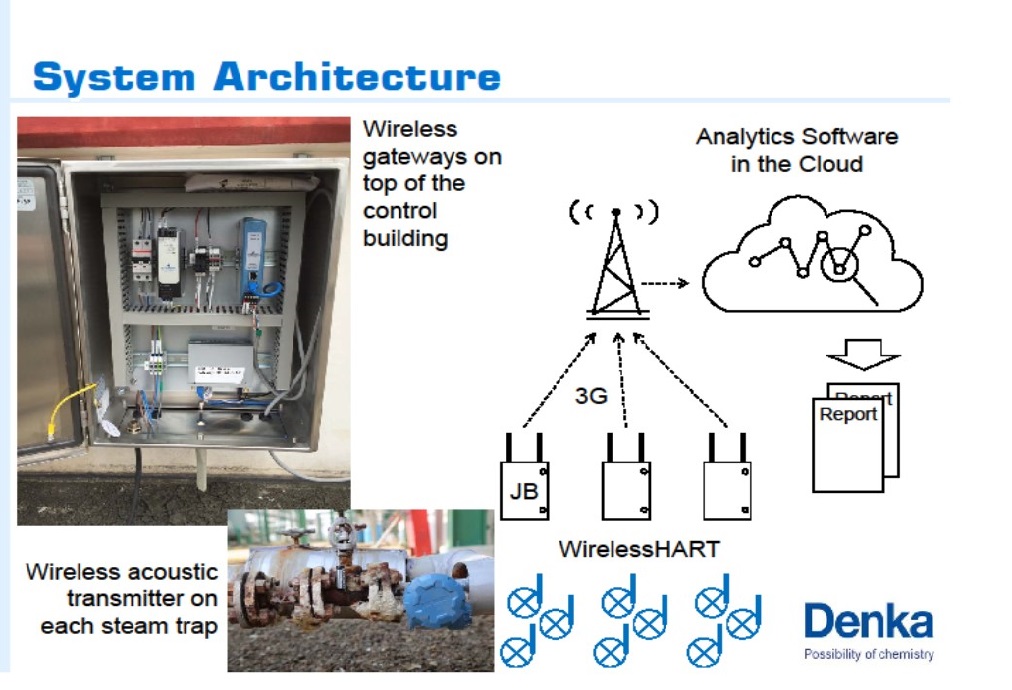
Key aspects of the IIoT solution
There are a number of interesting aspects to this solution. Firstly, it has no involvement with or connection to the plant control system (DCS). This alleviates common concerns of process-industry owner operators of interference with a live and running DCS and, in terms of security, DCS data potentially leaving the plant. It also simplifies implementation as Emerson does not have to meddle with any of the existing DCS I/O or software. This type of independent, outside-of-the-DCS architecture is something that ARC has been recommending for some time for IIoT solutions in the process industries.
Secondly, as Mr Ng related to ARC, none of the products comprising the solution were purchased by Denka, as Emerson provides at no cost all the transmitters, network infrastructure, analytics software, etc., and receives instead a monthly service fee from the client. So for Denka, it means upfront capital expenditure replaced by operational expenditure for as long as the system is installed and running in the plant.
And thirdly, the steam trap data is analyzed not within the Denka plant itself but several miles away at Emerson Process Management’s own Pervasive Sensing Regional Center of Excellence. Opened in 2014 as the company’s first such facility worldwide, this U$10 million investment provides data collection, analysis, and consulting services for Emerson’s Asia-Pacific customers and aims to help companies meet operational and maintenance goals without costly outlay on in-house resources.
Faster information, less steam
And its at the Pervasive Sensing Center where Emerson Process Management staff prepare a weekly Exception Report for Denka that lists and identifies those steam traps that have failed and need to be replaced. In addition, a monthly Savings Report provides cumulative information that includes trap failure rates, steam leakage and the equivalent dollar financial loss.
It is not surprising to learn that with far more timely alerts on steam trap performance, i.e. from every 52 weeks to every one week, Denka is able to replace failed traps far more quickly than it ever could before implementation of this IIoT solution and so can ensure a much higher percentage of correctly functioning steam traps in service.
In terms of numbers, after the system went live in September 2015, 33 of the 148 monitored traps were detected as failed. This failure rate of 22 percent, which is around the industry average, dropped to less than 10 percent after a further three months of monitoring and replacement. As for cost savings, as Mr Ng outlined at the Emerson event, Denka has reduced total steam consumption in the Styrenic Resins Plant by seven percent – a figure that is expected to increase in the coming months –and so achieved direct financial savings.
Jonas Berge, director of applied technology, Emerson Process Management Asia Pacific, and an enthusiastic Industrial IoT proponent, tells ARC that he and his colleagues are already in discussion with Denka with regard to a follow-up project for the manufacturer. And on a broader level, after managing to create a new service-based business model, one of the holy grails of IIoT, I expect Emerson will be looking to replicate the success of this landmark project at many other client sites in Asia.