Representative End User Clients







Representative Automation Clients







Representative Software Clients








With substantial parts of the manufacturing workforces eligible to retire in the next few years, a new generation of workers, often 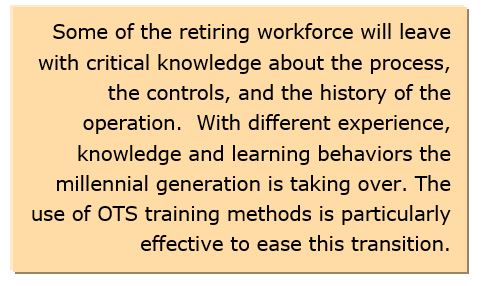 with different skills and learning habits, must be trained and up to speed quickly. Enter Operator Training Simulators (OTS), and knowledge transfer facilitated by OTS can be utilized to keep today’s increasingly complex plants operating safely, reliably and efficiently.
The new generation of workers, sometimes referred to as tech-savvy “Millennial’s” learn differently than do previous generations.
ARC recently conducted a survey in conjunction with CONTROL magazine and controlglobal.com to increase our understanding of why and how operator training simulators (OTS) are being used in today’s process plants to help overcome these challenges.
Today’s loss of experience has resulted in a number of high-profile industrial accidents in recent years. In just one tragic example, according to a 2009 report released by the US Chemical Safety Board (CSB), multiple deficiencies during start-up of a methomyl unit (a highly toxic agricultural chemical) in a chemical plant resulted in an over pressurized reactor exploding into a huge fireball, killing two workers and injuring eight others. Investigators found the start-up was begun prematurely due to management pressures and took place before valve lineups, equipment checkouts, a pre-startup safety review, and computer calibration were completed. 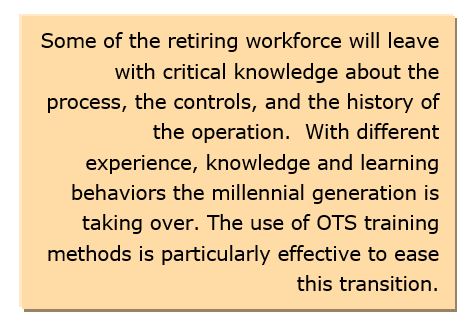 The report attributed this disaster to incomplete operator training on a new computer control system and inadequate control of process safeguards and other critical omissions. The investigation also revealed that critical operating equipment and instruments were not installed before the restart, and were discovered to be missing after the startup began.
The CSB Investigations Manager noted that equipment malfunctions distracted operators. “Human factors played a big part in this accident, and the absence of enforced, workable standard operating procedures and adequate safety systems meant that mistakes could prove fatal. For example, operators were troubleshooting several equipment problems and during the startup, inadvertently failed to prefill the residue treater vessel with solvent. A safety interlock was designed to stop workers from introducing highly-reactive methomyl, but it was bypassed as had been done in previous operations with managers’ knowledge. Once the chemical reaction of the highly concentrated methomyl started, it could not be stopped, and the temperature and pressure inside rose rapidly, finally causing an explosion.”
Better training might have prevented this incident. Better training helps operators to more quickly be aware of the situation, enabling faster and more appropriate operator responses. Perhaps a more experienced or better trained operator may have responded differently.
This generation is used to searching for information on demand. Clearly, new training strategies are needed to supplement or replace conventional approaches.
ARC Advisory Group recently conducted web-based research in conjunction with CONTROL magazine and controlglobal.com to develop a better understanding of today’s best practices and strategies for using OTS software. The survey examined various types of OTS solutions, implementation practices, reasons for implementing, training methods and benefits being used today.
This report highlights some of the key findings from the survey. The survey analysis focused on industrial end users. Those without direct end user experience with OTS were filtered out of the analysis and results. The majority of approximately 75 qualified participants were from the oil & gas and chemical and petrochemical industries, with some representation from the energy and nuclear industries.
Some of the topics covered here include:
When asked about the most important requirements for OTS, respondents answered that simulating startup and shutdowns was most important. Continuous plants like refineries and power plants can operate for three to five years between shutdowns. As many shutdowns and startups can largely be completed on a single shift, even experienced operators may never have experienced a startup. During startup, operators need to review SOPs, understand the safety and environmental issues, and use unfamiliar control system displays and features. Operational teams do not always get the hands-on training needed for starting up and shutting down a plant that their predecessors have experienced, and although technology has made it easier to capture procedures, critical plant information is not always easy to obtain when it counts the most. In batch plants, startups and shutdowns are done quite often and workers must understand how to do this without damaging equipment.
The second most important requirement indicated was to describe the dynamics of the process or plant. Operators complain that plants with highly effective automatic controls prevent them from getting a feel for the dynamics of the process. Operators have been known to put controllers into manual mode just to regain their confidence to assume control. OTS simulators with reasonably accurate dynamic simulations can provide operators with a safe, non-disruptive environment in which to practice manual interventions.

The third most important requirement indicated was to have a simulator that uses the exact same user interface as the real plant. Most DCS, PLC, and safety system suppliers can provide virtual control system emulation environments that can be directly connected to third-party dynamic simulations. Part of OTS training is to instruct the operator on how to “run the board.” This involves navigating the DCS displays, interacting with programs, algorithms, alarms, and trends. Amazingly, few operators know how to use all the features built into their own DCS. During startups, equipment often have permissives that need to be satisfied before a start button is enabled. An OTS gives an operator a chance to practice mission-critical procedures like startups, shutdowns, and special interactions with seldom-used control functions. OTS users recognize that training the operator is often just as much about understanding the control system as it is about understanding the field equipment.
A funny thing often happens during OTS training sessions. Astute operators find issues or defects in the control system displays, controls, or shutdown systems. Finding and fixing these issues improves ease of use, operational efficiency and safety. Many control system engineers believe that dynamic simulations provide the best way to test display, control, and shutdown software.
One participant indicated that he prefers to have the dynamic simulator as a part of the DCS. “We want trainees to interact with a DCS console during training, that looks and acts like the DCS console they use to run the plant.”
The fidelity of the OTS determines how closely the simulation matches the actual process. Some plants use simulators that are not exact matches but still enable the worker to practice potential scenarios. In other plants, the process simulation closely matches the actual process to provide high-fidelity OTS capabilities. We asked survey participants how they decide which type of OTS to use for different units.

Over 68 percent of the respondents indicated that they based this decision on the complexity or risk of the plant or unit. The higher the risk or complexity, the more likely the company equips the unit or plant with a high-fidelity OTS. The second most popular answer was that the decision is based on costs/economics or ROI. The cost-effectiveness of potentially expensive OTSs should be examined in terms of the impact the simulator would have on improving operator competence, plant safety and efficiency, and reducing risk.
Specific methods used to train workers vary by the role. OTS are used mainly to train operators and supervisors. Most training for maintenance workers is done in the classroom, on the job training, and/or online. ARC believes that OTS is the best method for training operators and supervisors in industries where the potential cost of an accident is high. Where OTS costs may be hard to justify, companies should consider using lower fidelity simulation with emphasis on helping operators master how they interact with the control system.
Companies should continue using a multi-faceted strategy that includes traditional classroom training, computer-based training, simulation training and newer technologies such as gaming and 3D visualization found in immersive training simulators (ITS). Some companies have implemented training programs that integrate all types of training with OTS. One participant commented that his company uses a DCS virtual controller with low-fidelity simulation for console operators and engineers.
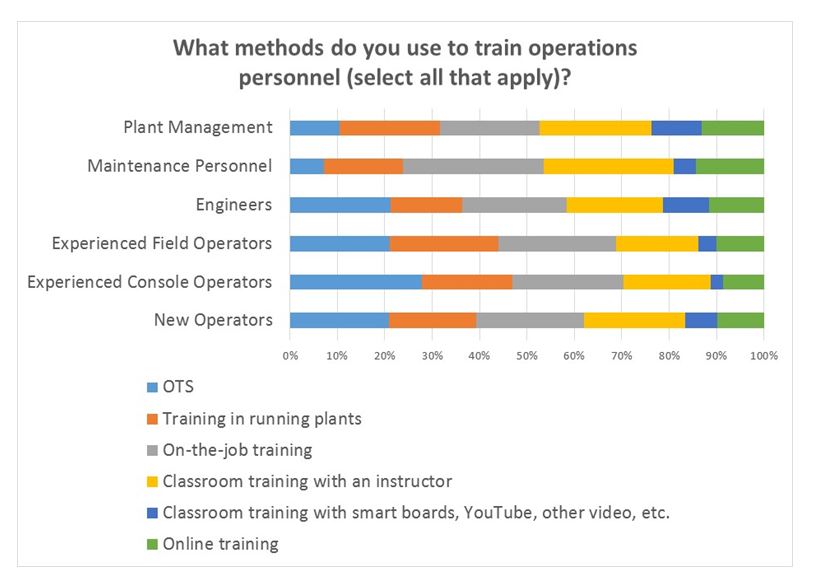
To a certain degree, OTS should be used to train all types of workers. Studies have shown that simulation improves learning and is effective in developing skills to deal with unanticipated plant situations, thus increasing the workers’ confidence in running the plant and his/her ability to deal with an emergency. The relatively high cost of operators training simulators is still often a barrier, but this usually depends on the fidelity and system chosen. One of the keys to success is to maintain the OTS over time and integrate it into other traditional and non-traditional education programs.
One respondent indicated that his company mainly uses simulation to test and validate new DCS software. These are typically migrations from one control platform to another or a platform upgrade. Operators are trained on the new system before it is implemented in the control room. The operators also help with program testing and validation.
Operations training continues to challenge industrial organizations. Operator training simulators are one of the best and fastest methods for training operators. In the US and EU, companies must deal with an aging workforce and train new workers to replace experienced retirees. In Asia, companies must deal with an excellent job market in which experienced workers leave every couple of years. Globally, manufacturers are implementing operations training programs that use simulators to train new operators effectively and pass on the plant knowledge quickly.
Based on ARC research and analysis, we recommend the following actions for owner-operators and other technology users:
ARC will continue to research and report on operator training simulators, operations training, training technologies, training strategies, benefits and other training methods and challenges. ARC analysts are also available to provide custom consulting on this and related topics.
If you would like to buy this report or obtain information about how to become a client, please Contact Us
Keywords: Operator Training Simulators (OTS), Industrial Training Simulator, ARC Advisory Group.