Representative End User Clients







Representative Automation Clients







Representative Software Clients








Earlier this week, ABB announced the impending automation acquisition of B&R, a supplier of factory automation solutions for  machinery. With this acquisition, ABB closes a long-standing gap in its industrial solutions portfolio, which should increase its competitiveness with arch rival Siemens. The purchase price was not revealed, and the acquisition is expected to close during the summer 2017.
This acquisition “reshuffles the cards” in the worldwide automation market, and especially in the European market. Once completed, the combination of ABB’s strength in process automation and B&R’s innovation in factory automation will create the third largest automation supplier after Siemens and Schneider Electric with significant offerings across the spectrum of industries, from discrete to hybrid to heavy process.
B&R had revenue of $600 million in 2016, and ABB turned over $6.5 billion in process automation alone, with another $6.4 billion coming from its discrete automation and motion business. The two companies did not disclose the purchase price, but a fair estimate based on common industry practices puts the price at roughly $2 billion.
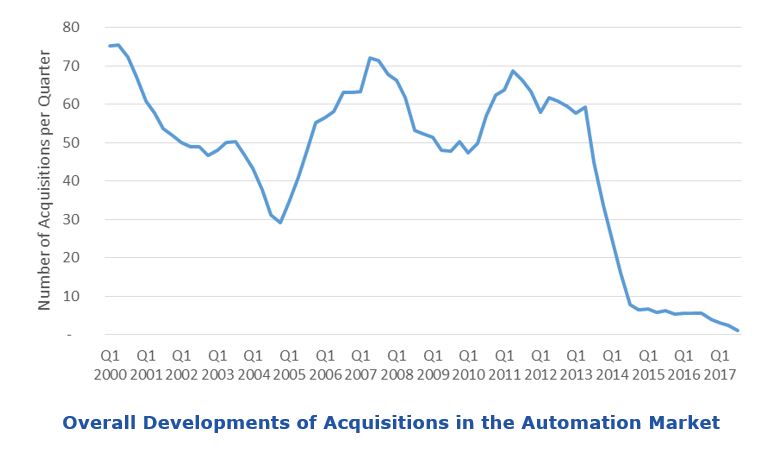
ABB has set a mid-term revenue target of $1 billion with B&R products, an increase of 67 percent over B&R’s current revenue. This mid-term target only refers to the development of the current B&R offering. In addition to this, there are around $260 million that are part of the current ABB portfolio, which will add to it. This means ABB and B&R plans to continue the growth path and even accelerate. B&R’s earnings before interest and taxes (EBIT) of 12 percent is above ARC’s calculated European average for automation companies of around 7 percent.
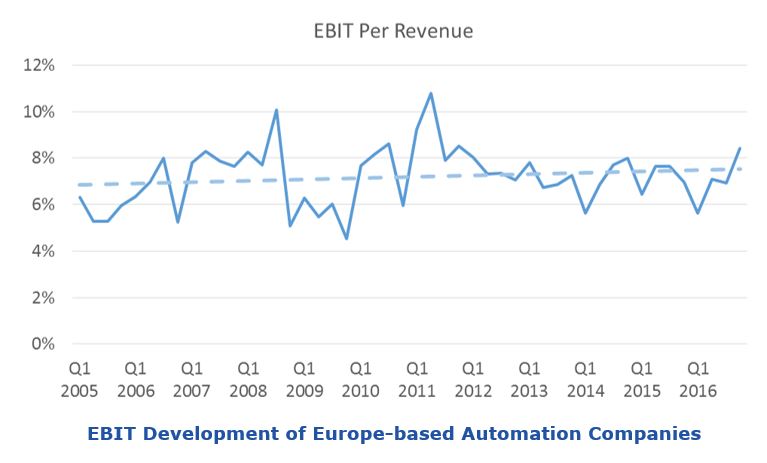
Since 2014, the number of acquisitions in the automation market has slowed dramatically. The boom years of 2006 to 2008 saw an increase in acquisitions and, in the aftermath of the 2009 crisis, there was another market consolidation. Overall, however, the number has gone down dramatically and the market is now fairly consolidated.
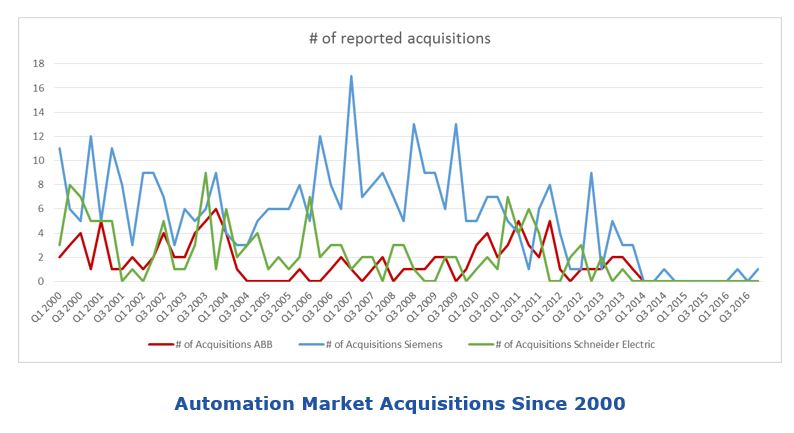
With the acquisition of B&R, ABB is joining the ranks of truly complete automation suppliers such as Schneider Electric and Siemens. Over the last few years, ABB has been comparably quiet when it came to large acquisitions, following a spurt of major deals from 2010 to 2013. These deals included Ventyx, Baldor, Mincom, Thomas & Betts, and Power One. These acquisitions improved the geographic and hardware/software balance of ABB’s overall business. But these were not automation-oriented acquisitions. During that same time, ABB’s European peers were also actively acquiring companies.
At Siemens, recent acquisitions have mainly been in industry software, starting with PLM software provider UGS for $3.5 billion in 2007, and followed by Innotec (COMOS) in 2012 for an undisclosed price. Another large software purchase was the recent $4.5 billion acquisition of Mentor Graphics, a provider of chip and electronics design software, announced in late 2016 and completed last month. To increase its presence in oil & gas, Siemens acquired Dresser Rand, a supplier of oilfield equipment, for $7.6 billion in 2013.
Schneider Electric went shopping for automation suppliers in the same time period, acquiring Invensys for $5.2 billion in 2013 and Telvent DTN for $2 billion in 2011. As part of the Invensys acquisition, Schneider Electric also acquired Wonderware, the pioneer of PC-based visualization software, which overlaps the functionality of the company’s Citect visualization software (itself a 2006 acquisition).
On the surface, it looks like giant ABB is acquiring a relatively small B&R. However, the intriguing aspect of this acquisition is not the volume of factory automation business that B&R brings to the table, but rather the potential for ABB to reach industrial customers for which its offering up to now has been incomplete and less integrated than competing suppliers. ABB’s portfolio has a clear gap in factory automation, and B&R’s offering of discrete industry controllers, panels, IPCs and servo drives fills this gap astoundingly well.
The following chart visualizes the strength of ABB, B&R and their combined strength as a heatmap (darker color = higher market share). We focused on larger markets and markets with high revenue contribution to the companies. An “x” in the product are means that the market is covered by a company.
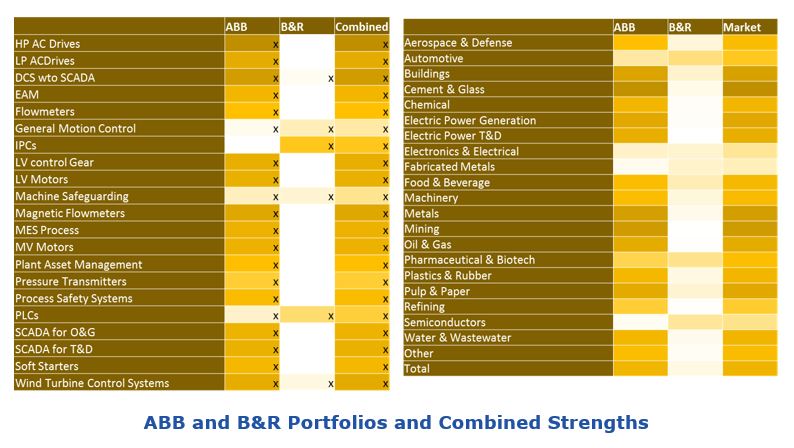
B&R’s process control solution, called Aprol, makes a small revenue contribution and represents a negligible share of the DCS market. The system is designed for smaller batch applications, while ABB’s DCS offering is scalable from small to large applications, so there is little overlap. Aprol is based on the same hardware as the company’s PLCs, so it is likely that B&R will continue to support the product line at least for existing customers.
B&R is a strong player in the industrial PC market where its IPCs are often used as automation platforms rather than just for data collection. The company’s portfolio includes a wide range of IPCs, including panels PCs. ABB has no such offering and will gain a solid foothold in the IPC market thanks to B&R.
ABB and B&R both offer operator panels, so its panel strategy will likely be streamlined in the near future.
When ABB acquired Jokab Safety in 2010, it became a supplier of machine safeguarding components. B&R offers many complementary products and supports its own safety network protocol for Powerlink, its version of industrial Ethernet. But, in the safety arena, B&R is mostly focused on safety PLCs, while ABB (Jokab) also offers additional safety devices. In this market, both companies are of similar size and together account for around 3 percent of the total market, so the impact on competition and the market is limited. An interesting aspect is the combination of ABB’s robotics business with the increased capabilities provided by the B&R machine safety business.
Both companies offer solutions for motion control, which is likely to generate some internal “acquisition friction.” While servo motors can be interchangeable, it often does not make much economic sense for the same company to offer competing solutions, so we expect some consolidation here.
ABB has a robust offering for robotics and B&R in recent years has added robotic control functionality to its automation solutions, so this integration could result in synergistic benefits.
While ABB does have a PLC offering, in the past, the company just didn’t appear to be very keen on marketing these products. While scalable and endowed with high-availability capabilities, the offering is limited and development seemed to lag. However, while ABB’s market share for PLCs has languished at around 1 to 2 percent for the past two decades, B&R grew its PLC business at about 11 percent annually to quadruple its PLC market share in that same time, according to ARC studies.
According to the acquisition announcement, B&R’s Austrian headquarters will become the seat of ABB’s new Machine & Factory Automation business unit. ARC research indicates that the combined PLC portfolios of ABB and B&R account for less than 6 percent of the market, but the potential of a rebranded platform led by B&R products is the greatest threat to ABB’s market peers.
B&R sells primarily to specialized machine builders. The company excels at customizing products for customers, which is one of its key success factors. B&R’s hardware design is modular and the company manufacturers its products in its own plants. This provides B&R with the flexibility to tackle customer projects that larger suppliers would turn down for lack of volume. Given ABB’s renewed focus on industry solutions, B&R’s solution focus could prevail in the new organization.
ABB has a good sales channel to the end user community, which opens up high potential.
With this acquisition, ABB is transforming itself into a full-line supplier of automation products for both discrete and process automation. Remaining gaps in the portfolio are in discrete sensors (similar to Siemens) and industry software. Among its peers, only Schneider Electric offers proximity and photoelectric sensors. While Omron has a strong position in the sensor market, the company does not offer process automation and field instrumentation. Rockwell Automation offers discrete sensors, but partners with Endress+Hauser to close the gap in process instrumentation.
Overall, market consolidation continues and we expect competition to increase further. ABB will become an even stronger competitor for Siemens and Schneider Electric as it adds B&R’s product offering to its own product offering and global sales and support structure.
For B&R, this acquisition may result in the loss of its status as a “renegade.” With 3,000 employees, the company is relatively small, but B&R has demonstrated that it knows how to use its small size to its advantage. While larger suppliers were selling standardized, off-the-shelf solutions, B&R developed a reputation in the 1980s and 1990s for “going the extra mile” to offer customized, engineered solutions, even in low-volume projects. Later, the company honed a reputation for product innovation, often going its own developmental way rather than following the mainstream.
B&R’s Austrian headquarters will now become ABB’s “Machine & Factory Automation” global business unit. As the two company cultures are merged, some of the entrepreneurial spirit and speed of innovation could be lost, but that will be outweighed by sheer potential of the new ABB.
If you would like to buy this report or obtain information about how to become a client, please Contact Us
Keywords: ABB, B&R, Process Automation, Factory Automation, ARC Advisory Group.