Representative End User Clients







Representative Automation Clients







Representative Software Clients








To improve China’s global competitiveness, the government launched national initiatives such as “Made in China 2025.” 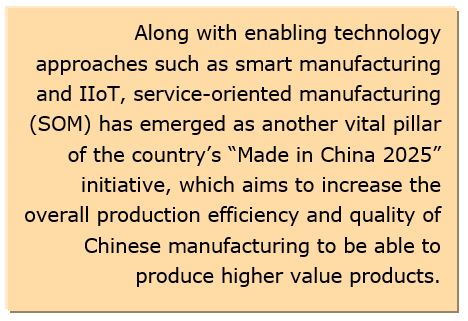 Along with enabling technology approaches, such as smart manufacturing and IIoT, China service-oriented manufacturing (SOM) has emerged as another vital pillar of the country’s Made in China 2025 initiative, which aims to increase the overall production efficiency and quality of Chinese manufacturing to be able to produce higher value products.
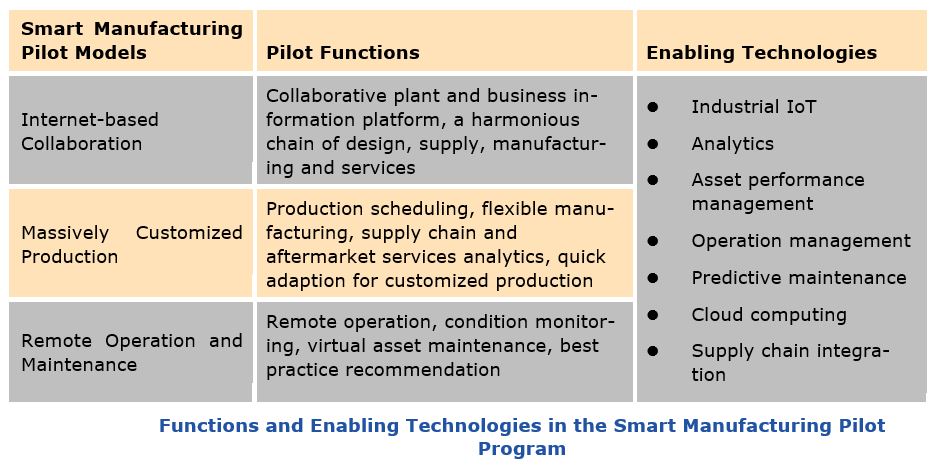
Last year, China’s Ministry of Industry and Technology Information (MIIT) and National Development and Reform Commission (NDRC), along with Chinese Academy of Engineering (CAE), released an action plan to promote development of service-oriented manufacturing. This encouraged manufacturers to transform to intensive, high-value-added and service-oriented manufacturing. ARC Advisory Group observes that many technologies are emerging that could serve as enablers for this challenging transformation. These include supply chain optimization, Industrial IoT, cloud computing, and others; many that are already being applied in smart manufacturing pilot programs.
Low labor costs and preferential government policies have enabled China to emerge as the world’s leading producer of low-cost products. However, China is still weak globally when it comes to innovation and the value chain; the country still has a long way to go relative to research & development, marketing, and other areas at the higher end of the value chain. The manufacturing services sector in China also remains relatively underdeveloped. The slow development of producer services, plus factors such as energy shortage, RMB appreciation, rising costs for both raw materials and labor, intellectual property disputes, and the financial crisis, have had an enormous impact on China's export of manufactured products. Also, with the latest industrial initiatives around the world, China’s manufacturing industry faces an unprecedented increase in external pressure.
Facing the urgent need for transformation, China has made smart manufacturing and service-oriented manufacturing as priorities to enter high-end sectors and global markets and increase the value of the “Made in China” brand.
As per the action plan initiated by the central government, service-oriented manufacturing can play a crucial role in upgrading China’s industrial structure, with the manufacturing and service sectors working more cohesively. This new manufacturing mode offers the promise to extend the country’s value chain to cover research and design, manufacturing, and aftermarket services.
Traditional manufacturers primarily produce and sell tangible goods to other companies and/or directly to consumers. In contrast, service-oriented manufacturers primarily sell their production capacity to other companies. Service-oriented manufacturing integrates production capabilities with services to provide customers with comprehensive solutions. Through innovation, upgrading, and adding more service factors to the production process; service-oriented manufacturers aim to improve production efficiency, value-add, and market share. An important measure of supply-side reform, service-oriented manufacturing also could become a new economic growth engine, benefiting the quality and profits of China’s supply system and helping meet the global appetite for higher value products.
Service-oriented manufacturing – enabled by several rapidly emerging technologies - aims to address many of its current bottlenecks of traditional manufacturing. These include inefficient manual collaboration between design and manufacturing; weak integration among elements of the supply chain; domain-specific product-process interactions; constrained production capacity due to inefficient material movement processes; and inefficient workflows, data management, and transactions.
Product-oriented manufacturing in China is often burdened by an over-reliance on maintaining expensive inventories to satisfy demand. Here, meeting production capacity demands via a service-oriented manufacturing network and integrated, optimized supply chain may be the better option.
In China, the increasing interconnectivity between manufacturers also lends itself to establishing service-oriented manufacturing networks. Cloud computing can enable new ecosystems of manufacturing services by allowing companies to communicate their respective needs and capacities automatically.
Industrial IoT-connected products, assets, and other “things” embedded with processors, sensors, and software allow data to be exchanged between the product, manufacturer, user, and other products and systems. IIoT-enabled services can shift the business models to deliver “pay-per-use” outcomes, availability, and performance. The products produced are generally complex, connected systems that can be remotely monitored by their manufacturer as they are used on site. This is key to enabling the manufacturer to offer product-centric services and deliver them effectively, efficiently, and profitably. Equipment/machine builders/OEMs can leverage the data and intelligence service from IIoT-enabled technologies to differentiate their offerings, drive improvements in efficiency and effectiveness, and enhance the customer experience.
Significantly, IIoT-enabled services create new opportunities and reasons for organizations to transform their value propositions and refine the service-oriented business model.
While the first iteration of the Made in China 2025 policy focused on financing investment in state-owned enterprises (SOEs), ARC believes that, moving forward, it will now increasingly focus on supporting the private sector and multinational manufacturers. The pilot program of smart manufacturing has already started to gain traction. Service-oriented manufacturing initiatives will speed up based on the lessons and best practices from the smart manufacturing pilot program.
Service-oriented manufacturing initiatives aim to lead the integration of manufacturing and service and speed up transformation of traditional production-oriented manufacturing to a service-oriented model. ARC recommends that end users, equipment/machine builders/OEMs and technology suppliers in China and elsewhere should seriously evaluate the potential benefits of combining the strategies of smart manufacturing with service-oriented manufacturing.
If you would like to buy this report or obtain information about how to become a client, please Contact Us
Keywords: China, Made in China 2025, Service-oriented Manufacturing (SOM), Industrial IoT, Supply Chain Management, Cloud Computing, ARC Advisory Group.