Representative End User Clients







Representative Automation Clients







Representative Software Clients








Most process plants and facilities are a product of their evolution. For example, many refineries in the United States were originally constructed in the early 1900s and have evolved over a period of over 100 years. These facilities were  modernized, expanded, and modernized again to adapt to generational changes in technology, both for production and control. Facilities evolved to be monolithic, and highly customized from an engineering standpoint. Automation systems and their design and engineering evolved to be the same way – monolithic, proprietary, and relying on a large amount of customization and custom engineering.
These proprietary, monolithic, highly engineered approaches present burdens that end users are increasingly finding unacceptable. Historically, automation projects are rarely completed on time and are usually over budget. At the same time, projects are getting larger and more complex. Even in today’s tough economic climate, record-breaking facilities are being built and commissioned, from the massive Sadara chemical project in Saud Arabia (a joint venture between Dow and Saudi Aramco), to the Shell Prelude floating LNG ship. These larger, highly complex projects are hard to manage. There is a lot of money on the line. While automation has historically been a barrier to on-time project completion, this is no longer acceptable.
End users have expressed their displeasure at the way automation systems have evolved. ExxonMobil, for example, recently announced its vision for an open automation system of the future that is more flexible and easier to deploy and maintain. Users have made it clear that they want a different approach to automation – one that removes the many complex layers that have built up over several decades of changing technology. They want a solution built on modular, standardized elements that can be easily integrated together.
 These changes in automation systems are reflected in the changing nature of the plants themselves, which are becoming more modular and flexible. In the pharmaceutical industry, for example, there is a push toward more open, modular plant construction. Instead of building a large, monolithic plant just to produce one drug, for example, pharmaceutical companies are opting for modular plants that can be configured to produce multiple drugs – ones that can be scaled up or down to increase or decrease capacity as market demands change. Modular plants also take less time to construct and can ease the process of meeting regulatory approvals.
Modularization also embraces standards. ARC Advisory Group believes that standards ultimately improve products and applications, and a standards-based solution results in a wider choice of both. This report examines four primary aspects of modularization in process and manufacturing industries today:
Modularization, which is being driven by end users, offers significant economic benefits both during the engineering and project phase and throughout the lifecycle of the plant or other industrial facility. Modularization embraces open standards and open approaches. Modularization significantly reduces customization and custom engineering costs. Modularization also supports the automation of many key automation functions both during design and installation and in the operational phase. ExxonMobil’s “DICED” (Auto-Detect/Auto-Interrogate/Auto-Configure/ Auto-Enable/Auto-Document) concept for I/O attests to this. Similarly, ARC’s Collaborative Process Automation System (CPAS) vision supports modular automation concepts.
If the concept is new to you, modular automation or modularization essentially means the breaking down of systems,  plants, processes, and unit operations into standard, modular components; much like those popular children’s building bricks that can be mixed and matched freely to make any number of different creations. You see the modular approach in new types of process automation systems that incorporate either programmable or characterizable forms of I/O and standard cabinets/field junction boxes. You also see it in new approaches to automation system design that incorporate “late binding” techniques and utilize engineering in the cloud and virtualization concepts. Even at the plant level, process plants and facilities are increasingly being built with modular concepts in mind.
Modularization of control system architectures is manifesting itself in several ways. We now have a new generation of “single point” I/O that can either be individually characterized with specific plug-in modules, what ARC refers to as “characterizable” I/O, and software-configurable single point I/O. Standard, modular cabinets and field enclosures are also becoming more feasible because of these new forms of I/O. ARC also sees increased use of remote instrument enclosures, which are essentially self-contained modules of controls and related equipment that can be deployed fairly quickly.
The new generation of configurable and characterizable I/O solutions promote modular construction because of their smaller footprint and ability to accommodate late changes in a project. The flexible design also eliminates the need for customized cabinets, which can provide considerable savings in cabinet design and customization.
As stated previously, single point, flexible I/O can eliminate the requirement for custom cabinets. The new solutions separate control cabinet design from control hardware, allowing the end user to choose from a variety of standard cabinet designs.
 ARC also sees increased use of remote instrument enclosures (RIEs) as an extension of the modular design philosophy. There are several advantages to remote instrument enclosures. Consider that the productivity of skilled shop craftspeople is 30 to 50 percent higher than for craftspeople that must install and commission devices in the field. This difference results in a considerable savings in the total project hours. These savings can offset and even exceed the greater modular engineering costs. The shop fabrication approach of RIEs also avoids weather delays. Availability of skilled craftspeople in certain areas is a major problem. For remote locations, skilled craftspeople may have to be relocated from other areas, which adds cost to the project.
In modular construction, the site construction time is very short. It is often possible to schedule installing the modules during the most favorable time of the year. Quality control in the fabrication shop environment results in a higher quality plant at lower inspection and testing cost. Availability of different disciplines at the fabrication shop such as insulation, paint, non-destructive testing, pressure testing, etc., results in shorter schedule and increased cost savings.
Modular concepts have existed for some time in the world of software development. The concept of “DevOps” in agile software design is one such example. DevOps principles include testing early and often, continuous improvement, automation of everything that can be automated, co-location of development team, strong source control, and delivery in small increments. Perhaps more importantly, DevOps principles encourage collaboration between software developers and other IT professionals.
When looking at the total cost of a project, the automation portion of that project tends to be quite small. For an average refinery, for example, automation can represent 1 percent or less of total project spending. Other aspects of the project, such as piping, fittings, and vessels account for much more. For this reason, the value that automation brings to a project is often overlooked. However, automation provides the “brains” behind the plant, and the process cannot run without a well thought out and executed automation strategy.

With so much pressure on the project side, it is clear that the traditional method of executing automation projects must change. This requires both a change in the work processes associated with projects and the technologies that make them possible.
The new breed of control systems that feature single point I/O also feature new ways of doing control system engineering and design. Most suppliers are offering “engineering in the cloud” functions that support true concurrent engineering, with multiple engineers in multiple locations around the world able to work on an automation system project in a secure, virtualized, cloud-based environment.
This new approach to engineering for standard, modular hardware also enables late binding techniques, where the physical aspects of a system can be completely divorced from the software and development aspects. In other words, the engineers can develop the system in a purely virtual environment in the cloud and, at the latest possible moment, deploy that software to the physical system. It also allows for automated binding of the physical aspects to the functional aspects. Late binding reduces and removes risks to the schedule and budget and offers more flexibility and agility. Again, the new forms of smart and single channel I/O are a major factor in enabling modular engineering.
Many factors drive the use of modular concepts in actual plant and process design. For industries like offshore oil & gas and floating production and storage operations, space is a huge consideration. Here, the modular approach is often the only way to fit everything into the required space. Modularization makes the most efficient use of space and  compactness but because of this can be design-intensive.
For the Shell Prelude floating gas-to-liquids (GTL) ship, for example, traditional gas to liquids process units had to be shrunk down to a quarter of their size and installed as modules in order to pack all the necessary equipment onto a single vessel, which already weighs in as the largest ship in the world. The project simply could not have been executed without a modular approach.
However, modular approaches are not limited to oil and gas applications. One could argue that modular concepts for plant design originated with the pharmaceuticals and fine chemicals industry. ARC wrote a case study back in 2006, for example, on a Reliance Life Sciences project that built a plant based on modular skids integrated together using FOUNDATION fieldbus technology. These skid-mounted or self-contained modules allow end users in the fine chemicals and life sciences industries to build plants more rapidly and with a smaller footprint, and can also ease the regulatory process. The NAMUR NE 148 recommendations referenced later in this report focus on these modular project approaches for these industries.
Process intensification is another chemical industry initiative that naturally leads to modular construction and approaches. Process intensification aims to dramatically reduce the size of plants and still meet production objectives. Process intensification brings dramatic changes in efficiency, and often uses new process technologies to reach this goal, such as innovative designs in reactors and heat exchangers.
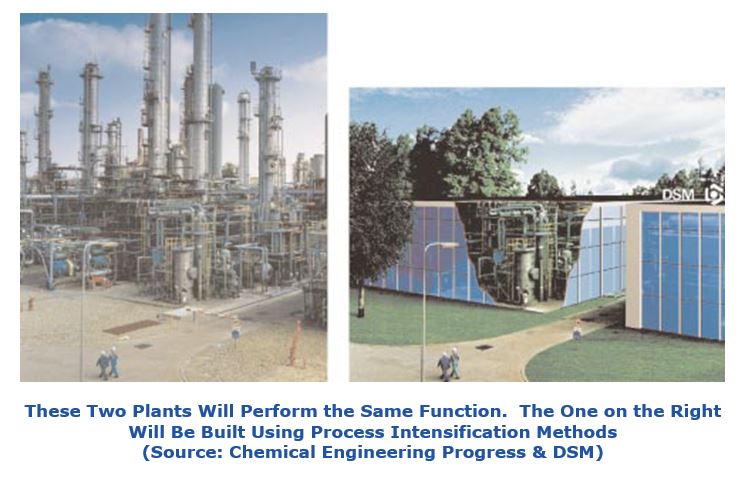
Many of these new approaches involve multifunction equipment that accomplishes the tasks done by formerly separate pieces of equipment. This often means combining reactions and different pieces of process equipment. Multifunctional reactors, for example, combine one or more functions traditionally performed in separate pieces of equipment and reverse flow reactors integrate reactor and heat transfer processes.
The increasing demand from end users for more open, standardized systems that provide a path to modularization is reflected in the future-looking visions of many end user companies and end user-sponsored industry initiatives.
In January 2016, ExxonMobil announced a contract with Lockheed Martin to architect and develop a proof-of-concept for a highly open process automation system. Far greater control-level interoperability is one goal of this initiative. This proof-of-concept system will be developed during 2016. However, ARC has been reporting on the ongoing development of this vision for a couple of years now, as ExxonMobil has been very public about the kinds of functional characteristics and the business metrics they expect to see from automation systems in the future.
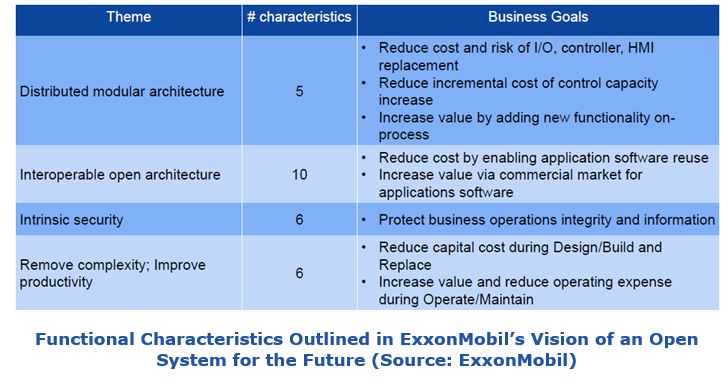
At the 2015 ARC Industry Forum in Orlando, Florida, ExxonMobil outlined what the company sees as the functional characteristics required for the open system of the future. The table shows that a distributed and modular architecture is chief among these characteristics, including reduced cost and risk of I/O, controller, and HMI replacement. This thinking can also be expanded to include areas that encroach into level 3 manufacturing operations management applications such as alarm management and asset management. For ExxonMobil, distributed and modular also means being able to easily increase capacity at reduced cost, as well as being able to add new functionality “on-process,” or while the process is still running.
 In addition to the functional characteristics, ExxonMobil unveiled the company’s vision for a new system architecture at the recent ARC Forum. The architecture for this vision for the system of the future also calls for modularity, with modular, standardized distributed control nodes or DCNs attached to a standard, common real-time service bus. Level 1 through Level 3 applications will exist within a common high-availability real-time computing environment for all these applications.
Another end user- sponsored industry initiative that encompasses modularization concepts is the F3 Factory initiative, a partnership between the EU, research institutions, and industry within the FP7 framework program for research. The goal of F3 Factory is to overcome the disadvantages of large-scale continuous processing (high capital investment and rigidity) and small scale-batch processing (inefficiency) and combine their respective advantages by introducing efficiency to multi-purpose, multi-product facilities; and introduce flexibility to world-scale continuous facilities.

Research objectives include:
Bayer, one of the primary end users supporting this initiative, recently completed a successful project implementing the principles of F3 Factory using a prefabricated module. The company examined the potential to take processes that exist in traditional, large-scale continuous production and make them more modular and flexible with “small-scale container-based production units.” Bayer demonstrated this using a range of innovative new production techniques, including integration of reaction and separation steps in its production unit (process intensification).
According to F3 Factory, some of the key benefits realized by this project include:
Standards include NAMUR NE 148 recommendations for modularization of process plants, the ISA 106 standard for modular procedural automation, and the ISA 88 standard for batch control. There is some degree of interrelationship between all three standards activities.
NAMUR, a chemical industry end user organization based in Germany, includes most of the major European chemical and pharmaceutical companies from BASF and Bayer to Novartis and Evonik. NAMUR issues recommendations documents and these almost always eventually find their way into supplier product offerings. The NAMUR NE 148 recommendations came out of the fine chemical and pharmaceutical industries that originally adopted modular concepts in plant and process design. The requirements for modular automation specify decentralized automation with each “module” being fully automated. NE 148 also specifies flexible integration in plantwide control layers, vendor-independent integration of modules, tool support for integration engineering tasks, and vendor-independent, functional, and consistent description of modules.
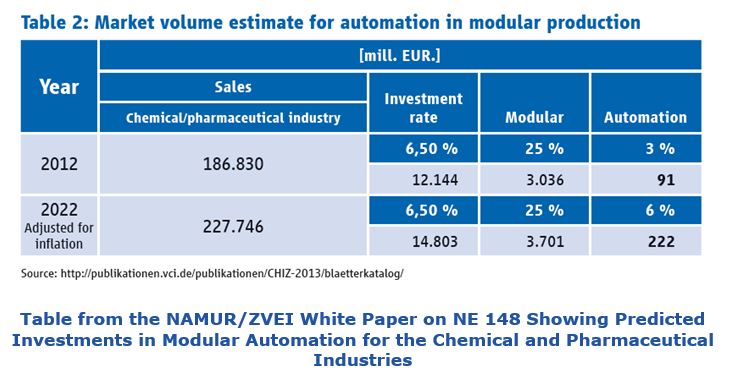
NAMUR and German industry organization ZVEI recently published a white paper outlining the requirements and recommendation for NE 148. ZVEI conducted a survey of major end users and determined that up to 25 percent of production processes in the chemical and pharmaceutical industries will be modular. According to the research, modular production processes will grow at a rate of 6.5 percent between 2012 and 2022, representing close to €4 billion of investment by 2022.
The document also references other existing standards that support modular concepts, including the ISA 106 standard for modular procedural automation and the ISA 88 standard for batch control. In addition to procedural automation, ISA 106 supports concepts for state-based control. The ISA 88 standard was originally developed for the batch industries, but its concepts can also support continuous production principles and ISA 106 can be viewed as an extension of the ISA 88 standard.
 Procedures govern the world of process automation. While we like to refer to the process industries as being largely “continuous,” this is not actually the case. Process manufacturing is constantly in flux. Whether in the midst of a startup, shutdown, grade change, or maintenance turnaround; plants are governed by procedures and transitional states. These transitions can run smoothly, providing with superior plant performance and safe and orderly startups/shut-down, or they can be costly terms of unplanned shutdowns, incidents, lost product, and lost opportunities.
The ISA 106 standard will provide industry with benchmarking data and design considerations for procedural automation in continuous processes. The standard addresses topics ranging from models and terminology to modularization of procedural steps with an eye toward reusability and lower cost of ownership.
One of the key concepts in NAMUR NE 148 is the development of Module Type Packages (MTPs) that encapsulate much of the process control system functionality and allow for much easier and less time and resource consuming integration.
ISA 88 is a five-part standard addressing batch process control. It is a design philosophy for describing equipment, and procedures. It is equally applicable to manual processes. It was adopted by the IEC as IEC 61512.
The series provides a consistent set of standards and terminology for batch control and defines the physical model, procedures, and recipes. The standard was developed to address the lack of a universal model for batch control, difficulty in communicating user requirement, integration among batch automation suppliers, and difficulty in batch control configuration. It helps create more flexible manufacturing processes. The standard defines a process model. This model consists of a process that consists of an ordered set of process stages, which consists of an ordered set of process operations, which consists of an ordered set of process actions. ISA 88 can be applied in fully automated, semi-automated, and even in completely manual production processes.
End users should consider modular approaches to automation because they offer significant cost savings both from a project standpoint and throughout the plant lifecycle. Modular approaches also offer smaller footprint, increased ease of regulatory compliance, and a path to open systems and standardization. It is no accident that major industry initiatives being driven by end users from ExxonMobil to Bayer are heavily incorporating modular concepts. Modularization concepts also fit quite well with existing standards activities such as NAMUR NE 148, ISA 106, and ISA 88.
Perhaps just as important is the ability of modular concepts to provide a “future proof” path to adoption of advanced new technologies such as the Industrial IoT, Big Data and analytics, virtualization, and cloud technologies. Many resources are available for end users interested in adopting modular automation in their plants. ARC offers numerous resources on how automation systems are becoming more modular in our Collaborative Process Automation System (CPAS) study. CPAS follows many of the same principles and ideas outlined in the modularization forum session.
Before jumping into this new paradigm, ARC recommends that industry participants:
If you would like to buy this report or obtain information about how to become a client, please Contact Us