Representative End User Clients







Representative Automation Clients







Representative Software Clients








In 2009, in the middle of the economic crisis, some economists consulted history books and made two conclusions: 1) recovery after a financial crisis takes significantly longer than after a crisis in manufacturing, and 2) in the past, it took around eight years to recover from an economic crisis.
Obviously, after a quick bounce back in 2011 – fueled by government intervention across the globe – we went through a long period of sideward movement. Some industries experienced booms and some suffered, but overall, it was a  sideward movement. Now, eight years later, we are in the middle of the first real uptick in industry and automation. This uptick crosses many industries and regions.
Another economic maxim also applies: In day-to-day business, short-term trends overpower long-term trends. This means that the current business cycle also masks some of the fundamental problems. Brexit in Europe, geopolitical crisis in the Middle East, middle income traps for emerging Asian countries, a consistently suffering Latin America, a purely resource-dependent Africa, and the US becoming a less reliable partner for global trade and stability.

Today, while both process and discrete industries are growing, ARC’s Discrete Automation Index is at a record high (superseding the value from 2011 and 2007); but the process industries have just started to recover and are still on a low level. This trend is global and all regions report similar dynamics.


Europe’s automation markets have been in a sideward movement for several quarters. Overall, Europe has stronger exposure to the discrete automation markets than many other regions. The region itself has a limited number of natural resources, but at the same time, supports numerous companies; from automation suppliers and other automation OEMs, to manufacturers that populate the local market for factory automation.

“Sorgenkinder,” a German word, literally means “problem children.” It is often used to describe subjects with problems. In this case, we are referring to Italy, UK, and (again) Greece. A brief update on these sorgenkinder follows.
While automation markets in Italy strongly benefit from the boom in China, local demand tends to be sluggish. The debt level is still high and political climate is again in a deadlock, without much progress on the needed reforms.
On the other hand, Spain managed to recover strongly. Accompanied by huge investments, both from external pull-effects and from FDI flowing into Spain to set up local production. This applies mainly to the automotive industry.
Despite the Brexit, many industries are currently doing well in UK. This is due to the global upswing and possibly to a “last call” phenomenon, with many users preferring to make investments under a known, secure legal framework to be better prepared for the post-Brexit era. The local oil & gas sector is still feeling tremendous pain, since the costs for subsea production did not come down to a level to be price competitive at an oil price of $60 to $70 per barrel, as it did with hydraulic fracturing. It’s possible that, in the long run, many of the manufacturing industries will move out of UK. For now, Brexit negotiations have finally started and the initial mood appears to be toward finding workable solutions.
Greece still faces a debt crisis. Overall, the situation has stabilized, but at a high cost for the Greek economy and state, which was forced by its creditors to sell/privatize a large share of its assets, crossing multiple red lines along the way. A sustainable and lasting solution is currently not in sight.
A lot happened in Turkey. Following the coup in 2016, President Erdogan started to pursue the responsible persons and applying a state of exception (emergency) over the country. However, this turned into a state of persecution, in which thousands of teachers, policemen, judges, and other state employed persons were fired or imprisoned, being accused to be part of the Gülen movement and to be terrorists. This witch hunt, which currently appears to address most critics of president Erdogan, extends to journalists, civil right workers, and some foreign-based companies (including, at one point, Daimler). We see no improvement in sight.
This led to a political crisis between the EU (mainly Germany) and Turkey, which affects both the economy and automation markets. Turkey, one of the key economic powers in the region, has been the link between Europe and the Middle East. The country also hosts a substantial machinery sector. While the short-term effects are bad, the long-term effects can be devastating. Once, users turn away from Turkish machinery and started to buy in Asia or elsewhere, there would probably be little incentive to turn back once the situation has normalized. The longer the current crisis continues, the longer lasting the effects will last.
Europe’s process industries are suffering overall and both DCS suppliers and suppliers of large drives feel the pain. Europe’s oil and gas production is relatively expensive, as it is mostly focused on deep sea exploration. Compared to the Middle East, even Russia’s oil production is relatively expensive. While the costs to produce shale gas in North America has come down significantly to enable shale gas producers to be competitive at an oil price of $50 to $70 per barrel, deep sea oil remains unprofitable at these low oil prices.
Political struggles with Ukraine, Russia, Turkey, and in the Middle East puts many of the larger projects on hold for now, so there is no relief in sight for Europe’s oil & gas industry. ARC nevertheless expects investments to pick up a bit, due to deferred maintenance/upgrades on existing assets and the need to replenish spare parts inventories. The investments will be very selective.
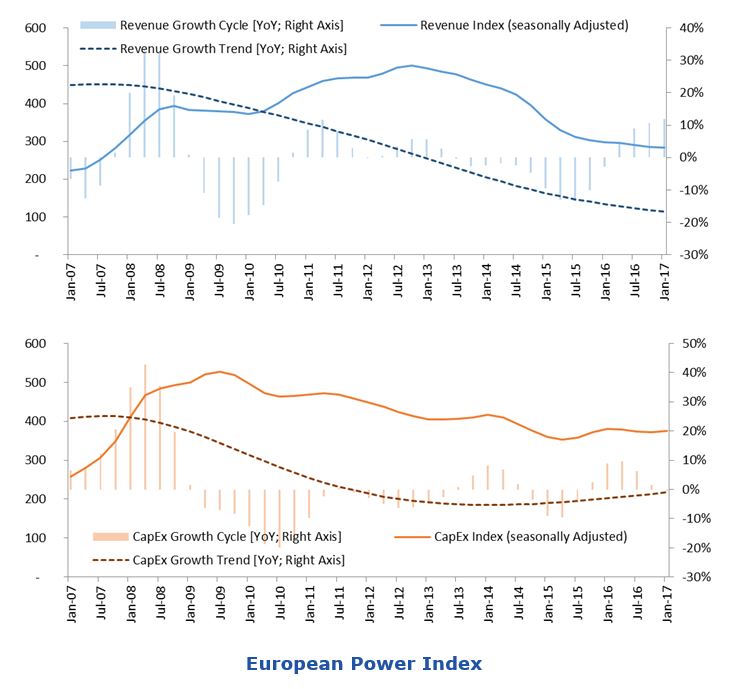
Europe’s utility sector is still stressed. However, capital expenditures in the power industry have stabilized and it seems that the initial shock of renewable energy in terms of prices, revenues, and capital expenditures has tapered off. The long-term trend points towards a stable market, but without growth. Water & wastewater is rather stable, but due to today’s low interest rates and the good shape of many of the economies, the investment climate is quite positive in this sector.
In Europe’s chemical industry, fine chemicals have gained increased importance in recent decades. Overall, local end users are quite positive and most have reached their financial targets. Germany’s end user companies in particular are focusing increasingly on digitalization and have kicked off company-wide initiatives. Bayer and Evonik are just two examples. The European chemical industry is also facing increased global competition, which has also led to a series of M&A activities (Bayer/Monsanto; DuPont/Dow; ChemChina/Syngenta). This is probably just the beginning of a consolidation trend that is likely to alter Europe’s chemical industry landscape.
Cost pressures remain in the bulk chemical market, particularly plastics and rubber.
In Europe, the hybrid industries show very stable development. While the end users included in our index often change their investment strategies, these typically apply outside of Europe and/or are prompted by exchange rates.
Recent turmoil has had little effect on the markets in Europe, which have shown slow, steady growth. We observe a continuously shrinking asset lifecycle in the food & beverage industry that supports ongoing demand for flexible machinery.
Potential new markets in Europe include precision and urban farming, but unlike in the US, most are small-scale farmers who are often reluctant to invest in new technology and/or simply do not have the resources to do so.
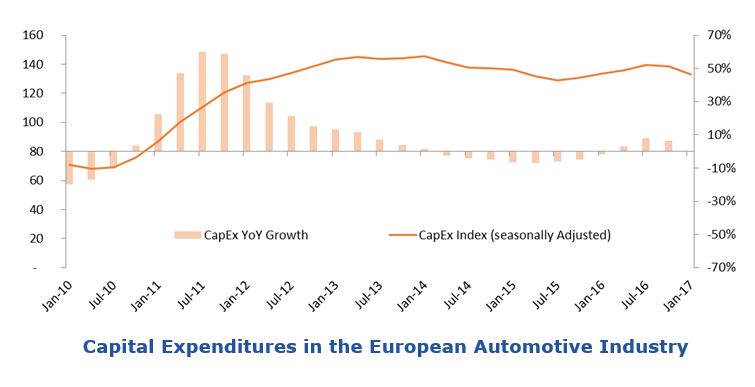
The discrete industries in Europe often benefit from a pull effect from emerging markets, mainly China. Automotive is the main local driver. As shown in the chart, the capital expenditures of the main automotive companies in Europe have been rather stable since mid-2013 and experienced a small increase in 2016. With the current uncertainty around the diesel-engine controversy and potential legal consequences (driving bans and fines for car manufacturers), investments tend to be cautious. However, car manufacturers plan their models far in advance and unless there are severe economic crises, they stick to their investment schedules. One of the main targets of Europe’s automotive industry has been the need to increase flexibility.
The local aerospace & defense industry is also in good shape. However, other than machine tools and PLM software, this represents only a small share of the automation markets.
Unlike consumer electronics, which are largely imported from China, electronics manufacturing in Europe often involves smaller batch lots for more specialized industrial electronics, such as PLCs and IO modules. As wages increase in China (and other low-wage places), some higher volume electronics manufacturing may return to Europe, if China’s manufacturers fail to implement adequate automation to offset the higher wages.
Economic activity rebounded strongly in the US in the second half of 2016 and the economy is now approaching full employment. The US economy has reacted positively since President Trump’s election. His administration’s promises to lower corporate taxes and streamline regulations have energized investment from both large and small US firms.

However, economists fear that the administration’s protectionist policies could lead to a global trade war and hamper growth in the US and globally. Many economists are also concerned about President Trump’s harsh stance on immigration. His anti-immigration policies have the potential to drive away millions of workers important to the country’s farming, construction, and service industries, while negatively impacting the country’s IT talent pool by restricting visas for engineers and computer programmers from foreign countries.
Political instability and economic concerns in Brazil and Venezuela negatively impacted growth in Latin America. On the other hand, capital investments in the water & wastewater and food & beverage industries due to higher consumer demand helped curb the market’s plunge. Economically, Argentina, Venezuela, and Brazil suffered in 2016, but Mexico showed resiliency despite the uncertainty of the future of the NAFTA agreement created by the new political environment in the US. One of the main reasons for Mexico’s positive development have been the increased investment from foreign automotive manufacturers and the lower Mexican Peso, which makes the country more attractive for FDIs.
As we’ve seen elsewhere around the globe, the discrete manufacturing industries in the Americas recovered quicker in 2016 than the process industries, with many companies making up for several years of deferred maintenance/repair/upgrades. North America’s automotive industry in particular has been performing well, since the low fuel prices have increased sales of highly profitable SUVs and trucks. However, this has not necessarily translated into increased automation investments.
With continuing depressed oil prices, less capital investment funding was available in the upstream oil & gas sector in 2016, the major consumer of automation technology in much of the region. With the current imbalance between supply and demand, oil prices have stayed at low levels through the first half of 2017, which ARC believes will represent the “new normal.” As mentioned previously, cost-reduction initiatives for unconventional shale oil & gas production have improved the economics; shifting capital expenditures in this sector into a growth mode in North America and elsewhere. However, while orders appear to be healthy, shipments lag due to the typically long lead times for automation for major projects in the process industries.
Due to ready access to shale gas, several North American LNG receiving/re-gasification terminals are being expanded to include new liquefaction plants for LNG export, each of which require a significant investment in field instrumentation, valves, DCS, safety-related systems, and software. The associated gas processing, storage, and loading facilities also require incremental automation investment.
Ready access to oil and gas for both feedstocks and energy has also provided economic justification for several large greenfield chemical projects in North America. The first grassroots petroleum refinery to be built in North America in many years is making its way through the regulatory hurdles. It aims to have a net zero impact on the environment.
The food & beverage sector showed steady capital investments. In the mining sector, there was higher level of investments in taconite, copper, and chromium mining, which should certainly provide a lift for Latin America. The pulp & paper industry also experienced higher level of investments in this region.
China’s automation markets started to recover strongly in the last quarter of 2016, with double-digit growth in the first quarter of 2017. Most leading automation suppliers, both domestic and multinational, showed strong performance.

We’ve heard many discussions about why China’s automation market has been experiencing such strong performance in recent quarters. Reason given include government initiatives (such as “Made in China 2025” and “One-Belt/One-Road”), deferred MRO investments, and so on. However, ARC believes the strong recovery in automation markets is largely a result of the business cycle, with China’s macro economy shifting from recession to recovery. The current strong Manufacturing PMI index and the fact that almost all industries have shown good growth since Q4 2016, not just those emerging industries on which the government initiatives focus, suggest that the overall economy is recovering.
China’s electronics manufacturing industry is doing especially well and is one of the main industries driving the country’s automation market today. This helps explain why GMC, PLC, CNC, machine vision, and discrete sensors experienced above-average growth within the country’s total automation market.
India undertook a series of structural reforms in the past three quarters; demonetization of high-value currency notes in 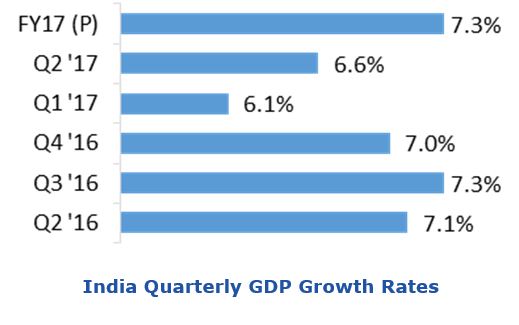 November 2016 and the recent rollout out of a Goods and Services Tax (GST) in July 2017. These have been testing times for the economy, as the impact of demonetization gradually settles down and the full impact of GST is yet to come to the fore.
Due to demonetization, the GDP drop in Q4 2016 worsened in Q1 2017 and economic growth slowed to 6.1 percent. There was a sharp dip in the manufacturing and construction sectors as can be seen in the contraction of the Manufacturing PMI Index in December 2016, compiled by Nikkei Markit, and its sluggish increase in the initial phase of Q1 2017.
In the three months from January through March 2017, India’s economy experienced the full impact of the note ban, with the effect on some industries more pronounced than others due to lack of liquid cash. Cash-based sectors, including the unorganized sector and small and medium scale industries (SMEs), which account for nearly half of the manufacturing GDP, were hit hard.
The most noticeable impact was on the labor-intensive construction industry, which contracted because of the cash crunch. The cash-dependent segments in the steel industry, comprising the medium and small sized secondary steel sectors that contribute a majority of the total steel output in India, witnessed slow growth. Cement output also dipped in the months following demonetization. Moreover, investment in plant and machinery, as measured by gross fixed capital formation (GFCF), was down to 25.5 percent in FY Q4 from 27 percent in FY Q3 2016, as per Central Statistics Office (CSO), a leading government body. India’s automotive industry also experienced lower demand due to the note ban. According to the Index of Industrial Production (IIP) compiled by CSO, during the same period, capital goods were lower by 3 percent and 17 out of 22 manufacturing sub-sectors reported contraction. However, the effects of demonetization were temporary and started to wane by the end of Jan-March quarter 2017, as the PMI expanded to 52.5 on the back of strong growth in orders, both domestic and exports.

In Q2 2017, the performance of both the PMI (quarter average) and GDP has fared better than in Q1, as new export orders boosted demand for goods manufactured in India. However, the PMI has been sliding since April due to factors such as weak domestic demand, water scarcity, and negative investor sentiments due to GST rollout.
Followed by demonetization, the second phase of economic reforms through the GST implementation in July has received mixed response from the industry. Industries’ negative sentiments impacted the industrial production and PMI contracted below 50 in July. The disruptions caused by GST are expected to be short-term and the efficiency gain post-implementation should become evident soon. The Reserve Bank of India anticipates higher GDP growth rate during the second half of 2017 as consumer spending and domestic demand rises, taking the overall GDP to about 7.3 percent for FY2017-18 as compared to 7.1 percent for FY2016-17. Moreover, lower tax rates due to GST rollout is anticipated to bring the unorganized sector into the formal economy, boost demand, lower the cost of capital goods, and reduce logistics and inventory costs.
Investments in infrastructure is getting a huge boost with about $60 billion allocated for the current financial year for upgrading urban infrastructure, ports, airports, roadways, and railways that get the largest chunk of investments. To meet this domestic demand, India is planning to triple local steel production over the next decade. This would give a boost to local steel companies as well as attract investments from global majors. The demand for oil and gas is also set to rise significantly to support the growing population, expanding industrial base, and demand for clean fuel with minimum sulfur content. This will also require a huge expansion in India’s refining capacity. India is in the process of upgrading the automotive emission regulation known as the “Bharat Stage” (BS) norms, equivalent to the European emission standards, from the current BS IV stage to BS VI by 2020. This entails skipping stage V and would involve large investments in refinery sector (estimated to be about $7.6 billion) to expand capacity over the next three years. Both discrete and process industries will gain from the above investments in 2017.
The Indian machinery segment is also witnessing tremendous growth. According to VDMA (German Engineering Federation), this market in India is expected to grow by 8 percent in 2017 and the production index grew by 5.5 percent in 2016-17 compared to the previous year. India's machine operators serve the lower-to-mid price segment and compete with second-hand products and imports from Asia. The target industries mainly comprise textile, construction, machine tools, and energy technologies. The machinery market will see a strong expansion of production in the upcoming years. Moreover, Indian associations are trying to make imports of competitive products more difficult. This may result in more foreign companies setting up factories in India to supply the domestic market. Since 2000, foreign companies have already invested $4.3 billion in machinery.
Key growth segments for the automation market include smart city solutions, transportation, process automation and instrumentation, power grids, renewables, remote monitoring, renewables, and others.
Japan’s real GDP showed 1.2 percent growth in FY2016, with similar growth expected for FY2017. In addition to a continuous increase in exports (mainly to the US and Asian countries, including China), capital investments recovery, and stable domestic consumption have contributed to its steady growth in recent years. Among world economic trends, the effects of Brexit and the policy shifts of the Trump Administration in the US have been major concerns since the second half of 2016, along with the strength of the yen. However, the recent progress of an agreed outline for the EPA (Economic Partnership Agreement) discussion with the EU has provided a positive perspective for industries in Japan. The combined EU and Japan markets register a scale of 28.4 percent of global GDP and 36.8 percent of world trade value.
As a result, Japan’s current account balance during the January-June 2017 period was fixed at 10.51 trillion yen, which for the first time in 10 years reached its highest first-half-of-the-year level since before the Lehman shock. By April 2017, the financial performance of companies reached record highs in three consecutive years, with many non-manufacturing sectors achieving double-digit growth. Because of the strength of the yen versus the dollar, profitability in export industry fell, causing decrease in the manufacturing sector. Investment in overseas markets, including M&A, reached a very high level. Also, the amount of cash corporations have on hand is at a record-high level due to investment uncertainty following the Lehman shock and the Great East Japan Earthquake of 2011.
In FY2017, capital investment in Japan by major corporations increased 11 percent compared to the previous fiscal year, according to the Development Bank of Japan, Inc. Investment by the manufacturing sector increased 14.2 percent. This includes development investment in new materials for automotive and aerospace, in addition to renewal of aged machinery in production lines. Japan’s industry expects the fourth quarter of consecutive record-high results at the end of FY2017, mainly due to recovery of the manufacturing sector at an estimated exchange rate of around 110 yen/dollar or 120 yen/euro.
According to JEMA (the Japan Electrical Manufacturers’ Association), the production value of power and industrial system equipment in Japan grew 2.3 percent in FY2016. In FY2017, the organization estimates 6.4 percent growth, including a 10.1 percent increase in build-to-order manufacturing equipment and a 4.1 percent increase in general-purpose industrial electric equipment. Turbines and boilers for power plants will lead the growth in the domestic market, and exports of the general-purpose products to China and other Asian countries are expected to continue to recover.
The China government’s “Made in China 2025” initiative has generated substantial demand for discrete industrial products, including PLCs and servo drives. An industrial source told ARC that the demand structure of industrial products has changed in China. Instead of dramatic swings in demand for certain products based on new product launches of iPhones, iPads, etc., dramatic up and down changes now tend to have stabilized at high levels all the time.
However, even as the AC drive market in China is growing every year, the government’s policy requiring these to be manufactured domestically has reduced demand for mainstream, general-purpose AC drives from overseas manufacturers.
A PLC manufacturer explained that the strong demand for PLCs during FY2016 was mainly a result of strong investment in LCD and OLED in China and Korea, in addition to investment in Li-Ion batteries in China.
For the process automation industry in Japan, the estimated total sales of electric measurement equipment for domestic, exports plus sales in overseas offices grew 2.3 percent in FY2016 and will grow 0.7 percent in FY2017, according to JEMIMA (the Japan Electric Measuring Instruments Manufacturers’ Association). Replacement of conventional electric meters by smart meters by domestic power companies boosted sales in FY2016, but sales will be flat in FY2017.
Downstream, the trend continues for oil companies to consolidate their ethylene plants, and chemical companies to shift from basic chemical products to value-added functional products.
The Japan government encourages both electric power companies and oil and chemical companies to utilize IoT, Big Data, and AI analytics by deregulating the Electric Utility Industry Law and High Pressure Gas Safety Act and provide incentives for companies to move to IoT-enabled “smart” operations in their plants to improve safety and efficiency.
Southeast Asia continues to be a bright spot on the global economy in 2017 and, with good reason, the multinational automation suppliers increasingly look to the $2.5 trillion (GDP) region for business growth opportunities.
Automation demand comes from several long-term drivers: the high level of manufacturing activity in the major economies; the rising population (100 million more people in the next 20 years) and especially middle class increasing the demand for all manner of manufactured goods; urbanization and the growth of cities, necessitating investment in infrastructure; and a healthy level of natural resources, such as oil, gas, copper, nickel and tin, which require extraction and processing.
Multiple languages, currencies, and legal systems can make Southeast Asia a complex place to do business, certainly compared to the more monolithic blocs of China and India, the other large Asian growth regions. Still, most automation suppliers have a “Southeast Asia” organization, with Singapore usually the headquarters for operations. The six countries that constitute the bulk of their activities and command most corporate attention are Indonesia, Malaysia, Philippines, Singapore, Thailand and Vietnam, which together account for 97 percent of total Southeast Asia GDP.
Southeast Asia, as defined by these six countries, closed out 2016 with a 4.6 percent GDP growth rate. And based on economic performance thus far in 2017 (Q1, Q2), full-year 2017 growth is likely to see an increase to 4.8 percent, according to the most recent (July 2017) Asian Development Bank forecast. As in 2016, there is significant variation in the country growth rates, to the extent it is useful to construct three bands for the levels of economic expansion:
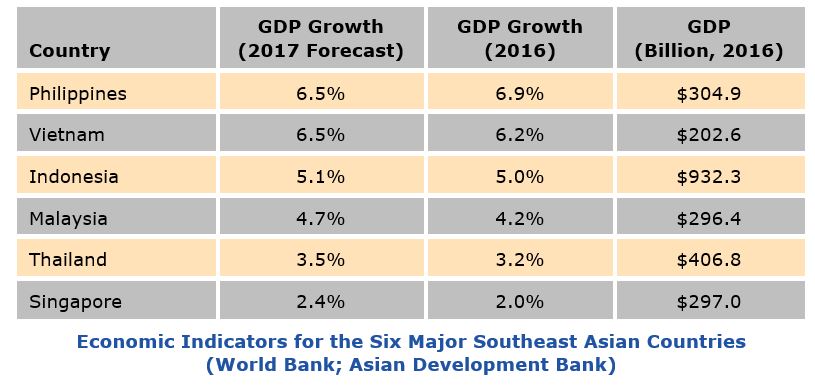
The upside surprises in 2017 are Malaysia and Singapore. Malaysia’s 5.6 percent expansion in Q1 was its highest in two years, with drivers including double-digit growth in fixed investment, both manufacturing and services, as well as increases in government infrastructure spending and domestic consumption. The country’s currency, the Malaysian ringgit, which suffered steep falls after the oil price collapse, may be the best performer in Asia this year, but still helps the country’s exporters, with May 2017 exports hitting seven-year high growth of 33 percent.
And for Singapore, given the widespread misconception (especially outside the region), that there is “no more manufacturing” in this city-state, it’s worth noting that it is spearheading manufacturing growth this year, with the 8.5 percent and 8.1 percent year-on-year expansions in Q1 and Q2 comparing very favorably with services growing from negative 3 percent to positive 3.3 percent in the same period. And within Singapore’s manufacturing sector, which accounts for a fifth of the country’s $300 million GDP, electronics stands out as the star performer, with factories producing semiconductors and semiconductor equipment benefiting from strong export demand.
As in 2016, the Philippines and Vietnam continue to lead economic expansion in industrialized Southeast Asia. The growth drivers are different, however: strong domestic consumption and government expenditure in the Philippines; and high levels of foreign direct investment and manufacturing exports (particularly electronics) in Vietnam.
These two countries also fare best in the Nikkei ASEAN Manufacturing Purchasing Managers’ Index (PMI), which surveys data from over 2,000 manufacturing firms in the region, and which has remained in expansionary (above 50) or no-change (50) territory for the first six months of 2017. The Philippines’ PMI average of 53.6 and Vietnam’s of 53.1 come in well above the ASEAN six-month average of 50.5.
Indonesia’s economy is performing in line with expectations, with the 5 percent expansion in the first half of 2017 helped by a recovering commodities market enabling higher prices for coal, palm oil, nickel, and other resources. The country still urgently needs to boost its infrastructure extent and quality, notably power generation capacity, as well as reduce its reliance on energy imports by boosting crude as well as refined oil production. While this should be positive for automation technology demand, slow decision making and postponed projects mean a rather delayed bounty for the suppliers.
Meanwhile, Thailand’s economy continues to strengthen from its 2013-15 lows, with exports of automotive components, refined petroleum products and chemicals all increasing this year, and government expenditure rising by almost 10 percent.
Looking more closely at automation technology demand, discussions between ARC and the major suppliers to Southeast Asian markets over recent months indicate a brighter picture for discrete and hybrid end-markets than for process. Hence, suppliers to manufacturing sectors such as automotive, electronics and food & beverage are in a better position this year, especially compared to automation companies that traditionally rely heavily on the oil & gas industry for business.
Process automation suppliers point to a relative lack of greenfield project opportunities in the region, especially large ones of the order of Malaysia’s RAPID downstream mega-complex. This is one reason these companies are increasing efforts and resources to serve the existing installed base with solutions particularly for cybersecurity and operational efficiency.
This December in Singapore, Honeywell Process Solutions launches its industrial cybersecurity center of excellence (COE) for Asia Pacific. The COE will feature a cybersecurity R&D lab, an advanced training facility, and a security operations center for managed security services. Meanwhile, Emerson Automation Solutions has been notably active at Internet of Things (IoT) events in the region this year, promoting its PlantWeb Digital Ecosystem as a solution for improving plant performance in areas such as energy efficiency, safety and reliability.
Despite the generally positive outlook for automation markets (at least for the short term), ARC recommends that automation suppliers continue to diligently follow trends in individual product, industry, and regional markets to be able to stay on top of rapidly evolving market trends.
Now, more than ever, it’s also critical to listen carefully to your customers to be able to meet their current and future requirements for innovative, high-quality, and cost-effective automation solutions that recognize and support today’s multiple industrial initiatives such as Industrie 4.0, Smart Manufacturing, Made in China 2025, IIoT, smart grid, and smart oilfields.
If you would like to buy this report or obtain information about how to become a client, please Contact Us