Representative End User Clients







Representative Automation Clients







Representative Software Clients








Summary
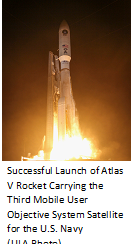
In January, Siemens PLM invited ARC Advisory Group to attend the launch of an Atlas V rocket, which placed a seven-ton communications satellite for the U.S. Navy into orbit. The launch was conducted by United Launch Alliance (ULA) a 50-50 joint venture between the Boeing Company and Lockheed Martin. ULA designed and built the Atlas V launch vehicle and operates its launch facilities at the Kennedy Space Center in Cape Canaveral, Florida. ULA regularly places satellite payloads into orbit for a variety of global customers.
According to a ULA news release, this was "…the heaviest payload to launch atop an Atlas V launch vehicle. The Atlas V generated more than two and half million pounds of thrust at liftoff to meet the demands of lifting this nearly 7.5-ton satellite."
ULA uses Siemens PLM design software and solutions to design, test, simulate, and build its launch vehicles, and to manage launch operations.
Siemens PLM Partners with ULA to Support Multiple Space Programs
Siemens PLM is not new to space exploration. Its software applications were used to design, test, and simulate the Mars Curiosity rover and the space systems that delivered Curiosity to the surface of the "Red Planet" in 2012, as well as the Atlas V launch vehicle that propelled Curiosity into space for its historic landing on Mars.
Established in 2006, ULA is the oldest and most experienced launch services company. ULA provides launch services for the U.S. Department of Defense, NASA, National Reconnaissance Office, and commercial customers with its Delta II and IV and Atlas V launch vehicles. This represents ULA's 92nd consecutive successful launch since it began operations.
Siemens PLM is partnering with ULA to develop a fully integrated PLM management system that creates a collaborative engineering data environment for users and systems across the design/build enterprise. For mission programs, ULA has used Siemens PLM to develop and manage mission requirements interface control documents (ICD) in an integrated system that provides closed-loop control for mission management engineers.
Siemens PLM, with its portfolio of engineering design solutions, is participating in the new space economy of emerging commercial companies providing the next generation of technology and space exploration hardware. This represents a very cost-conscience business model. Companies like ULA provide launch capacity for many countries now entering the world of satellites, orbiting space stations, and deep space exploration. Companies like ULA will need to run efficiently and effectively to compete for commercial space business and the growing market opportunities. Matt Smith, ULA states, "Moving a vehicle all the way from conceptual design of the spacecraft through launch involves processing tremendous amounts of data that have to be analyzed and digested. The Siemens data analysis and processing tool helps to connect the business: engineering with supply chain with factory and launch."
Siemens PLM serves as a technology partner to a wide range of global organizations and companies in this business. In addition to ULA this includes NASA's Jet Propulsion Laboratory (JPL), the European Space Agency (ESA), Blue Origin Space Systems, and Sierra Nevada Corporation (SNC).
SNC uses Siemens PLM software to support its Dream Chaser Program. Dream Chaser is a re-usable, lifting-body space vehicle that can be crewed or un-crewed for use in commercial space applications and missions. An Atlas V rocket is scheduled to launch an un-crewed Dream Chaser space craft in September 2016 from Kennedy Space Center. John Roth, SNC, stated, "Siemens has been an incredibly strong partner. Integrated and robust tool sets like the PLM tools from Siemens are absolutely required if we're ever going to get to Mars."
Additionally, companies like Blue Origin are partnering with ULA to develop new rocket engines that will replace the current dependence on Russian engines.
Of particular interest was the panel discussion with members comprised of ULA, SNC, the German Space Agency (DLR), the Japan Aerospace Exploration Agency (JAXA), and Siemens. The panel focused on the future of space exploration, priorities, the challenges to be met, and particularly on the importance of international collaboration for future missions. These missions include deep space exploration, including a manned Mars mission, and the long-term effects of deep space missions on astronauts.
The business of space, mission success is critical, and failures costly. The business is demanding and exact, with only one chance to get it right. Siemens PLM helps participants master the complexity, optimize productivity, meet tight launch deadlines, and execute successful programs.
All signed-in ARC Advisory Group clients can view this report in pdf format at this Link
If you would like to buy this report or obtain information about how to become a client, please Request ARC Info
Keywords: United Launch Alliance, Kennedy Space Center, New Space Economy, Launch Vehicle Capacity, Siemens PLM Design Tools.