Representative End User Clients







Representative Automation Clients







Representative Software Clients








A company incurs capital expenditure (CapEx) to acquire or upgrade physical assets, including property, plant, and equipment. In this periodic report, ARC Advisory Group looks at several different manufacturing industries to identify the current CapEx trends in India. We calculate CapEx in two separate segments: based on the money spent on acquiring and upgrading total fixed assets, and on the money spent on acquiring and upgrading the plant and machinery.
While ARC also publishes a separate global Capital Expenditures report for leading industries in all world regions, this report focuses exclusively on India’s capital expenditure analysis and includes the CapEx trends for leading industries in the country. These include automotive, cement, chemical & petrochemical, electric power, metals, oil & gas and refining, food & beverage, and pharmaceutical.
Industrial companies are seizing the present growth opportunities that India offers. Companies are building best-in-class industrial facilities to meet the growing needs of the country’s expanding consumer class. Major investments have been planned for infrastructure development and should help push domestic steel companies to increase production. The plan to expand and upgrade refineries to meet India’s Bharat Stage (BS) emissions standards for vehicle fuels has also been implemented.
The Government of India implemented the BS VI transportation fuel mandate on April 1, 2020. Despite many challenges, India successfully managed the timely implementation of BS VI. This new emission standard required significant changes in hardware, like improvements in engine combustion and calibration along with the introduction of after-treatment devices, all of which required heavy investments. However, with the collaborative and focused approach across the value chain, India ensured a smooth transition.
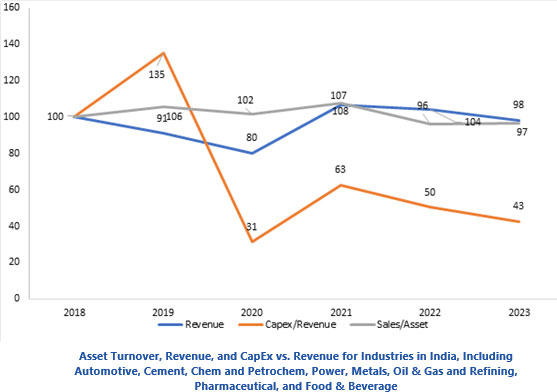
While a few sectors are currently burdened with overcapacity and underutilization of assets, eventually, the rise in domestic demand should increase value creation through these assets. On the infrastructure front, the government has allocated huge investments for building roads, railways, airports, and ports; and companies are likely to ramp up their capacity expansion activities to meet domestic demand in the coming years. According to ARC Advisory Group’s India CapEx Survey, capital spending as a percentage of revenue has improved compared to the previous year.
India’s GDP was approximately $3,737 billion, and the per capita GDP (PPP) was estimated to be over $9,000 in 2023 and expected to reach over $10,000 by 2024. The growth in real GDP during 2023-24 is estimated at 8.2 percent as compared to 7.0 percent in 2022-23. India’s GDP in market exchange rates is expected to reach $30-35 trillion by 2047. India’s GDP was expected to grow at 7.3 percent in 2023-24, higher than the 2022-23 GDP which was 7.2 percent. The robust demand within the country for both consumption and investment, coupled with the government's sustained focus on capital spending, are recognized as the primary contributors to GDP growth.
The Economic Survey says that India’s economy showed resilience to a gamut of global and external challenges as real GDP grew by 8.2 percent in FY 24, exceeding the 8 percent mark in three out of four quarters of FY 24, driven by stable consumption demand and steadily improving investment demand.
The service sector has over 50 percent contribution to India’s GDP, and it had witnessed a growth of 9.1 percent in 2022-23. Out of 8.12 million jobs in FY23, service sector companies in IT, banking, and finance accounted for almost half of the new jobs generated.
The services sector of India remains the engine of growth for India’s economy and contributed 55 percent to India’s Gross Value Added at current prices in FY24 (as per advance estimates). The services category ranked first in FDI inflows, as per data released by the Department for Promotion of Industry and Internal Trade (DPIIT). The significant domestic demand, rapid urbanization, and expansion of e-commerce platforms have led to increased requirements for logistics and digital-related services, highlighting important factors that shape the domestic demand for services.
India's manufacturing activity maintained its impressive momentum from the previous year, driven by robust demand. Fueled by new orders, increased inventories, and higher job creation, manufacturing activity reached a 16-year high of 59.1 percent in March 2024 according to the HSBC Manufacturing Purchasing Managers’ Index (PMI). New work inflows grew from both domestic and export markets, with new export orders rising at the fastest rate since May 2022. Indian manufacturers remain confident of a rise in production volumes, citing better deals and marketing efforts. The National Manufacturing Policy aims to uplift the manufacturing sector and has set a target of 25 percent share of GDP from manufacturing by 2025. According to Laghu Udyog Bharati (LUB), a group that works to support and improve the MSME sector in India, the percentage of manufacturing Micro, Small, and Medium Enterprises (MSMEs) in the country's GDP is predicted to increase by 100 percent by 2025.
In January 2024, the Ministry of Heavy Industries extended the Production Linked Incentive (PLI) Scheme for automobile and auto components by one year, making the incentive applicable for five consecutive financial years until March 31, 2028. Ministry officials also disclosed plans for a new scheme aimed at incentivizing electric vehicle purchases and enhancing charging infrastructure, in line with the interim budget's emphasis on eco-friendly transportation. Additionally, the allocation of about $321 million for 2024-25 is expected to be fully utilized by March 31, 2024. Under phase II of the FAME India Scheme, subsidies amounting to nearly $697 million have been awarded to EV manufacturers for the sale of 1,341,459 electric vehicles as of January 31, 2024. Addressing the automotive industry's needs, MHI has extended the tenure of the PLI Scheme for automobile and auto components by one year, offering incentives for determined sales over five consecutive financial years from 2023-24 to 2027-28, with disbursement occurring in the subsequent financial year. The scheme has proven successful, attracting proposed investments of $8.1 billion against the target estimate of $5.1 billion over five years, with $1.6 billion already invested by December 31, 2023.
The government has launched several organizations to draw investment, including the National Single Window System (NSWS), the India Industrial Land Bank (IILB), the Industrial Park Rating System (IPRS), the National Infrastructure Pipeline (NIP), and the National Monetization Pipeline (NMP). Cumulative). The cumulative overall exports during April-August 2024 is estimated at $374.33 billion, as compared to $350.11 billion in April-August 2023, with an estimated growth of 5.35 percent. India’s total value of imports for the period April-August 2024 is $375.33 billion, as against $350.11 billion during the same period in 2023. Major industries in India include textiles, telecommunications, chemicals, food & beverage, steel, cement, refining, electric power, pharmaceuticals, and IT & software.
ARC Advisory Group’s India Capital Expenditure Survey 2023-2024 tracks total capital expenditure, capital expenditure on plant and machinery, total revenue, total assets, and asset turnover. The sample size includes 95 companies from eight major industries representing more than $500 billion in revenues in 2023. This capital expenditure survey is based on the analysis of the information from the annual reports of India’s leading companies in the following key growth industries: automotive, cement, chemical & petrochemical, electric power, metals, oil & gas and refining, pharmaceutical, and food & beverage.
Table of Contents
ARC Advisory Group clients can view the complete report at the ARC Client Portal.
Contact Us if you would like to speak with the author.
Obtain more ARC In-depth Research Market Analysis.