Representative End User Clients







Representative Automation Clients







Representative Software Clients








Keywords: Industrial Sustainability, Energy Transition, Renewable Power, Electrification, Energy Efficiency, Control System Migration, Enablon, Siemens Energy, Valmet Automation, Wolters Kluwer
If AI is the leading technology trend in the world of manufacturing and automation, then sustainability is the leading business issue. Most of the business and operational challenges faced by end users today can be traced back to the issue of sustainability, from increasing energy efficiency to reducing emissions, meeting regulatory reporting requirements, reducing emissions, and more. At the recent ARC Industry Forum in Orlando, ARC’s sustainability team partnered with supplier sponsors Siemens Energy, Valmet Automation, and Wolters Kluwer/Enablon to host our second annual Sustainability Workshop, a half-day session solely dedicated to the operational and business challenge faced by end users around the issue of sustainability.
The workshop was designed to cover many of the key sustainability challenges facing end users today. First, we examined what the leading end users are doing to implement sustainability strategies in their own organizations by examining the results of the ARC decarbonization pacesetter survey.
The session also covered recent advancements in carbon capture utilization and storage (CCUS) and hydrogen. The session also covered regulatory reporting requirements and software trends, digital product passports, and concluded with a session on how end users are modernizing their existing automation infrastructure to meet sustainability targets.
ARC sustainability practice leader and vice president Mike Guilfoyle kicked off the workshop by presenting the results of the recently completed ARC Decarbonization Pacesetter Report, which is part of ARC’s new Executive Advisory Service. The report surveyed over 500 respondents across 18 industries around the world and illustrates what the leading end user companies are doing relative to sustainability and decarbonization initiatives versus mainstream and laggard companies.
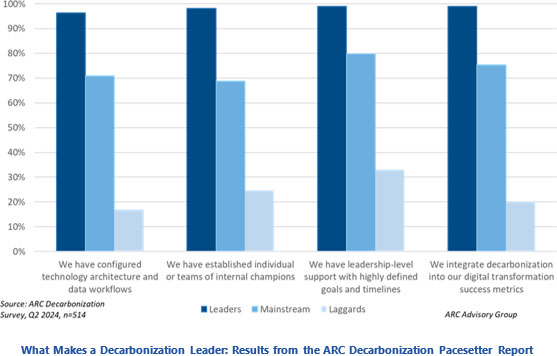
Decarbonization is clearly a characteristic of a market in transition, one in which core fundamentals are going to be significantly altered and/or replaced. As this occurs through some combination of regulation and innovation, markets in transition are unnaturally split between avoiding penalties on one hand and being rewarded on the other by proactively advancing decarbonization when and where it makes sense. It’s often a very delicate balancing act.
Leaders emerge as those who are proactively willing to step into unnaturally split markets, where confusion is in play. They do so with the understanding that the market will eventually be more cohesive. Over the long-term, they can evolve into that cohesion and win. Strategizing, executing, and evolving in such a dynamic business environment requires a specific set of business characteristics, each enabling the organization to implement sustainability initiatives, such as decarbonization, across internal and external facets of the business.
ARC Advisory Group clients can view the complete report at the ARC Client Portal.
Contact Us if you would like to speak with the author.
Obtain more ARC In-depth Research Market Analysis.