Representative End User Clients







Representative Automation Clients







Representative Software Clients








Welcome back to our ongoing teardown of the 2026 ARC Industry Leadership Forum in Orlando. I've often used the analogy of the "Industrial AI Wars" to describe the high-stakes battle for operational supremacy currently dividing the market. If the morning keynotes from undeniable Pacesetters like PepsiCo and Jabil were the generals mapping out grand, visionary blueprints, my Tuesday afternoon session in Oceans 6–8 took us straight into the trenches—a stark look at the gritty, unglamorous reality of the plant floor for the rest of the industry.
I had the pleasure of hosting the Tuesday afternoon breakout track, culminating in the "Industrial AI's Journey Panel." If you want to understand why the mainstream majority of manufacturers remain stuck in the "Intelligence Divide" while top-tier Pacesetters scale at breakneck speed, this session provided the unvarnished truth. The secret to bridging that gap isn't a magical new algorithm; it's ruthless change management, engineered context, and closing the loop on physical assets.
If the morning keynotes showcased the apex of the Pacesetters, this breakout session highlighted the very best of the Mainstream. The session kicked off with two presentations from operational leaders deep in the trenches, actively fighting their way across the transformation chasm that swallows most Industrial AI initiatives.
Jonathan Alexander, who leads AI and analytics efforts at Albemarle Corporation, took the stage with a daunting promise: getting through 120 slides in just 30 minutes. True to his word, he not only beat the clock but delivered a masterclass on the "Top 10 Reasons You're Stuck in Pilot Purgatory." He detailed Albemarle's six-year journey, driving over $150 million in annual savings by upskilling operators to improve OEE, quality, and reliability. His core message was a wake-up call for technology-obsessed organizations:
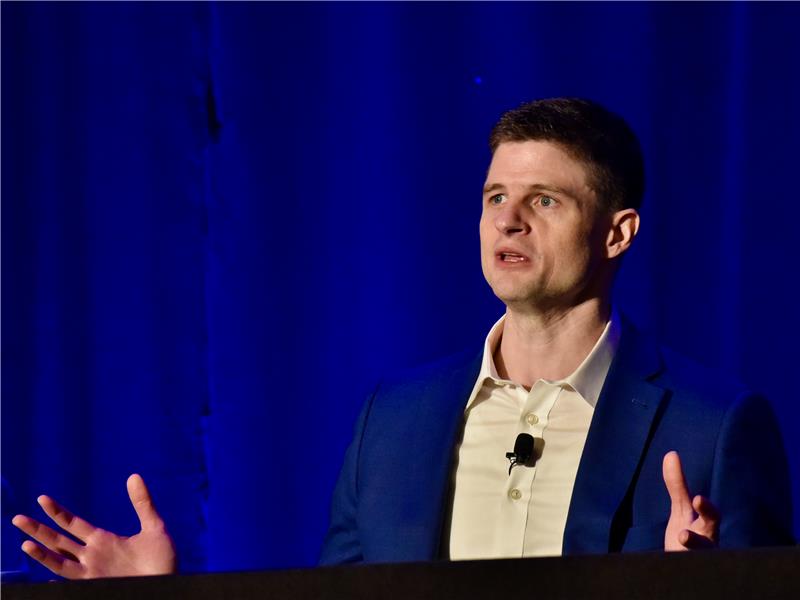
"We went and implemented the technology at the first site, and we got a ton of value. We went and did the same thing at a second site, and saw no value, zero... I spent time with their leaders, redesigning the management systems and the work processes... and in two months, they were at $10 million in annual savings. No new technology for two years. The only difference we did was change management." — Jonathan Alexander, Albemarle Corporation
Sachin Chakote, Senior Product and Engineering Manager at Halliburton, followed by illustrating what happens when organizations finally break out of pilot purgatory and apply AI to heavy physical assets. He outlined Halliburton's evolution from reactive maintenance to operational autonomy in the energy sector, offering a roadmap that resonates with legacy operations:

"Our version of a closed loop is subsurface insight equipment, and then decision back to the equipment. That's basically automation, subsurface insight, and AI. You can imagine we will be moving towards a very autonomous or Sentinel system, where our assets are smart, connected by Industrial IoT, and we will be closing the loop by making our next design better." — Sachin Chakote, Halliburton
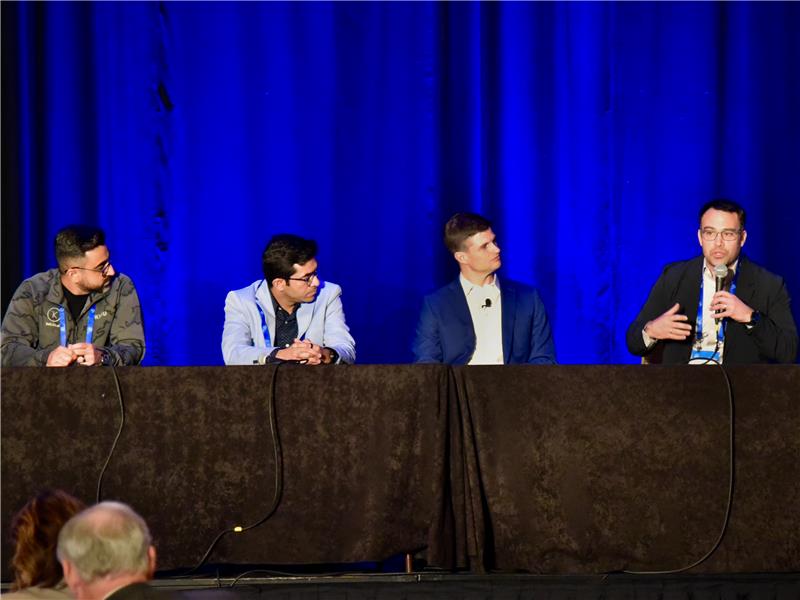
When we transitioned to the panel discussion, I invited Joe Rosing (Head of Smart Manufacturing & Supply Chain COE at AWS) and Suhail Jiwani (CTO of Kelvin) to join Jonathan and Sachin. The debate immediately zeroed in on the massive friction point between business ambition, IT infrastructure, and OT reality.
As the moderator, I framed the core architectural and cultural dilemma facing the industrial sector:

"We see major regional differences in how organizations are approaching AI and what they're prioritizing. We all know IT and OT have different perspectives. But when you talk to business leaders, you often get completely different priorities again. So how do you actually reconcile those viewpoints to scale these models?" — Colin Masson, ARC Advisory Group
The panelists did not hold back. Suhail from Kelvin brought the discussion to the edge of multi-agent orchestration, emphasizing that generic AI models fail without deep operational context and the ability to safely execute control decisions:
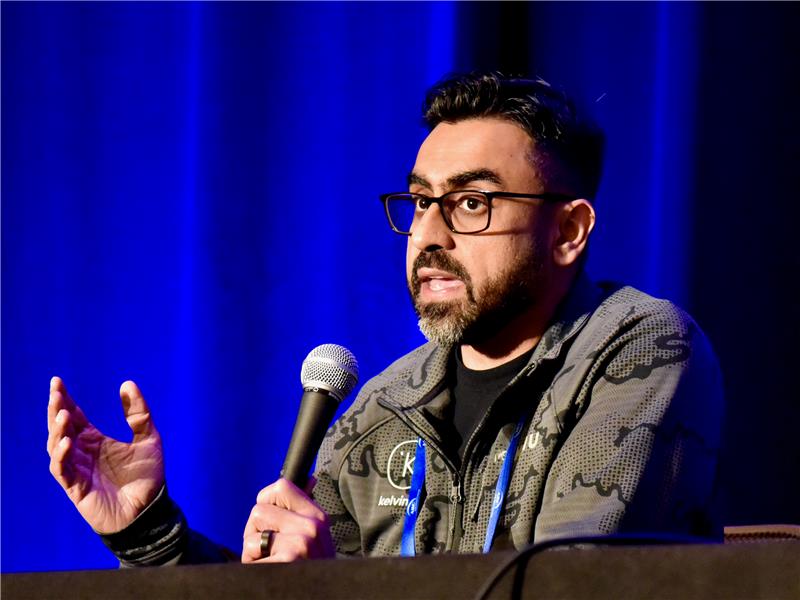
"You can't just drop a generalized AI model onto a complex control system and expect it to optimize a process. The real competitive advantage right now is multi-agent orchestration—building specialized AI agents that understand the physical constraints of the equipment and can execute autonomous operations safely at the edge." — Suhail Jiwani, CTO, Kelvin
Joe Rosing from AWS reinforced this, noting that hyperscalers are realizing the cloud alone cannot solve the industrial data problem without a serious commitment to standardizing context and governance:
"Business leaders want enterprise-wide visibility, but you can't deliver that if your OT data lacks context. Escaping pilot purgatory requires a unified namespace and an industrial data fabric that securely connects the shop floor to the cloud, allowing you to feed these advanced generative and agentic AI models the exact context they need to drive competitive advantage." — Joe Rosing, AWS
If you walked away from this Tuesday session with one takeaway, let it be this: you cannot buy your way out of pilot purgatory with better software. The organizations successfully pulling themselves out of the Mainstream pack aren't winning because they have access to superior large language models. They are winning because they understand context engineering.
They are doing the hard, unglamorous work of aligning IT, OT, and business leaders. They are fixing their data architecture. And most importantly, they are treating change management as a core operational discipline—not an HR afterthought.
The era of the "Fast Follower" is dead. If you are still running isolated AI science projects without a clear path to closing the loop on physical assets, you are already falling behind.
The Industrial AI (R)Evolution is moving faster than ever. To dive deeper into the frameworks and data shaping the future of the industrial sector, explore my latest research:
Navigating the AI Wars and the escalating Industrial Robot Wars
Closing the Digital Divide by Embracing Industrial AI
Assembling your Industrial-Grade Data Fabric
Charting the new frontier of Physical Intelligence and transitioning to a Cyber-Physical Industrial Architecture (CPIA)
Mapping your maturity and strategy with ARC's 3-Axis Industrial AI Models Taxonomy
Where do YOU stand in the Industrial AI (R)Evolution? Take our Industrial AI Assessment to benchmark your organization's maturity, identify critical gaps in your IT/OT/ET convergence, and get actionable recommendations to accelerate your path to becoming an Industrial AI Pacesetter.
Don't guess what your global operations or prospective customers need. Use empirical data to align your stakeholders and de-hype the market with ARC Advisory Group's Voice of Market Service.
For tailored recommendations on governing and guiding major people, process, and technology decisions across the enterprise, cloud, industrial edge, and AI, please contact Colin Masson at [email protected].
Or, set up a meeting with my fellow Analysts and I at ARC Advisory Group to find out more about our Executive Insights Service for Industrial organizations and our Industrial AI Insights Service for Vendors.