Representative End User Clients







Representative Automation Clients







Representative Software Clients








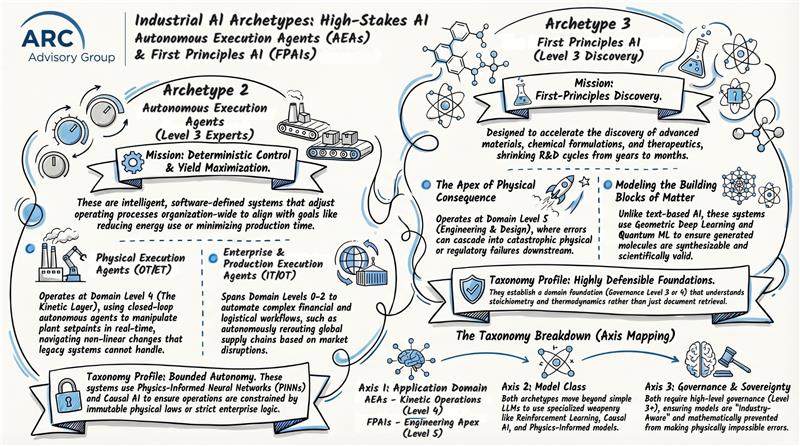
Continuing our detailed breakdown of the ARC 3-Axis Industrial AI Taxonomy, we look at the next wave of archetypes discovered on our ongoing research voyage. As we move further up the Axis 1 Escalation Ladder, we enter domains where the physical and regulatory consequences of AI execution are profound.
(Note: As stated previously, we are actively mapping over 120 vendors. The companies mentioned below are representative examples, and many frequently cross archetype boundaries.)
The Mission: Deterministic control, yield maximization, and autonomous execution of complex cyber-physical actions and enterprise business workflows.
The Strategic Shift: It is critical to note that we have specifically moved away from the legacy term "Process Optimizer." That term is inherently problematic, as it incorrectly anchors the technology to continuous process manufacturing (where much of ARC's historical focus lies) and suggests a traditional, rules-based system. Instead, we use the term Autonomous Execution Agent (AEA).
The Comprehensive Definition: To ensure this archetype accurately reflects the entire agentic shift across both discrete and continuous spectrums, we look to the modernized definition formulated by ARC Advisory Group’s Greg Gorbach:
"Industrial AI Autonomous Execution Agents (AEAs) are intelligent, software-defined operational archetypes that dynamically ingest contextualized data across IT, OT, and ET environments to autonomously execute tasks and adjust operating parameters organization-wide, aligning with strategic goals like maximizing yield, reducing energy, or minimizing takt time. Spanning a spectrum from open-loop advisory systems to closed-loop autonomous agents, they transcend traditional modeling and scheduling. In continuous sectors, they use advanced AI to adapt to non-linear dynamics and orchestrate real-time setpoint adjustments. In discrete or hybrid sectors, they autonomously adjust manufacturing execution parameters to optimize business goals."
— Greg Gorbach, VP Digitization and IoT, ARC Advisory Group
Mapping to the 3-Axis Taxonomy:
Axis 1 (Domain): Straddles the intelligence divide. Physical Execution Agents operate at Level 4 (Operations & Process Control). Enterprise & Production Execution Agents span across Levels 0, 1, 2, and 3 (Enterprise, Supply Chain, and Operations Management).
Axis 2 (Model Class): Utilizes highly deterministic frameworks, specifically Physics-Informed Neural Networks (PINNs), Causal AI (SCMs), and advanced Reinforcement Learning.
Axis 3 (Governance): Firmly established at Level 3 (Domain-Specific), executing bounded, supervised autonomy constrained by immutable physical laws or strict enterprise logic.
Operating strictly on the physical side of the divide, this archetype exists on a spectrum ranging from open-loop advisory systems to Closed-Loop AI Optimization (AIO), where neural networks and reinforcement learning agents autonomously manipulate plant setpoints in near real time.
The Closed-Loop AIO Vanguard: Companies like Imubit set the benchmark here. Utilizing Foundation Process Models™, their Deep Learning Process Control (DLPC) technology represents a profound shift in training paradigms. Rather than evolving primarily in deployment, DLPC builds experience offline through rigorous simulation and reinforcement learning before ever being deployed to the plant. This 'learn first, then execute' approach ensures it can safely and autonomously navigate non-linear changes in continuous chemical and refining operations that legacy Advanced Process Control (APC) simply cannot handle. Already recognized as a leading Execution Agent, especially within the Oil and Gas sector, Imubit proves that true intelligence requires rigorous offline grounding. Aspen Technology similarly dominates complex chemical and refining environments, expanding its Industrial AI portfolio to embed advanced predictive logic directly into its process control suites, while enterprise platforms like C3 AI deploy robust execution applications to balance massive systemic variables across the broader energy sector.
Causal & Discrete Experts: Ethon AI applies Causal AI and computer vision specifically to discrete and batch manufacturing, conducting rapid root-cause analysis to significantly reduce manufacturing scrap. causaLens similarly deploys Structural Causal Models to isolate exact production bottlenecks.
Edge & Hybrid Specialists: Haber integrates proprietary AI with physical auto-sampling hardware to optimize fluid and utility management. SymphonyAI and Micraft MES push this intelligence to the extreme edge, running predictive models locally on Industrial IoT nodes to execute instantaneous control.
Legacy Titans Evolving: Heritage automation leaders are adapting. Yokogawa is charting the "IA2IA" journey, transitioning users from open-loop advisors to closed-loop controllers. Honeywell integrates edge-based neural networks directly into physical processing hardware via its Optimizer Suite.
Operating across the enterprise and production software domains, these systems utilize multi-agent orchestration and predictive analytics to automate complex administrative, financial, logistical, and manufacturing execution workflows across the entire value chain.
Supply Chain & Logistics Orchestrators: Kinaxis leverages its Maestro Agents for context-aware assistance, real-time demand/supply simulation, and automated machine learning workflows. o9 Solutions utilizes its Digital Brain platform for next-generation integrated business planning. Blue Yonder deploys multi-tiered AI advisory agents for dynamic logistics execution and predictive demand planning. Manhattan Associates utilizes Manhattan Active Maven for agentic warehouse optimization.
Enterprise, BPM & Process Intelligence: SAP extends far beyond conversational copilots, utilizing S/4HANA to embed autonomous execution directly into supply network orchestration. IBM combines process mining with Watson AI to uncover hidden operational bottlenecks, while Software AG (ARIS) and Appian deploy AI-driven business process management and agentic workflow orchestration. Salesforce (Einstein) automates complex customer service routing and predictive lead scoring.
Production Operations (The Future of MES): While there is potential for confusion with traditional MES, the emergence of these agents points toward the future evolution of MES itself. To be absolutely clear, a traditional Manufacturing Execution System is a static system of record, not an AI execution agent. However, a new wave of specialized production AEAs is emerging to autonomously adjust execution parameters and optimize scheduling directly on the shop floor. Startups and focused specialists like Quartic.ai and OdenTechnologies are deploying targeted execution agents that synthesize live factory telemetry to dramatically reduce cycle times and scrap without requiring full closed-loop kinetic control. Meanwhile, established platforms are injecting this intelligence directly into their ecosystems, seen with Plex (by Rockwell Automation) and its smart manufacturing capabilities, or Epicor embedding AI into advanced manufacturing workflows.
The Mission: Accelerating the first-principles discovery of advanced materials, complex chemical formulations, and life-saving therapeutics, shrinking R&D cycles from years down to months.
The Strategic Shift: Much like our shift to AEAs, we have actively retired the legacy term "Deep Science Generators." The term "Generators" leaned too heavily on the "Generative AI" buzzword associated with hallucinating chatbots. Instead, we introduce First-Principles AI (FPAI)—an uncompromising, scientific category that signals these models are grounded in the fundamental laws of physics and chemistry.
The Comprehensive Definition: To accurately capture the profound physical implications of this category, we establish the following definition:
"Industrial First-Principles AI (FPAI) models are computational architectures designed to natively embed the laws of chemistry (stoichiometry, molecular dynamics) and physics (quantum mechanics, thermodynamics). By bypassing traditional trial-and-error laboratory research, these systems execute de novo drug discovery, advanced polymer formulation, and novel catalyst design. They ensure that all AI-generated molecules, materials, and digital twins are synthesizable and adhere to strict scientific constraints in the real world."
— Colin Masson Director of Research, Industrial AI, ARC Advisory Group
It is critical to address a pervasive market confusion here. When we say FPAI utilizes "Generative Models (Physical/Science)," we are not referring to Large Language Models such as ChatGPT or Claude. LLMs are probabilistic text engines that predict the next word in a sequence. In contrast, FPAI systems utilize entirely different mathematical frameworks—such as Geometric Deep Learning, 3D Diffusion Models, Quantum Machine Learning, and interatomic potentials—to predict viable molecular structures or physical states. They do not generate text; they generate physically valid outputs constrained by thermodynamics and stoichiometry.
Axis 1 (Domain): Operating at the absolute apex, Level 5 (Engineering, R&D, and Design). The molecular models and chemical formulations established here dictate manufacturability and safety downstream, demanding near-zero tolerance for error.
Axis 2 (Model Class): Generative Models (Physical/Science), Geometric Deep Learning, Diffusion Architectures, and Quantum Machine Learning.
Axis 3 (Governance): Operates at Level 3 (Domain-Specific), establishing a highly defensible, physics-bounded baseline, often progressing to Level 4 (Regulated & Certified) for pharmaceutical batch formulations and clinical trials.
The Market: This archetype applies specialized generative AI not to text, but to the fundamental building blocks of matter.
Materials & Energy: Orbital Materials utilizes interatomic potentials to design novel hardware and materials for carbon capture. Citrine Informatics streamlines the formulation of specialty chemicals, plastics, and advanced alloys. Microsoft Research is pushing the boundaries with MatterGen, enabling the generative design of inorganic materials via novel diffusion architectures. Noble.AI leverages science-based AI to accelerate chemical and material product development, while SandboxAQ combines advanced AI and quantum simulation to uncover novel alloys and compounds.
Physics & Simulation Innovators: Heavily funded specialists like PhysicsX are creating lightning-fast deep learning surrogate models. Legacy simulation leaders like Ansys (SimAI) and Altair (PhysicsAI) utilize geometric deep learning to predict physics outcomes significantly faster than traditional solvers.
Bio-Pharma & Chemistry: Computational biology and chemistry are experiencing a major resurgence. Google DeepMind (GNoME and AlphaFold3) has mapped millions of novel crystalline structures and predicted complex molecular interactions. Recursion Pharmaceuticals operates as a platform for drug discovery, mapping vast biological relationships. Isomorphic Labs advances drug design from first principles, while Schrödinger provides physics-based computational platforms for pharmaceutical innovation. Insilico Medicine automates end-to-end drug discovery with Pharma.AI, Chemify digitizes chemical synthesis, BenchSci accelerates preclinical R&D, Iktos combines de novo drug design with automated synthesis, and Deep Principle focuses on optimizing chemical reaction discovery and synthesis routes.
In the final part of our Archetypes series next week, we will explore the domain of Certified Execution Agents, the kinetic world of Embodied Intelligence Systems, and the foundational Cyber-Physical Context Engines that make all of this possible.
The Industrial AI (R)Evolution is moving faster than ever. To dive deeper into the frameworks and data shaping the future of the industrial sector, explore my latest research:
Navigating the AI Wars and the escalating Industrial Robot Wars
Closing the Digital Divide by Embracing Industrial AI
Assembling your Industrial-Grade Data Fabric
Charting the new frontier of Physical Intelligence and transitioning to a Cyber-Physical Industrial Architecture (CPIA)
Mapping your maturity and strategy with ARC's 3-Axis Industrial AI Models Taxonomy
Where do you stand in the Industrial AI (R)Evolution? Take our Industrial AI Assessment to benchmark your organization's maturity, identify critical gaps in your IT/OT/ET convergence, and get actionable recommendations to accelerate your path to becoming an Industrial AI Pacesetter.
Don't guess what your global operations or prospective customers need. Use empirical data to align your stakeholders and de-hype the market with ARC Advisory Group's Voice of Market Service.
For tailored recommendations on governing and guiding major people, process, and technology decisions across the enterprise, cloud, industrial edge, and AI, please contact Colin Masson at [email protected].
Or, set up a meeting with my fellow Analysts and I at ARC Advisory Group to find out more about our Executive Insights Service for Industrial organizations and our Industrial AI Insights Service for Vendors.