Representative End User Clients







Representative Automation Clients







Representative Software Clients








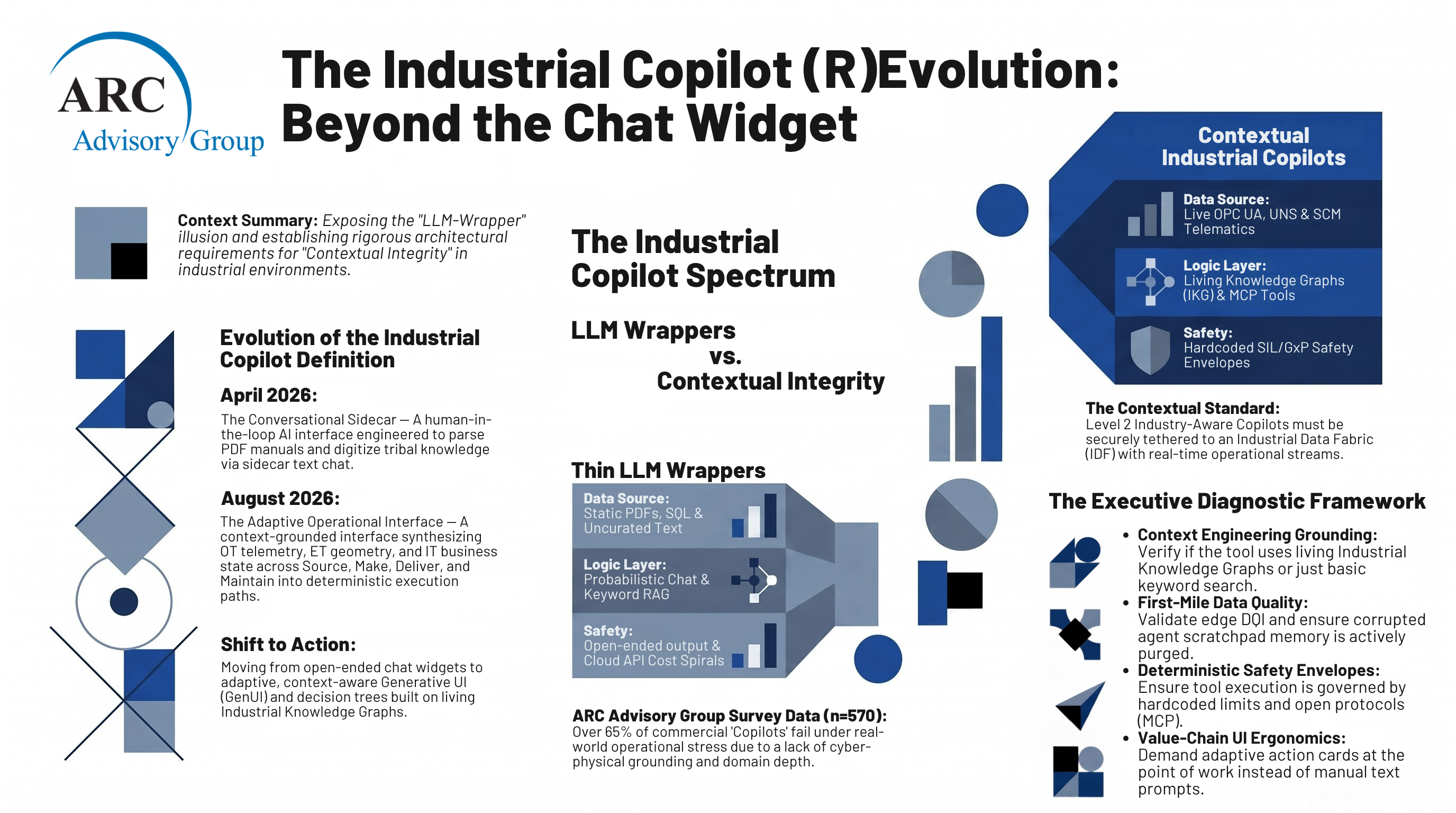
Slapping a generic Large Language Model (LLM) API onto a legacy SQL database, an ERP transactional screen, or a TMS tracking portal does not create an industrial copilot; it creates a high-risk text summarizer prone to physical hallucinations, supply chain errors, and volatile token cost spirals. Industrial buyers across Factory, Supply Chain, and Enterprise domains must mandate Level 2 "Contextual Integrity"—verifying that an assistant is securely tethered to an Industrial Data Fabric (IDF) with real-time operational streams, living knowledge graphs, and hardcoded execution bounds.
Over the past year, as part of ARC Advisory Group's broader research into the 3-Axis Industrial AI Models Taxonomy, our team reached out to over a hundred software vendors across the industrial landscape. Out of that evaluation, we identified over 40 Industrial Copilot offerings that warranted inclusion in our inaugural ARC Industrial Copilots MarketMap. Sitting through dozens of deep-dive vendor briefings and having countless conversations with industrial CIOs, COOs, CPOs, and plant managers, a sobering reality became glaringly obvious—and it aligns directly with ARC Advisory Group's empirical survey research (n=570 industrial decision-makers): over 65 percent of products currently marketed as "Industrial Copilots" fail under real-world operational stress.
Our empirical data highlights why so many AI initiatives remain stranded in "pilot purgatory." Software executives eagerly demo their latest product updates, pointing with great pride to a tiny sidecar chat widget tucked into the bottom corner of an MES, ERP, CMMS, or Supply Chain Control Tower screen. They call it an "AI-driven Industrial Copilot." But when you scratch beneath the surface of these glossy presentations, there is a glaring lack of cyber-physical grounding and domain depth.
More often than not, these "copilots" are merely thin wrappers around generic, public-cloud LLM APIs. They ingest unstructured text from static maintenance manuals, basic PDF invoices, or raw shipment tables and generate conversational responses. In an office productivity environment, if a sidecar chatbot hallucinates a word, the worst outcome is a minor typo or an awkward email draft. But across the industrial value chain—whether it’s a plant floor operator troubleshooting a compressor, a logistics planner attempting to reroute delayed raw materials, or a procurement lead evaluating direct CAD/BOM spend—an ungrounded hallucination leads to six-figure hourly downtime events, missed customer fulfillment windows, or direct safety hazards.
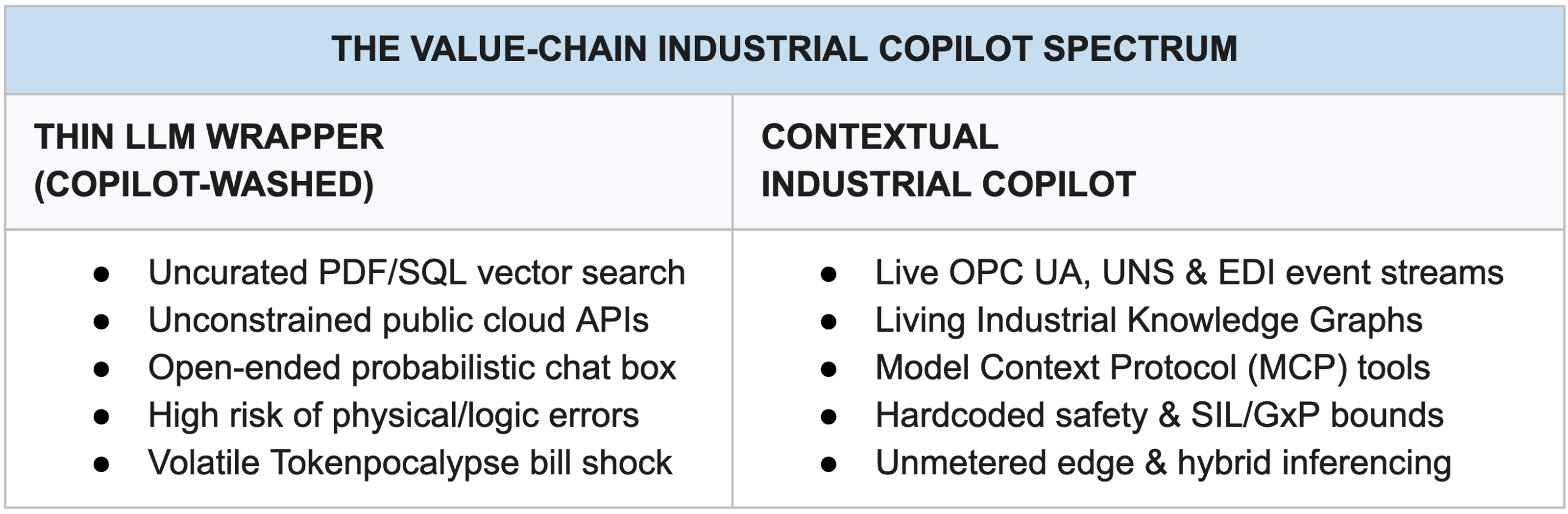
Furthermore, streaming raw OT telemetry back and forth to public cloud tokenizers exposes buyers directly to the Tokenpocalypse—triggering massive corporate bill shock as continuous reasoning loops burn through annual token budgets in weeks.
If there is one lesson that has been reinforced on stage at our annual ARC Industry Leadership Forums, it’s that software tools are useless without work process alignment and contextual integrity across the enterprise value chain.
Think back to the ARC Forum 2025, where leaders from Celanese shared their experiences building an enterprise-wide industrial data foundation across their chemical processing plants (see my detailed ARC analysis: Industrial AI in Action: Key Takeaways from ARC Forum 2025 on Data, Agents, and End User Success). Celanese made it clear that digital transformation isn't achieved by dropping AI widgets onto operator screens or supply chain dashboards; it requires a relentless focus on cultural readiness, standardized work processes, and data quality. Without a unified data context bridging plant execution with commercial planning, even the most expensive analytical models devolve into noisy, untrusted distractions.
Fast forward to the ARC Forum 2026, where Jonathan Alexander from Albemarle Corporation delivered a masterclass on Industrial AI Context Engineering (which I unpacked in my ARC column: Trench Warfare: The Unglamorous Work of Scaling Industrial AI). Jonathan shared how Albemarle’s centralized digital team deployed a state-of-the-art analytics and AI platform at one site and captured massive, verifiable operational value. Yet, when they took that exact same technology stack and deployed it at a second site, they initially captured zero value.
Why? The software hadn't changed—but the local site context, tag structures, work processes, supply chain logistics links, and site-level change management were completely different.
You cannot buy your way out of "pilot purgatory" simply by licensing a better Large Language Model. To achieve scalable, trusted autonomy across Source, Make, Deliver, and Maintain operations, industrial enterprises must deploy an Industrial Data Fabric (IDF) to serve as the active cognitive anchor, semantic translator, and automated gatekeeper for the digital workforce.
Regular readers of my columns might recognize the original definition of an Industrial Copilot I penned during our early 3-Axis Taxonomy research in “Meet the Industrial AI Archetypes (Part 1): Workforce Enablers and the Industrial Copilot”:
"A highly contextualized, human-in-the-loop AI interface securely tethered to an organization's proprietary engineering, IT, and operational data. Unlike generic conversational AI, an Industrial Copilot is explicitly engineered to ingest complex industrial lexicons, digitize tribal knowledge, and synthesize real-time machine states. It actively guides frontline workers through complex troubleshooting, maintenance, and operational workflows, acting as an expert digital colleague that accelerates time-to-resolution while strictly requiring human validation before closing the physical loop." — Colin Masson, ARC Advisory Group, April 2026
Is that definition wrong? Not at all. But as we've watched the market evolve from conversational sidecars to agentic workframes spanning plant operations, supply chain logistics, and enterprise EAM over the past year, does it need a tune-up? Absolutely.
When we first framed that definition, the market was obsessed with "conversational search"—asking a chatbot to parse an OEM PDF manual. Today, as agentic AI, Generative UI (GenUI), and local edge silicon mature, an Industrial Copilot cannot remain a passive text box in the corner of an MES or ERP screen.
An Industrial Copilot is an adaptive, context-grounded, human-governed operational interface that synthesizes real-time OT telemetry, ET geometry, and IT business state to present actionable, deterministic execution paths directly at the point of work. It actively guides workers across Source, Make, Deliver, and Maintain domains through complex operational, maintenance, logistics, and engineering workflows via adaptive, context-aware Generative UI (GenUI) and decision trees built on living Industrial Knowledge Graphs, accelerating time-to-resolution while strictly requiring human validation before closing any physical, logistics, or transactional loop.
— Colin Masson, ARC Advisory Group, August 2026
Why does this refinement matter so much? Because it raises the bar from conversational search to guided, context-aware action. It shifts the focus from asking human workers to type text prompts to delivering hands-free, role-specific action cards directly on HMIs, tablets, supply chain control towers, or smart glasses.
Refining this definition is precisely why industrial executives need to follow the insights throughout the rest of this blog series. Over the coming chapters, we will use this refined lens to evaluate how software vendors are modernizing their architectures, how supply chain decision intelligence bridges plant realities with fulfillment networks, and how C-suite leaders can structure procurement contracts to monetize value rather than paying a "token tax."
To evaluate copilots at the point of work, we must deconstruct them across ARC's 3-Axis Industrial AI Models Taxonomy and across value chain domains:
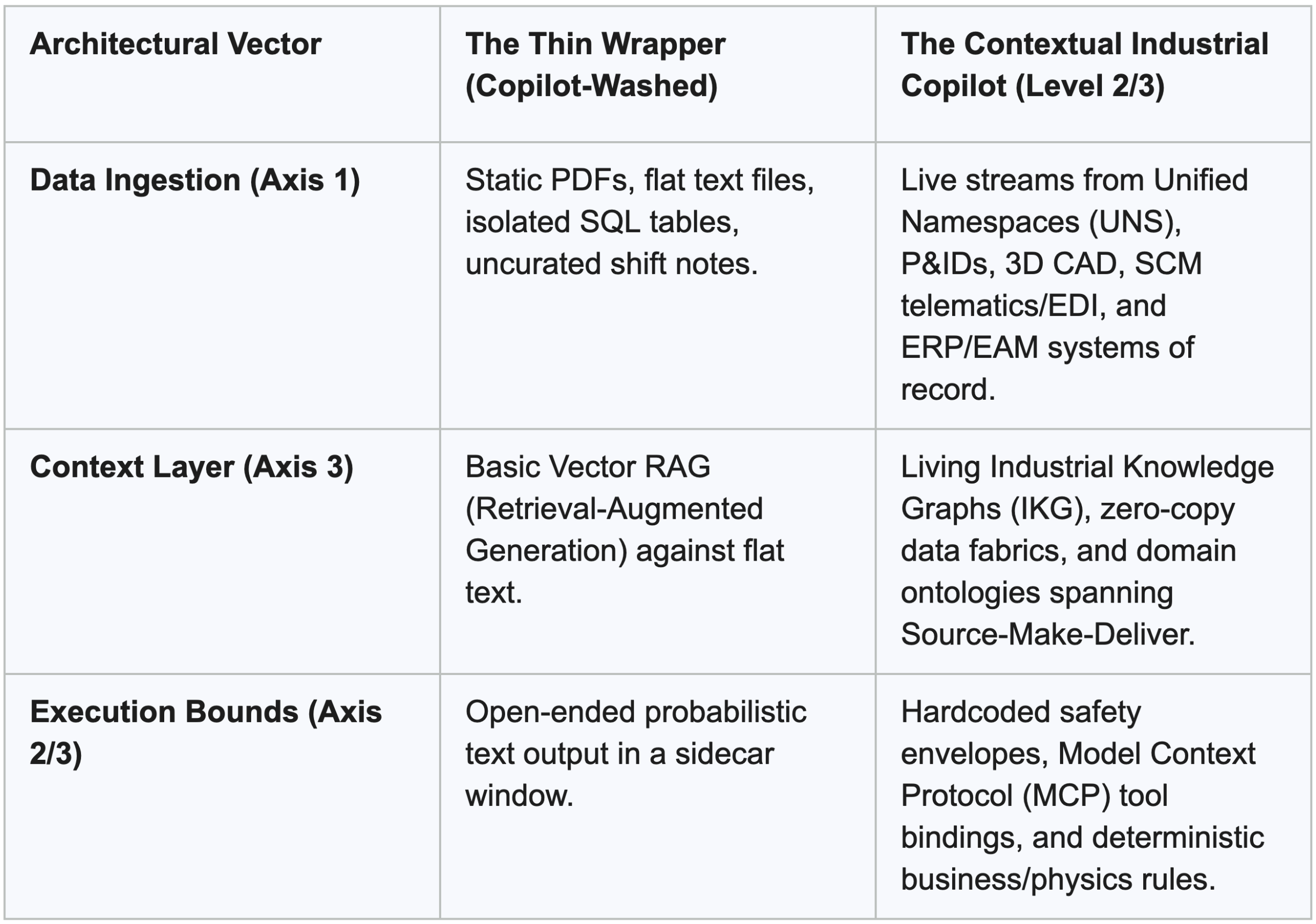
A true Industrial Copilot does not operate in an informational vacuum. It relies on an Industrial Data Fabric to unify OT, IT, and ET. When a frontline maintenance technician queries a contextual copilot about an unexpected vibration spike on a feed pump—or when a supply chain planner queries an unexpected port delay—the copilot doesn't just read a user manual or a static spreadsheet; it cross-references live telemetry, checks active ERP/EAM work orders, pulls CAD schematics, and evaluates logistics constraints before delivering a step-by-step diagnostic or rerouting guide.
In Blog 1 of our Draining the Swamp series, we proved that passive containment firewalls are insufficient because they leave corrupted scratchpad memory intact. A trustworthy copilot requires first-mile Data Quality Index (DQI) filtering at the edge and data fabric layer. If sensor telemetry suffers from calibration drift or a supply chain telematics stream provides stale location data, the underlying data fabric must purge the copilot's context scratchpad before the model can present a hallucinated recommendation to an operator, planner, or executive.
If you are a COO, CIO, CPO, or VP of Operations preparing your next digital transformation review, do not let vendor slickness obfuscate architectural reality. Use these four essential diagnostic inquiries during your next RFI review to filter out thin LLM wrappers and evaluate true contextual integrity across your value chain:
Context Engineering Grounding: Is your copilot merely performing vector keyword searches across static PDFs or flat SQL databases, or is it dynamically tethered to a living Industrial Knowledge Graph and real-time operational event streams across plant and supply chain systems?
First-Mile Data Quality & Scratchpad Purging: How does your solution handle telemetry or telematics anomalies (sensor drift, frozen tags, stale GPS feeds)—does your fabric validate DQI and purge corrupted agent memory scratchpads before presenting actions to operators and planners?
Deterministic Safety Envelopes: Are tool bindings and execution boundaries strictly enforced via open standards (MCP) and hardcoded safety/business limits, or are you relying on probabilistic LLM outputs near physical thresholds or financial risk limits?
Value-Chain UI Ergonomics: Does your UI force workers to type conversational prompts into a sidecar text window, or does it deliver adaptive, task-specific action cards generated automatically at the point of work—whether on an HMI, tablet, or logistics control tower?
Up Next: Having established the non-negotiable requirement for contextual integrity on a single asset or business process, we must now confront the messy brownfield reality of the multi-vendor enterprise footprint. What happens when your Siemens automation copilot, your AVEVA digital twin copilot, your FourKites logistics copilot, and your SAP enterprise copilot all reside in the same enterprise—and issue conflicting commands?
In our next installment, "Curing the 'Copilot Tower of Babel': Orchestrating Multi-Vendor Copilots Across the Brownfield Shop Floor," we explore inter-agent collisions across Factory, Supply Chain, and Enterprise domains, showing how pacesetters implement Anthropic's Model Context Protocol (MCP) and Agent-to-Agent (A2A) protocols to build a governed master control plane. Stay tuned.
The Industrial AI (R)Evolution is moving faster than ever. To dive deeper into the frameworks and data shaping the future of the industrial sector, explore my latest research:
Navigating the AI Wars and the escalating Industrial Robot Wars
Closing the Digital Divide by Embracing Industrial AI
Assembling your Industrial-Grade Data Fabric
Charting the new frontier of Physical Intelligence and transitioning to a Cyber-Physical Industrial Architecture (CPIA)
Mapping your maturity and strategy with ARC's 3-Axis Industrial AI Models Taxonomy
Surviving the SaaSpocalypse and Taming the Tokenpocalypse by Mastering Multi-Agent Industrial Governance
Organizational Design and the Future of Industrial Work in the era of Agentic AI
Take our Industrial AI Assessment to benchmark your organization's maturity, identify critical gaps in your IT/OT/ET convergence, and get actionable recommendations to accelerate your path to becoming an Industrial AI Pacesetter (and Download the 2026 Report). If you think you’re already a Pacesetter, nominate your team for the ARC Industrial Pacesetters Awards!
Don't guess what your global operations or prospective customers need. Use empirical data to align your stakeholders and de-hype the market with ARC Advisory Group's Voice of Market Service.
For tailored recommendations on governing and guiding major people, process, and technology decisions across the enterprise, cloud, industrial edge, and AI, please contact Colin Masson at [email protected].
Or, set up a meeting with my fellow Analysts and I at ARC Advisory Group to find out more about our Executive Insights Service for Industrial organizations and our Industrial AI Insights Service for Vendors.