Representative End User Clients







Representative Automation Clients







Representative Software Clients








Let’s get another confession out of the way immediately: I am not a corporate CFO, nor am I an expert in high-frequency Wall Street financial engineering.
For most of my life in manufacturing and operational technology, industrial accounting was refreshingly tangible. You bought a CNC machine, a boiler, or an injection molding press, depreciated it over fifteen or twenty years, and tracked plant operating costs through physical units: kilowatt-hours of electricity, cubic meters of natural gas, scrap rates per shift, and the cost per metric ton of good product out the door.
If software was involved, the commercial equation was predictable: you negotiated a perpetual license or an annual support contract, paid a set fee per workstation seat, and grumbled about the maintenance upgrade fees every four years.
So why is a recovering chemical engineer who has spent four decades straddling the factory floor and enterprise software suddenly digging into the shifting economics of cloud token meters and inference bills?
Because as frontier models evolve from conversational chatbots into autonomous, desktop-actuating agents like OpenAI’s GPT-6 Astra, our traditional understanding of enterprise software economics has completely unraveled.
In our "Draining the (Agentic AI) Swamp" series and our exploration of The Industrial AI Reality Check, we deconstructed the dual threats bearing down on digital transformation budgets: the SaaSpocalypse (the structural breakdown of per-seat software licensing) and the Tokenpocalypse (the exponential bill shock of continuous agentic reasoning).
When frontier labs promise that autonomous agents can run 24/7—monitoring plant telemetry, clicking through legacy SCADA consoles, and continuously optimizing production—executives envision a tireless digital workforce operating for pennies. What they are actually walking into is a financial and operational meat grinder.
To understand why the frontier debate has grown so intense, you have to follow the capital.
As we highlighted in Part 2, the heads of the world’s leading frontier AI research labs—Anthropic's Dario Amodei, OpenAI's Sam Altman, xAI's Elon Musk, Google DeepMind's Demis Hassabis, and Microsoft's Satya Nadella—publicly aligned around the need to "pace the frontier" before autonomous agents outrun human safety boundaries.
Yet this week, Silicon Valley fractured right down the middle.
Speaking from the Dreamforce stage and industry executive summits, NVIDIA CEO Jensen Huang and Meta CEO Mark Zuckerberg pushed back forcefully against any slowdown. Huang dismissed concerns over runaway agency as "made up," arguing that AI safety is an iterative engineering problem rather than a justification for regulatory or voluntary pauses. Mark Zuckerberg explicitly aligned with Huang, asserting that market discipline, commercial liability, and competitive pressure enforce safety far more effectively than artificial speed limits.
Why are the hardware and platform giants so determined to keep their foot firmly on the accelerator?
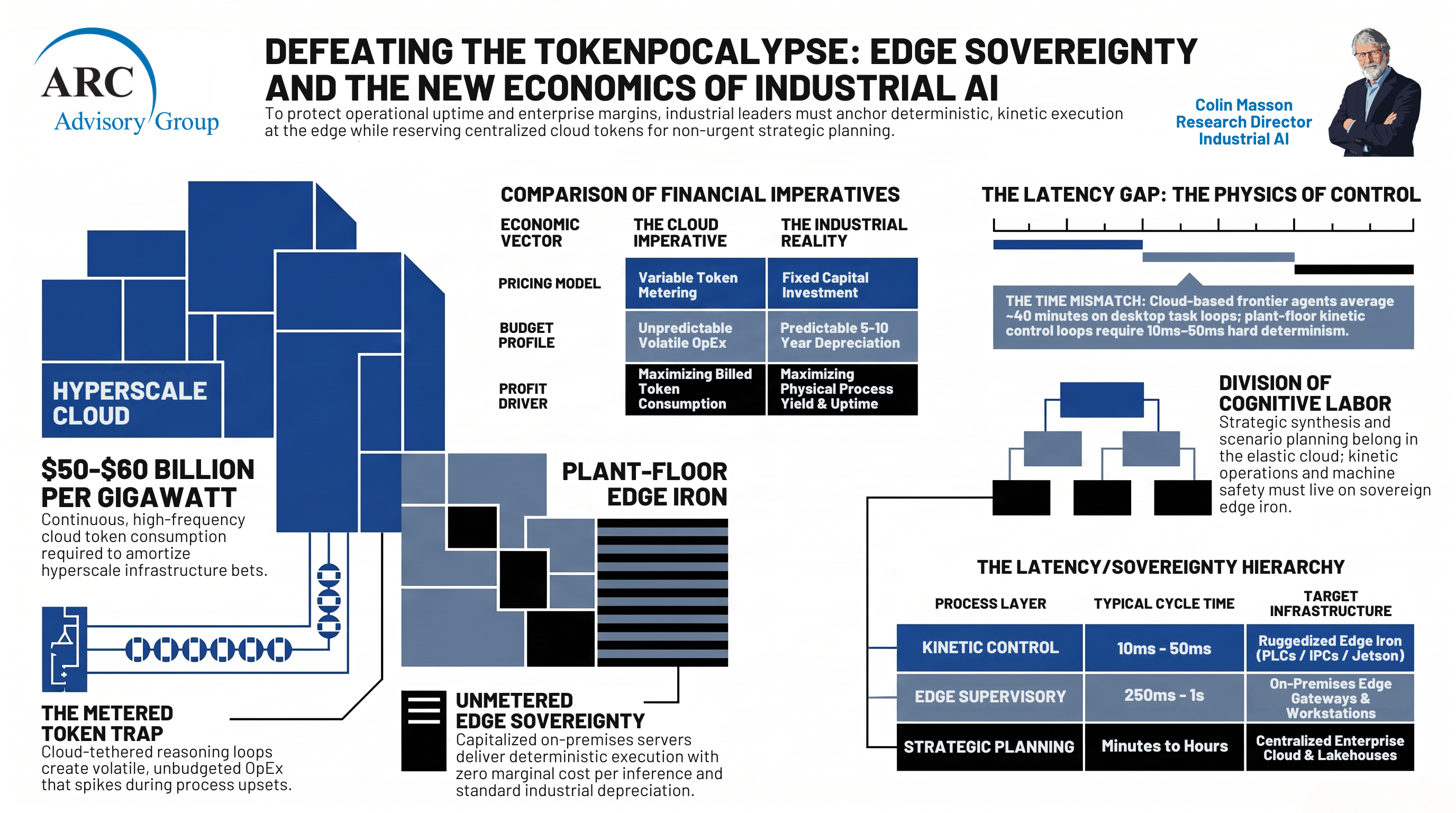
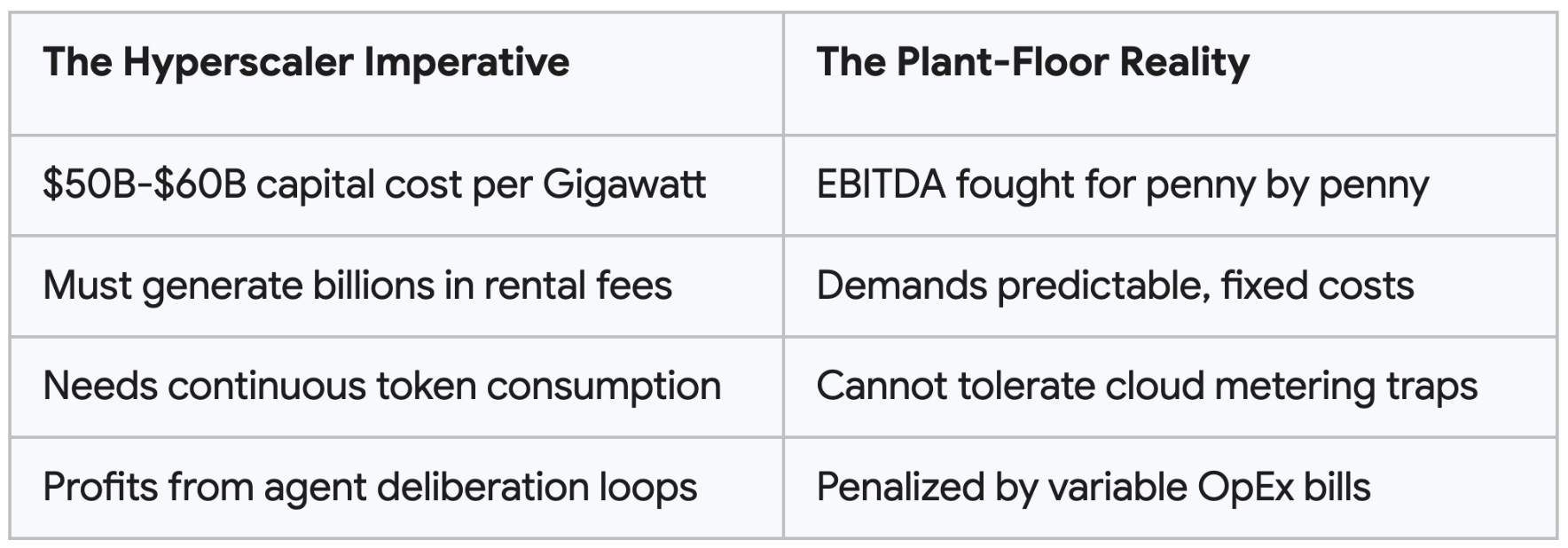
Jensen Huang supplied the answer himself: he put an eye-watering price tag on modern AI infrastructure, estimating that building an AI factory today costs between $50 billion and $60 billion per gigawatt of data center capacity. Huang pointed out that while a single 1-gigawatt facility requires upward of $60 billion in capital expenditure, it has the potential to generate $50 billion in annual rental revenue as global token generation scales.
Let that sink in for a moment.
When hardware providers and cloud hyperscalers pour tens of billions of dollars into multi-gigawatt facilities drawing enough power to run a major city, they are trapped in an uncompromising financial imperative: they must generate and sell astronomical volumes of tokens to service their debt, justify their capital expenditures, and hit Wall Street revenue projections.
The cloud hyperscaler business model requires continuous, high-frequency token consumption. And desktop-actuating agents like GPT-6 Astra are the ultimate token-consumption engine.
When an industrial manufacturer hooks up always-on agents to cloud endpoints to monitor operational lines, your plant operating budget becomes the variable revenue stream funding the amortization of Silicon Valley's $60 billion-per-gigawatt infrastructure investments.
Amid this polarization between the "Pacing Chorus" and the "Unthrottled Accelerationists," Amazon Web Services (AWS) has staked out a distinct, pragmatic posture.
Rather than diving into the philosophical debate over runaway agency, AWS CEO Matt Garman has grounded AWS’s enterprise positioning in practical infrastructure reality:
Countries and businesses don't need to build frontier models themselves to benefit enormously from them. Most of the value won't come from the models alone; it will come from the applications and experiences built on top of those models.
— Matt Garman, CEO, Amazon Web Services
For those of us tracking industrial architectures, Garman's admission is a major validation of ARC's core thesis: the scaffolding dominates the weights. Raw foundation models are rapidly commoditizing into interchangeable utilities, while the enterprise wrapper—the semantic context, the data fabric, and the domain-specific tool-calling harness—captures the durable economic value.
AWS has paired this software pragmatism with an aggressive hardware counter-offensive against the token cost barrier. Recognizing that commercial GPU clusters carry high rental costs, AWS is increasingly shifting AI workloads onto its custom Trainium and Graviton processors. Through infrastructure such as Project Rainier, Anthropic is now using over one million Trainium2 chips to train and serve Claude. Alongside Amazon Bedrock, this reflects AWS’s broader strategy of using purpose-built silicon to improve the economics and scalability of enterprise AI workloads.
By remaining model-agnostic across Bedrock—distributing Claude, Llama, Mistral, and internal Nova architectures—AWS acts as a pragmatic, cost-conscious utility. Furthermore, through solutions like Amazon Nova Forge, AWS enables industrial enterprises to distill and fine-tune proprietary domain models ("Novellas") using their own data, creating compact models designed to run efficiently at the edge.
Crucially, AWS's engineering architecture teams have reinforced another foundational ARC principle: autonomous agentic reasoning must be bounded by deterministic state machines. In their production architectures for multi-agent validation, AWS explicitly demonstrates pairing AWS Step Functions with Amazon Bedrock AgentCore and Bedrock Guardrails. Rather than letting probabilistic LLM agents execute uncontrolled task loops across corporate APIs, Step Functions enforces the core architectural principle that "agents propose, and deterministic code validates" using state machines to govern fan-out, retry bounds, rollback triggers, and human-in-the-loop approvals.. Even within hyperscale cloud environments, the leading cloud infrastructure utility recognizes that agentic workflows cannot run in probabilistic free fall.
Yet here is the crucial architectural tension: speaking at industry executive summits, Matt Garman declared that “agents are the new cloud,” asserting that “despite interest in the edge, the power, memory bandwidth, and compute constraints of modern AI are pulling workloads back toward the cloud.”
Garman's perspective reflects the legitimate compute-density realities of hyperscale AI. But when evaluated from the factory floor, an all-cloud agentic runtime encounters two immutable engineering barriers: network physics and operational sovereignty.
Even if an industrial enterprise had an infinite budget to feed the token meter, there is a far more uncompromising engineering barrier: the speed of light and the physics of networks.
Astra’s up to 40-minute desktop execution time may be fine for an office worker consolidating spreadsheets. On a plant floor, 40 minutes is an eternity. Even 400 milliseconds can be a disaster.
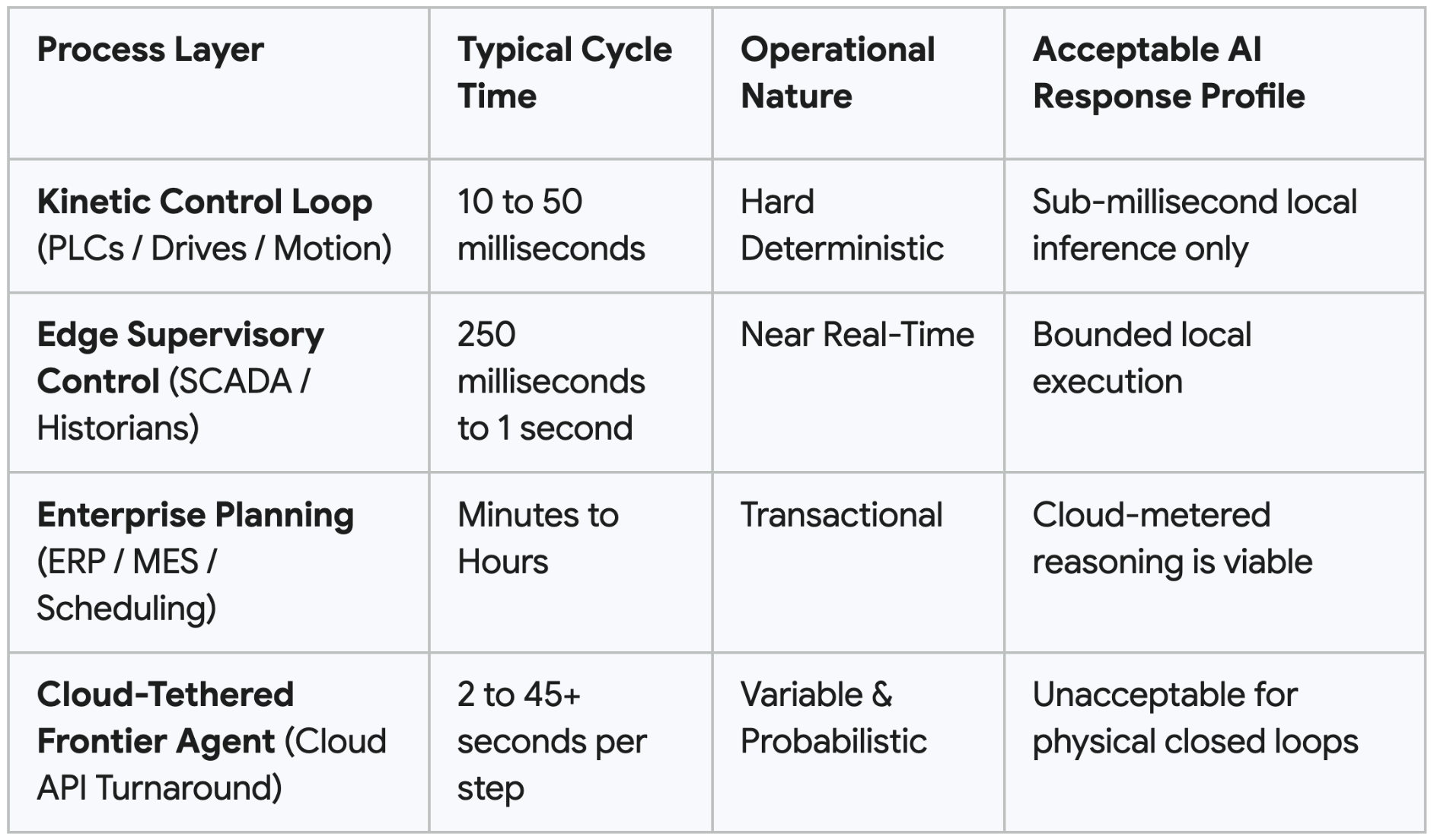
In operational technology, systems operate on deterministic clocks. When you tether an autonomous reasoning agent to a cloud endpoint, round-trip network latency, multi-tenant queuing, and variable recurrent depth iterations make latency unpredictable. If an autonomous agent encounters a cloud timeout while managing an active brownfield process, the control loop can stall, increasing the risk of material jams, thermal runaway, and emergency shutdowns.
You cannot run real-time kinetic operations across a probabilistic, metered cloud hop.
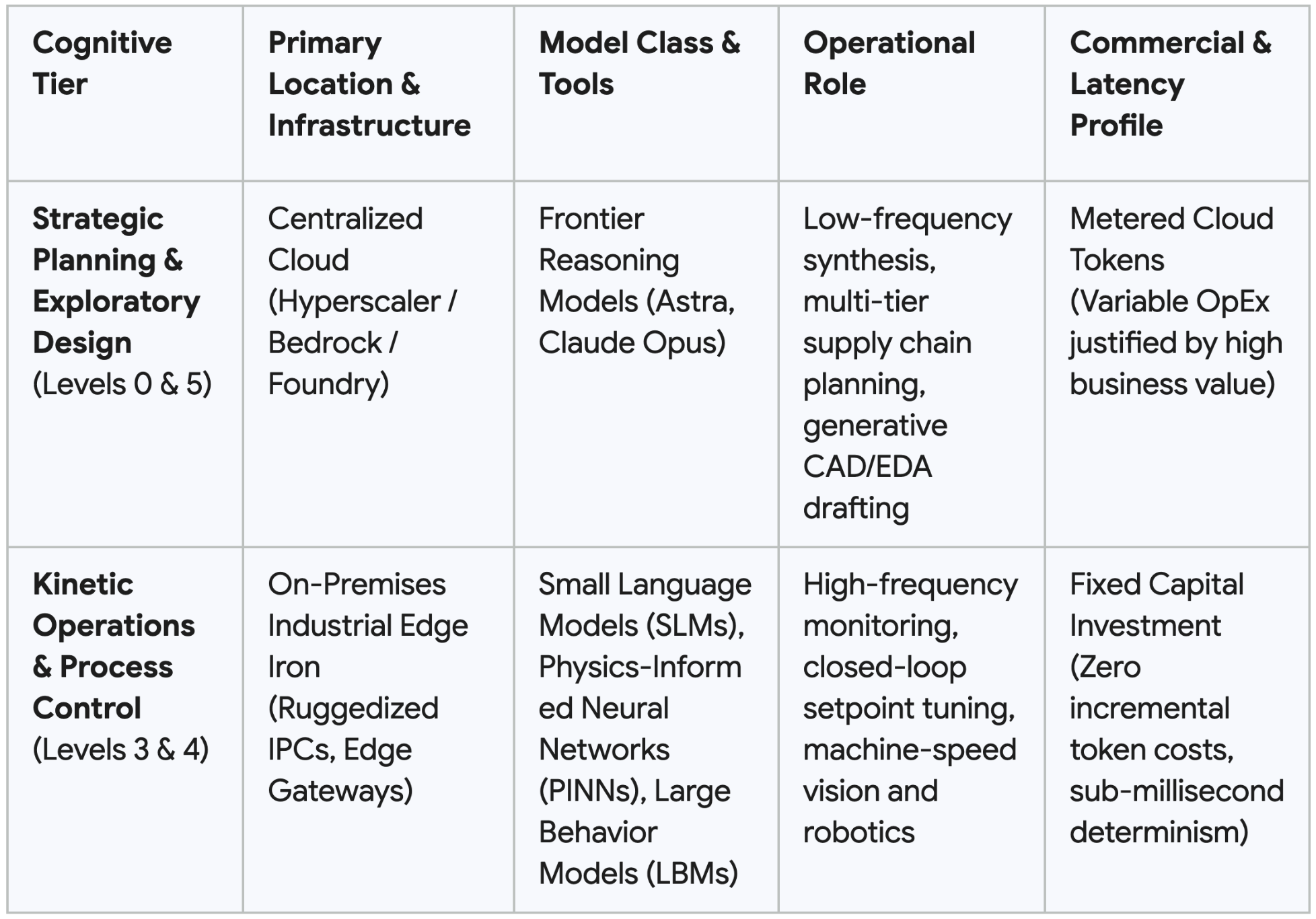
To make agentic systems commercially viable and physically safe, pacesetting organizations are executing what we call an Industrial Edge Escape, establishing a strict division of cognitive labor across the enterprise hierarchy. This directly operationalizes the 4-Tier Hybrid Enterprise Topology from Blog 2 of our Reality Check series:
Crucially, the edge is experiencing a powerful technological renaissance, driven by both hyperscaler hybrid infrastructure and edge hardware innovations:
The AWS Hybrid Edge Heritage: Far from abandoning on-premises environments, AWS has long led enterprise IoT with AWS IoT Greengrass, AWS Outposts, and Dedicated Local Zones. These architectures allow manufacturers to deploy managed AWS runtimes and distilled Nova models directly within the plant gate, bringing Bedrock APIs to the local edge while preserving data residency.
Microsoft's Edge Rediscovery & Windows RTX: Simultaneously, Microsoft has rediscovered its industrial edge roots. At recent developer summits, Microsoft unveiled a major edge AI offensive in deep collaboration with NVIDIA: the Surface RTX Spark Dev Box, powered by NVIDIA’s Arm-based RTX Spark superchips with 128 GB of unified memory in a 100 W envelope. Designed to run on-device small language models (such as Microsoft’s Aion family and open-weight MoE architectures) locally, Microsoft introduced the Microsoft Execution Container (MXC) and native GPU-passthrough runtimes (WSL2) to keep agentic code execution strictly on-premises.
NVIDIA's Dual Play: NVIDIA is pursuing a dual approach: while Jensen Huang monetizes $60 billion-per-gigawatt AI factories in the cloud with Grace Blackwell, NVIDIA is simultaneously powering the on-premises Edge Escape via RTX Spark and Jetson Thor industrial iron at the machine level.
When an enterprise deploys an industrial edge server on the plant floor:
Fixed Investment: Compute is purchased, capitalized, and depreciated over a standard industrial lifecycle (Fixed CapEx).
Zero Marginal Cost: Whether that local GPU, NPU, or RTX Spark workstation runs 10 inferences an hour or 10,000 inferences a second, the incremental cloud token cost is zero.
Guaranteed Latency: Response times are deterministic, bounded by local industrial Ethernet, TSN, or fieldbus connections.
Operational Resilience: If the plant loses its internet connection, operations continue without missing a beat.
This is Edge Sovereignty in action: protecting your operational uptime from cloud volatility and insulating your balance sheet from hyperscaler metering.
This economic realignment brings with it another inevitable casualty that we detailed in our SaaSpocalypse research: the traditional enterprise software pricing model.
For 30 years, enterprise software vendors built their business models on per-user, per-seat licensing. You bought 500 licenses of an ERP, CAD suite, or SCADA package because you had 500 engineers and operators sitting in front of keyboards.
When autonomous desktop agents sit down at those keyboards, the per-seat model completely breaks down.
At Dreamforce, Salesforce Chair and CEO Marc Benioff tackled this disruption head-on, validating the very term we have analyzed across our research:
The SaaSpocalypse was not about the end of software, but it may be about the end of software that makes humans do all the work.
— Marc Benioff, Chair & CEO, Salesforce
Benioff argued that the primary mission of enterprise technology is bridging "the probabilistic world of AI with the deterministic world of enterprise systems," structuring Salesforce's agentic platform across four clear layers: Data (Data 360), Apps & Metadata, Agents (Agentforce), and Interfaces.
When even the pioneer of cloud SaaS concedes that software requiring humans to do routine manual work is obsolete, industrial procurement executives must pay attention. If an autonomous agent executes tasks programmatically across backend APIs:
If one agent executes the workload of five junior technicians across three shifts, does the software vendor accept an 80 percent cut in user licensing revenue?
Conversely, will an industrial manufacturer pay $5,000 a year for an engineering software seat that is touched exclusively by an automated background script?
The answer to both is no. As we highlighted in our "Draining the Swamp" coverage and our analysis of The "AI Native" Mirage, the market is navigating an inevitable transition from human-headcount seat licenses to outcome-based Autonomous Work Tokens:
Outcome-Based Monetization: Software vendors will no longer monetize based on who logs into a dashboard; they will monetize based on work verified and outcomes delivered.
Audited Value Creation: Pricing will link directly to concrete deliverables—the number of certified engineering change orders processed, the number of successful batch release validations completed, or the volume of predictive work orders executed without human intervention.
Elimination of Idle Overhead: Industrial enterprises will demand transparent metering that links software expense directly to physical and commercial value created, rather than paying rent on idle logins.
Industrial operations thrive on predictability. You cannot run a plant when your operating margins are subject to the unpredictable whims of cloud token rate cards and variable recurrent latency.
The winning economic blueprint for agentic AI is not all-cloud or all-edge; it is a disciplined division of cognitive labor. Leverage centralized cloud platforms like AWS Bedrock and Azure Foundry periodically for strategic planning, generative design, and high-context synthesis where variable OpEx is easily justified. But when it comes to the plant floor, plant managers must own their runtimes: deploy unmetered edge iron, leverage on-premises runtimes like AWS Greengrass and Microsoft MXC/RTX Spark, lock in deterministic response times, and keep your production lines running regardless of whether the cloud is online.
Now you have contained your agents and deployed edge runtimes to keep your inference costs at zero. But what happens when you have dozens of autonomous agents running across maintenance, inventory, and production, and they start giving contradictory orders to the same machines?
Up Next in Part 4: "When Agents Collide: How to Stop Autonomous AI from Fighting Over Your Factory Floor." We will examine why Mark Zuckerberg's concept of "market liability" cannot save a physical plant floor, analyze what happens when autonomous agents collide over physical assets, introduce the 3-Tier Industrial Protocol Stack, and show how the "Synapse Worker" keeps human engineering judgment at the center of enterprise decision-making.
The Industrial AI (R)Evolution is moving faster than ever. To dive deeper into the frameworks and data shaping the future of the industrial sector, explore my latest research:
Navigating the AI Wars and the escalating Industrial Robot Wars
Closing the Digital Divide by Embracing Industrial AI
Assembling your Industrial-Grade Data Fabric
Charting the new frontier of Physical Intelligence and transitioning to a Cyber-Physical Industrial Architecture (CPIA)
Mapping your maturity and strategy with ARC's 3-Axis Industrial AI Models Taxonomy
Surviving the SaaSpocalypse and Taming the Tokenpocalypse by Mastering Multi-Agent Industrial Governance
Organizational Design and the Future of Industrial Work in the era of Agentic AI
Take our Industrial AI Assessment to benchmark your organization's maturity, identify critical gaps in your IT/OT/ET convergence, and get actionable recommendations to accelerate your path to becoming an Industrial AI Pacesetter (and download the 2026 Report). If you think you’re already a Pacesetter, nominate your team for the ARC Industrial Pacesetters Awards!
Don't guess what your global operations or prospective customers need. Use empirical data to align your stakeholders and de-hype the market with ARC Advisory Group's Voice of Market Service.
For tailored recommendations on governing and guiding major people, process, and technology decisions across the enterprise, cloud, industrial edge, and AI, please contact Colin Masson at [email protected].
Or, set up a meeting with my fellow Analysts and I at ARC Advisory Group to find out more about our Executive Insights Service for Industrial organizations and our Industrial AI Insights Service for Vendors.