With 16 people dead so far, more than 150 injured, 70 million vehicles recalled in America, 100 million worldwide, and yet millions of cars still being driven around with defective and dangerous products, the Takata airbags scandal does make for very grim reading. And perhaps more so when you consider that the equipment supposed to protect and save in an auto incident is the very thing that is killing and maiming.
Take 35-year old Carlos Solis, who died in in his Honda Accord in Houston in 2015 after a low-speed collision. As reported (
Bloomberg BusinessWeek): “A round piece of metal the size of a hockey puck shot out of the Accord’s air bag, sliced into Solis’s neck, and lodged in his cervical spine and shoulder. It severed his carotid artery and jugular vein and fractured his windpipe.” Or Kirsty Williams, whose car (Honda Civic) was not even moving or involved in a collision but stopped at a red light in Georgia in 2010 when the Civic’s airbag inflator exploded and she was hit in the neck by shredded metal and her carotid artery similarly severed. Although Ms Williams survived, the severe blood loss led to strokes and has left her with a speech disorder.
And the incidents are not just restricted to the US. Here in Asia just a few months ago, in June, Norazlin Haron, driving her Honda City in the Malaysian capital Kuala Lumpur and involved in a minor accident with a Mercedes Benz, was killed after the car’s airbag activated and she was hit in the chest by a sharp metal object. Tellingly, none of the other passengers in the car or any of the occupants in the Mercedes suffered any injuries. Two years earlier, in the Malaysian town of Sibu, another woman, also driving a Honda City, suffered a similar fate when, in the words of a Honda spokesman, “The driver's airbag deployed abnormally and the inflator case was broken. She was pregnant and the foetus also died."
Aside from the gruesome nature of the fatalities and injuries linked to defective Takata airbags, several things stand out in this sorry saga. One is that it has been more than a decade since the first reported incident – in Alabama in 2004, when a Honda Accord driver was injured by metal fragments from an exploding airbag, and eight years since the first auto recalls – 4,000 Civics and Accords by Honda in 2008. As more incidents came to light, and as more people died, recalls were stepped up, with eventually, in the US, the National Highway Traffic Safety Administration (NHTSA) taking over and
ordering multiple car companies to recall their vehicles. (While as Takata’s largest customer Honda is the most affected auto manufacturer, the recall extends to most makes of vehicles, including the likes of Toyota, Ford, Mazda and BMW.)
Another aspect is that the product recalls initiated thus far have been slow and ineffective; for instance, in the case of Carlos Solis, the recall notice was received two weeks after his death. With cars routinely changing ownership perhaps multiple times, it is a huge task for auto companies to locate drivers with affected vehicles. Honda, for example, has resorted to placing ads in Facebook and Twitter, flashing alerts in stadiums, and even hiring private detectives in order to find at-risk drivers.
While there may be much talk of connected products and the promise of billions of devices about to be connected to the internet, the reality as of now is that once a product is manufactured and leaves the factory gates, most manufacturers would know next to nothing about how its performance out in the field – whether that’s in another facility in the case of industrial equipment like a pump or a compressor, or in a consumer environment in the case of something like a washing machine or a car.
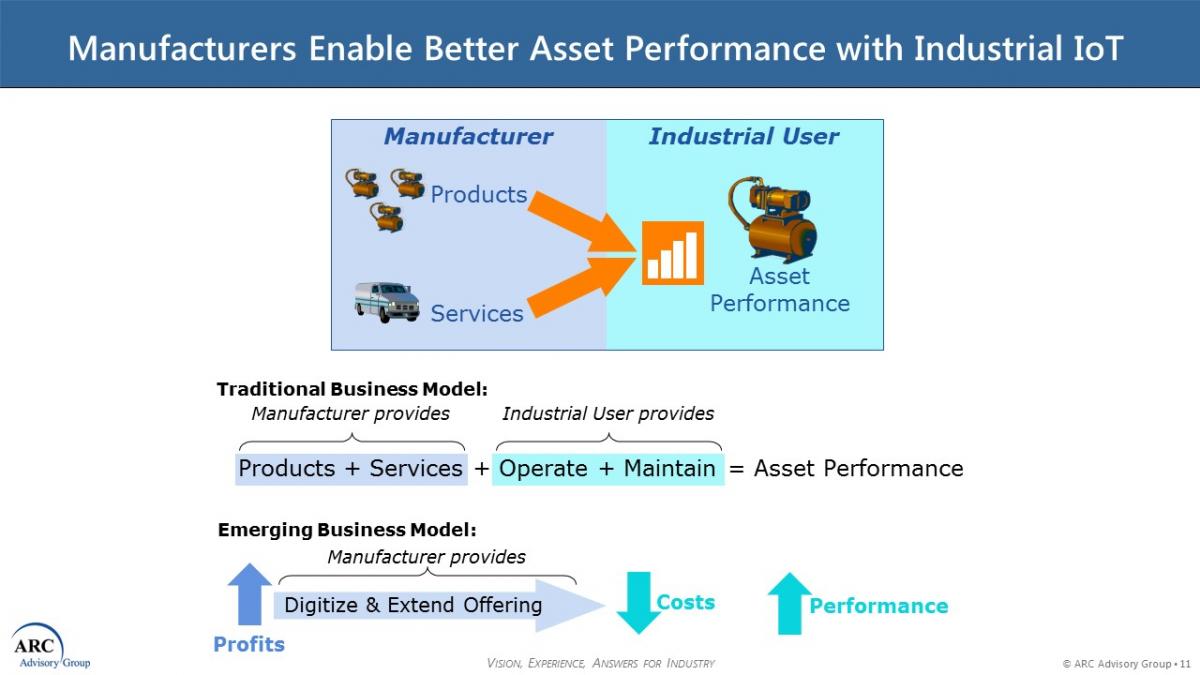
One of the benefits of Industrial IoT technology that ARC Advisory Group has been articulating for some time now is that, crucially, it enables equipment manufacturers as well as associated interested parties (such as allied service organizations) to access and share real-time operating data and thus stay connected to products and be able to respond proactively to out-of-scope performance, unusual performance behavior, or impending failure, rather than simply react after what could be expensive incurred downtime or even a catastrophic incident.
In the case of the Takata airbags, after considerable investigations, federal safety regulators concluded in May 2016 that the ammonium nitrate propellant used for its airbag inflators is dangerously sensitive to environmental conditions: “The science now clearly shows that these inflators can become unsafe over time, and faster when exposed to high humidity and high temperature fluctuations.” There’s a clear explanation here as to why the fatal incidents are occurring in older rather than newer vehicles and in more humid locations like the southern United States and Malaysia.
It is not difficult to see that had today's Industrial IoT technology been available and installed – sensors, communications, analytics – Takata and its auto industry customers could have detected a trend of exploding airbags – where they were occurring, that they were rupturing even after minor collisions, that some vehicles were even stationary, etc. – far sooner than they were able to working with a very manual incident-to-awareness information feedback loop. And with the type of location technology now commonly available, you would think that future product recalls can far better find and identify affected products and their owners and not have to rely on sports stadium broadcasts or your local private investigator.
Takata has not surprisingly been severely damaged by the airbag saga, with a criminal investigation by the US Dept. of Justice and financial losses likely to spiral upwards of $11 billion. But it is not the only company hit by putting out defective automotive products and being slow to deal with the consequences. After 124 auto fatalities and 275 injuries were formally linked to
faulty ignition switches in its cars, and the company judged to have delayed making vehicle recalls, General Motors had by the end of last year paid out some $6.9 billion in fines and lawsuits. As a result, a now contrite GM says it is making safety a priority and endeavoring to catch problems sooner rather than later.
Outside of the auto industry, while Samsung's problems with its exploding Note 7 batteries have been grabbing headlines, the Korean company is also trying to deal with the rather alarming reports in the last few weeks of
exploding washing machines in consumers' homes in the US: "Affected units may experience abnormal vibrations that could pose a risk of personal injury or property damage when washing bedding, bulky or water-resistant items," said the company in a statement.
If anything, all these incidents, and there's many more besides, do go to show the sheer unconnected and uninformed world of things that we live in and hence the huge opportunity that exists for Industrial IoT – to allow products to remain connected to their manufacturers long after coming off the production line and to deliver early and highly valuable insights into field performance.




















