Representative End User Clients







Representative Automation Clients







Representative Software Clients








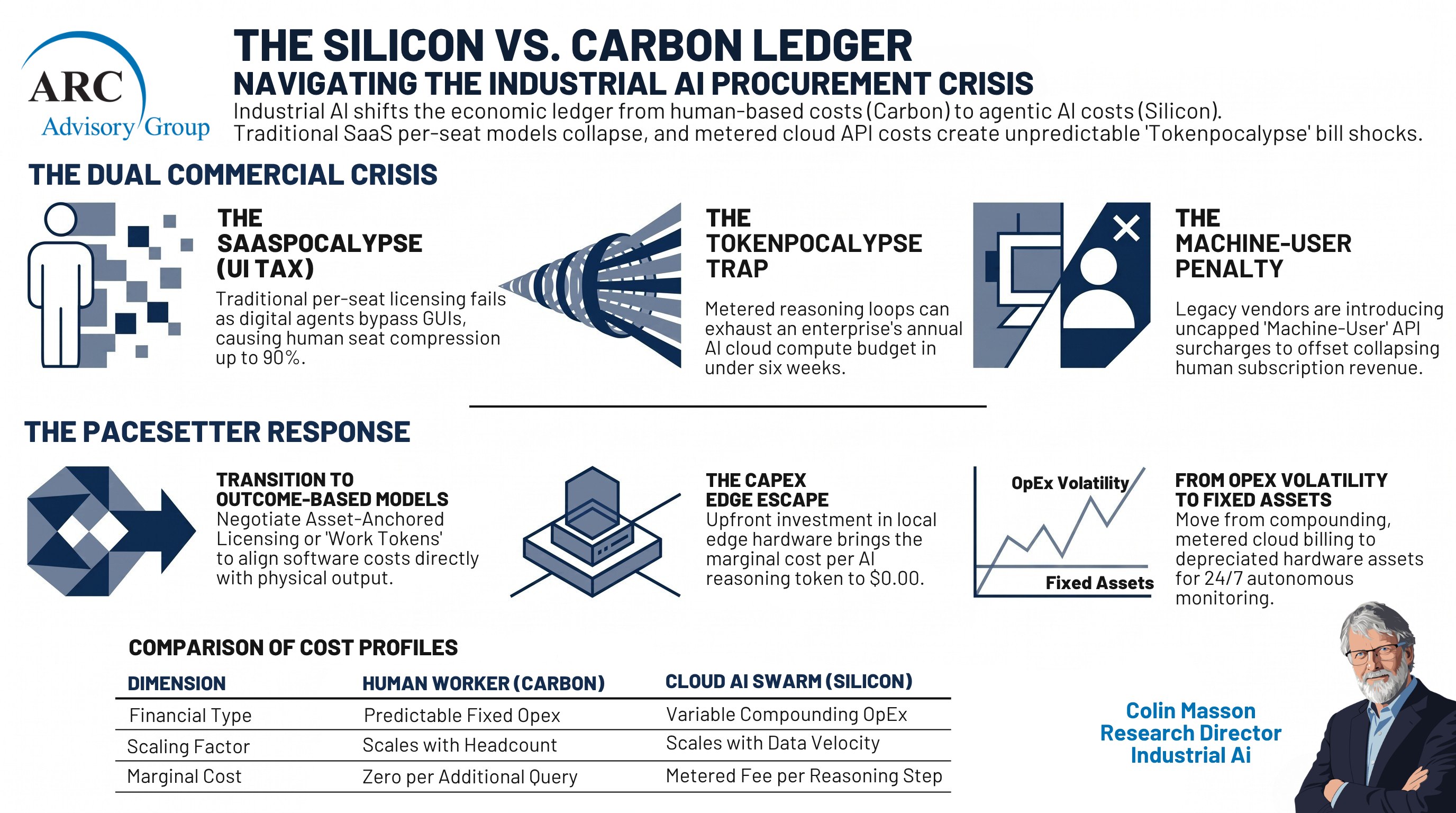
Purchasing agentic AI software through 30-year-old per-seat SaaS RFP templates is a commercial trap. As headless digital workers execute tasks via APIs without occupying human user seats, per-seat revenue models collapse into the SaaSpocalypse. Simultaneously, streaming high-velocity factory telemetry or logistics telematics to cloud tokenizers causes disastrous Tokenpocalypse bill shock. CFOs, CISOs, and CPOs must restructure contracts around outcome-linked licensing, Autonomous Work Tokens, and local/hybrid CapEx edge supercomputing to economically scale Industrial Copilots.
Across the first six installments of this blog series building up to the release of the ARC Industrial Copilots MarketMap, I’ve tried to map the architectural and operational foundations of the Copilot Era: penetrating LLM-wrapper illusions (Blog 1), resolving inter-agent collisions via MCP and A2A (Blog 2), anchoring autonomy at the machine face (Blog 3), orchestrating multi-enterprise networks (Blog 4), aligning top-floor ERP strategy (Blog 5), and empowering connected frontline workers through Generative UI (Blog 6).
Yet, even the most elegant cyber-physical architecture collapses if its commercial model is economically unviable. In Draining the Swamp Blog 3 (The Silicon vs. Carbon Ledger: The Unforgiving Mathematics of the Agentic Labor Trade-Off), we analyzed the economic trade-offs of replacing human labor (carbon) with autonomous digital workers (silicon). Now, in Blog 7, we translate that ledger into concrete commercial procurement strategies, contract terms, and localized edge hardware investments.
When executive leadership teams evaluate Industrial Copilots and agentic AI through a traditional SaaS lens, they fall into a dangerous accounting trap.
Traditional software ROI is evaluated on human productivity gains: a software tool costs $50/user/month and saves a human engineer 3 hours per week. But autonomous digital agents and Industrial Copilots are not mere productivity tools for humans—they are digital workers that perform multi-step cognitive labor directly.
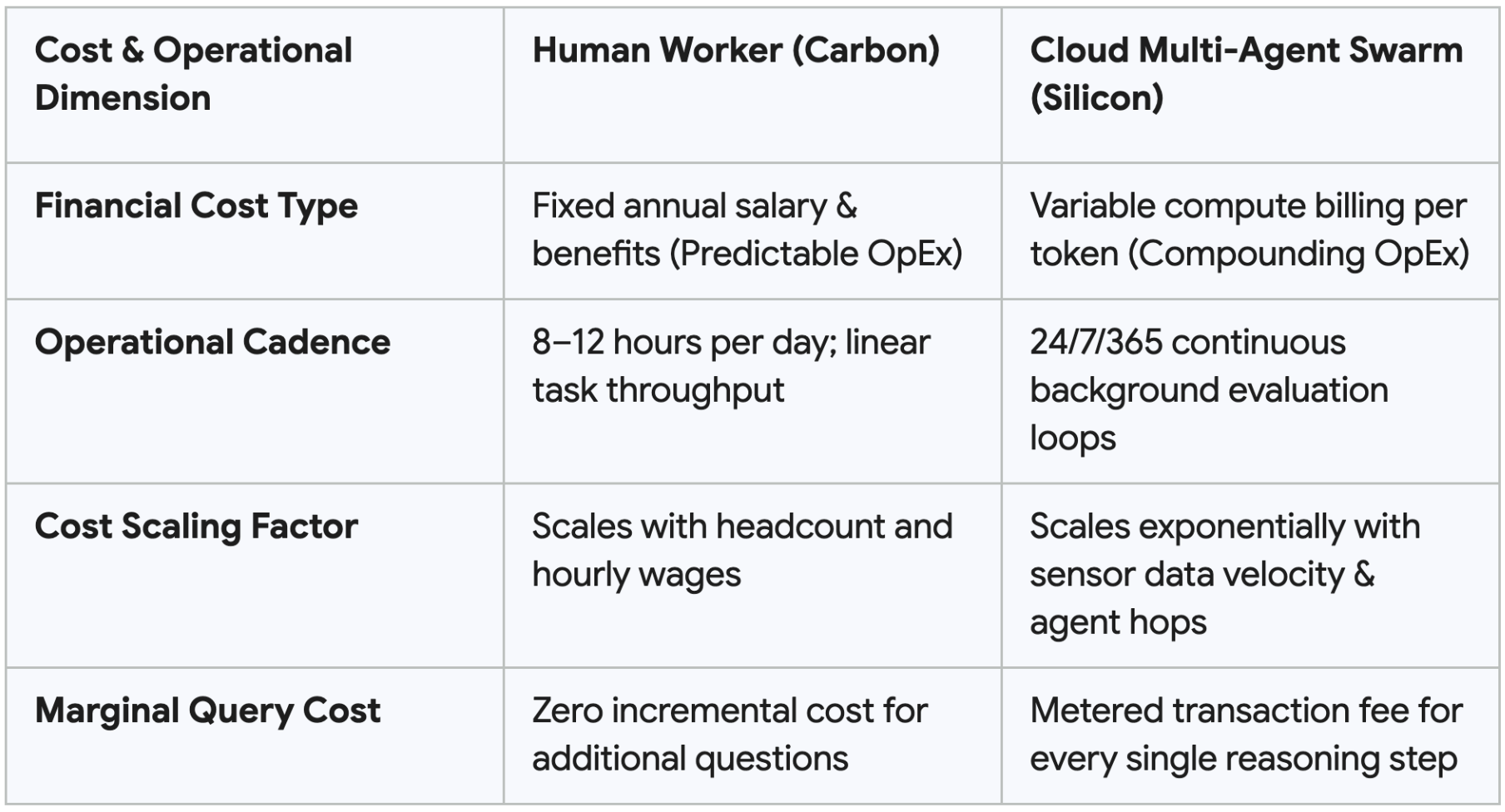
When you evaluate the fully burdened economic ledger, human labor and cloud-based AI reasoning scale under completely different cost profiles:
The Human (Carbon) Cost Profile:
Predictable Fixed OpEx: Base salary, overtime, healthcare, pensions, and payroll taxes.
Onboarding & Friction Costs: An 18-month training curve to master a complex brownfield plant, combined with daily shift turnover communication friction.
Linear Output: A human works a fixed 8-to-12-hour shift with zero marginal cost per additional operational inquiry.
The Cloud AI (Silicon) Cost Profile:
Variable, Metered OpEx: Billed continuously per fractional token processed across cloud GPUs.
The Hidden Reasoning Multiplier: Frontier reasoning models generate thousands of hidden "thinking" tokens behind the scenes to evaluate engineering hypotheses and check constraints. These reasoning tokens carry a 3x to 5x price premium over standard input tokens.
Continuous Swarm Consumption: When multi-agent swarms monitor live operational streams 24/7/365, they run thousands of autonomous evaluation loops overnight without human prompts.
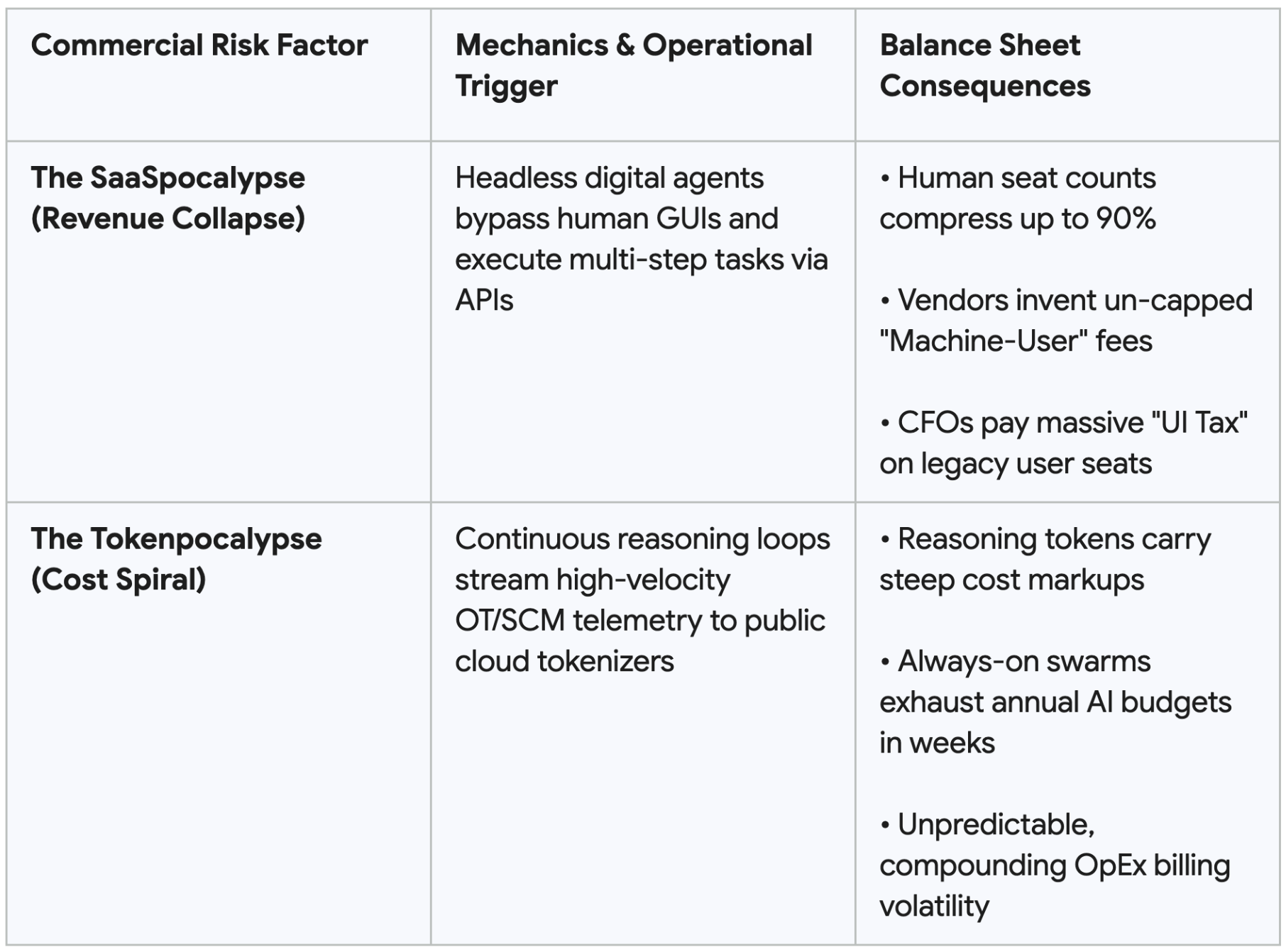
A single operational exception—when orchestrated across an APM diagnostic agent, a logistics rerouting agent, and an ERP financial agent—can easily burn through 50,000 to 200,000 reasoning and tool tokens in seconds. Billed against metered public cloud API rates, an always-on multi-agent copilot swarm deployed across 20 facilities can exhaust an enterprise's entire annual AI cloud compute budget in less than six weeks.
This economic reality creates a dual commercial crisis across the Industrial Copilot industry:
1. Collapse of Per-Seat SaaS (The SaaSpocalypse)
For three decades, enterprise software vendors built massive recurring revenue models on per-seat subscription fees. But as headless digital workers execute complex workflows directly via Model Context Protocol (MCP) and open APIs without ever touching a graphical user interface (GUI), the number of human logins plummets. An enterprise that previously licensed 500 MES or ERP user seats now requires only 10 human "Synapse Workers" sitting above the loop to audit copilot exception cards.
If vendors remain locked into per-seat pricing, their enterprise revenues collapse by up to 90 percent—the SaaSpocalypse.
2. The "Machine User" & API Surcharge Trap
To counter this revenue collapse, legacy software providers are hastily altering their commercial terms. They are introducing steep fees for "machine users", charging per digital worker API call, or placing aggressive surcharges on third-party data egress. If corporate procurement teams blindly accept these uncapped "machine user" addendums, core enterprise Industrial Copilot deployment costs can inflate by over 40 percent annually without delivering proportional business value—paying a massive "UI Tax" on unused human seats while simultaneously getting penalized for automation.
To insulate the corporate balance sheet, forward-thinking CFOs, CISOs, and CPOs evaluating Industrial Copilot software are dismantling 30-year-old per-seat RFP templates and negotiating four outcome-grounded commercial structures:
Autonomous Work Tokens & Capability Credits: Instead of charging for raw, volatile cloud API tokens, vendors sell predictable annual blocks of capability credits. Human engineering workflows and headless 2:00 AM autonomous optimization agents draw from the same prepaid credit pool, capping annual budget exposure.
Asset-Anchored Licensing: Software licensing is anchored directly to the scale of physical assets managed (e.g., number of turbines, continuous processing lines, or fleet units) rather than human headcount. This completely neutralizes the per-seat penalty of the SaaSpocalypse while aligning software cost with physical output.
Flat-Fee Agentic Orchestration: Replaces per-token metering with an all-inclusive flat-fee subscription for prepackaged libraries of role-based agents, providing absolute OpEx predictability for enterprise copilots.
Value-Based Licensing (VBL) Pools: Flexible, shared entitlement pools where human engineers and automated digital workers dynamically check software capabilities in and out on demand across global operational sites.
While outcome-based contracting protects software licensing, what about the underlying computational inference bill for Industrial Copilots? To permanently eliminate cloud token metering and guarantee air-gapped cyber-physical security, pacesetting industrial enterprises execute a CapEx Edge Escape.
By making a fixed, upfront capital investment in localized, high-density edge silicon—such as the NVIDIA RTX Spark/DGX Spark superchip appliances (featuring 128GB of high-bandwidth unified memory), NVIDIA Jetson Thor industrial modules, or ruggedized private AI systems like the Red Hat & EdgeScale "Cube"—copilot inference executes entirely on-premises at the plant or regional data center.
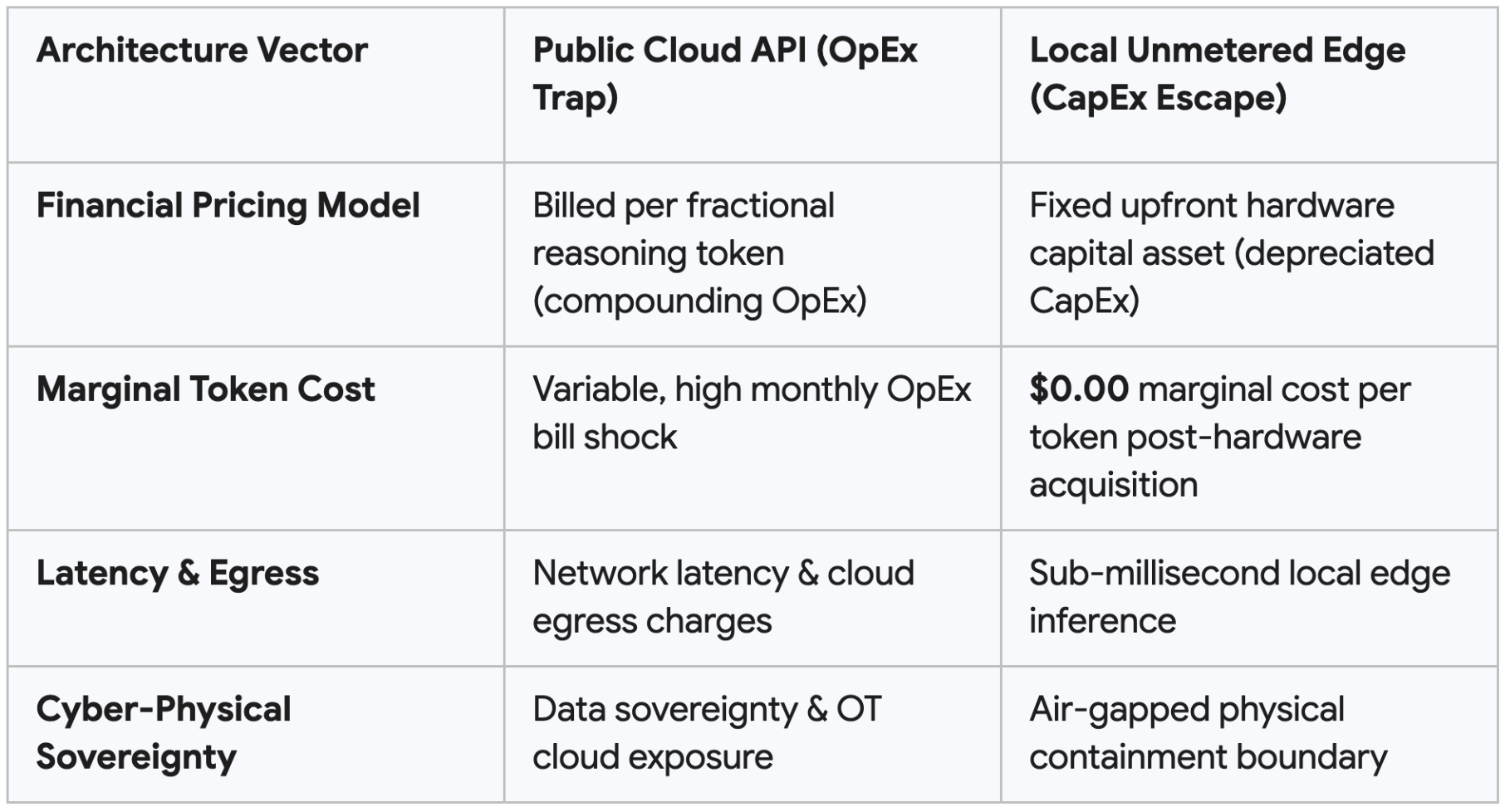
The financial math of the CapEx Edge Escape is compelling for CFOs: once the localized edge hardware is capitalized and written off over a standard 3-to-5-year depreciation schedule, the marginal cost per reasoning token processed drops to effectively zero (excluding minimal baseline facility power and cooling). This allows Industrial Copilot swarms to run 24/7 continuous 5-Why diagnostic loops, thermodynamic calculations, and real-time S&OP simulations at sub-millisecond latency without triggering a single cloud API charge.
When restructuring software procurement, contract terms, and edge infrastructure investments for Industrial Copilots, use these six essential diagnostic inquiries during commercial RFI reviews:
Commercial Metric Alignment: Does the vendor offer asset-anchored licensing, flat-fee agent pools, or Autonomous Work Tokens—or are they attempting to enforce legacy per-seat fees plus uncapped "machine user" API surcharges?
Token Volatility & Capping Protections: Are agent reasoning loops capped by structured capability credits and hard operational limits, or does the contract expose your corporate balance sheet to metered public cloud token spirals?
CapEx Edge Escape Feasibility: Can the copilot's core reasoning SLMs and domain tools execute locally on unmetered edge iron (NVIDIA RTX Spark, Red Hat EdgeScale Cube) to bring marginal token costs to $0.00?
Elimination of the "UI Tax": Does the contract allow your organization to compress human GUI user seats as digital agents automate data entry, reallocating those software expenditures into outcome-based agent capabilities?
Value-Based Software Pooling: Does the licensing agreement allow human engineers and automated digital workers to dynamically share software entitlement pools across global sites without per-login penalties?
Data Egress & Machine User Governance: Does the vendor contractually guarantee zero financial penalties or API surcharges for streaming first-mile telemetry between plant unified namespaces and third-party copilot swarms?
Having solved the architectural, frontline ergonomic, and commercial equations of Industrial Copilots, one final prerequisite remains: organizational redesign. In our series finale, Blog 8, we dismantle Henry Mintzberg’s century-old "Programmed Machine Bureaucracy" to architect the Hybrid Synapse Adhocracy. We formalize the three new career pathways of the Synapse Worker, deliver a 10-point diagnostic audit synthesizing the entire series, and show executive steering committees how to leverage the full ARC Industrial Copilots MarketMap to accelerate their journey out of pilot purgatory.
The Industrial AI (R)Evolution is moving faster than ever. To dive deeper into the frameworks and data shaping the future of the industrial sector, explore my latest research:
Navigating the AI Wars and the escalating Industrial Robot Wars
Closing the Digital Divide by Embracing Industrial AI
Assembling your Industrial-Grade Data Fabric
Charting the new frontier of Physical Intelligence and transitioning to a Cyber-Physical Industrial Architecture (CPIA)
Mapping your maturity and strategy with ARC's 3-Axis Industrial AI Models Taxonomy
Surviving the SaaSpocalypse and Taming the Tokenpocalypse by Mastering Multi-Agent Industrial Governance
Organizational Design and the Future of Industrial Work in the era of Agentic AI
Take our Industrial AI Assessment to benchmark your organization's maturity, identify critical gaps in your IT/OT/ET convergence, and get actionable recommendations to accelerate your path to becoming an Industrial AI Pacesetter (and download the 2026 Report). If you think you’re already a Pacesetter, nominate your team for the ARC Industrial Pacesetters Awards!
Don't guess what your global operations or prospective customers need. Use empirical data to align your stakeholders and de-hype the market with ARC Advisory Group's Voice of Market Service.
For tailored recommendations on governing and guiding major people, process, and technology decisions across the enterprise, cloud, industrial edge, and AI, please contact Colin Masson at [email protected].
Or, set up a meeting with my fellow Analysts and I at ARC Advisory Group to find out more about our Executive Insights Service for Industrial organizations and our Industrial AI Insights Service for Vendors.