Representative End User Clients







Representative Automation Clients







Representative Software Clients








ARC Advisory Group analysts and others have long discussed the lack of qualified automation candidates in the job  market, the exodus of expertise due to retirement, and the increasing diversity of technology knowledge needed. People discuss the cultural challenges of onboarding a generation of Millennial’s and how companies must adapt to different expectations about a career. The press is awash with articles about the lack of students graduating with STEM degrees. What Is the Future for Automation Engineers ? So, what can industry do?
These trends will force industry to search for and create solutions to help reduce the need for engineering talent for automation tasks. Technology will fill much of the need, with many of the more laborious and non-value-adding engineering tasks becoming automated. But highly qualified people will still be needed in roles requiring deep process knowledge, problem solving innovation, and creativity. Clearly, the pressure on companies to adapt will intensify.
At the recent ARC Industry Forum in Orlando, Florida, we hosted several sessions on the current trends in process control. Nearly every participant voiced the difficulty of finding expertise in the market place. Job postings are not being filled. Candidates do not have the right industry or technology experience. Companies are stealing talent from competitors and the cost of this specialized labor is increasing.
The older employees retire faster than the new employees can be trained. It takes a college graduate about five years to become adequately proficient in most automation. Many older employees will be gone before that happens. 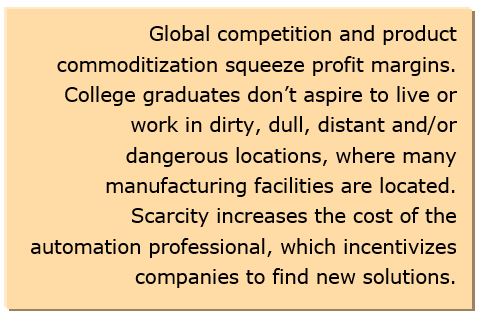 Companies must resort to contracting the retirees to supplement the missing expertise.
Automation engineers wear many different hats, some which no longer actually require an “engineer.” Many automation tools have institutionalized engineering knowledge. The “science” of loop tuning, for example, has been coded into software that monitors the loop and can tune it accordingly. Advanced process control applications have programmed the highly specialized skills out of the controller commissioning and model tuning process. Most of this work has become quite routine and based heavily in industry and company standards. Standards are rules. Rules can be coded.
Companies are facing other headwinds as well. Global competition and product commoditization squeeze profit margins. College graduates don’t aspire to live near or work in dirty, dull, distant and/or dangerous locations, where many manufacturing facilities are located. Scarcity increases the cost of the automation professional and the cost and risk of training up an automation professional is high as well, which incentivizes companies to find new solutions.
New technology solutions are conspiring to reduce the need for automation personnel. These solutions leverage base technologies such as more powerful and readily available computing power and internet connectivity. Internet connectivity, or the Internet of Things (IoT), has enabled free data flow globally. This means that automation experts can access information and systems globally and no longer need to be on site. Connectivity of “things” also allows non-human things to communicate, coordinate, and collaborate quickly. For IT systems programming, much of the tedious programming in Java and Python has been replaced by more agile approaches that leverage reusable code found on the internet.
This connectivity also allows off-site experts to support on-site personnel in real time. Augmented reality (AR) is becoming mainstream, allowing less experienced site personnel to access information and geographically dispersed expertise. Wearable devices now allow personnel to access manuals, videos, real-time data, trends, cognitive computing applications, and live people. These devices also allow remote resources to see the physical environment at the same time and have the same view as the person in the field. This means the engineering resource could support a technician in the field without having to be on site.
 Furthermore, the on-site “resource” may not be a person. Drone technologies continue to develop rapidly, reducing the need for onsite personnel. While a bit weird, some recent robotic developments demonstrate extreme agility and capability. Drones could simply provide eyes on site or even full-bodied dexterous avatars, reducing the need for on-site personnel and perhaps enabling cognitive computer systems to have physical embodiments.
Cognitive analytics methods are designed to replicate human thought processes in computers and machines. While often marketed using terms such as deep learning, deep machine learning, neural networks, neural nets, and artificial intelligence; in industrial applications they are often combined with several other analytical methods.
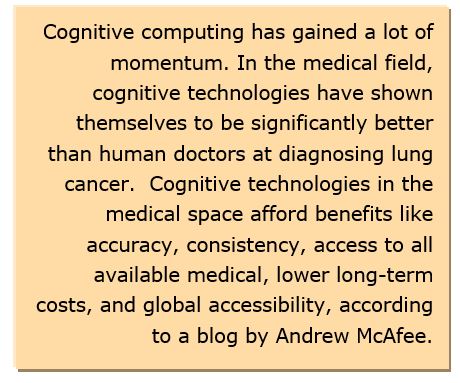
Cognitive analytics are experiencing a resurgence, particularly for business use, as the historic computing challenges can now be managed (calculating and accurately training these many-layered analytics had been massively difficult). The technology has a lot of momentum. In the medical field, cognitive technologies have proven to be significantly better than human doctors at diagnosing lung cancer. Cognitive technologies in the medical space afford benefits like accuracy, consistency, access to all available medical knowledge, lower long-term costs, and global accessibility, according to a blog by Andrew McAfee.
Simpler analytics applications are more distributed throughout a facility and will also conspire to replace manual automation-related tasks. Significantly, analytics can replicate an expert’s insight into a situation across the enterprise. This replicated expert is now monitoring the process 24/7, alerting personnel (or systems) to problems; many times in advance of an abnormal situation. As such, analytics are another tool that allows companies to capture, institutionalize, and distribute engineering knowledge. Other tools that do this can be as simple as controller logic and advanced process control models.
Once a facility is designed, especially process facilities, change is incremental at best. More importantly, change tends to follow strict rules, many spelled out in company and industry standards. Add to this mix the push to modularize production units using a “cookie cutter” approach. The push is to make repeatable, predictable processes, reducing the cost of design.
Companies still rely on the roles and tasks assigned to automation engineers. The availability of this talent is getting tight, and companies believe cultivating talent is expensive and risky. Experience is leaving the industry faster than it can be replaced, much of this is the fault of industry itself.
Computer processing, analytics, and cognitive computing are advancing rapidly. Today, these technologies have conspired to outperform humans. This trend will continue, with increasing capabilities made even more powerful by connectivity. If it can be thought through logically, the computer can do it faster, more accurately and repeatably, for less money, all the time. These technologies are another automation tool and represent the natural progression of things.
It is yet to be seen if these conglomerations of silicon and electrons can create and invent on their own. This might happen, but if so, it will be in the distant future. For that reason, there will still be parts of the automation profession that continue to be necessary for design and perhaps optimization. Some may be needed to maintain the systems that have addressed many of the former automation engineering tasks.
Are automation engineers no longer needed? The short answer is “no,” but the role certainly is changing. Technology continues to advance rapidly. The ability for computers and software to emulate more of what humans perform increases exponentially.
Imagination is a particularly human trait and continues to be necessary when applying technology. The skillset will change as technology becomes more advanced, and fewer humans will be needed. End users need to be aware and plan for the evolution of the field. To be blunt, industry has squandered engineering talent on rote and mundane tasks. Companies need to reassess their use of this increasingly rare and valuable resource.
Some believe that raising the minimum wage will lead to automating minimum wage jobs. That same concept applies at all levels. If the resource is scarce or difficult to cultivate, alternatives must be found. The work still needs to get done. The market isn’t providing the labor. Something’s “gotta give.” Add all this up and it looks like industry is well on its way to automating the automation engineer. Maybe Mark Cuban is right. "I personally think there's going to be a greater demand in 10 years for liberal arts majors than for programming majors and maybe even engineering," Cuban said in an interview with Inc. "Maybe not now," Cuban acquiesced. "They're gonna starve for a while."
Based on ARC research and analysis, we recommend the following actions for owner-operators and other technology users:
If you would like to speak with the author, please Contact Us