Representative End User Clients







Representative Automation Clients







Representative Software Clients








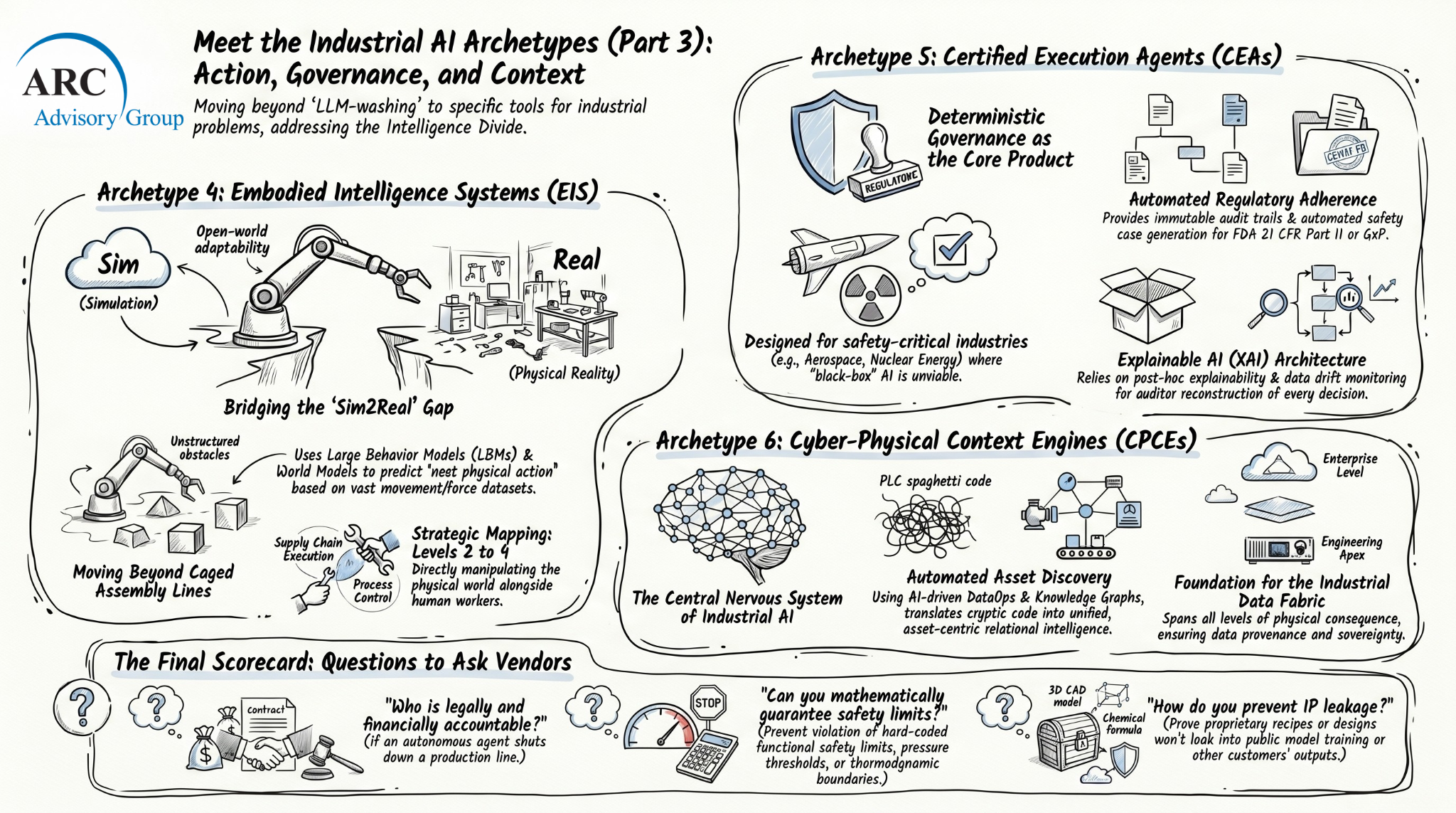
Before we dive into our next 3 Industrial AI archetypes, let’s briefly remind ourselves why we embarked on this mapping exercise. The purpose of the ARC 3-Axis Industrial AI Models Taxonomy is to provide our industrial end-users with a definitive procurement scorecard. We needed a framework to cut through the generic "Generative AI" marketing noise and rigorously evaluate software based on three hard realities: the physical consequence of the operational domain (Axis 1), the specific mathematical architecture being deployed (Axis 2), and the uncompromising demands of industrial governance and data sovereignty (Axis 3).
By converging these three axes, we can identify distinct Industrial AI Archetypes—highly specialized strategic groupings of vendor solutions designed to solve exact cyber-physical problems.
In this final installment exploring the specific vendor archetypes of the ARC Taxonomy, we look at the systems that execute physical labor, enforce regulatory consequence across the operational axes, and provide the foundational contextual layer that underpins the entire ecosystem. (As a reminder, the vendors highlighted are representative examples from our broader 120+ vendor mapping).
The Mission: Bridging the elusive "Sim2Real" gap to endow robotic hardware with open-world adaptability, freeing them from rigid, pre-programmed paths to navigate chaotic, unstructured environments.
Mapping to the 3-Axis Taxonomy:
Axis 1 (Domain): Firmly bridging Level 2 (Supply Chain Execution) and Level 4 (Operations & Process Control), directly manipulating the physical world.
Axis 2 (Model Class): Behavioral Models (LBMs), World Models, and advanced Vision-Language-Action (VLA) architectures.
Axis 3 (Governance): Operating at Level 3 (Domain-Specific), bounded by spatial and kinematic realities.
The Market: The pioneers in this space are training foundation models on vast datasets of physical movement and force to predict the next action, moving robotics out of caged assembly lines.
Foundation LBM Pioneers: Innovators like Physical Intelligence (with their first general-purpose foundation model for robot control, which they’ve named π-zero (pi-zero)), Skild AI, and Covariant (with RFM-1 for logistics) are developing the universal "brains" capable of adapting to various physical tasks and environments without explicit hard-coding.
The Simulation & Compute Vanguard: A dedicated callout must be made for NVIDIA. Through initiatives like Project GR00T (their general-purpose foundation model for humanoid robot learning) and the Isaac robotics platform operating within the physically accurate Omniverse, NVIDIA is essentially providing both the heavy compute and the digital training grounds required to make embodied intelligence a reality.
Humanoid & Bipedal Robotics: Figure AI, 1X Technologies (with the NEO android), Sanctuary AI, Agility Robotics (focused on warehouse logistics), and established incumbents like Boston Dynamics (deploying LBMs onto the Atlas platform) are building the physical humanoid and bipedal manifestations of this embodied intelligence, designed to work safely alongside humans.
Computer Vision & Legacy Automation Convergence: Legacy automation and robotics giants like FANUC, Yaskawa Electric, KUKA, and ABB are rapidly converging with modern computer vision and AI pioneers like Landing AI, Cognex, and KEYENCE to integrate deep spatial awareness and reinforcement learning into high-speed inspection, machine tending, and logistics.
The Mission: Deterministic governance, automated reporting, and flawless regulatory adherence for highly scrutinized and safety-critical industries.
Mapping to the 3-Axis Taxonomy:
Axis 1 (Domain): Acts as the crucial governance overlay across the highest physical risk tiers, enforcing regulatory adherence within Level 4 (Process Control) and Level 5 (Engineering & R&D).
Axis 2 (Model Class): Explainable AI (XAI) and rigorously Certified Machine Learning pipelines.
Axis 3 (Governance): Establishes the absolute pinnacle of Level 4 (Regulated & Certified) AI execution.
The Market: For high-risk environments, unpredictable "black-box" deep learning is legally and operationally unviable. These vendors eliminate the burden of manual reporting by providing immutable audit trails, where governance is the core product itself.
Regulated Platforms: Companies like Domino Data Lab and Aizon provide enterprise AI platforms that are mathematically compliant with stringent frameworks like FDA 21 CFR Part 11 and GxP for life sciences.
Compliance & Safety Agents: Specialists like Saphira.ai focus on automated safety case generation for automotive standards (ISO 26262), Dot Compliance powers AI-enabled eQMS workflows, and Mareana ensures pharmaceutical network genealogy and continuous compliance.
XAI & Governance Tools: To meet the absolute burden of proof required at Level 4, platforms like Fiddler AI, Arize AI, and Aporia provide the robust post-hoc explainability, data drift monitoring, and traceability required for strict compliance attribution.
Certification & Sovereign Identity: Authorities like Exida and UL Solutions are establishing the functional safety certification standards (e.g., UL 3115) for AI software, while entities like Cofinity-X (operating the Catena-X marketplace) enable secure, sovereign data exchange for supply chain transparency.
The Mission: Providing the indispensable semantic context required to organize, clean, and feed data into all the other specialized archetypes.
For those wanting to dig deeply into how these context engines operate, I highly recommend catching up on my previous Voyage of Discovery into Industrial Data Fabrics. We have placed this at the absolute core of the Industrial AI (R)Evolution since I first started covering it for ARC Advisory Group back in 2023. As that extensive research details, a single monolithic platform cannot serve the entire industrial enterprise. Instead, organizations are actively assembling broad data fabrics using these AI-powered Cyber-Physical Context Engines to anchor their architecture.
The Mission: Providing the indispensable semantic context required to organize, clean, and feed data into all the other specialized archetypes.
For those wanting to dig deeply into how these context engines operate, I highly recommend catching up on my previous Voyage of Discovery into Industrial Data Fabrics. We have placed this at the absolute core of the Industrial AI (R)Evolution since I first started covering it for ARC Advisory Group back in 2023. As that extensive research details, a single monolithic platform cannot serve the entire industrial enterprise. Instead, organizations are actively assembling broad data fabrics using these AI-powered Cyber-Physical Context Engines to anchor their architecture.
Axis 1 (Domain): Spanning the entirety of Axis 1, from Level 0 (Enterprise Business) all the way to the foundational truth of Level 5 (Engineering & Design). These engines construct the central nervous system that makes scaling AI possible across all physical and operational risk tiers.
Axis 2 (Model Class): AI-Driven DataOps, Graph Neural Networks (GNNs), specialized LLMs for automated semantic mapping, and dynamic Knowledge Graphs.
Axis 3 (Governance): Establishes the foundational governance layer (Levels 2 through 4), ensuring data provenance, sovereignty, and role-based access control.
The Market: Without deep operational context, even the smartest AI hallucinates. This archetype utilizes AI to solve the data problem itself. Rather than relying on armies of engineers to manually map data tags, these platforms deploy specialized AI models to auto-discover assets, contextualize decades of "PLC spaghetti code," and translate cryptic OT telemetry into clean, relational intelligence across the varied IDF centers of gravity.
IT/Enterprise & Data Science Centric: Hyperscalers like Microsoft (Microsoft Fabric), AWS (AWS IoT SiteWise/IDF), and Google Cloud provide the massive foundational compute, while Data Cloud giants like Databricks, Snowflake, Palantir (Foundry), and C3 AI deliver the highly scalable data architectures and MLOps workbenches necessary for enterprise-wide intelligence and data science initiatives.
Asset & Application Centric: Vendors deeply rooted in industrial physics and digital twins, such as Cognite (Data Fusion), utilize AI-driven DataOps to turn raw sensor data into structured, asset-centric namespaces, acting as the ultimate system of intelligence bridging IT and OT.
Production & Process Context Experts: Vendors like SightMachine and TwinThread are absolute staples in this space, acting as the semantic bridge for the factory floor. By utilizing AI to transform continuous streams of raw manufacturing telemetry into unified, standardized data models, they provide the exact cyber-physical context required for enterprise-wide visibility and predictive operations.
Edge & DataOps Centric: Innovators like HighByte and Litmus, alongside middleware protocol players like Cirrus Link (MQTT) and time-series databases like InfluxData, focus aggressively on processing high-velocity telemetry directly at the operational source, using intelligent structuring to feed the broader fabric without latency.
Design Centric: Engineering Technology (ET) titans like Siemens and AVEVA are weaving CAD, PLM, and multiphysics simulation data directly into the operational thread, successfully connecting the "as-designed" digital models with the "as-manufactured" physical reality.
Agentic Orchestrators (The New Frontier): As Multi-Agent Systems transition from theory to deployment, emerging frameworks like LangChain, CrewAI, and Jira Rovo are providing the orchestration logic to coordinate decentralized networks of these specialized AI agents, increasingly leveraging protocols like the Model Context Protocol (MCP) and Agent-to-Agent (A2A) communication.
Understanding exactly where a solution fits within these six archetypes—from Workforce Enablers to Cyber-Physical Context Engines—is the key to successfully architecting your Cyber-Physical Industrial stack.
But how do you translate this theoretical mapping into actionable procurement? How do you answer those uncompromising questions about liability, auditability, and deterministic safety that we raised earlier in this series?
In the seventh and final post of this series, we will bring all of these pieces together. We will recap the full 3-Axis Taxonomy and reveal how our upcoming ARC Advisory Group Market Analysis Report (MAR), Archetypes Report, and specific Market Maps are designed to serve as your ultimate procurement scorecard, ensuring rapid time to value.
The Industrial AI (R)Evolution is moving faster than ever. To dive deeper into the frameworks and data shaping the future of the industrial sector, explore my latest research:
Navigating the AI Wars and the escalating Industrial Robot Wars
Closing the Digital Divide by Embracing Industrial AI
Assembling your Industrial-Grade Data Fabric
Charting the new frontier of Physical Intelligence and transitioning to a Cyber-Physical Industrial Architecture (CPIA)
Mapping your maturity and strategy with ARC's 3-Axis Industrial AI Models Taxonomy
Where do you stand in the Industrial AI (R)Evolution? Take our Industrial AI Assessment to benchmark your organization's maturity, identify critical gaps in your IT/OT/ET convergence, and get actionable recommendations to accelerate your path to becoming an Industrial AI Pacesetter.
Don't guess what your global operations or prospective customers need. Use empirical data to align your stakeholders and de-hype the market with ARC Advisory Group's Voice of Market Service.
For tailored recommendations on governing and guiding major people, process, and technology decisions across the enterprise, cloud, industrial edge, and AI, please contact Colin Masson at [email protected].
Or, set up a meeting with my fellow Analysts and I at ARC Advisory Group to find out more about our Executive Insights Service for Industrial organizations and our Industrial AI Insights Service for Vendors.