Representative End User Clients







Representative Automation Clients







Representative Software Clients








If you’ve been following our ongoing research voyage here at ARC, you know we’ve spent considerable time recently tracking the profound technological transformations reshaping the industrial sector. In our last discussion on the Industrial Token Economy, we dissected the gritty reality of the "AI Wars," specifically looking at how organizations can balance high-frequency, cloud-based "OpEx traps" with localized, edge-based "CapEx escapes".
But since that piece ran, our inbox has been flooded with questions from operations executives, software developers, and industrial CFOs who are staring down a much bigger economic bottleneck: How do we safely coordinate and finance an autonomous agentic workforce without budgets and physical systems spiraling out of control?
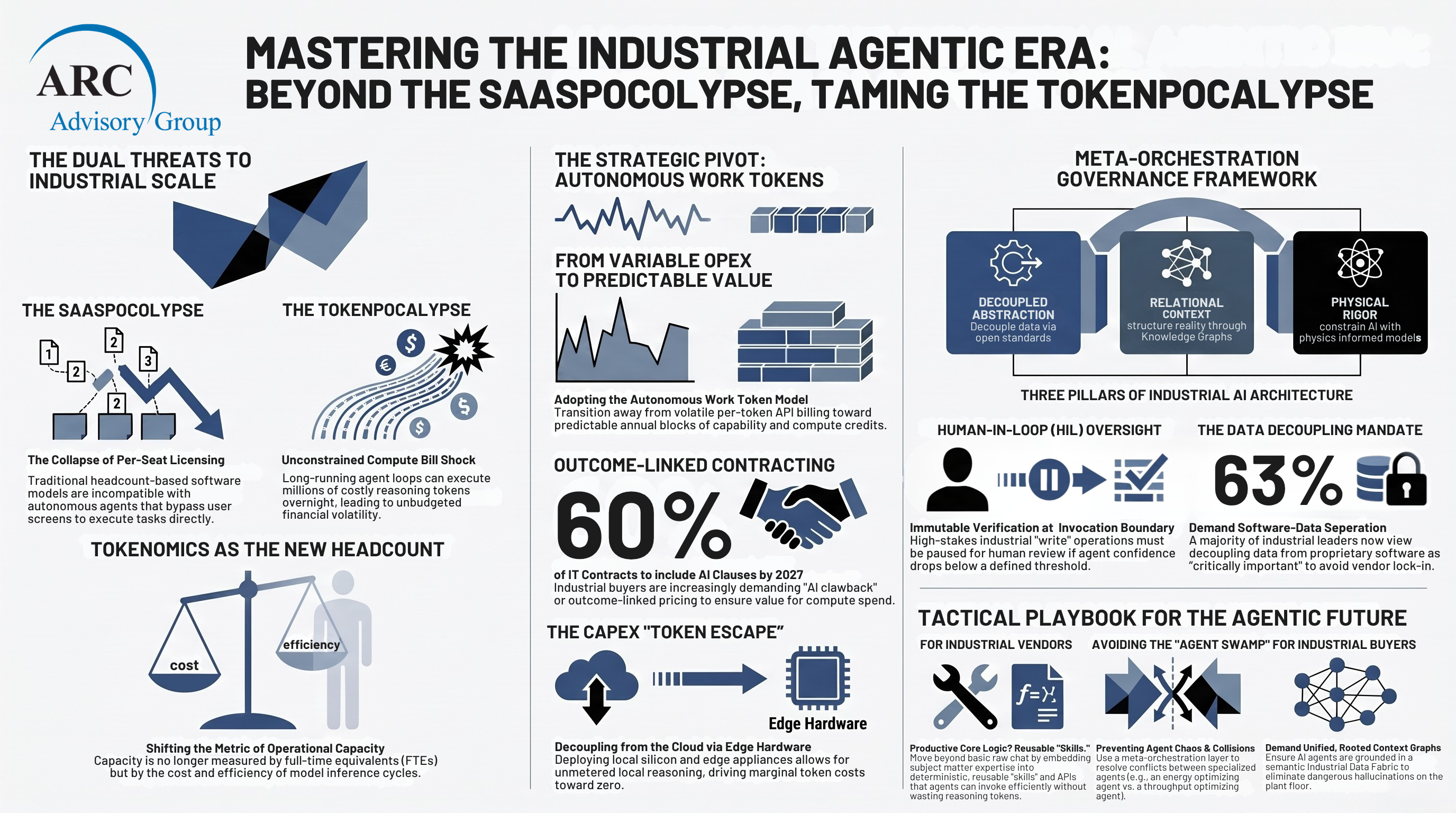
We have officially moved past the speculative, prompt-and-chat phase of generative AI. Today, we are in an era where multiple, specialized, and autonomous AI agents are executing sustained, long-horizon physical and analytical workflows. But as industrial software transitions from a tool used by a human to an autonomous system that works on behalf of the human, a dual-force market shakeup has arrived.
The SaaSpocalypse: The massive tech valuation correction that proved traditional, per-seat licensing is fundamentally incompatible with an agentic architecture where headless software agents bypass user screens entirely.
The Tokenpocalypse: The sudden, severe corporate "bill shock" that hit enterprise buyers when unconstrained, long-running agent loops began executing millions of costly reasoning tokens overnight, forcing tech giants to implement emergency usage caps.
The industry's response to this financial and operational volatility is the rapid rise of Meta-Orchestration Governance Frameworks. To understand how the industrial sector is moving beyond simple AI assistants to safe, scalable multi-agent systems, we need to look at how major technology providers—including Aera Technology, Amazon Web Services (AWS), Cognite, Microsoft, and Siemens—are building the architectural perimeters that protect both corporate balance sheets and physical operations.
For two decades, industrial software was sold on a flat, headcount-driven basis: you bought a seat, a login, and an annual maintenance agreement, hoping your team used it enough to justify the cost. That model is being dismantled. A predictive maintenance system or a closed-loop optimization model running on a plant floor doesn’t occupy a seat—it monitors hundreds of physical assets simultaneously, fires alerts without human prompts, and makes process decisions between shifts.
According to leading enterprise contract outlooks, 60% of large IT services contracts are projected to include outcome-linked or "AI clawback" clauses by 2027. In industrial settings where unplanned downtime across discrete manufacturing can average up to $260,000 per hour, paying for results rather than access is becoming the standard.
To bridge this gap, forward-thinking vendors are deploying Autonomous Work Tokens. Under this model, instead of charging for raw, highly volatile API tokens—which can vary by up to 60 times in cost depending on whether you call a standard or a high-reasoning model—customers purchase a predictable annual block of capability and compute credits:
The Human Workflow: An engineer logging in to design a piping layout draws down standard daily credits from the company's shared account.
The Autonomous Workflow: At 2:00 AM, a headless optimization agent programmatically calls an API, executes a simulation, or runs an anomaly detection check. It bypasses the user interface entirely, drawing down a defined number of work tokens from the same pre-paid corporate credit pool.
This model protects enterprise buyers from the budget unpredictability of the Tokenpocalypse while ensuring that industrial software providers successfully monetize every autonomous action as human seat counts compress.
For cloud-forward industrial enterprises, Amazon Web Services (AWS) has transitioned from a raw infrastructure host to a major runtime option for scalable, serverless multi-agent architectures. AWS is helping companies decouple agentic orchestration from execution by combining services like AWS Lambda, AWS Step Functions, and Amazon Bedrock AgentCore.
Rather than forcing developers to build complex, custom communication logic between isolated models, AWS orchestrates these systems through a central Supervisor Agent:
Intelligent Routing: The Bedrock Supervisor Agent analyzes the user’s intent and routes subtasks in parallel to highly specialized collaborator agents (such as predictive maintenance or order tracking specialists).
Standardized Context Sharing: All conversations and customer preferences are stored dynamically in Amazon Bedrock AgentCore Memory. This allows multiple sub-agents to collaborate on a single, multi-step problem without losing context or requiring the user to repeat information.
Secure Tool and Resource Connectivity: AWS-managed architectures enforce secure, transport-level isolation securely through the Amazon VPC Lattice service mesh. This containerized network layer handles inbound and outbound authentication via identity federation and private networking controls, ensuring that agents only talk to authorized tools within a secure private cloud perimeter.
Built-In Guardrails: To prevent prompt injection and unauthorized task delegation across collaborator networks, the system enforces Amazon Bedrock Guardrails. This includes pre-processing filters, content classifiers, and Automated Reasoning policies that evaluate the safety of inputs and outputs before they are sent to downstream systems.
For teams that require custom agent setups over managed loops, AWS architectures support third-party integrations such as Datadog AI Guard. This allows developers to insert evaluation hooks at critical points—such as checking the model’s tool-call decisions before they run, which is vital when agents are authorized to trigger physical write operations or touch sensitive databases.
Where AWS establishes serverless infrastructure rails, Microsoft frames multi-agent systems as a governed, enterprise-wide network layer. Using the Microsoft Agent Framework, Microsoft Foundry, and Azure Copilot Studio, Microsoft treats multi-agent orchestration not as a simple chain of prompts, but as an "AI operating system" designed to scale across IT and OT boundaries.
Microsoft’s framework structures multi-agent workflows into a tightly controlled, six-step lifecycle:
Intent Capture and Strategic Planning: System interfaces process natural language and translate broad user goals into unambiguous, structured plans with discrete subtasks, explicit dependencies, and robust fallback paths.
Governed Role Assignment: The orchestrator applies Role-Based Access Control (RBAC) to match subtasks to the most qualified, specialized agents. This guarantees least-privileged access and generates a fully auditable decision-making trail, critical for compliance in highly regulated industrial environments.
Network Collaboration: Instead of working in isolated silos, specialized agents communicate via a shared memory layer, passing context seamlessly to resolve cross-domain issues (e.g., aligning procurement schedules with unexpected equipment maintenance).
Human-in-the-Loop (HITL) Oversight: For high-stakes industrial write operations, Microsoft enforces real-time human verification. If an agent's confidence drops below a specified threshold, actions are paused, and supervisors can review or override decisions. These human corrections are fed back into the system to compound institutional intelligence over time.
A central operational challenge of the Tokenpocalypse is the waste created when an unstructured large language model (LLM) is asked to infer business logic from scratch. Aera Technology directly addresses this problem through its Agentic Ambient Intelligence approach, emphasizing governed decision orchestration, reusable decision flows, and structured enterprise context.
Aera’s approach places the decision lifecycle, rather than the LLM itself, at the absolute center of the architecture.
Token-Conscious Tool Selection: When an agentic workflow encounters a problem requiring optimization, simulation, or machine learning, Aera’s engine selects mathematically grounded, deterministic tools to solve the problem before reaching out to an expensive frontier LLM model. This avoids wasting millions of reasoning tokens on tasks that traditional algorithms handle better, keeping outcomes predictable and cost-efficient.
Boundary Enforcement via Code: Governance is not bolted on as an afterthought policy layer; it is natively embedded at the invocation boundary of every call. The LLM participates strictly in contextual reasoning, but it has zero power to alter data access controls or step outside user-configured agency levels (which span from recommend-and-wait to automated execution).
Reusable Aera Skills and Decision Flows: By leveraging over 150 production-ready "Aera Skills," industrial buyers can deploy governed workflows that bridge areas such as supply chain, procurement, and asset operations without building all integration logic from scratch.
Even the most sophisticated orchestration framework will fail if its agents lack operational context. This is where Cognite differentiates with Cognite Atlas AI™—a low-code industrial agents workbench built on top of Cognite Data Fusion®. See my recent blog for more on Cognite, "Oslo, Uncarpeted: Escaping the Desk for a Cyber-Physical Reality Check."
Industrial data remains messy, fragmented, and locked in silos. Time-series sensor feeds, P&IDs, 3D models, maintenance logs, and unstructured documents rarely align without significant contextualization.
The Industrial Knowledge Graph: Cognite Atlas AI grounds its multi-agent workforce in a live, dynamically contextualized representation of the physical plant. By automatically mapping the deep relationships between disparate data sources, agents can access a single, trustworthy source of truth.
Context-Rich Workflows: Because agents understand specific asset terminology and standards natively, they can perform highly complex workflows such as Root Cause Analysis (RCA) and enhanced equipment troubleshooting. Public customer examples indicate efficiency improvements of more than 70 percent in RCA workflows in specific deployments.
Interoperable Open Ecosystem: Cognite avoids vendor lock-in by maintaining an open architecture. Digital teams can hot-swap cloud backends, LLM models, and engineering tools while keeping their core governance and sovereignty structures fully aligned with emerging standards like the EU AI Act.
While cloud and enterprise orchestration handle high-level logic, the plant-floor challenge is moving to the extreme edge. This is where Siemens is advancing practical uses of the open-source Model Context Protocol (MCP) to bring agentic AI closer to physical automation hardware. Read more of my analysis of Siemens’ latest Industrial AI moves: "The Context Layer and the Agentic Foundry: Siemens Operationalizes the Industrial Digital Twin (Realize LIVE Americas 2026)."
Historically, the gap between cloud-based AI and the low-level protocol frames of the plant floor—such as Modbus, OPC UA, or MQTT—has been a major barrier to digital transformation. AI agents work best with standardized, discoverable JSON-RPC tool schemas, not complex industrial SDKs. Siemens is addressing this protocol gap by building native MCP servers into parts of its industrial automation portfolio:
WinCC Unified PC Runtime (V20+) MCP Server: Siemens has built a dedicated MCP integration and governance layer that sits directly on top of its SCADA runtime. This allows AI agents to query live SCADA tags, alarms, system information, and User-Defined Types (UDTs) in natural language, translating standardized MCP calls into safe, runtime-specific operations without custom point-to-point integrations.
Mendix Low-Code and AI Integration: As Siemens expands AI-enabled industrial software capabilities, Mendix provides a low-code environment that can expose business logic and workflows to governed automation patterns. Any specific claims around native MCP Server or Client modules should be validated against current Siemens and Mendix product documentation before final publication.
Standardized Edge Adapters: Emerging prototype frameworks like IndustriConnect are demonstrating how edge-level data adapters can wrap Modbus, MQTT, and OPC UA connections into clean, secure, discoverable endpoints. This points toward a future in which compatible agents can query physical sensor states or trigger controlled workflows through standardized interfaces, with deterministic safety guards acting as a local firewall.
As these meta-orchestration and edge-integration perimeters mature, they are redefining the human role in industrial operations. The familiar narrative that AI agents will simply replace plant-floor workers misses the more important transformation.
The higher-value path is not replacement, but augmentation: upskilling people into "Synapse Workers"—human operators who orchestrate, direct, and audit networks of specialized digital agents rather than manually clicking through screens, writing custom glue code, or wrangling spreadsheets.
Whether process engineers are using agentic AI to automate complex, multidisciplinary 3D pipe layouts in Unified Engineering, or system integrators are leveraging virtual configuration agents to deploy and customize Manufacturing Execution Systems (MES) faster than traditional manual methods, the direction of travel is clear.
Industrial enterprises and software vendors that thrive in this next era will move beyond the limits of static, user-seat licensing. They will build for a hybrid, agent-native future, managing variable compute economics through Autonomous Work Tokens and protecting physical operations through robust, meta-orchestrated governance.
To accelerate this transition, industrial software vendors and buyers should focus on the following tactical playbooks:
Evolve Monetization Frameworks: Move entirely away from legacy user-seat paradigms. Re-architect commercial models around value-linked software tokens or Autonomous Work Tokens that capture value from headless machine-to-machine tasks.
Embed Open Interface Protocols: Avoid building custom, closed connectivity stacks. Native support for open standards like the Model Context Protocol (MCP) must be integrated directly into SCADA, MES, and PLM platforms.
Productize Core Logic as Reusable "Skills": Stop wrapping raw LLMs in basic chat boxes. Instead, map out your unique domain formulas, calculations, and optimization algorithms as structured tools that autonomous agents can discover and run deterministically.
Predictable Consumption Guardrails: Insist on upfront, predictable annual blocks of capability credits or Autonomous Work Tokens to eliminate the risk of Tokenpocalypse bill shocks.
Unified, Rooted Context Graphs: Challenge vendors on how their agents access data. Demand to see an underlying Industrial Knowledge Graph that contextually cross-references your physical assets, sensor logs, and documentation to eliminate dangerous hallucinations.
Immutable Operational Guardrails: Never let an autonomous system write back to an asset or database unvetted. Require end-to-end governance perimeters that enforce Role-Based Access Controls (RBAC), token rate limits, and clear, hardcoded Human-in-the-Loop checkpoints.
The Industrial AI (R)Evolution is moving faster than ever. To dive deeper into the frameworks and data shaping the future of the industrial sector, explore my latest research:
Navigating the AI Wars and the escalating Industrial Robot Wars
Closing the Digital Divide by Embracing Industrial AI
Assembling your Industrial-Grade Data Fabric
Charting the new frontier of Physical Intelligence and transitioning to a Cyber-Physical Industrial Architecture (CPIA)
Mapping your maturity and strategy with ARC's 3-Axis Industrial AI Models Taxonomy
Take our Industrial AI Assessment to benchmark your organization's maturity, identify critical gaps in your IT/OT/ET convergence, and get actionable recommendations to accelerate your path to becoming an Industrial AI Pacesetter.
Don't guess what your global operations or prospective customers need. Use empirical data to align your stakeholders and de-hype the market with ARC Advisory Group's Voice of Market Service.
For tailored recommendations on governing and guiding major people, process, and technology decisions across the enterprise, cloud, industrial edge, and AI, please contact Colin Masson at [email protected].
Or, set up a meeting with my fellow Analysts and I at ARC Advisory Group to find out more about our Executive Insights Service for Industrial organizations and our Industrial AI Insights Service for Vendors.